Most community engagement analytics dashboards stop too early.
They count likes, comments, impressions, and clicks. Useful inputs. Bad finish line.
When I look at community engagement for a B2B SaaS GTM team, I am not trying to prove that people reacted. I am trying to find out whether the right people created a signal worth acting on. Did a target buyer ask for a recommendation? Did a customer surface churn risk? Did a competitor user describe a gap? Did a GitHub thread reveal implementation pain that sales keeps hearing on calls?
That is the work beyond likes and comments.
Community engagement analytics should help GTM teams turn community conversations into action: sales follow-up, product feedback, support escalation, founder response, competitive intelligence, or content that answers real buyer language.
Do not just show the post. Show the next move.
The Engagement Metrics I Ignore First#
I do not ignore likes and comments because they are useless. I ignore them first because they are easy to overvalue.
Standard engagement reporting usually starts with impressions, likes, comments, shares, saves, clicks, profile visits, direct messages, follower growth, and engagement rate.
Hootsuite includes those visible actions in its social engagement guidance because they show attention and response behavior Hootsuite guide to social media engagement metrics.
That is fine for post-performance reporting.
It is not enough for community-led GTM.
A LinkedIn post with 300 likes can create no buyer movement. A Reddit thread with 11 comments can reveal three competitor users looking for a different product. A GitHub issue with two replies can explain why technical evaluators are getting stuck before sales ever sees the account.
The metric that matters is not "people engaged."
The metric that matters is "this engagement changed what we did."
My Test For A Community Metric Worth Tracking#
Before I put a metric on a dashboard, I run it through four filters.
Signal quality: Does it reveal intent, pain, preference, risk, or market movement?
Actionability: Can sales, marketing, product, support, or a founder act on it this week?
Business connection: Can it connect to pipeline, retention, expansion, product feedback, or competitive position?
Timing: Does it help the team respond while the conversation still matters?
This article uses public vendor documentation, community industry research, and buyer-behavior research available at present. I am not claiming a private benchmark or fake hands-on test.
I am using a source-grounded GTM framework for deciding what deserves attention.
One useful anchor comes from CMX. Its 2024 Community Industry Trends Report shows that community teams track more than activity. They report business-impact measures such as customer retention, conversation engagement, and new user or member signups CMX 2024 Community Industry Trends Report.
That is the standard. A metric earns its place when it explains behavior and points to a next action.
Measure Who Engaged, Not Just How Many#
The first upgrade is qualified participation.
Raw participation counts everyone the same. Qualified participation asks whether relevant people took meaningful actions.
I would rather see three competitor customers comparing migration pain than 80 generic reactions from people outside the market. I would rather see one target-account buyer ask "what are people using instead of X?" than a broad comment thread full of agreement.
Tag participants into groups that map to GTM decisions:
Target buyers
Existing customers
Former customers
Competitor users
Technical evaluators
Community moderators
Analysts or category voices
Internal team members
Then measure what each group does. Who starts threads? Who asks follow-up questions? Who recommends vendors? Who complains about pricing? Who answers prospects?
Calculate qualified participation as qualified actions divided by total community actions for the period. Segment it by source and participant type.
A useful weekly field looks like this: Reddit: 22 qualified actions / 140 total actions = 15.7% qualified participation; top group = competitor users.
That tells a demand gen lead or product marketer where the signal is coming from. "47 comments" does not.
Track Conversation Depth Because Buyers Explain Themselves In Threads#
A like is a tap. A comment can be a reflex. A thread is where buyers explain themselves.
Conversation depth measures whether a topic creates real exchange:
Replies per thread
Unique participants per thread
Back-and-forth reply chains
Follow-up questions
Peer-to-peer answers
Threads that trigger a second discussion later
I review depth as a distribution, not just an average. Track the percentage of threads with at least three unique participants and at least one follow-up question.
That separates one-off comments from conversations where people compare tools, correct each other, add context, and expose the language your market actually uses.
This matters because community influence often happens through peer explanation. One operator asks a vague question. Another names a product. A third explains why implementation failed. A fourth recommends an alternative.
In one thread, you can learn positioning gaps, objections, competitor weaknesses, and urgency.
Do not stop at comment volume. Sort for threads where people are solving, comparing, warning, recommending, or escalating.
Use Intent Density To Separate Noise From Buyer Signals#
Intent density is the percentage of monitored community conversations that contain a commercially relevant signal.
For a B2B SaaS team, I would tag these as high-intent:
"What tool should I use for..."
"Alternatives to..."
"Has anyone tried..."
"We are switching from..."
"Pricing is too high"
"This integration is broken"
"Looking for recommendations"
"Any vendor that supports..."
"How do I solve this workflow?"
These are not just mentions. They are buyer, customer, or market signals.
Intent density protects teams from two bad habits. The first is chasing every mention. The second is dismissing a community because total volume looks small.
A niche Slack group with 18 high-intent threads can matter more than a broad channel with 5,000 low-context reactions.
CommunityTracker is built around this distinction: monitor channels such as Reddit, LinkedIn, X, Slack, GitHub, Hacker News, Product Hunt, Stack Overflow, Bluesky, Indie Hackers, and Dev.to, then filter for buying intent, competitor comparisons, recommendation requests, and pain-point threads.
Calculate intent density as high-intent conversations divided by all relevant monitored conversations. Review it by source, topic, and owner.
The metric is not "mentions per week." It is "high-intent signals per week, by source, topic, and next move."
Response Speed Is Part Of Engagement Analytics#
Community engagement is not only audience behavior. It is also team behavior.
If a high-intent Reddit thread appears on Monday and nobody reviews it until Friday, the engagement problem is internal. The signal existed. The workflow failed.
Sprout Social reports that 73% of social media users expect brands to respond on social within 24 hours Sprout Social social media best practices.
In B2B communities, the exact response expectation varies by channel, but the principle holds: buyers notice whether a company is present, useful, and timely.
Track response performance with operational metrics:
Time to first internal review
Time to route to the right owner
Time to first public or private response
Percentage of high-priority signals resolved
Percentage of signals with a logged next action
Number of stale, unowned signals
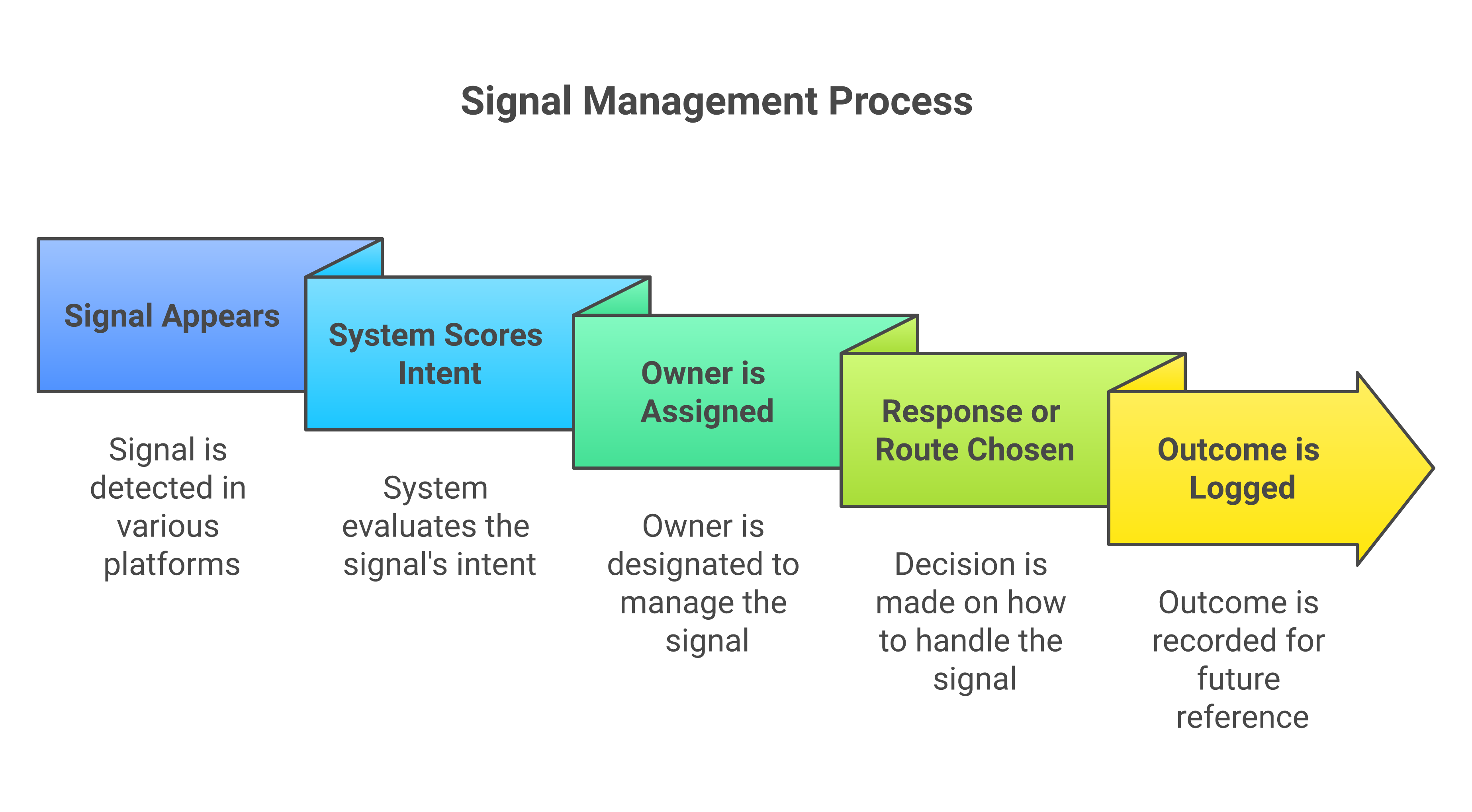
This is where many teams lose the value. They monitor the conversation but do not operationalize it. The alert exists. The action does not.
If your team already finds high-intent Reddit, LinkedIn, Slack, GitHub, or X conversations but loses them in spreadsheets, the fix is not another reporting tab. Build a signal queue with source, intent, owner, next action, and status with CommunityTracker signal discovery workflow.
Sentiment Only Helps When You Capture The Reason#
Plain sentiment is too blunt.
Positive, neutral, and negative labels help with scanning, but they do not tell the team what to do.
A negative thread about pricing needs a different response than a negative thread about support.
A positive customer mention needs a different action than a positive peer recommendation during vendor selection.
I would track sentiment with reason codes:
Pricing friction
Missing feature
Support delay
Implementation blocker
Product reliability
Competitor praise
Competitor frustration
Category confusion
Recommendation request
Report it as sentiment + reason + owner. Example: Negative / pricing friction / product marketing should create a different next move than Negative / support delay / customer success.
Keep the reason-code list short enough that the team uses it consistently. The goal is not perfect classification. The goal is to turn market language into a better route.
Reason-coded sentiment gives marketing sharper messaging, product better prioritization, sales better objection language, and support better escalation context.
It also prevents false confidence. Your owned community can look healthy while third-party Reddit, GitHub, or Slack conversations show buyer frustration.
Share Of Voice Should Be Measured By Topic#
Share of voice often gets reported as brand mentions divided by total mentions.
That is a start. It is too broad for action.
I care about share of voice by topic, pain point, competitor, use case, community, funnel stage, and account segment.
If your company has 20% share of voice overall but 3% share in "SOC 2 automation for startups," the average hides a real GTM problem.
The same applies across channels. A competitor can own Reddit recommendation threads while your brand owns LinkedIn awareness. That is not a vanity difference. It changes buyer consideration.
Calculate topic share of voice as your brand's relevant mentions divided by all relevant brand and competitor mentions for that topic. Review the top five topics weekly.
The practical question is simple: where are competitors winning conversations your team did not know were happening?
Repeat Participation Shows Commitment, Risk, And Influence#
One-off engagement can be noisy. Repeat behavior is harder to fake.
Track whether the same people return, answer others, share updates, or move from passive reading to active contribution.
In customer communities, repeat participation can show health or risk. In open market communities, it shows which voices shape the category.
Useful repeat-participation metrics include:
Returning contributors
Repeat question askers
Customers who answer prospects
Inactive members who reappear with complaints
Prospects who ask multiple category questions over time
Threads that create follow-up discussion later
For B2B teams, repeat activity separates curiosity from commitment. A prospect who asks three category questions across two weeks deserves different treatment than a person who liked one post.
Use a rolling 30-day window. That keeps one launch spike from distorting the trend.
The Metric That Matters Most: Signal-To-Action Conversion#
The most important community engagement analytics metric is usually missing from the community dashboard:
How many useful signals became actions?
Actions can include:
Sales follows up with context
A founder replies in the thread
Product logs a repeated feature request
Support resolves a public issue
Marketing creates a response asset
Competitive intel updates a battlecard
Customer success checks in with an at-risk account
Measure conversion as completed actions divided by qualified signals. Then break completed actions into sales, support, product, marketing, and founder response.
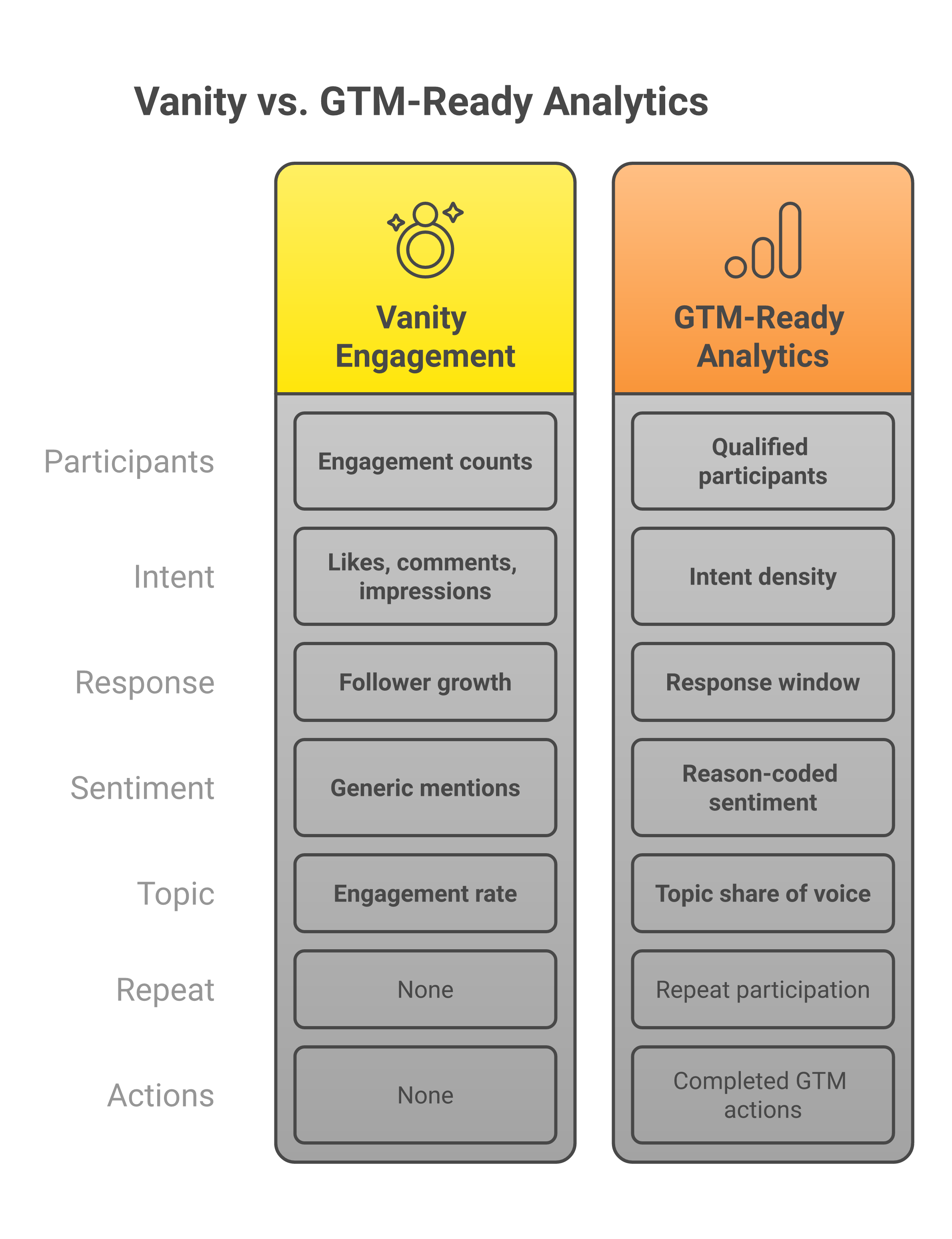
This is the final test. If community engagement analytics does not change what the team does, it is reporting, not operating intelligence.
How I Read The Same Metrics Across Different Communities#
Metrics create bad decisions when teams treat them as universal truth.
Do not compare Reddit comments to LinkedIn likes as if they are the same behavior. Reddit rewards usefulness and peer scrutiny. LinkedIn rewards professional identity and network visibility. GitHub captures implementation friction. Stack Overflow captures technical blockers. Slack and Discord often contain high-context operator discussion.
Benchmark within the same source first. Compare r/SaaS recommendation threads to past r/SaaS recommendation threads.
Compare GitHub implementation issues to previous GitHub implementation issues. Cross-platform comparisons become useful only after you normalize for behavior and intent.
Also separate audience engagement from buyer engagement.
A broad AI post can produce reach. A tactical discussion about migration pain can produce fewer reactions but attract people with budget, urgency, and implementation responsibility.
When you cannot identify the participant, classify the signal by context:
Is the person naming a workflow?
Are they comparing vendors?
Are they describing budget, implementation, or team pain?
Are they asking for a recommendation?
Are they warning others away from a tool?
Buyer engagement is not always louder. It is usually more specific.
That matters because B2B buyers research before they talk to vendors. Gartner reports that 90% of B2B buyers use social media when considering a purchase Gartner research on B2B buyers and social media.
Reddit's B2B research also describes business decision-makers using community conversations during discovery and validation Reddit Business on B2B discovery and validation.
Owned-channel analytics will undercount this movement. Monitor category language, competitor mentions, and recommendation requests where buyers already talk.
The Weekly Dashboard I Would Actually Use#
Build the dashboard around decisions, not charts.
A useful weekly view should answer six questions:
Where did meaningful community conversations happen this week?
Which conversations contained buying intent, churn risk, product feedback, or competitor movement?
Which communities produced the highest signal quality?
Which topics are gaining or losing momentum?
Which signals need a response now?
Which actions were completed, and what outcome did they create?
Start with three layers.
Dashboard layer | Day-one fields | Mature-team fields |
Signal inbox | Source, topic, priority, owner, status | Intent score, account match, competitor mention, recommended next step |
Metrics view | Qualified signals, response time, completed actions | Intent density, topic share of voice, repeat engagement trends |
Outcome view | Routed actions by team | Pipeline influence, support insights, product feedback loop |
The day-one dashboard should prioritize a signal inbox, intent and topic trends, competitive share of voice, response performance, and business outcome links. Keep it compact. Each signal needs source, topic, priority, owner, status, and next action.
Teams can add account matching, opportunity influence, product-roadmap links, and support-resolution links later.
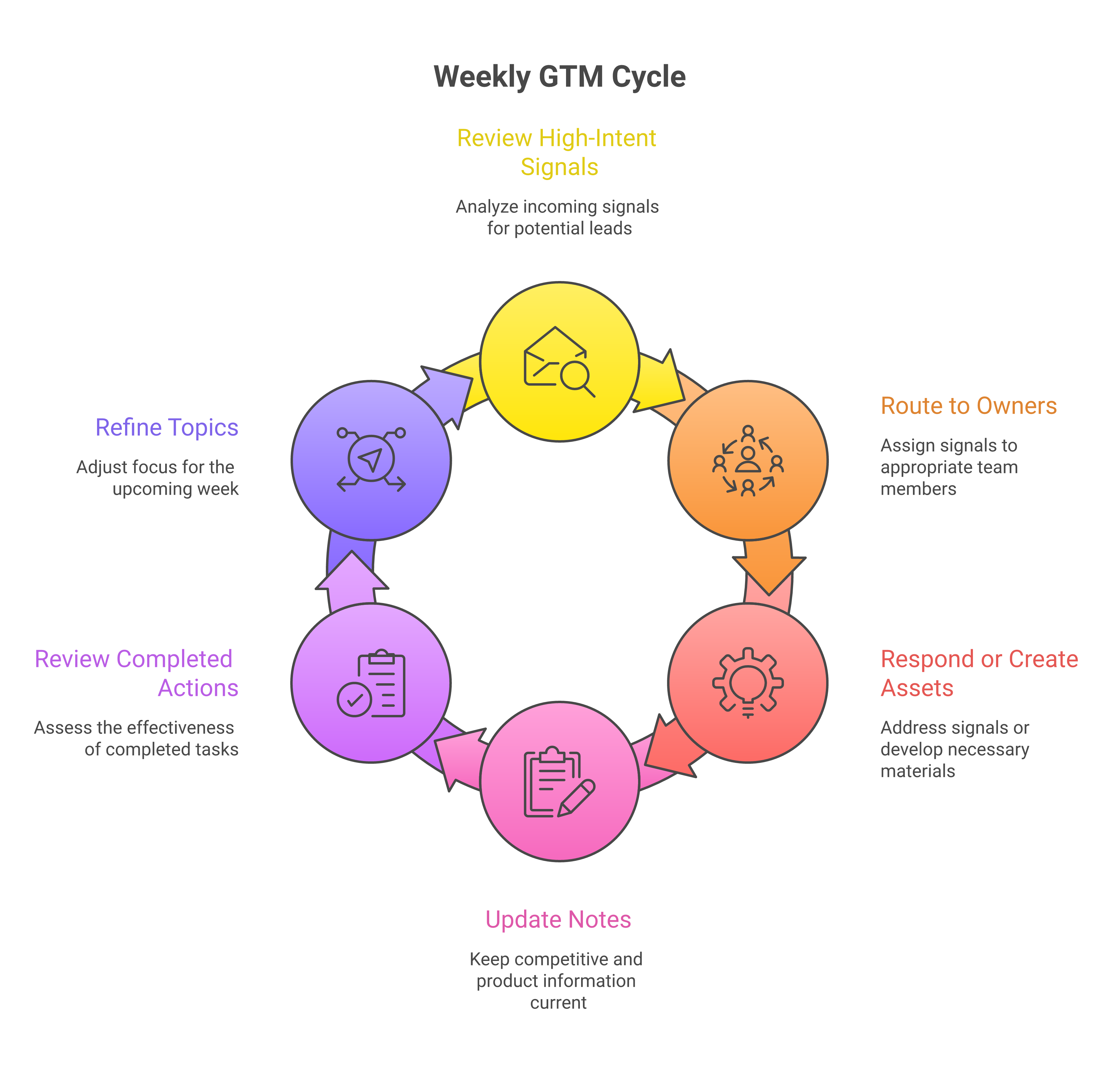
This makes community engagement analytics useful across GTM. Demand gen sees real topic demand. Product marketing sees objection language. Sales sees warm context. Customer success sees account risk. Product sees repeated friction.
The Mistakes That Make Community Analytics Useless#
The first mistake is reporting engagement without context.
"Engagement increased 18%" is not useful by itself. A better update is: "High-intent recommendation threads increased in two Reddit communities. The top repeated pain was migration complexity. Two competitor users asked for alternatives. Sales has three account-matched follow-ups, and product has one repeated integration request."
The second update tells people what changed and what to do.
The second mistake is treating all communities the same. Reddit, LinkedIn, GitHub, Slack, Hacker News, and Stack Overflow do not produce the same signals. Reddit is strong for peer validation and vendor comparison. GitHub and Stack Overflow reveal technical friction. Slack captures high-context operator discussion. Measure each source by the signal it is best at producing.
The third mistake is optimizing for engagement instead of trust. Sprout's 2025 Index press release reported that 93% of consumers say it is important for brands to keep up with online culture, while one third think brands jumping on viral trends is embarrassing Sprout Social 2025 Index press release.
The lesson is not "post faster." It is "read the room."
In B2B communities, trust comes from relevance, timing, and usefulness. A precise technical answer can beat a high-reach brand post.
The fourth mistake is leaving signals unowned. Every high-priority signal should end in one of six outcomes: respond now, route to sales, route to support, route to product, monitor, or ignore with reason.
If no owner exists, the workflow is incomplete.
What To Do This Week#
Start small. Do not rebuild your analytics stack.
Pick one community source where your buyers already talk. For many B2B SaaS teams, that is Reddit, LinkedIn, Slack, GitHub, Hacker News, Stack Overflow, or a niche operator forum.
For the next seven days, track five things:
High-intent signals
Participant type
Sentiment reason
Response owner
Completed action
At the end of the week, ask one question:
"Which conversations changed what we did?"
If the answer is none, the analytics are too passive. Tighten the filters, change the source, or define clearer action paths.
If the answer includes sales follow-up, product feedback, support escalation, competitor insight, or new content shipped from real market language, you are measuring the right layer.
To operationalize that review, set up one CommunityTracker workflow for a single priority source, one topic, and one owner. Monitor the source, route only high-intent signals, and review completed actions after seven days. Expand only after the workflow creates real GTM movement.
Community engagement analytics should not make your reporting deck prettier. It should help your team find the signal while it still matters, understand why it matters, and make the next move.
That is the point beyond likes and comments.