Brand24 and Hootsuite are often compared because both help teams manage social media.
Brand24 is designed to help teams understand what people are saying about their brand, competitors, products, and industry. It focuses on monitoring conversations, tracking sentiment, measuring share of voice, and alerting teams when something important happens online.
Hootsuite is designed to help teams manage social media operations. It focuses on publishing content, managing multiple social accounts, scheduling posts, handling inbox messages, tracking channel performance, and coordinating work across marketing teams.
That distinction matters because most buyers do not need both jobs solved equally.
If your biggest challenge is tracking mentions, monitoring reputation, measuring campaign impact, or understanding competitor conversations, Brand24 is the closer fit.
If your biggest challenge is managing content calendars, approvals, publishing workflows, social inboxes, and team collaboration, Hootsuite is the closer fit.
Brand24 vs Hootsuite at a glance#
Brand24 | PR, comms, reputation, campaign monitoring | Track mentions, filter noise, analyze sentiment, report coverage | Dedicated monitoring depth across mentions, sentiment, share of voice, alerts, and reports | Keywords, mention volume, refresh rate, users, API/add-ons, and higher monitoring scale | You mainly need a content calendar, approval workflow, inbox, or bulk publishing |
Hootsuite | Social media managers, content teams, agencies, enterprise social teams | Plan, schedule, publish, engage, analyze, and coordinate social work | Publishing, calendar, inbox, approvals, analytics, ads, and Talkwalker-backed listening in one suite | Per-user pricing, social account count, advanced analytics, enterprise listening, and add-ons | You only need focused mention monitoring and do not want a broader social management suite |
How I evaluated Brand24 and Hootsuite#
I evaluated Brand24 and Hootsuite by what happens after a conversation is found. A useful comparison does not stop at source coverage or summaries.
It asks whether the team can detect the right signal, understand why it matters, assign the next action, and avoid paying for publishing or monitoring capacity that does not match the actual job.
Primary workflow: Is the platform built around monitoring and reputation, publishing and engagement, or community-led GTM action?
Signal quality and source coverage: Does it surface useful mentions across the channels the team cares about, and can it reduce noisy keyword matches?
Action loop: After a mention appears, can the team assign it, reply, publish, report, or route it into outreach and content workflows?
Pricing pressure: Does cost scale by seats, social accounts, tracked keywords, mention volume, enterprise add-ons, API access, or custom workflow needs?
Team ownership: Is the likely owner PR, social, support, product marketing, revenue, or a cross-functional GTM team?
What Brand24 is built to do#
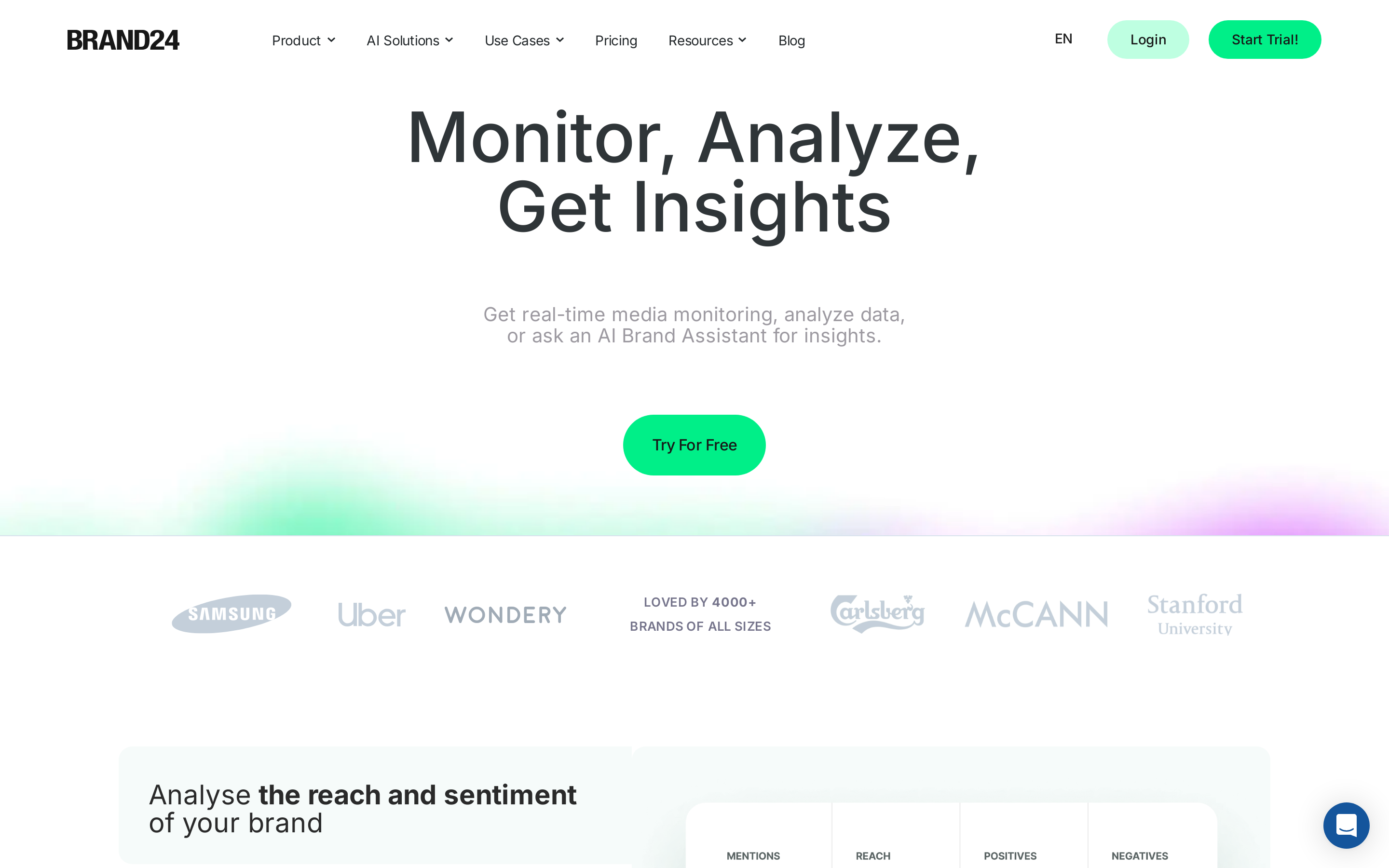
Brand24 focuses on helping teams understand how their brand, competitors, products, and campaigns are being discussed online.
The platform collects mentions from social media, news sites, blogs, forums, review platforms, podcasts, and other web sources, then adds sentiment analysis, reach metrics, alerts, share-of-voice reporting, and AI-generated insights on top of that data.
For PR and communications teams, this is often the main job.
When a campaign creates unexpected attention, a journalist mentions the company, or customer sentiment starts shifting, the first question is usually not "What should we publish next?" It is "What happened, where is it happening, how big is it, and do we need to respond?"
What Brand24 does well:
Monitors brand, competitor, product, campaign, and executive mentions across multiple sources.
Tracks sentiment changes and highlights positive, negative, and neutral conversations.
Measures reach, influence, and mention volume over time.
Sends alerts for spikes, unusual activity, and emerging conversations.
Provides share-of-voice reporting for competitor monitoring.
Generates reports for PR, communications, and stakeholder updates.
Uses AI-powered summaries and insights to help teams review large volumes of mentions.
The limitation is that Brand24 stops closer to insight than execution.
It can help teams understand what people are saying and where conversations are happening. It does not manage content calendars, publishing workflows, post approvals, social inboxes, or engagement operations.
For PR and reputation management teams, that is usually enough.
For teams managing day-to-day social media operations, Brand24 often becomes one part of the workflow rather than the entire workflow.
What Hootsuite is built to do#
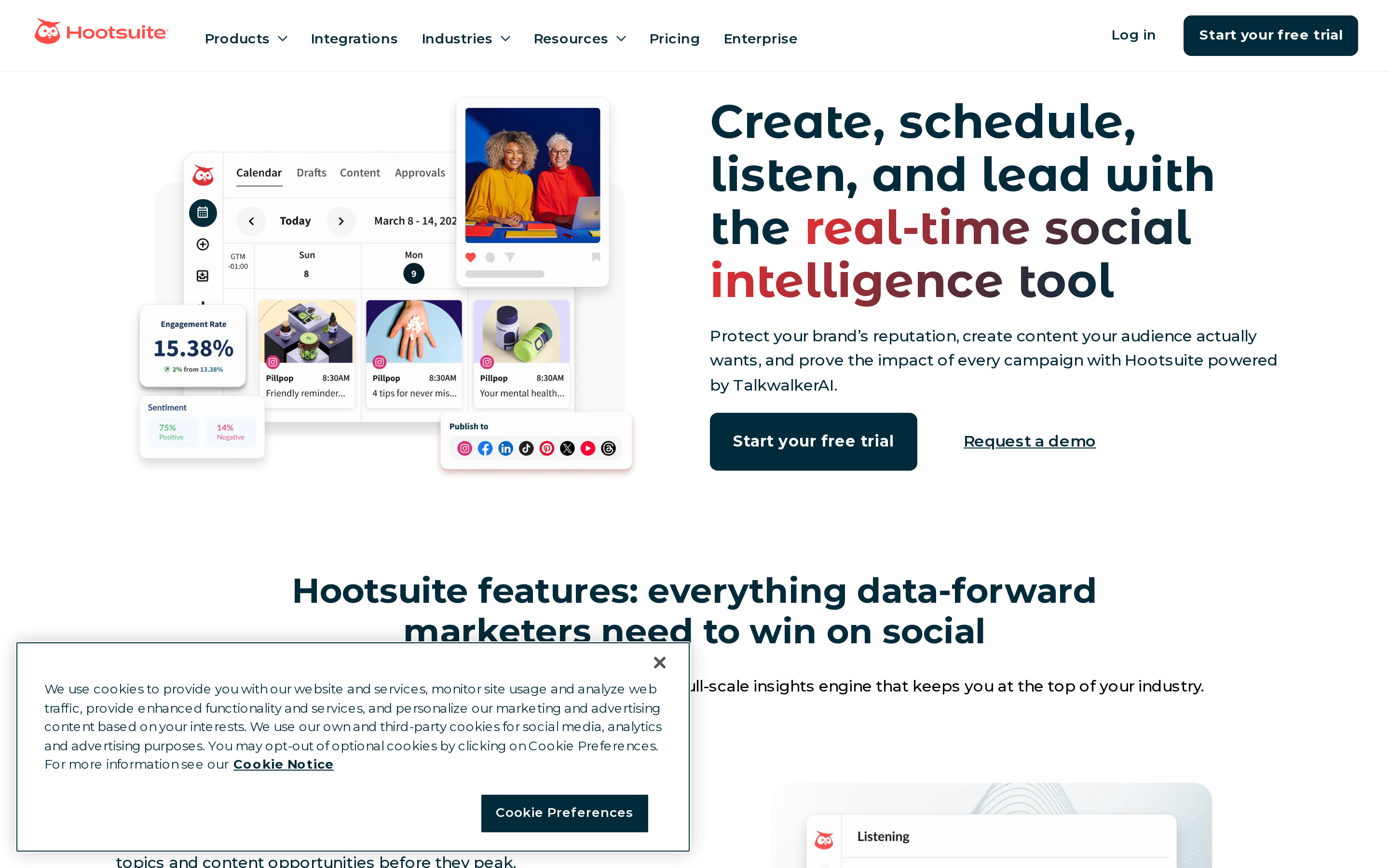
Hootsuite's core workflow starts with publishing, not monitoring.
Most teams buy Hootsuite because they need to manage multiple social accounts, schedule content, coordinate approvals, handle incoming messages, and measure performance from a single workspace.
Over the last few years, Hootsuite has expanded beyond publishing. Following its acquisition of Talkwalker, the platform now includes social listening capabilities such as mention tracking, sentiment analysis, competitor benchmarking, and listening streams.
That gives users visibility into conversations happening around their brand, but the platform still revolves around social media operations rather than reputation monitoring.
What Hootsuite does well:
Schedules and publishes content across multiple social media accounts.
Provides a centralized content calendar for planning campaigns.
Supports approvals, internal comments, and team collaboration.
Brings public comments, private messages, and DMs into a shared inbox.
Tracks post performance, channel performance, and engagement metrics.
Includes competitor benchmarking and social listening capabilities.
Supports social advertising, employee advocacy, advanced analytics, and enterprise features.
Integrates with a large number of social media and marketing tools.
The limitation is that many of Hootsuite's features only create value if your team actively manages social channels.
If the goal is simply to track mentions, monitor sentiment, receive alerts, and generate reports, much of the publishing, inbox, approval, and collaboration functionality may go unused.
In those situations, a monitoring-focused platform can often accomplish the job with less complexity and lower cost.
Brand24 & Hootsuite's Feature comparison #
Most comparison articles treat listening, publishing, reporting, inbox management, competitor tracking, and social engagement as if they are the same job.
They are not.
The easiest way to understand Brand24 vs Hootsuite is to follow the workflow.
Monitoring and Listening#
This is where Brand24 has the clearer focus.
It revolves around collecting and analyzing conversations from social media, news sites, blogs, forums, review platforms, podcasts, newsletters, and other public sources. Once mentions are collected, teams can filter them by sentiment, source, reach, influence, and other criteria.
Brand24 is the better fit when the question is:
Who is talking about us?
What is the sentiment?
Which sources are driving attention?
Are competitor mentions increasing?
Is there a reputation issue developing?
Hootsuite includes listening features, but listening is only one part of a larger social media workflow. Depending on the plan, teams can monitor mentions, sentiment, and competitors, while Enterprise users can access listening capabilities powered by Talkwalker.
Choose Brand24 when monitoring and interpretation are the primary job.
Choose Hootsuite when monitoring is one input into a larger social media operation.
Publishing and Content Operations#
This is where Hootsuite becomes the more natural fit.
The platform includes post scheduling, content calendars, approval workflows, bulk scheduling, recommended posting times, asset management, and team collaboration tools.
For teams managing multiple brands, multiple channels, or a large publishing volume, these workflows matter every day.
Brand24 does not solve that problem.
It can help explain how people reacted to content after it was published, but it is not where the content operation runs.
Inbox and Social Engagement#
Hootsuite brings comments, messages, and DMs into a centralized inbox and includes assignment workflows, saved replies, automation, tagging, and team productivity tracking.
For customer support teams, community managers, and social teams handling incoming conversations at scale, these features are part of the daily workflow.
Brand24 helps identify conversations worth paying attention to.
Hootsuite helps manage the conversations after they arrive.
Reporting and Analytics#
Both products include reporting, but the reports answer different questions.
Brand24 reports focus on:
Sentiment
Reach
Share of voice
Source analysis
Reputation trends
Campaign reaction
Competitor mentions
Hootsuite reports focus on:
Post performance
Channel performance
Engagement metrics
Audience growth
Team productivity
Social ROI
Competitor benchmarking
If the report is for a PR team or communications leader, Brand24 usually aligns better.
If the report is for a social media manager or marketing team, Hootsuite often aligns better.
Competitor Tracking#
Both platforms support competitor analysis, but they approach it differently.
Brand24 tracks how often competitors are mentioned, where conversations happen, and whether sentiment is positive or negative.
Hootsuite focuses more on social account benchmarking, engagement performance, posting activity, and channel-level comparisons.
One helps answer, "What are people saying about competitors?"
The other helps answer, "How are competitors performing on social media?"
Buyer Intent and Community Signals#
Brand24 can surface conversations.
Hootsuite can help publish and engage on supported social channels.
But neither platform is primarily focused on identifying buyer-intent discussions and turning them into GTM actions.
A Reddit thread asking for alternatives, a LinkedIn discussion about switching vendors, a GitHub issue exposing a product gap, or a Slack conversation discussing budget approvals may be more valuable to a revenue team than hundreds of ordinary brand mentions.
That is where CommunityTracker fits differently.
Instead of starting with mentions or publishing workflows, it starts with community conversations and buyer signals. The goal is to help teams identify commercially relevant discussions, track competitor share of voice, and route those conversations into actions before they go cold.
For PR and social teams, Brand24 and Hootsuite solve different parts of the workflow.
For GTM teams, the bigger question may be whether monitoring the conversation is enough, or whether acting on the conversation is the actual goal.
Pricing comparison#
Pricing changes. Treat this section as a dated buying note, not a permanent price sheet.
Brand24 pricing#
Individual | $249/mo | $199/mo billed annually | 3 keywords, 2K mentions/month, 1 user, 12-hour updates |
Team | $349/mo | $299/mo billed annually | 7 keywords, 10K mentions/month, unlimited users, hourly updates |
Pro | $499/mo | $399/mo billed annually | 12 keywords, 40K mentions/month, unlimited users, real-time updates |
Business | $699/mo | $599/mo billed annually | 25 keywords, 100K mentions/month, unlimited users, real-time updates |
Enterprise | From $1,499/mo billed annually | From $1,499/mo billed annually | Custom keyword count and custom mention limit |
Brand24 pricing comes from monitoring scale. You pay more when you need more keywords, more monthly mentions, faster refresh, more advanced analysis, custom reporting, customer success, or add-ons such as API access. The official pricing page lists API access as an additional $99 fee on some tiers.
Brand24 becomes expensive when you monitor many brands, competitors, products, campaigns, or client accounts. It is easier to justify when the business value is reputation risk, PR reporting, campaign coverage, or competitive intelligence.
Hootsuite pricing#
Pricing: Hootsuite starts at $99/month when billed annually and scales based on the number of users, social accounts, and collaboration features. A 30-day free trial is available, but there is no permanent free plan.
Plan overview:
Professional ($99/month):
1 user, 10 social accounts, unlimited scheduling, AI caption generation, best-time-to-post recommendations, and a centralized social inbox.
Team ($249/month):
3 users, 20 social accounts, customizable analytics, bulk scheduling for up to 350 posts, and collaboration features that make the platform more valuable for teams managing social media together.
Business & Enterprise (Custom):
5+ users, 50+ social accounts, advanced workflows, AI compliance controls, enterprise analytics, and deeper listening capabilities.
Hootsuite’s value is strongest in publishing, approvals, inbox management, and team collaboration rather than social listening alone. The upgrade from Professional to Team is typically driven by the need for additional users and workflow controls, while organizations focused primarily on mention monitoring and sentiment analysis may find more cost-effective listening-specific alternatives.
Choose by scenario#
PR or reputation team: choose Brand24#
Choose Brand24 if the team needs to monitor what people say about the brand, campaign, executive, product, or competitor. The value is detection plus interpretation: mentions, sentiment, share of voice, influence, source mix, and reporting.
Watch-out: if the team also needs to plan content, route DMs, approve posts, and manage social accounts, Brand24 will not cover the operational workflow.
Social media manager or content team: choose Hootsuite#
Choose Hootsuite if the daily work is publishing, scheduling, approvals, inbox, analytics, and channel coordination. Hootsuite is built around the work a social team repeats every day.
Watch-out: if the only goal is monitoring mentions, Hootsuite can be more platform than you need. You may pay for publishing and collaboration features that sit unused.
Agency: choose by client bottleneck#
Agencies need to separate reporting clients from publishing clients.
If clients pay you for reputation monitoring, campaign coverage, competitor mentions, and share-of-voice reports, Brand24 is the cleaner fit. If clients pay you to run content calendars, approvals, posting, engagement, and social reporting, Hootsuite is closer to the work.
If the agency runs community-led demand capture for B2B SaaS clients, neither category fully covers the job. In that case, CommunityTracker belongs in the stack discussion because the work is not just monitoring or publishing. It is finding relevant buyer signals and turning them into outreach, content, or account-level action.
B2B SaaS GTM team: choose CommunityTracker#
A B2B SaaS team comparing Brand24 vs Hootsuite often has a third problem hiding under the query: "Where are prospects talking before they enter our funnel?"
Those conversations happen on Reddit, Slack, LinkedIn, X, GitHub, Hacker News, Product Hunt, Stack Overflow, Indie Hackers, Discord, and niche forums. A social scheduler will not solve that. A broad monitoring dashboard may find some of it, but the next action still needs GTM context.
CommunityTracker is a stronger fit when the workflow needs:
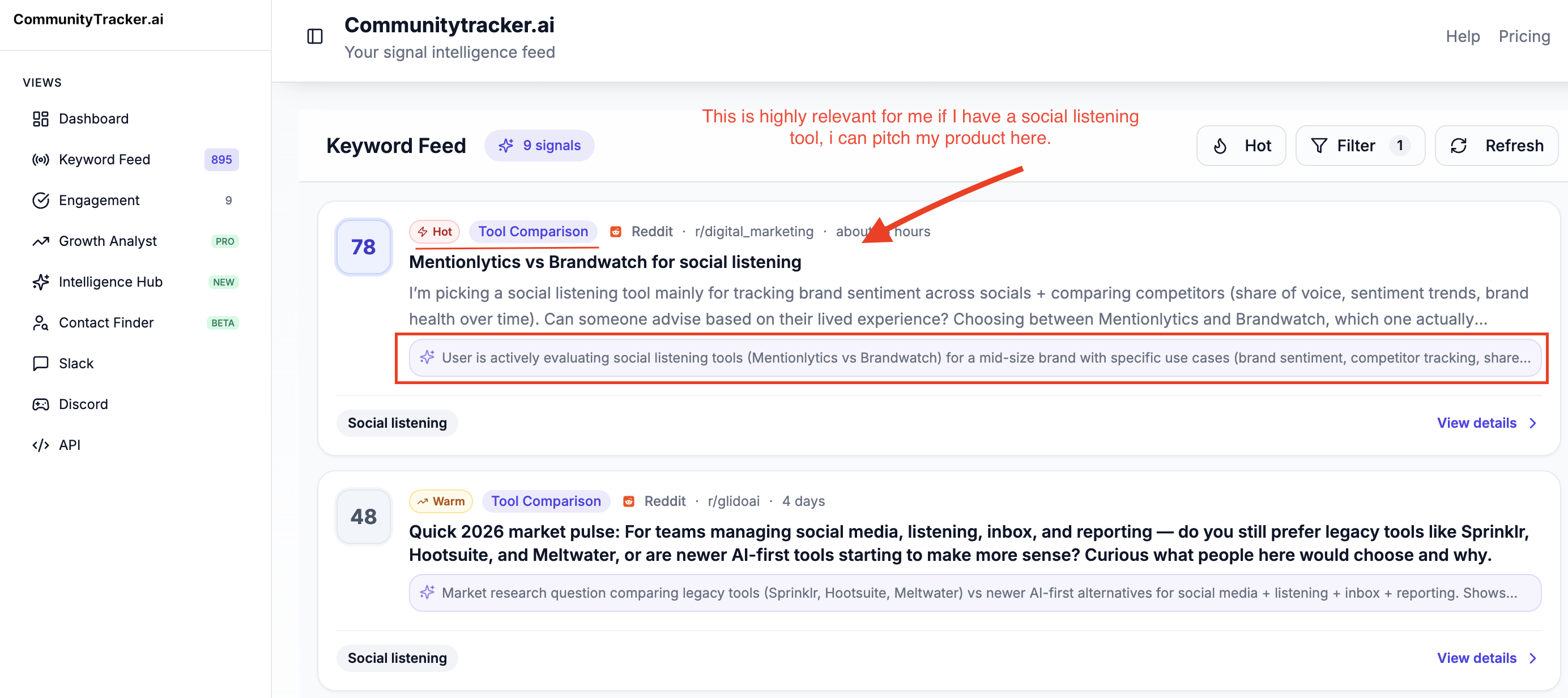
Buyer intent detection from recommendation, comparison, pain-point, and competitor threads.
Competitor share-of-voice tracking across communities.
Prioritized alerts for commercially relevant signals, not generic chatter.
Action items for demand gen, founder-led sales, product marketing, or RevOps.
Outreach and content workflows based on the original conversation context.
Do not choose CommunityTracker if the job is scheduling posts or building PR coverage reports. Choose it when the job is finding signals early and acting before competitors do.
Enterprise social team: Hootsuite may make more sense#
If an enterprise team needs social publishing, governance, advanced inbox, analytics, compliance, integrations, and enterprise listening in one vendor relationship, Hootsuite is the stronger enterprise fit. Talkwalker-backed listening makes that case more credible than older Hootsuite comparisons suggest.
Watch-out: confirm the exact plan and add-ons before buying. Enterprise listening, advanced inbox, SSO, compliance integrations, and Salesforce integration sit in custom territory.
Where CommunityTracker fits if neither tool matches the job#
Brand24 and Hootsuite both start from social or web conversation, but they move in different directions.
Brand24 asks: "What is being said about us, where, and with what sentiment?"
Hootsuite asks: "How do we publish, respond, coordinate, and measure social work?"
CommunityTracker asks: "Which community signals matter commercially, and what should the GTM team do next?"
That distinction matters for B2B SaaS.
A Reddit thread asking "What are people using instead of our competitor?" is not only a mention. It is a buyer signal. A GitHub issue complaining about a missing integration is not only product feedback. It can become content, outbound context, roadmap input, or competitive positioning.
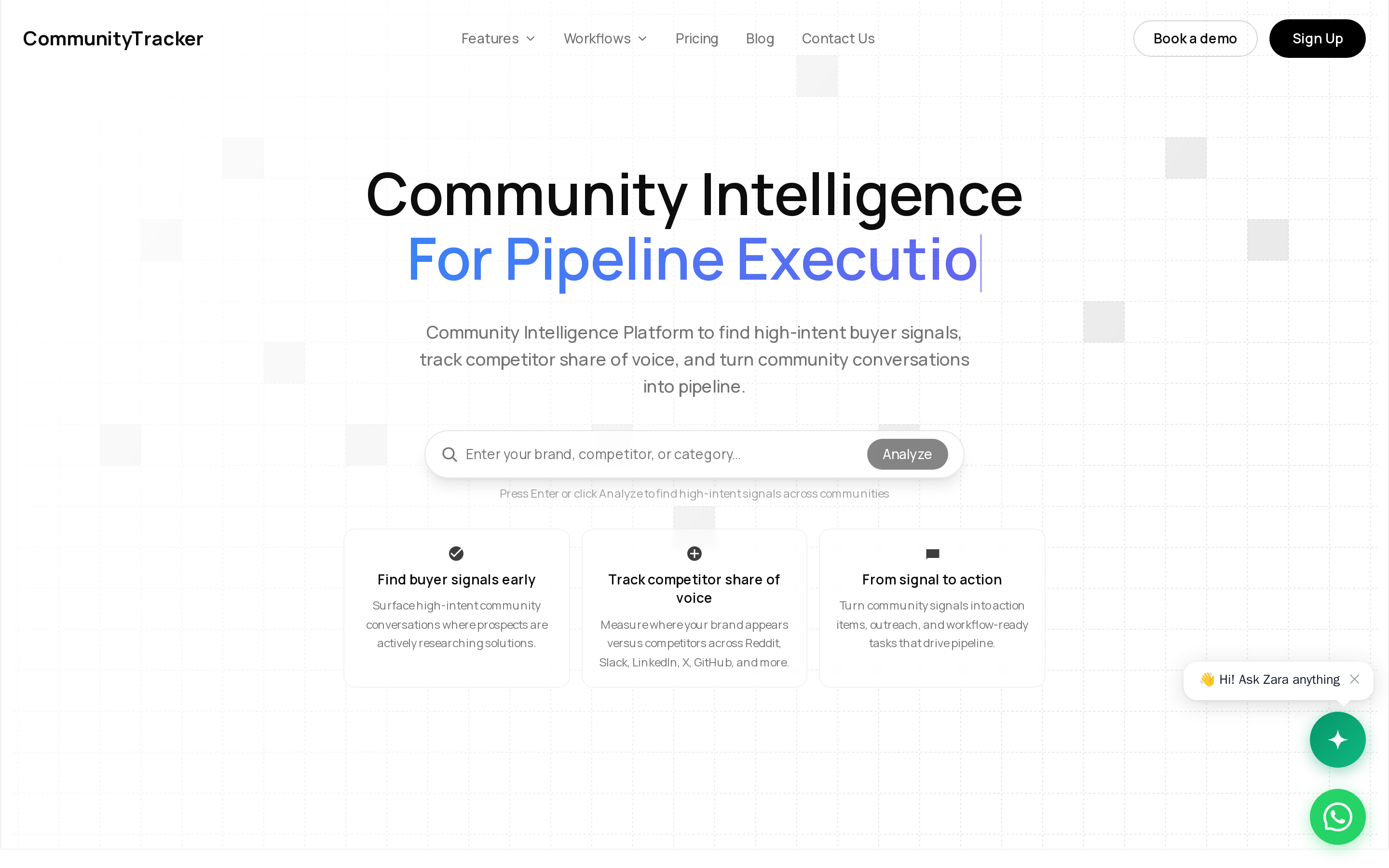
CommunityTracker's finds high-intent buyer signals, tracks competitor share of voice, and turns community conversations into pipeline.
That makes it useful for:
Demand gen teams that want to capture demand before forms get filled.
Founders who want founder-led sales context from real buyer conversations.
Product marketers who need comparison threads, objection language, and competitor movement.
RevOps teams that want relevant signals routed into workflows instead of buried in alerts.
Agencies that run community-led GTM for SaaS clients.
It is not the right choice for every Brand24 vs Hootsuite searcher.
Who should not choose CommunityTracker:
Teams that mainly need a content calendar, bulk scheduling, approval workflows, or a unified social inbox. Hootsuite is a better fit.
Teams that mainly need broad PR monitoring, media coverage reports, or reputation dashboards. Brand24 is a better fit.
Teams that want one tool for every social function. CommunityTracker is a GTM signal workflow, not an all-in-one social suite.
Final recommendation#
The easiest way to choose between Brand24 and Hootsuite is to look at what happens after a signal appears.
If the next step is publishing content, replying to messages, managing approvals, updating a content calendar, or coordinating a social team, Hootsuite is usually the better fit. It is built around running day-to-day social media operations.
If the next step is investigating a mention, monitoring sentiment, tracking competitors, measuring share of voice, or understanding how people are reacting to your brand, Brand24 is usually the better fit. It is built around monitoring and analysis rather than social execution.
There is also a third workflow that neither tool fully covers.
Sometimes the most valuable conversation is not a brand mention at all. It is a prospect asking for alternatives on Reddit, a founder complaining about a competitor on LinkedIn, a product discussion on GitHub, or a recommendation thread on Hacker News. Those conversations often matter more to revenue teams than social engagement metrics.
That is where CommunityTracker fits. It focuses on community conversations across Reddit, Slack, LinkedIn, X, GitHub, Product Hunt, Stack Overflow, Hacker News, Indie Hackers, and other communities, then helps teams identify which conversations deserve action.
Use this simple test:
Need to publish, schedule, manage inboxes, and run social channels? → Choose Hootsuite
Need to monitor mentions, sentiment, reputation, and competitor conversations? → Choose Brand24
Need to find and act on buyer-intent conversations in communities? → Evaluate CommunityTracker
The best tool is usually the one that helps your team take the next action faster, not the one with the longest feature list.