If you're looking at Common Room, you've probably already decided that outbound based on static lead lists isn't enough anymore.
Your reps already have Apollo. They already have Sales Navigator. Maybe they have Bombora, 6sense, Clay, or another data provider too.
Finding companies isn't the problem.
Figuring out which account deserves attention today is.
That is why buying signals have become one of the fastest-growing categories in sales software. Instead of asking, "Who fits my ICP?" teams are asking, "Who is showing signs of needing us right now?"
Common Room is one of the biggest names in that category.
It promises to bring together website visits, product usage, GitHub activity, CRM history, LinkedIn engagement, community conversations, and dozens of other signals into one workspace so reps know who to contact first.
That sounds like exactly what modern outbound needs.
But after reviewing dozens of sales tools, we've noticed something.
Collecting signals is no longer difficult.
Almost every intent platform can tell you someone visited your pricing page, raised funding, hired a VP, or starred your GitHub repository.
The harder question is what happens next.
When that signal appears, does the rep know exactly who to contact, why now is the right time, what to say, and how to turn that activity into a meeting?
Or does it become another notification that disappears into a dashboard after a few weeks?
That's the question this review is built around.
Instead of counting integrations or AI features, we're looking at whether Common Room actually helps revenue teams turn buying signals into pipeline.
Quick take on Common Room#
Common Room is strongest for B2B teams that already have signal volume across product, website, CRM, GitHub, LinkedIn, Slack, Discord, Reddit, G2, and sales tools.
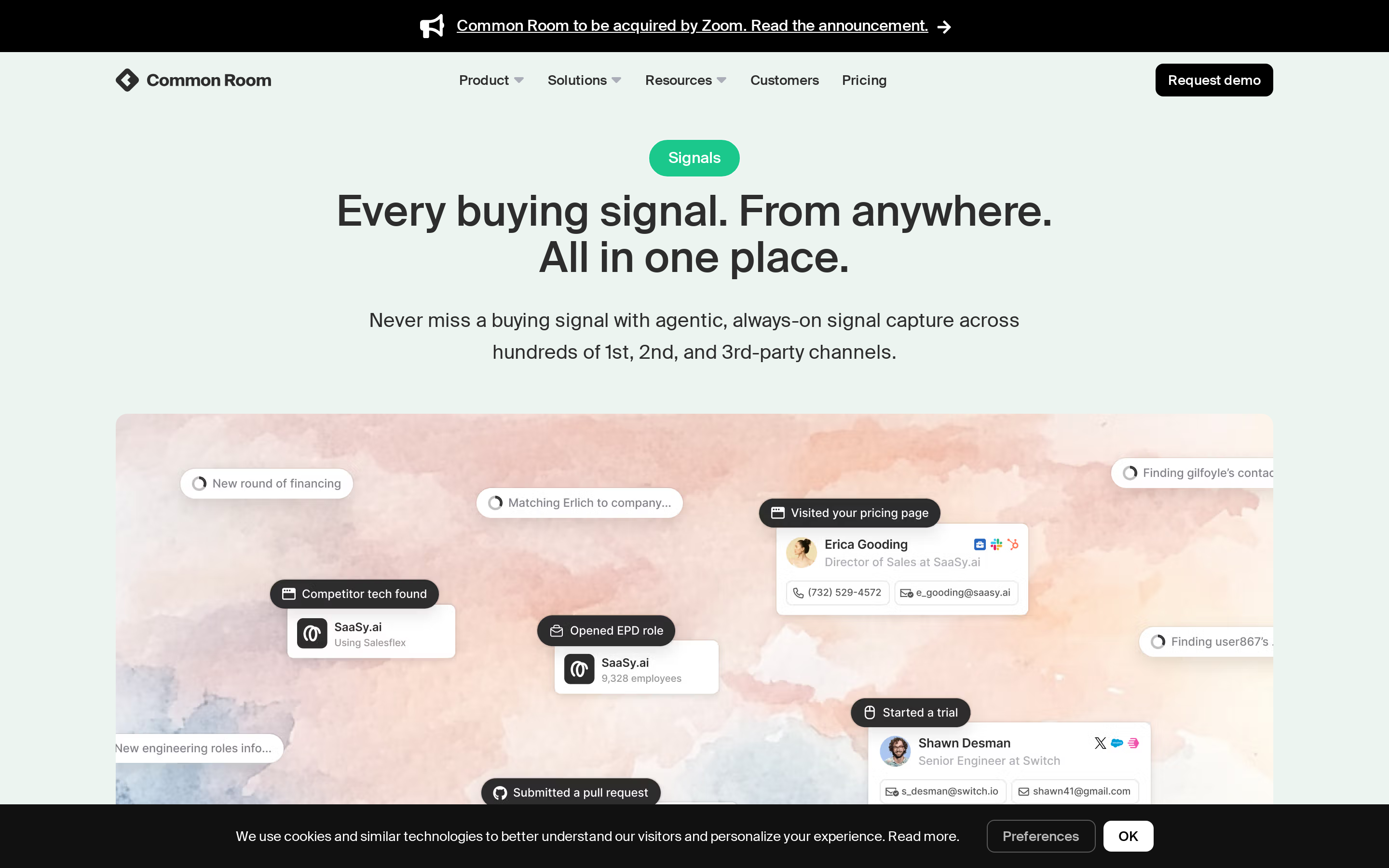
It is weaker as a first lead source for a lean outbound team that mainly needs emails, fast prioritization, and a cheaper way to act on public intent.
Best fit | Mid-market or enterprise GTM teams with product, website, CRM, and community activity |
Weak fit | Teams that need only contact data, sending infrastructure, or a simple list builder |
Starting price | Essential is $2,500/month billed annually |
Buying signals didn't replace outbound. They changed how good outbound works.#
Five years ago, outbound was mostly a volume game. Build a list, enrich the contacts, write a sequence, and send enough emails that the math eventually worked in your favor.
That playbook still exists, but buyers have changed. Decision-makers receive more cold emails than ever before, and generic personalization no longer feels personal. Mentioning a funding round or a recent LinkedIn post doesn't stand out when every SDR has access to the same information.
What separates great outbound today isn't who has the biggest database.
It's who has the best timing.
Think about the difference between these two emails.
"Hi Sarah, I noticed your company recently raised a Series A..."
versus
"Saw two engineers from your team comparing Kubernetes deployment options in your docs this week. Curious if you're evaluating infrastructure changes?"
Both emails are personalized.
Only one is tied to an actual buying moment. That's why companies are investing in signal platforms.
They're not buying more data.
They're trying to answer one question every morning:
Which accounts deserve my reps' attention today?
Common Room is one of the most complete platforms trying to answer that question.
But there's an important distinction buyers should understand before scheduling a demo.
Signals don't create pipeline. Sales teams do. Signals only become valuable when they change what the rep does next.
Find high-intent buyer signals with CommunityTracker and turn community conversations into pipeline.
What Common Room is actually trying to solve#
Most review sites describe Common Room as a customer intelligence platform, a signal platform, or an intent data platform.
None of those descriptions really explain why someone would buy it.
The simpler explanation is this. Common Room tries to answer a question every sales team asks dozens of times a day.
Who should we contact right now?
Instead of relying only on firmographic filters like industry, employee count, funding stage, or job title, Common Room combines those filters with live activity happening across your business and the public web.
That activity might come from someone exploring your pricing page.
It might come from a developer opening a GitHub issue. It might come from product usage inside your application. Or it might come from someone engaging with your LinkedIn company page or joining your Slack community.
Individually, those actions don't tell the whole story.
Together, they often reveal something much more useful.
They tell you that an account isn't just a good fit. They're paying attention. That's an important distinction because outbound isn't really a lead generation problem anymore.
It's a prioritization problem.
Most sales teams already have more prospects than they can realistically contact.
What they don't have is confidence that they're spending time on the right ones.
That's the workflow Common Room is trying to improve.
Not replacing your CRM. Not replacing your sequencing platform. Not replacing your contact database.
Instead, it sits between all of those systems, helping your team decide where to focus before the first email gets written.
Whether it succeeds at that is the rest of this review.
Here's how I'm evaluating Common Room (and why most reviews miss the point)#
Most software reviews spend their time counting features.
How many integrations does it have?
How many signals can it collect?
How many AI features are included?
Those are useful questions.
They're just not the questions that determine whether a sales team creates more pipeline.
A platform can monitor 100 different buying signals and still produce terrible outbound if reps don't know how to use those signals.
That's why I evaluated Common Room differently.
Instead of asking what the platform can track, I asked what those signals actually help a rep do.
Throughout this review, every feature gets measured against five simple questions.
Does the signal explain why this account deserves attention today?
Can the activity be connected to a real buying person instead of just an anonymous company?
Does the rep have enough context to write something more relevant than generic personalization?
Can the account move into Salesforce, HubSpot, Outreach, or the existing sales workflow without manual work?
Can the sales team measure which signal types actually turned into meetings and revenue?
Those questions sound simple.
They're surprisingly difficult for most signal platforms to answer consistently.
Because in the end, Common Room isn't competing with another dashboard. It's competing with the way your sales team already works.
If the platform makes it easier for reps to prioritize, personalize, and act on buying signals, it earns its place in the stack.
If it simply creates another feed for reps to check every morning, it becomes another expensive dashboard that everyone stops opening after the first few weeks.
Those five questions sound simple, but they expose a bigger problem with the buying signal category.
Most platforms compete by collecting more signals. Buyers assume that means more opportunities. In reality, the opposite often happens. The more activity a platform surfaces, the harder it becomes to decide what actually deserves a rep's time.
That's where most signal-led outbound programs succeed or fail.
Must Read: Demand Signal Detection: How Smart GTM Teams Spot Buyers Before Demo Requests
The problem isn't finding buying signals. It's knowing which ones deserve attention.#
Instead of selling Common Room, start by talking about what buyers experience.
For most revenue teams, the challenge isn't a lack of intent data anymore.
Apollo shows hiring activity. LinkedIn tells you when someone changes jobs. Bombora scores research intent. Website analytics reveal who visited pricing. Product analytics show who's adopting new features. By the time a team starts evaluating Common Room, they usually have signals coming from half a dozen places already.
The problem is that none of those tools answers the question every SDR asks at the start of the day:
"Who should I contact first?"
That's where many buying signal discussions become misleading.
More signals don't automatically create better outbound. In fact, they often create more indecision. A pricing-page visit, a GitHub star, a webinar registration, and a new job posting all look important in isolation. Without context, they're just a queue of notifications competing for attention.
The companies that get the most value from signal platforms aren't the ones collecting the most activity. They're the ones that know which activity deserves a human response and which can safely be ignored.
That's the problem Common Room is trying to solve.
The biggest promise Common Room makes#
Every software category has one promise that buyers are really paying for.
CRM platforms promise a single source of truth.
Sales engagement platforms promise more efficient outreach.
Signal platforms promise better timing.
Common Room takes that idea a step further.
Instead of showing isolated events, it tries to build a complete picture of account intent. Website visits, product usage, CRM history, GitHub activity, LinkedIn engagement, community conversations, and third-party signals are all stitched together into a single timeline.
The goal isn't simply to collect more data. It's to help a rep understand why an account deserves attention right now.
That's an important distinction because timing is what separates modern outbound from list-based prospecting.
A company that matches your ICP isn't necessarily in the market.
A company actively comparing your pricing, reading implementation docs, inviting teammates into a product trial, and discussing similar tools in public probably is.
When Common Room works well, it helps sales teams identify those moments much earlier than traditional prospecting workflows.
The challenge is that surfacing those moments is only half the job.
Someone still has to decide what they mean.
Where Common Room actually delivers#
This is where I think Common Room is genuinely different from many intent platforms.
Most competitors surface one type of signal well. Common Room is designed to connect signals that would normally live in separate systems.
That's particularly valuable for companies with longer or more technical buying journeys.
A developer might spend a week inside your documentation before anyone from procurement gets involved. Someone else from the same account might visit your pricing page. A product champion could already be using your free plan while another stakeholder joins your Slack community.
Viewed separately, none of those interactions says much.
Viewed together, they tell a much stronger story.
That's why Common Room tends to resonate most with product-led SaaS companies, developer tools, and businesses with active communities. Those organizations naturally generate buying signals across multiple touchpoints, and connecting those touchpoints gives sales teams better context before they reach out.
Just as importantly, Common Room doesn't ask reps to abandon the rest of their stack. Once an account has been prioritized, it can flow into existing CRM and sales engagement workflows with the surrounding context attached.
That's where the platform creates the most value—not by generating more activity, but by helping teams understand the activity they already have.
Where I think Common Room falls short#
This is also where I'd be more cautious than many reviews.
Common Room does a good job collecting and connecting buying signals. That doesn't automatically make those signals actionable.
The platform still depends on your team answering some difficult operational questions.
Which signals should trigger immediate outreach?
Which ones are useful only when paired with another signal?
Which should notify an SDR, and which belong with an account executive?
Those decisions don't come out of the box.
They depend on your sales motion, your product, and your buyers.
That's why I don't think Common Room is a plug-and-play solution for every outbound team.
If your organization already has mature RevOps processes, clean CRM data, meaningful product usage, and enough signal volume to prioritize accounts, the platform has a strong foundation to build on.
If you're still trying to solve basic prospecting problems, finding verified contacts, improving email deliverability, or building your first outbound motion, Common Room is likely solving a problem you don't have yet.
That's the tradeoff buyers should understand.
Common Room isn't difficult because it's a bad product.
It's difficult because getting value from it requires operational maturity that many teams haven't built yet.
Find high-intent buyer signals with CommunityTracker and turn community conversations into pipeline.
The real cost of Common Room isn't the subscription#
Common Room's Essential plan starts at $2,500 per month, billed annually, putting the entry point at around $30,000 a year. Enterprise pricing isn't public, so larger deployments require speaking with sales.
Most buyers focus on Common Room's starting price.
They shouldn't.
The subscription is easy to calculate. The harder cost to estimate is everything required to make the platform successful.
Signal platforms only become valuable when someone decides which signals matter, how they're scored, who owns follow-up, and how those signals move through the rest of the sales process.
That usually means ongoing work from RevOps, sales leadership, and operations teams. Someone has to refine scoring rules, remove noisy signals, update workflows, and make sure reps continue trusting the recommendations the platform produces.
Those costs don't appear on the pricing page, but they have a much bigger impact on ROI than the software itself.
That's why I wouldn't ask whether Common Room is worth $2,500 per month.
I'd ask whether your organization is ready to operate a signal-led outbound motion.
For some companies, the answer is clearly yes.
For others, the software arrives long before the operational maturity does.
Before you buy Common Room, answer these five questions#
I think software reviews spend too much time telling buyers what a product can do.
The more useful question is whether your business is actually ready for it.
Before scheduling a demo, I'd answer these five questions internally.
1. Are we already generating meaningful buying signals?#
If your prospects rarely interact with your website, product, documentation, GitHub repositories, or community, there isn't much for Common Room to connect.
The richer your first-party data, the more valuable the platform becomes.
2. Do we know which signals actually predict pipeline?#
Many teams assume they'll figure this out after implementation.
In reality, that's one of the biggest reasons signal projects lose momentum.
If nobody agrees on what deserves outreach, every alert eventually starts looking important.
3. Will reps actually change how they prospect?#
Common Room only creates value if it changes daily behavior.
If your SDRs still begin every morning inside Apollo or Sales Navigator and never look at buying signals before prospecting, the platform becomes another expensive browser tab.
4. Are we solving a prioritization problem or a prospecting problem?#
These aren't the same thing.
Companies with plenty of accounts but poor prioritization often benefit from signal platforms.
Companies struggling to find prospects usually need better data, enrichment, or outbound infrastructure first.
5. Do we have someone who owns this system?#
Buying signals don't manage themselves.
Someone needs to monitor workflows, evaluate signal quality, and continuously improve how the organization responds to intent.
If nobody owns that process, adoption usually fades over time.
None of these questions are unique to Common Room.
They're the questions I'd ask before buying any signal platform.
Who should buy Common Room?#
After looking at the platform in detail, I think Common Room is best suited for companies that already have a mature GTM motion.
That usually means mid-market and enterprise SaaS companies with product usage data, healthy website traffic, active communities, clean CRM records, and enough buying signals that prioritization has become a bigger challenge than prospecting.
Those teams already know who their ideal customers are.
What they need is a better way to identify which of those customers are actively evaluating a solution today.
That's where Common Room delivers the most value.
It helps bring fragmented buyer activity into one place and gives revenue teams more context before they reach out.
Who should probably skip Common Room?#
The opposite is also true.
If your biggest challenge is still generating pipeline, Common Room is unlikely to solve it.
Early-stage companies often need more prospects, better contact data, reliable email infrastructure, and consistent outbound execution before they need advanced signal orchestration.
Adding another layer of intelligence doesn't help very much if the underlying outbound engine isn't producing enough activity in the first place.
I'd also be cautious if your organization doesn't have dedicated RevOps support.
The platform can surface a huge amount of information, but someone still has to turn that information into repeatable workflows.
Without that ownership, it's easy for buying signals to become another stream of notifications that gradually gets ignored.
Not every buying signal starts inside your business#
One assumption sits underneath most signal platforms.
They expect buying intent to appear somewhere inside your ecosystem. A prospect visits your pricing page, signs up for a trial, reads your documentation, joins your Slack community, or starts using your product. Those signals are incredibly useful because they show someone already knows who you are.
The challenge is that many buying decisions begin much earlier than that.
Long before someone visits your website, they're asking peers for recommendations on Reddit, discussing implementation challenges in Slack communities, comparing alternatives on LinkedIn, or looking for advice in niche industry forums.
By the time they reach your pricing page, they've often narrowed down their shortlist.
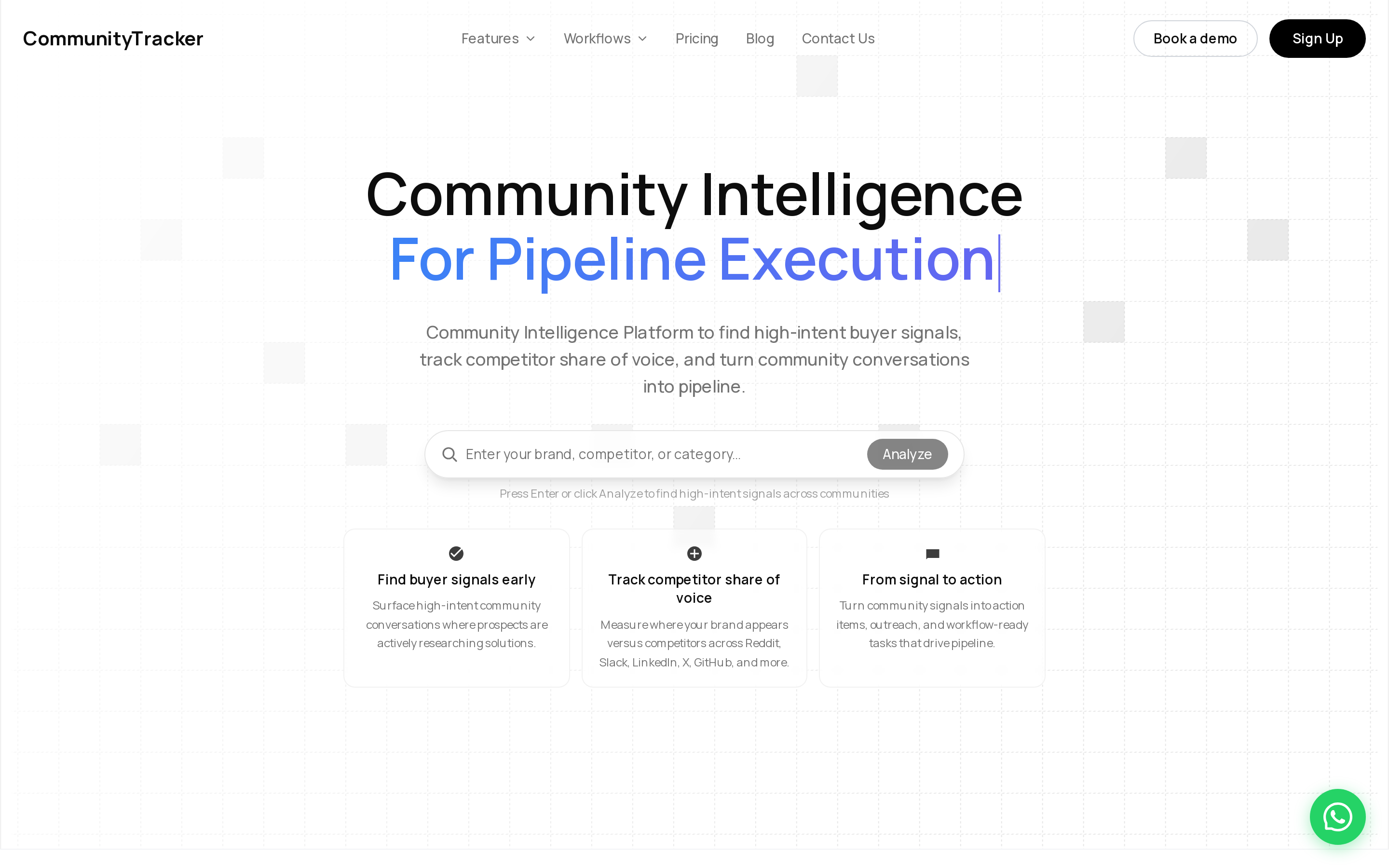
That's why CommunityTracker takes a different approach. Instead of waiting for intent to show up inside your product or website, it surfaces conversations where buyers are actively describing the problems they're trying to solve.
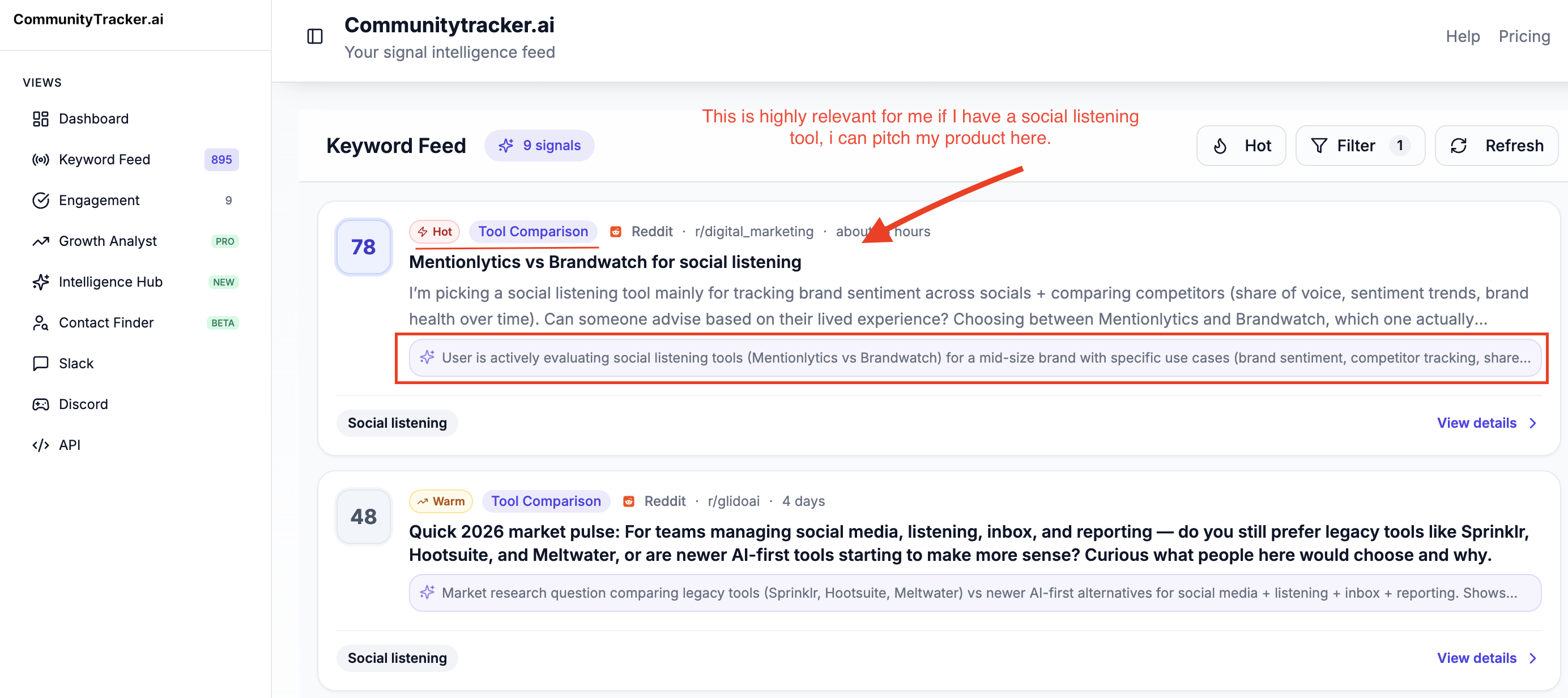
The signal isn't that someone visited your company. The signal is that they're already looking for a solution.
For outbound teams, that's often the difference between joining the buying conversation early and competing after every vendor has already entered the picture.
Which approach makes more sense?#
I don't think this is a question of one platform being better than the other. They're built around different stages of the buying journey.
If your company already generates rich first-party signals across product usage, website activity, CRM data, GitHub, and community engagement, Common Room gives your sales team a much better way to connect those signals and prioritize accounts.
If your challenge is finding buyers before they ever enter your funnel, monitoring external conversations is often the more valuable starting point. Those discussions usually reveal intent earlier, give reps more context, and create opportunities before the prospect starts evaluating a dozen different vendors.
Understanding that distinction is more useful than comparing feature checklists. Both approaches rely on buying signals. They simply answer different questions.
Common Room helps you understand which known accounts deserve attention, while CommunityTracker helps you discover who is actively looking for a solution before they become a known account.