If you're searching for Common Room Alternatives, you're probably trying to fix a signal problem that has started to show up in pipeline.
Maybe your reps see community posts too late. Another team may already have Common Room, but the cost and setup now feel heavier than the signal volume justifies. Or your buyers do not live in one neat community system: they ask questions on Reddit, complain on LinkedIn, compare vendors on X, file issues on GitHub, and show product intent before they ever book a demo.
There is a bigger thing worth flagging before we get into the list.
Common Room has moved from a community-led growth platform into a broader AI GTM platform. That gives larger teams a fuller buyer-intelligence system, but it also changes the buying question. You are no longer only asking, "Which tool looks like Common Room?" You are asking, "Which tool catches the buyer signal my team can act on this week?"
CommunityTracker is our product, and we include it first because this specific search is about finding actual buyers from community and intent signals. We'll let you decide after you see what we bring to the table.
In this post we'll cover the best alternatives by signal type. Then we'll show you where Common Room still makes sense, where it falls short, and how each option fits a RevOps workflow. By the end, you'll know which tool fits your motion without treating every vendor as a direct substitute.
Let's get started.
TL;DR - 9 Best Common Room Alternatives #
CommunityTracker is the best Common Room alternative when you need buyer intelligence that moves from trigger detection to warm outreach and brand visibility across Reddit, LinkedIn, X, Bluesky, Hacker News, Indie Hackers, Dev.to, Stack Overflow, Product Hunt, GitHub, and Slack.
CommunityTracker: Best alternative if you're looking for real-time social triggers, warm outreach, and competitor visibility in one buyer-intelligence workflow.
Trigify: Best alternative if you're looking for person-level social signals tied to a specific post.
Factors.ai: Best alternative if you're looking for website account identification, ABM scoring, and attribution.
Warmly: Best alternative if you're looking for live website visitor routing and inbound chat.
Koala: Best alternative if you're looking for product-led intent, but its public pages say it is shutting down on September 30.
Salesmotion: Best alternative if you're looking for public business-event signals and account research.
Apollo: Best alternative if you're looking for contact data, intent filters, and outbound execution in one sales platform.
Clay: Best alternative if you're looking for a build-your-own buyer-intelligence system.
UserGems: Best alternative if you're looking for champion tracking and job-change signals.
We covered the broader signal framework in our demand signal detection guide if you want the full setup before choosing a tool.
Why teams look for Common Room alternatives#
Common Room is still a serious platform. It brings together buyer intelligence, enrichment, AI research, Prospector credits, CRM connections, alerts, workflows, and segments. Essential is built for teams getting started with signal-based selling. Advanced and Enterprise expand contacts, seats, credits, RoomieAI capacity, support, and governance.
That scope is useful. It can also be more systematic than the job requires.
The switching reasons usually come down to five problems:
The team wants real-time triggers from public conversations, not a full GTM operating layer.
Sellers need to reach out through email, phone, comments, and DMs when a signal appears.
Warm outreach needs to flow into tools already in place, such as Salesforge, Smartlead, Instantly, CRM, Slack, or a custom workflow.
Brand visibility matters because the category conversation is happening before buyers search for a vendor.
The budget only makes sense if the product creates action items, not another queue to inspect.
A founder asking for a competitor replacement on Reddit is different from an anonymous pricing-page visit. A LinkedIn complaint about a competitor's pricing is different from a job-change alert. A GitHub issue about a missing feature is different from an account visiting your comparison page.
The best Common Room alternative depends on which buyer signal you can act on.
Turn Social Buyer Signals Into Pipeline With CommunityTracker
What Common Room still does well#
Common Room works well when a company wants a broad buyer-intelligence layer across account and contact data.
Its platform combines enrichment, signal capture, account and contact scoring, RoomieAI research and messages, Spark notifications, Bombora Company Surge topics, job-change tracking, custom signals, alerts, workflows, segments, and integrations.
That makes sense when a company already has enough sales capacity to work the output. A larger team can justify one system that collects signals, enriches contacts, researches accounts, and routes workflows into the sales process.
Common Room deserves credit for that breadth. The tradeoff is that some teams are looking for sharper buyer intelligence: set a trigger, catch the post, understand the intent, reach out through the right channel, and improve brand visibility before competitors dominate the conversation.
Where Common Room falls short for buyer-intelligence workflows#
When a product expands into a broad AI GTM platform, smaller teams can end up paying for a system that covers more data sources than they can act on. A team may only need to catch high-intent Reddit and LinkedIn posts. Another company may care most about website visitors. A sales motion may be driven by champion job changes, public business events, or product usage.
Common Room also works best when the team wants its platform logic. If your outreach already happens in Salesforge, Smartlead, Instantly, email, phone, comments, and DMs, the missing layer may be buyer-intelligence triggers rather than another sales system.
Here is the practical test: if the signal does not produce a clear next action, it is not buyer intelligence yet. It is another alert.
How I evaluated these Common Room alternatives#
I judged each alternative by whether it helps a team find a real buyer moment and turn it into action. The lens here is buyer intelligence, not social listening. A strong tool needs to detect trigger-worthy posts or account behavior, explain why the signal matters, and push the team toward outreach, routing, visibility, or pipeline action.
Trigger quality: Does the tool catch real buying signals from public posts, website visits, product usage, account events, job changes, or relationship movement?
Outreach path: Can the team act through email, phone, comments, DMs, CRM, Slack, Salesforge, Smartlead, Instantly, or another sales workflow?
Buyer context: Does the tool show the person, account, source, intent, and reason to reach out?
Visibility impact: Does it help track competitor share of voice, category mentions, or brand presence where buyers compare options?
Operating fit: Is the tool focused enough to use quickly, or does it require a larger implementation before sellers get value?
Here's the category map:
Tool | Best buyer-intelligence job | Real-time triggers | Outreach path | Visibility view | Starting point |
Social triggers to Outreach | Yes | Yes | Yes | $39/mo | |
Trigify | Person-level social posts | Yes | Yes | No | $40/mo |
Factors.ai | Website and ABM intent | Yes | Yes | Partial | $199/mo |
Warmly | Live inbound visitors | Yes | Yes | Partial | $10K/yr |
Koala | Product-led intent | Yes | Yes | Partial | Free plan |
Salesmotion | Public account events | Yes | Yes | No | $85/mo |
Apollo | Data plus outbound | Partial | Yes | No | $49/user/mo |
Clay | Custom signal systems | Yes | Yes | Partial | $185/mo |
Champion movement | Yes | Yes | No | Quote-led |
1. CommunityTracker#
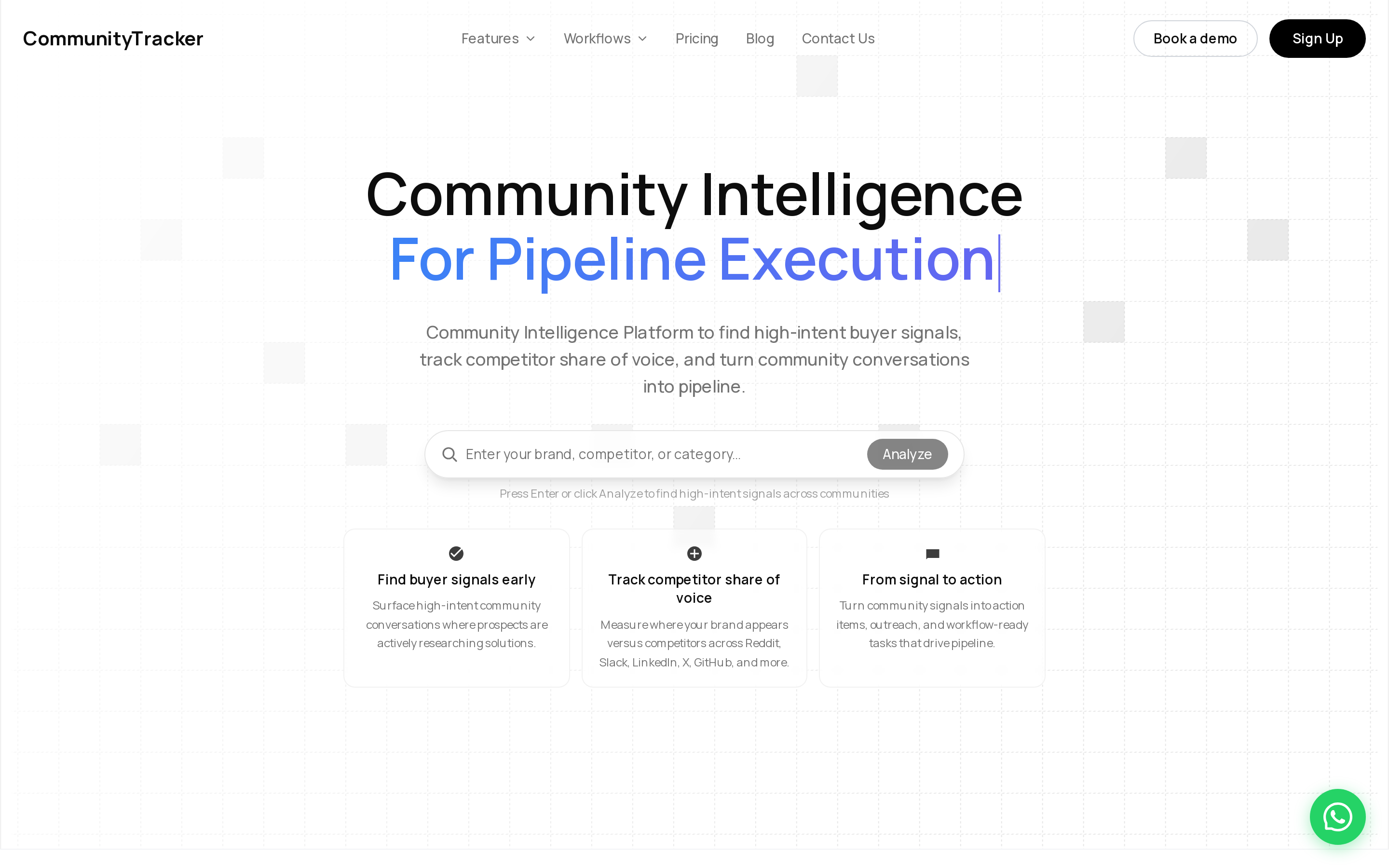
CommunityTracker is the most direct Common Room alternative when the job is finding buyers from public conversations and acting while the context is still fresh.
You set triggers around competitors, keywords, categories, pain points, and ICP topics, then track posts in real time across Reddit, LinkedIn, X, Bluesky, Hacker News, Indie Hackers, Dev.to, Stack Overflow, Product Hunt, GitHub, and Slack.
The newer CommunityTracker workflow goes beyond detection. It helps you reach out through email, phone, comments, and DMs, with warm outreach automation and integrations with tools such as Salesforge, Smartlead, Instantly, and more. It also tracks brand visibility against competitors and turns visibility gaps into action items.
Disclosure: We build CommunityTracker, and it earns the top slot here because this article is about finding actual buyers, reaching them, and improving brand visibility across public conversations.
Features#
Trigger setup for keywords, competitors, ICP pain points, category conversations, and buying intent.
Real-time post tracking across the canonical 11 CT platforms.
Buyer-intent scoring that separates high-intent signal from low-value mentions.
Outreach paths through email, phone, comments, and DMs.
Warm outreach automation with integrations such as Salesforge, Smartlead, Instantly, and more.
Share of Voice and AI visibility tracking against competitors.
Action items that move a signal from discovery to outreach, content, or visibility work.
Slack alerts and response generation for faster follow-up.
Pricing#
Free: $0 with 1 keyword, limited mentions, Reddit-only coverage, daily alerts, and basic analytics.
Starter: $39 per month with 4 keywords, 5,000 mentions, signal detection, Reddit, LinkedIn, Hacker News, GitHub, daily alerts, up to 100 warm emails per month, and the response generator.
Pro: $99 per month with 10 keywords, unlimited mentions, advanced AI filtering, all communities, unlimited warm emails, AI scoring, daily Slack alerts, Share of Voice, and Community AI.
Advanced: $199 per month with 20 keywords, unlimited mentions, everything in Pro, Share-of-Voice Exporter, and AI visibility.
CommunityTracker vs Common Room#
Parameter | CommunityTracker | Common Room | Better fit when |
Primary job | Social triggers, outreach, visibility | Broad AI GTM platform | You need focused buyer intelligence |
Signal source | 10+ social and community platforms | Community, CRM, enrichment, product, intent, Website traffic | Public conversations drive demand |
Outreach | Email, phone, comments, DMs, warm automation | Workflows, AI messages, sales intelligence | Existing outreach tools stay in place |
Brand visibility | Share of Voice and AI visibility | Broader account intelligence | Competitor presence matters |
Setup weight | Focused trigger-to-action workflow | Larger platform implementation | Speed matters more than breadth |
CommunityTracker is narrower than Common Room by design. It is built for buyer-intelligence workflows where a prospect asks for recommendations, complains about a competitor, files a GitHub issue, or shows category intent in a public thread.
Common Room fits a larger GTM data layer. CommunityTracker fits teams that want to turn community conversations into pipeline without buying a broader system than they need.
We wrote a deeper guide on AI social listening tools for buyer intent if you want to compare this category against older monitoring tools.
Pros#
Strong trigger setup for competitor, category, keyword, and ICP pain-point signals.
Clear action path from signal discovery to email, phone, comment, DM, or warm outreach workflow.
Share of Voice connects competitor visibility to the places where buyers compare vendors.
Integrations with Salesforge, Smartlead, Instantly, and related tools keep outreach close to execution.
Public self-serve pricing makes it easier to test before adding another annual platform.
Cons#
CommunityTracker is not a publishing, scheduling, or all-purpose inbox suite.
It is newer than broad incumbents, so enterprise procurement history is thinner.
Does not provide website visitors identification.
Teams that need a data warehouse-style buyer-intelligence layer may outgrow the focused workflow.
The strongest value comes when your buyers actually talk in public conversations.
Who should not choose CommunityTracker: Choose Warmly if the main buying moment is a live website visitor that needs chat or instant routing. Pick Clay if you have someone who wants to build a custom enrichment and workflow system across many data providers.
Summary#
CommunityTracker is the best fit when buyer intelligence starts in the conversation: Reddit alternatives threads, LinkedIn competitor complaints, X category posts, GitHub issues, Slack questions, and Product Hunt movement. Use it when the job is from signal discovery to GTM action.
2. Trigify#
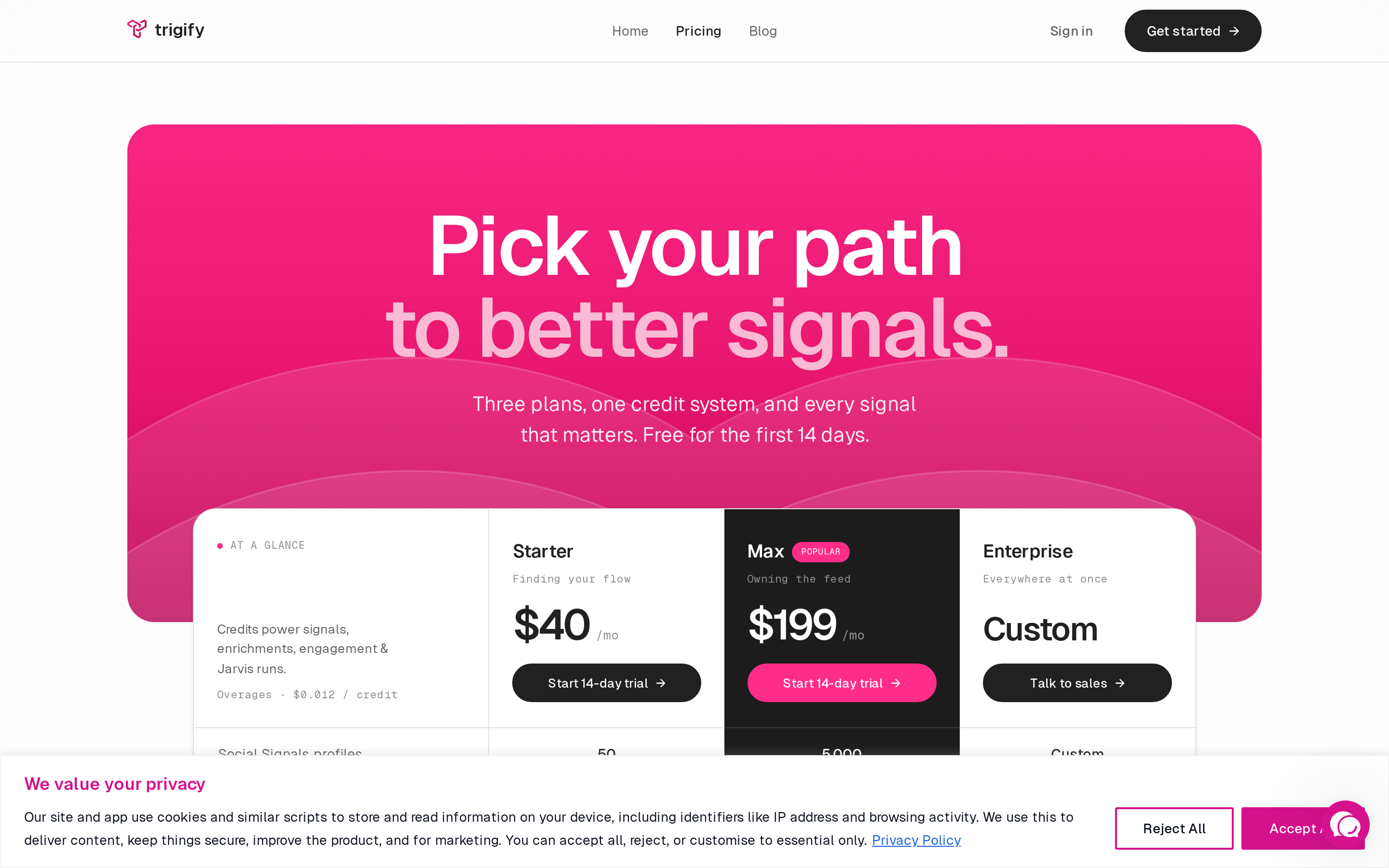
Trigify is a better Common Room alternative when the buyer signal is tied to one person and one post. It monitors professional networks, X, Reddit, YouTube, and podcasts, then resolves signals to named people with source context attached.
That matters when the next move is direct outreach. A seller needs more than account activity. They need the person, the post, the reason, and the channel.
Features#
Social listening searches with original-post context.
Person-level signal profiles tied to buying-intent triggers.
CRM, Outreach, Slack, API, MCP, and CLI paths for routing signals.
Shared credits across signals, enrichments, engagement, and Jarvis runs.
Search history from 7 days on Starter to 12 months on Max.
Workflows for signal scoring and enrichment.
Pricing#
Starter: $40 per month with a 14-day trial, 25 searches, 50 Social Signals profiles, 4,000 credits per month, and 7 days of search history.
Max: $199 per month with unlimited searches, 5,000 profiles, 40,000 credits, and 12 months of search history.
Enterprise: custom pricing with unlimited credits, custom profiles, SSO/SAML, RBAC, dedicated CSM, and SLA.
Trigify vs Common Room#
Parameter | Trigify | Common Room | Better fit when |
Primary job | Person-level social signals | Unified buyer intelligence | The post author matters most |
Signal source | LinkedIn, X, Reddit, YouTube, podcasts | Broader GTM data | Public posts drive outreach |
Outreach | CRM, Slack, Outreach, API paths | Workflows and AI messages | Existing tools handle execution |
Visibility | Signal-level context | Broader account context | You need source proof |
Setup weight | Focused search and profiles | Larger platform | Fast signal capture is enough |
Trigify is more focused on person-level social intent. Common Room handles a broader buyer-intelligence system with enrichment, AI research, account scoring, and workflows.
Pros#
Original-post context helps explain why the outreach is relevant.
Person-level profiles fit direct email, DM, and call follow-up.
Lower starting cost than broad annual buyer-intelligence platforms.
API and MCP access make it useful for custom AI workflows.
Search history controls help teams decide how far back signal discovery should go.
Cons#
It will not replace account intelligence across CRM, product, and enrichment data.
Starter has short search history and smaller profile limits.
The team still needs a CRM and sales engagement system to complete the motion.
Visibility tracking is not the main product job.
It is weaker when buyers do not talk publicly on supported sources.
Summary#
Trigify fits when the exact person behind the post matters more than a broad account view. CommunityTracker fits when competitor visibility and warm outreach need to sit beside the signal.
3. Factors.ai#
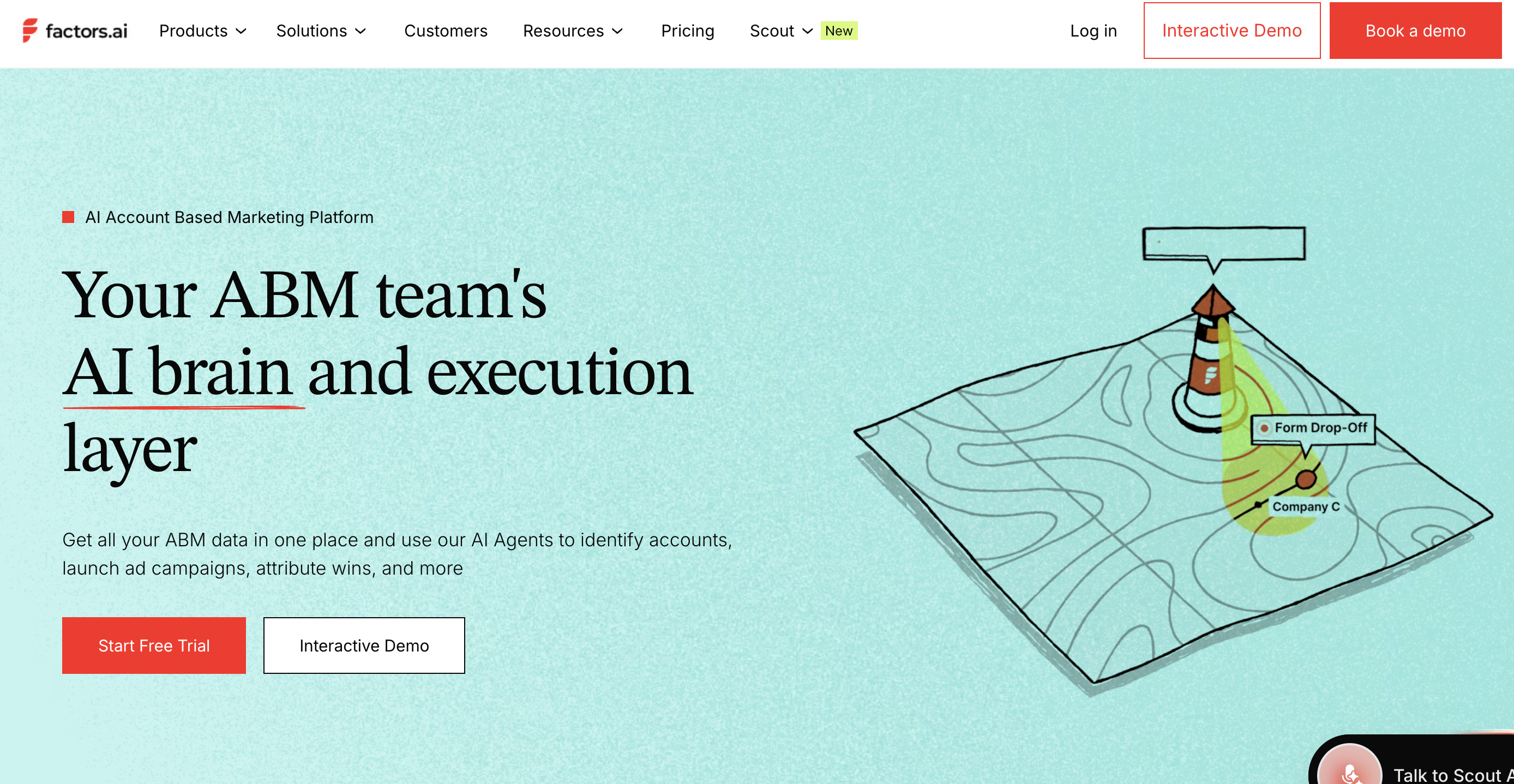
Factors.ai belongs on the shortlist when the buyer-intelligence problem starts on your website. It turns visitor identification, LinkedIn ad engagement, G2 intent, account scoring, and journey data into sales-ready account lists.
A team comparing it with Common Room is usually asking a different question: which target accounts are active right now, and which campaign or page made them worth contacting?
Features#
IP-to-company identification and waterfall enrichment.
Account enrichment, account exclusions, and account profiles.
LinkedIn intent signals, G2 intent signals, and third-party intent upload.
Buyer journey timelines and custom account scoring.
LinkedIn Adpilot, Google Adpilot, and ad attribution capabilities.
Slack and Microsoft Teams alerts on lower tiers.
Pricing#
Lite: $199 per month with website company identification, traffic analysis, and Slack or Microsoft Teams alerts.
Basic: $6,000 per year with stronger visitor-to-lead workflows, segmentation, LinkedIn ad influence, and rule-based alerts.
Growth: custom tier that expands tracked users, identified companies, seats, predictive scoring, intent, and Adpilot features.
Enterprise: custom tier for the largest monthly tracked-user and identified-company needs, with advanced support and governance.
Factors.ai vs Common Room#
Parameter | Factors.ai | Common Room | Better fit when |
Primary job | Website intent and ABM attribution | Broad buyer intelligence | Web visits drive pipeline |
Signal source | Site, ads, G2, third-party intent | Community, CRM, enrichment, product | Marketing activity needs sales routing |
Outreach | Alerts, segments, CRM workflows | Workflows and AI messages | Account prioritization is the job |
Visibility | Campaign and account visibility | Buyer/account intelligence | You need attribution clarity |
Setup weight | Needs clean site and campaign data | Needs broad GTM data | Website data is already mature |
Factors.ai is stronger for ABM teams that want website identification, attribution, and account scoring around paid and owned demand. Common Room is stronger when the buyer signal comes from communities, enrichment, product signals, and unified person/account intelligence.
Pros#
Strong fit when website behavior is the clearest buying signal.
Account scoring connects marketing activity to sales follow-up.
Ad influence reporting helps show which campaigns create account movement.
Slack and Microsoft Teams alerts make routing easier.
Public entry pricing reduces budget ambiguity.
Cons#
It does not catch community-native buying conversations as the primary signal.
Account-level intent can miss the person and post behind the buying moment.
Predictive and advanced ABM features sit higher in the plan structure.
The tool depends on clean campaign, web, and CRM hygiene.
It will not solve brand visibility across public category conversations by itself.
Summary#
Factors.ai is the better alternative when buyer intelligence begins with your website and ad programs. It is not the first pick when the signal starts in Reddit, LinkedIn, GitHub, Slack, or other public conversations.
4. Warmly#
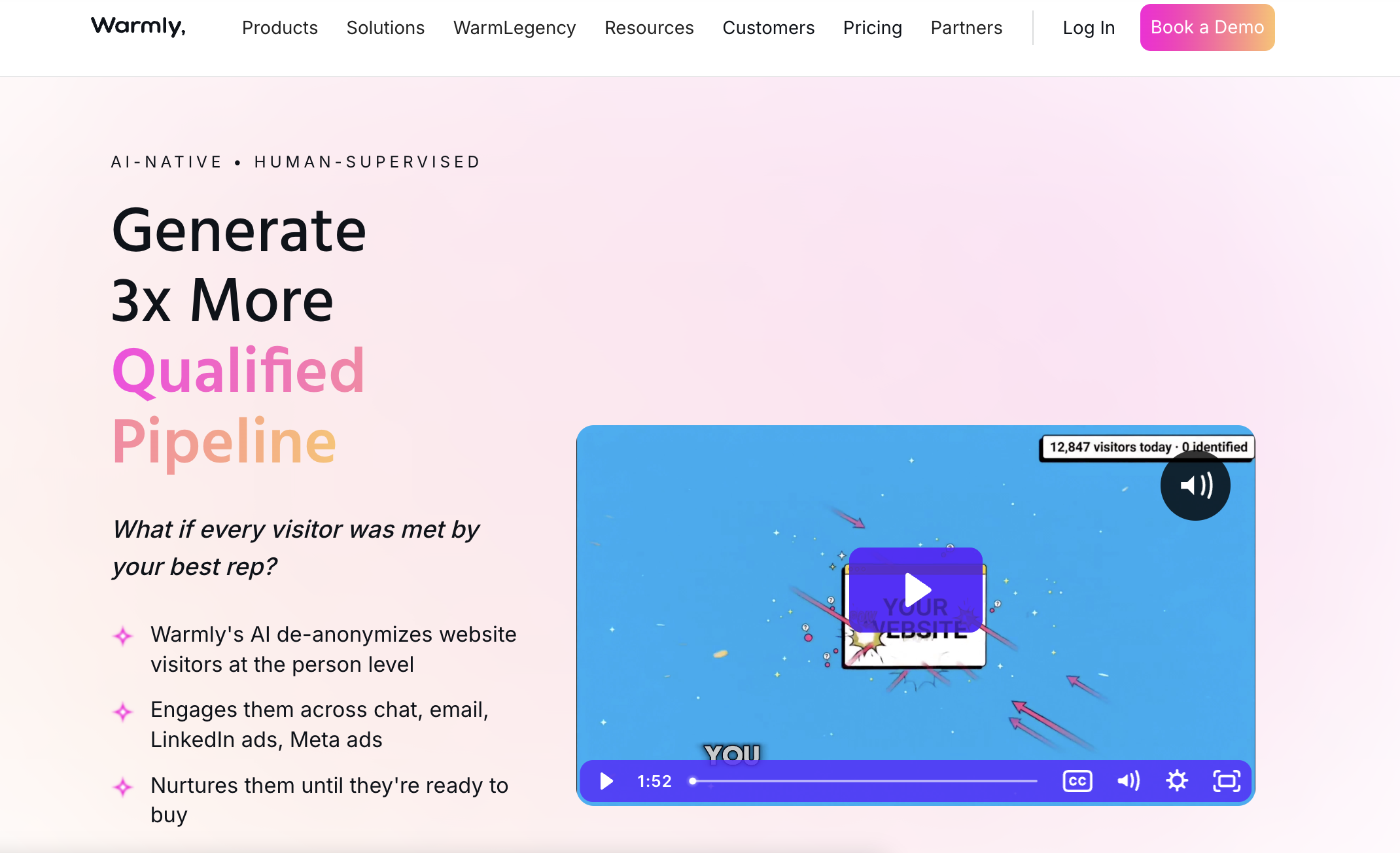
Warmly is a Common Room alternative for teams whose strongest buying signal is happening on their own website. It separates AI web deanonymization, inbound chat, AI inbound autopilot, and add-ons for GTM signals and personalized website experiences.
That makes Warmly less of a public-signal buyer-intelligence tool and more of a warm-inbound execution system.
Features#
AI web deanonymization for website visitors.
Company and contact identification with ICP filtering.
Real-time alerts, Slack alerts, lead routing, CRM sync, and sales engagement or webhook integrations.
Inbound chat with AI Studio Agent, Warm Calling, Warm Offers, chat metrics, and automated follow-up on higher tiers.
GTM Signals Package add-on for intent data, hiring activity, funding events, and competitive intelligence.
Personalized website experiences through Warm Experiences add-on.
Pricing#
AI Web-Deanonymization: $10,000 per year for 10,000 credits per month, visitor identification, and routing foundations.
Inbound Chat: $20,000 per year with everything in AI Web-Deanonymization plus AI chatbot, Warm Calling, Warm Offers, chat metrics, and automated email follow-up.
AI Inbound Autopilot: $30,000 per year with higher automation depth for inbound routing and AI-led engagement.
Add-ons: GTM Signals Package at $10,000 per year and Warm Experiences at $10,000 per year. No free plan or trial is published.
Warmly vs Common Room#
Parameter | Warmly | Common Room | Better fit when |
Primary job | Live inbound action | Broad buyer intelligence | Website visitors need fast response |
Signal source | Website traffic and chat | Community, CRM, enrichment, product | Your site has enough qualified visits |
Outreach | Chat, calls, email follow-up, routing | Workflows and AI messages | Speed-to-lead matters most |
Visibility | Web experience and GTM signals add-ons | Broader account intelligence | On-site conversion is the gap |
Setup weight | Website and routing setup | Broader GTM platform setup | Inbound revenue is mature |
Warmly is sharper for live inbound: who is on the website, what they are doing, and how quickly a seller or AI agent can engage them. Common Room is broader across enrichment, account intelligence, community/product signals, and workflows.
Pros#
Strong fit for teams with qualified website traffic and fast follow-up capacity.
Visitor identification connects anonymous demand to a specific account motion.
Chat, calls, routing, and automated follow-up make the signal actionable.
Add-ons cover broader GTM signals when the inbound use case matures.
Personalized website experiences can help convert active visitors.
Cons#
Starting cost is high for teams that only need basic signal detection.
Public conversations are not the core signal source.
Add-ons may be needed for broader buyer-intelligence coverage.
The value depends on having enough qualified website traffic.
It will not track brand visibility across public category discussions by itself.
Summary#
Warmly fits when the buying moment is already on your website. CommunityTracker fits when the buying moment happens earlier, inside a public conversation your competitors can also see.
5. Koala#
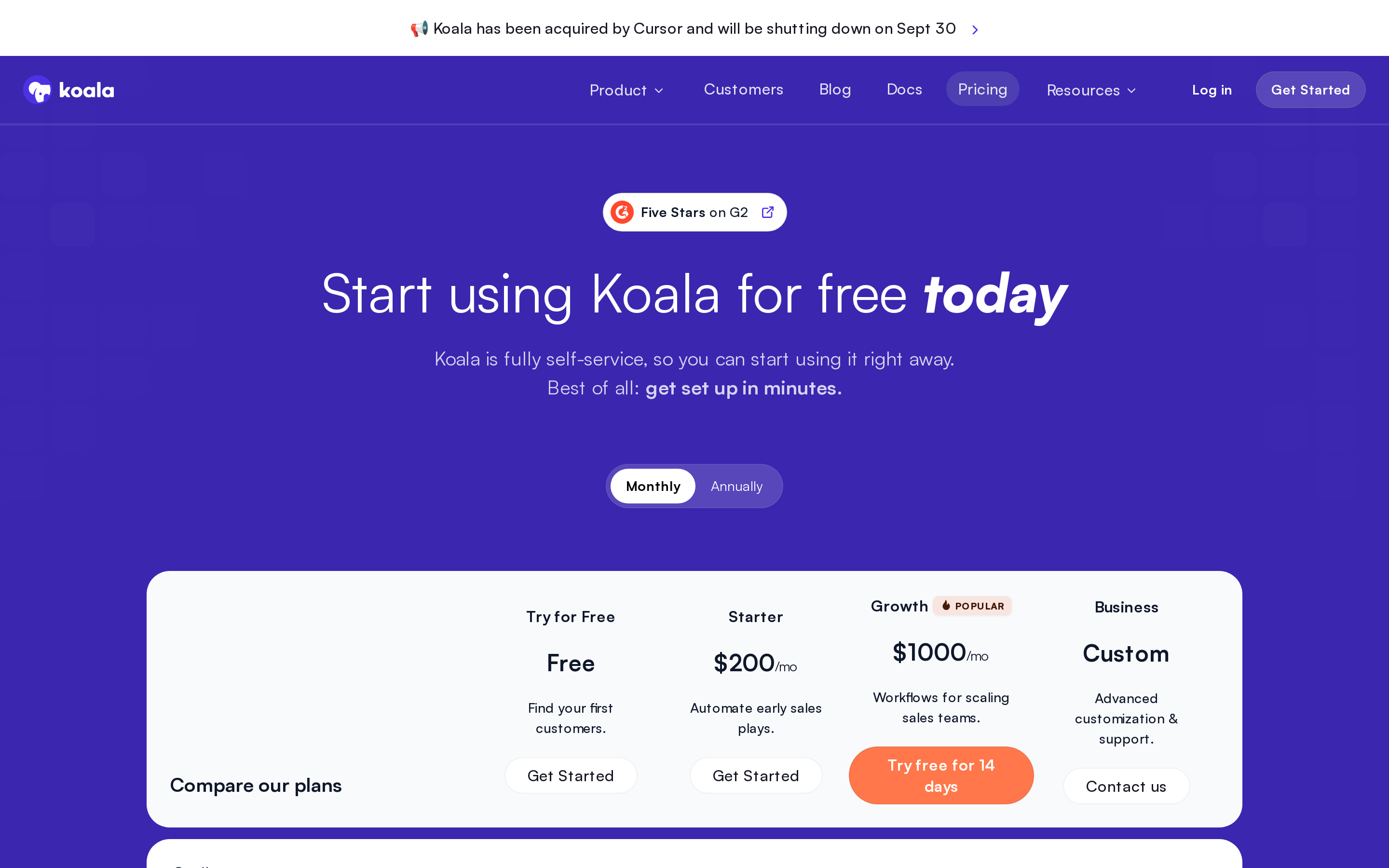
Koala is strongest when a product-led company wants to know which accounts are heating up through web visits, product usage, email clicks, ads intent, and enrichment. It brings first-party and third-party signals into one seller-friendly view and helps teams build plays around what is already converting.
There is one practical caveat. Koala's public pages now say it was acquired by Cursor and will shut down on September 30, so treat it as a useful category reference or short-term transition product, not a long-term default.
Features#
Product usage signals from onboarding status, milestones, and analytics data.
Website page views, active session time, email click-throughs, and ads intent.
Account Fit and Intent Scoring.
Content Reports that analyze intent and conversion.
Native connections with CDP, warehouse, product analytics, Salesforce, HubSpot, and Slack.
Play ROI reporting and play performance by rep.
Pricing#
Free: self-serve free plan for getting started with first-party intent.
Starter: $200 per month for early sales plays, company research, outreach strategy and drafting, CRM data, routing options, webhooks, and limited auto outbound.
Growth: $1,000 per month with workflow depth for scaling teams, CRM ownership logic, 1,000 webhook credits per month, 100 Auto Outbound prospects per month, and a 14-day trial.
Business: custom plan with advanced integrations, custom objects and fields, data warehouses, and broader automation limits.
Koala vs Common Room#
Parameter | Koala | Common Room | Better fit when |
Primary job | Product-led intent | Broad buyer intelligence | Product usage drives sales timing |
Signal source | Site and product behavior | Community, CRM, enrichment, product | First-party data is strongest |
Outreach | Plays, routing, CRM, auto outbound | Workflows and AI messages | Sales plays start from usage |
Visibility | Content and conversion visibility | Broader account context | Product funnel needs clarity |
Setup weight | Needs product and site data | Needs broad GTM data | PLG data already exists |
Koala is stronger when the buyer signal is product usage, page activity, and account surging. Common Room is stronger when the team wants community data, enrichment, RoomieAI research, buyer intelligence, and workflows in one wider system.
Pros#
Good fit when product behavior is the strongest buyer signal.
Seller-friendly account views reduce the gap between product analytics and outreach.
Slack and CRM routing help convert usage into action.
Content Reports connect marketing surfaces to account intent.
A free plan lowers the barrier to initial inspection.
Cons#
The announced shutdown makes it a poor long-term buying choice for new evaluations.
It does not focus on public buyer conversations.
Teams without meaningful product usage data will get less value.
Outreach still depends on connected sales systems and workflow setup.
Brand visibility across competitors is not the main job.
Summary#
Koala explains the product-led intent lane well, but the shutdown notice changes the recommendation. Use it as a benchmark for what product-led buyer intelligence should provide, then choose a live long-term system for production buying.
Try CommunityTracker Now and Start Monitoring Social Media Buyer Signals
6. Salesmotion#
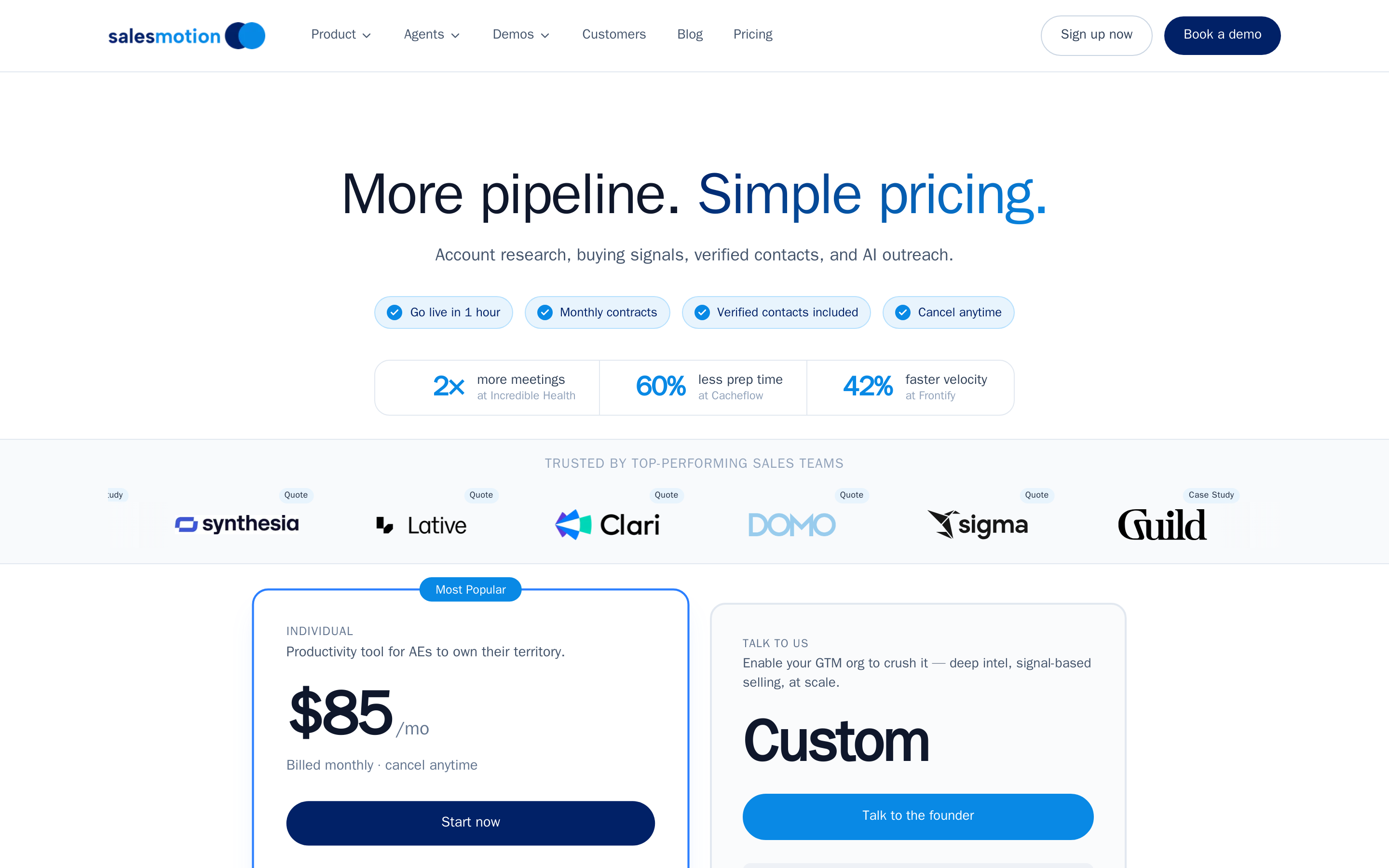
Salesmotion is built around account research, public business-event signals, verified contacts, and AI outreach. It tracks public sources such as company websites, news, press releases, earnings calls, SEC filings, job postings, leadership changes, funding rounds, and M&A activity.
That makes it a Common Room alternative when the buyer signal is not a community post or product event. It is a business event that gives a seller a reason to reach out.
Features#
Signal Agent for leadership changes, funding, hiring surges, expansion, and other public business events.
Deep Research Agent for account briefs from filings, news, earnings calls, and other public sources.
AI Messaging tied to account research and buying signals.
Verified contacts with email addresses and direct-dial phone numbers.
Salesforce and HubSpot integrations.
Lookalike Finder and territory/account monitoring.
Pricing#
Individual: $85 per month for one user, public account signals, research workflows, and signal-led outreach.
Team: custom pricing with unlimited users, monitored-account scaling, shared account workflows, and team rollout support.
Enterprise: custom pricing for larger account lists, enterprise controls, integrations, and support. No free trial is published.
Salesmotion vs Common Room#
Parameter | Salesmotion | Common Room | Better fit when |
Primary job | Public account events | Broad buyer intelligence | Company change creates outreach |
Signal source | Funding, hiring, filings, news | Community, CRM, enrichment, product | Account research drives timing |
Outreach | AI messages and verified contacts | Workflows and AI messages | Sellers need reasons to call |
Visibility | Account change visibility | Broader account and contact context | Territory monitoring matters |
Setup weight | Account-list focused | Platform-wide | Named accounts are the motion |
Salesmotion wins when account teams need a reason to call: a hiring surge, leadership change, funding event, filing, or public company update. Common Room wins when the data layer centers on community, enrichment, CRM, product, and account intelligence in one place.
Pros#
Strong for account teams that sell from public company change.
Verified contacts and direct-dial numbers help reduce research friction.
AI-drafted messages connect the event to the outreach angle.
Pricing starts low for individual use compared with broad platforms.
Monitored-account pricing can fit teams that do not want seat-based expansion.
Cons#
It does not monitor CT's core public conversation surfaces as its primary job.
Team pricing requires a sales conversation.
Public business events can be too early or too late for buyer intent.
Product usage and website behavior are outside the center of gravity.
Brand visibility against competitors is not the main product outcome.
Summary#
Salesmotion is the better alternative when account change creates the opening. CommunityTracker is stronger when a buyer is already discussing the problem, competitor, or category in public.
7. Apollo#
Apollo is not a pure Common Room substitute, but it belongs on the list because many teams comparing buyer-intelligence tools also need contact data and execution. Apollo combines a B2B database, lead filters, enrichment, sequences, dialer features, inbound routing, AI research, workflows, and CRM integrations.
For smaller teams, that bundle can matter more than a specialized signal layer.
Features#
B2B contact and company database with advanced prospect filters.
Buyer-intent topics on paid plans.
Email sequences, dialer features, mailboxes, and workflow automation.
CRM integrations and data enrichment.
Inbound lead routing and website visitor identification use cases.
AI research and automation on higher tiers.
Pricing#
Free: $0 with 900 credits per year, 2 sequences, and basic filters.
Basic: $49 per user per month with 30,000 credits per year, unlimited sequences, CRM integrations, and 6 intent topics.
Professional: $79 per user per month with 48,000 credits per year, US dialer, 5 mailboxes, automated workflows, and AI research.
Organization: $119 per user per month with a 3-user minimum, 72,000 credits per year, international dialer, 15 mailboxes, SSO, and advanced security.
Apollo vs Common Room#
Parameter | Apollo | Common Room | Better fit when |
Primary job | Data plus outbound | Broad buyer intelligence | Contact execution matters most |
Signal source | Database, intent topics, inbound | Community, CRM, enrichment, product | You need leads and sequencing |
Outreach | Email, dialer, sequences, workflows | Workflows and AI messages | Outbound lives in the same tool |
Visibility | Pipeline and data visibility | Account and buyer context | Database coverage is the gap |
Setup weight | Sales platform setup | Buyer-intelligence platform | Budget favors all-in-one sales tools |
Apollo is stronger when the main job is finding contacts, enriching them, and running outbound. Common Room is stronger when the main job is unified buyer intelligence across community, enrichment, product, and account context.
Pros#
Clear public pricing and a free plan make evaluation easy.
Contact data and outbound execution sit in the same workflow.
Buyer-intent topics can support basic prioritization.
Dialer, sequences, mailboxes, and workflows reduce tool switching.
Lower starting cost than enterprise buyer-intelligence platforms.
Cons#
Public conversation triggers are not the main signal source.
Intent depth depends on plan, credits, topics, and setup.
Data accuracy needs ongoing governance as usage grows.
Per-user pricing rises as more sellers need access.
Brand visibility and competitor share of voice are outside the core product.
Summary#
Apollo is the practical pick when contact data and outbound execution matter more than specialized buyer intelligence. CommunityTracker fits better when the trigger starts in a public buyer conversation and needs action across comments, DMs, email, or phone.
8. Clay#
Clay is the alternative for teams with technical GTM capacity. It centralizes enrichments, intent signals, CRM data, audiences, web intent, ads audiences, APIs, webhooks, native sequencing, and workflow building. Instead of giving you one opinionated signal workflow, Clay gives you the system to build many.
That is useful when the team knows exactly which signals to combine.
Features#
Data marketplace with 200+ providers.
Waterfall enrichment and AI research through Claygent-style research workflows.
Signals and intent tracking, including job changes and web intent.
Audiences that combine first-party and third-party sources.
CRM auto-sync, HTTP API integrations, webhook automation, and ads audiences on higher plans.
Native sequencer and workflow building with natural language.
Pricing#
Free: $0 with 500 actions per month and 100 data credits per month.
Launch: $185 per month with more actions and credits for early workflow building.
Growth: $495 per month with higher action and data-credit limits, CRM auto-sync, HTTP API integrations, webhook automation, web intent signal tracking, ads audiences, and priority support.
Enterprise: custom pricing with larger data-credit and action volumes, SSO, RBAC, data warehouse sync, and dedicated support.
Clay vs Common Room#
Parameter | Clay | Common Room | Better fit when |
Primary job | Build custom workflows | Packaged buyer intelligence | You want control over logic |
Signal source | Many providers and APIs | Common Room's platform sources | Data mix is custom |
Outreach | Sequencer, webhooks, CRM, API | Workflows and AI messages | Workflow ownership matters |
Visibility | Built from chosen data | Built-in account context | You can design the model |
Setup weight | Higher build effort | Packaged setup | Flexibility beats speed |
Clay is a build system. Common Room is an opinionated AI GTM platform. Clay fits teams that want to compose their own signal, enrichment, and outreach workflows across data providers.
Pros#
Strongest option here for custom buyer-intelligence workflow building.
Broad provider access gives many enrichment paths.
Webhooks, APIs, and CRM sync support complex routing.
Native sequencing can close the gap between signal and outreach.
Flexible credit and action model supports experimentation.
Cons#
It requires more operational skill than packaged buyer-intelligence tools.
Costs can rise with data credits, actions, and scale.
The team has to define signal logic and maintain workflows.
Time-to-value depends on the builder, not only the product.
It can be too much system for teams that only need social triggers and warm outreach.
Summary#
Clay is the right alternative when you want to design the machine. CommunityTracker, Trigify, Factors.ai, Warmly, and Salesmotion are better when you want a focused buyer-intelligence product with less build work.
9. UserGems#
UserGems is the best Common Room alternative when the buyer signal is relationship movement: past champions changing jobs, contacts moving into new buying committees, or accounts showing signals that deserve coordinated outbound and ABM.
It is not primarily a public conversation tool. It is a signal and orchestration layer for companies that already have customer and contact history worth mining.
Features#
Job-change and relationship signals for past champions and buyers.
Gem-E AI agent for outbound and ABM workflows.
Account scoring and buyer capture from multiple signals.
CRM, marketing automation, sales engagement, and ad platform integrations.
Contact-level signals, custom scoring, and coordinated sales/marketing action.
Security posture that includes GDPR, CCPA, and SOC 2 messaging.
Pricing#
Core: quote-led, with reported 2026 market data around $2,750 per month for champion tracking and relationship-led outbound.
Advanced: quote-led, with reported market data around $5,750 per month for broader signal orchestration and account coverage.
Elite: quote-led, with reported market data around $10,000 per month for larger teams and deeper enterprise needs.
Implementation fees are commonly reported between $3,000 and $10,000. No free plan or trial is published.
UserGems vs Common Room#
Parameter | UserGems | Common Room | Better fit when |
Primary job | Champion movement | Broad buyer intelligence | Past buyers create pipeline |
Signal source | Job changes and relationships | Community, CRM, enrichment, product | CRM history is strong |
Outreach | ABM and outbound orchestration | Workflows and AI messages | Warm relationship context matters |
Visibility | Relationship visibility | Account and buyer context | Known contacts drive the motion |
Setup weight | CRM-history dependent | Platform-wide | Relationship graph is clean |
UserGems is narrower and relationship-led. Common Room is broader across buyer intelligence, enrichment, AI research, Prospector credits, custom signals, community/product data, and workflows.
Pros#
Strong fit when past champions and customers create warm outbound.
Contact movement can be easier to act on than vague account intent.
CRM and sales engagement integrations support coordinated follow-up.
Account scoring helps prioritize relationship-led plays.
ABM coordination gives sales and marketing a shared signal source.
Cons#
Quote-led pricing and implementation fees make it a larger commitment.
The system depends on clean CRM history and enough customer/contact volume.
It does not solve public buyer-signal discovery.
Smaller teams may not have enough champions to justify the workflow.
Brand visibility against competitors is not the product's main outcome.
Summary#
UserGems is the pick when your best buyers already know you and have moved somewhere new. It is not the answer when your team needs to catch public demand before it enters your CRM.
Detailed comparison of Common Room alternatives#
Alternative | Buyer signal it catches | Outreach path | Visibility angle | Beats Common Room when |
CommunityTracker | Public social and community triggers | Email, phone, comments, DMs, warm automation | Brand visibility and Share of Voice | You need focused signal-to-action execution |
Trigify | Person-level social posts | CRM, Slack, Outreach, API | Source-post proof | Individual posts drive outreach |
Factors.ai | Website, ads, G2, account intent | Alerts, CRM, segments | Campaign and account visibility | Web account behavior drives pipeline |
Warmly | Live website visitors | Chat, calls, routing, email follow-up | Website experience | Speed-to-lead is the main gap |
Koala | Product and site behavior | Plays, CRM, Slack, auto outbound | Content and product conversion | Product usage drives timing |
Salesmotion | Public account events | Verified contacts, AI messages | Account change tracking | Company events create reasons to call |
Apollo | Contact data and intent filters | Email, dialer, sequences | Sales database visibility | Data plus execution matters most |
Clay | Custom data and intent workflows | Sequencer, APIs, webhooks, CRM | User-built visibility | You want to design the system |
UserGems | Champion job changes | ABM and outbound workflows | Relationship movement | Past buyers create warm pipeline |
Final decision guide for Common Room alternatives#
Use this shortlist by buyer-intelligence job:
CommunityTracker: Choose it when you need social triggers, warm outreach, and competitor visibility across 10+ public platforms.
Trigify: Pick it when the exact person behind a social post matters most.
Factors.ai: Use it when website identification, ABM scoring, and attribution drive sales timing.
Warmly: Evaluate it when live website visitors need chat, calls, routing, or instant follow-up.
Koala: Treat it as a product-led intent reference because the shutdown notice changes the long-term buying case.
Salesmotion: Use it when public business events give sellers a reason to reach out.
Apollo: Pick it when contact data, sequencing, dialer, and basic intent belong in one sales platform.
Clay: Use it when you want to build the buyer-intelligence workflow yourself.
UserGems: Evaluate it when past champions and job changes create the warmest pipeline.
The mistake is treating all of these as one category. They do different jobs. A public post, a product signal, a pricing-page visit, a funding event, and a champion job change should not route through the same playbook unless the team has designed that system deliberately.
We wrote a practical post on tracking competitors across communities if competitive signal is the main reason you are leaving a broad platform.
Use CommunityTracker to turn buyer intelligence into outreach and visibility#
Common Room deserves credit for building a serious buyer-intelligence platform. Factors.ai, Warmly, Koala, Salesmotion, Apollo, Clay, Trigify, and UserGems each solve a real problem in their own lane.
The question is where your buyers show intent first and what action follows.
When the signal starts on your website, Warmly or Factors.ai will be easier to justify. Product-led companies should use a product-intent tool, though Koala's shutdown notice changes the vendor decision. Technical teams may get more control from Clay. Champion-led sales should evaluate UserGems. Sellers who need data and sequences together may start with Apollo.
CommunityTracker fits when the signal starts in the conversation: a Reddit thread asking for alternatives, a LinkedIn post complaining about competitor pricing, a GitHub issue describing the gap your product closes, a Stack Overflow question around a manual workaround, a Hacker News category discussion, or a Product Hunt launch in your space.
That is where CommunityTracker helps your team catch it before your competitors do.
Set triggers for competitors, categories, keywords, and ICP pain points.
Track posts in real time across 10+ public platforms.
Reach out through email, phone, comments, and DMs, with warm outreach automation.
Connect action to Salesforge, Smartlead, Instantly, and more.
Track brand visibility against competitors and create action items to increase it.
Use CommunityTracker when the workflow is buyer intelligence for public conversations, warm outreach, and brand visibility. If your team only needs website chat, product usage scoring, or a custom enrichment system, alternatives above may be the cleaner buy.
Try CommunityTracker Now and Start Monitoring Social Media Buyer Signals