Most teams approach community lead generation backward.
They start with the pitch: a product link, a calendar ask, a discount, a reply template. Then they look for places to drop it. That is why so many community replies feel like sales activity wearing a community costume.
If you want to generate leads from communities, start with the signal instead.
Look for the person already describing a pain, comparing tools, asking for recommendations, complaining about a workflow, or exposing a buying trigger. Then decide the next move based on the thread.
My rule is simple: do not just show the post. Show the next move.
This matters because buyers are tired of irrelevant outreach.
Gartner's 2025 sales survey found that 61% of B2B buyers prefer a rep-free buying experience and 73% actively avoid suppliers that send irrelevant outreach. Communities make that problem more visible.
On Reddit, HN, Slack groups, LinkedIn threads, Product Hunt, Stack Overflow, Indie Hackers, GitHub, and Dev.to, the audience can see whether you are helping or hunting.
The opportunity is still real. Reddit reported 121.4 million daily active uniques in Q4 2025, and its Q3 2025 release described Reddit as home to 100,000+ active communities. But community leads work because of context, not scale.
Community posts tell you what the person cares about before you respond. That is the advantage. Use it.
A Community Lead Is a Problem With a Next Step#
A community lead is not any person who mentions your category.
It is a conversation with enough context to justify action: a pain, a buying question, a competitor comparison, an implementation blocker, a hiring trigger, a migration complaint, or a request for peer advice.
A weak signal sounds broad: "Anyone using AI tools for marketing?" A stronger signal includes the problem, context, and next step:
"We are replacing Brandwatch because it misses Reddit and Slack. What should we evaluate?"
"Our sales team wants alerts when prospects complain about a competitor. Has anyone automated this?"
"We need to track GitHub issues, HN posts, and Reddit threads before they become support tickets."
The second group has a problem, context, and a likely next step. That is where GTM teams should spend time.
This is the first judgment call I would make before anyone replies: is there a real operating problem here, or are we just reacting to a keyword match?
If it is only a keyword match, save it for market research. If it has pain, timing, fit, and openness, it becomes one of your community signals.
Salesy Replies Fail Because They Ignore the Room#
Communities are not lead databases with comment boxes.
Each platform has its own norms, moderation style, and tolerance for commercial activity.
Reddit's spam policy says repeated or unsolicited actions that negatively affect users or communities are not allowed, including mass-posting repetitive content for exposure or financial gain.
Stack Overflow tells users to avoid overt self-promotion and disclose affiliation when mentioning their product. Hacker News asks for comments to be more thoughtful and substantive as topics get more divisive, and says HN is for conversation between humans.
Those rules point to the same operating principle: the community decides whether your contribution belongs. A sales-rep reply usually fails because it ignores one of four things.
Answer the Question Before Naming the Product#
Someone asks, "How are you handling competitor mention tracking across Reddit and Slack?"
The weak reply says, "We built a platform for this. Book a demo." That does not answer the question.
A better reply starts with decision criteria:
"For Reddit and Slack, keyword monitoring from intent monitoring. Keyword alerts are useful for brand mentions, but they miss posts where the buyer describes the pain without naming your category. If your team needs sales follow-up, make sure the tool can classify intent and route the post to the right owner. Disclosure: I work on CommunityTracker, which covers this workflow across Reddit, Slack, LinkedIn, X, GitHub, and a few other communities. Happy to share the checklist if useful."
The product appears after the useful frame.
Do Not Treat Every Mention as a Lead#
A complaint is not always a lead. A joke is not a lead. A student asking for homework help is not a lead. A developer asking for a free workaround is not automatically a buyer.
Good community lead generation filters for commercial relevance before outreach: pain severity, role fit, company fit, recency, intent language, and whether the post invites vendor input.
Disclose Affiliation Before Trust Breaks#
Hidden affiliation is fragile. When readers discover it, the response feels manipulative even if the advice was decent.
Stack Overflow's rule is a useful baseline: if you mention your product, disclose your affiliation in the post. That does not mean every response needs a disclaimer at the top. It means readers should never have to guess whether you benefit from the recommendation.
Earn the DM Instead of Forcing It#
A public question deserves a public answer unless the person asks for private help or shares sensitive context.
Moving straight to DM makes the exchange feel like capture. Public value earns permission. Private follow-up should be specific: "I can send the scoring template" beats "DM me."
Turn Real Social Signals Into Blog Ideas
Stop guessing what to write next. CommunityTracker turns real conversations, pain points, and buyer signals into SEO-ready blog briefs with titles, hooks, outlines, target keywords, and priority scores.
Use This Workflow to Generate Leads From Communities#
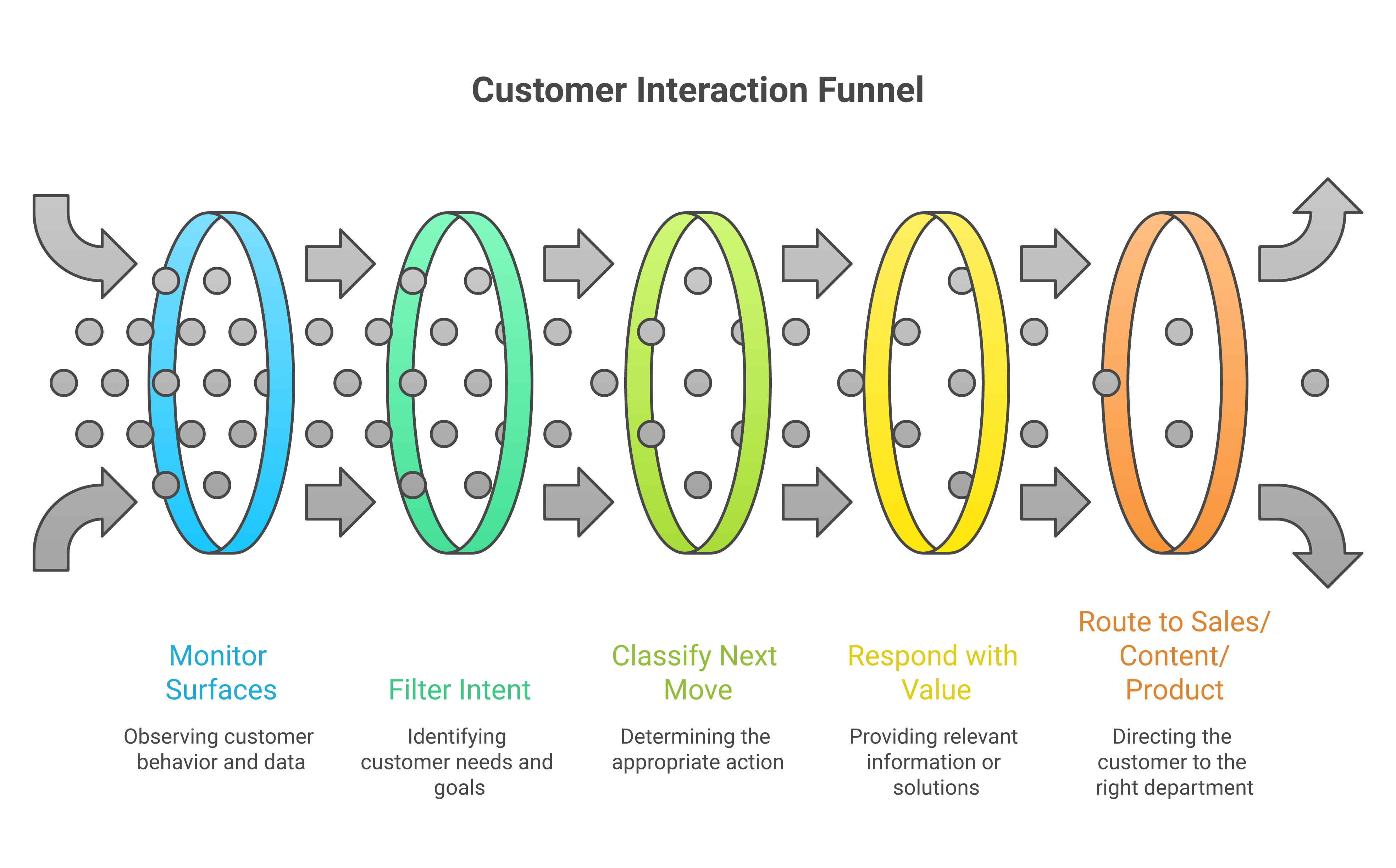
To generate leads from communities without sounding like a sales rep, build the workflow in this order:
Monitor the right surfaces.
Filter for intent.
Classify the next move.
Respond with useful context.
Route the signal into GTM execution.
1. Monitor the Places Where Demand Shows Up Early#
Do not monitor only your brand name.
Most high-intent community conversations happen before your brand is mentioned. People ask about symptoms, alternatives, integrations, pricing, implementation problems, and peer recommendations.
For a B2B SaaS company, the monitoring map should include:
Problem language: "how do you track," "what are you using for," "any tool for," "manual process," "spreadsheet broke," "alerts are noisy"
Category language: "social listening," "community intelligence," "intent signals," "Reddit monitoring," "share of voice"
Competitor language: alternatives, pricing complaints, migration questions, missing features
Trigger language: "we are hiring," "we just migrated," "our team is evaluating," "budget approved," "need before launch"
Platform-specific surfaces: subreddits, scrapes LinkedIn posts and comments, Slack groups, X threads, HN discussions, GitHub issues, Product Hunt comments, Stack Overflow questions, Indie Hackers threads, Dev.to comments
This is where CommunityTracker fits naturally. It monitors conversations across Reddit, Slack, LinkedIn, X, GitHub, Product Hunt, Stack Overflow, Indie Hackers, Dev.to, HN, and other communities, then scores intent and routes signals into action workflows.

If your team is still checking Reddit, Slack, LinkedIn, GitHub, and HN manually, use CommunityTracker to collect those conversations in one signal inbox before deciding who should reply. see how CommunityTracker monitors buyer signals
2. Score Intent Before Anyone Touches the Thread#
A useful intent filter prevents two bad outcomes: wasting time on low-fit chatter and replying where you do not belong.
Use a simple scoring model:
Pain: Is the person describing a real workflow problem?
Timing: Is the problem current, recurring, or urgent?
Fit: Does the company, role, or use case match your ICP?
Openness: Did they ask for tools, examples, templates, feedback, or recommendations?
Context: Can you add something specific without forcing a pitch?
Risk: Does the community rule, topic, or thread tone make vendor participation unwelcome?
A post with high pain, high timing, strong fit, and direct openness deserves action. A post with weak pain and no invitation deserves monitoring or a content idea.
I would rather miss a low-fit mention than train a team to chase every alert. Volume creates noise. Intent creates action.
3. Route the Signal to the Right Owner#
Not every signal should go to sales.
Some signals belong with content, product, support, customer success, or founder-led response. Classify the next move so the team does not default to "reply with a pitch."
Use this routing logic:
Direct buying question: public answer, then sales follow-up only if the person asks for help or engages.
Competitor pain: helpful comparison frame, then route to sales with the exact complaint and context.
Category confusion: content idea or educational reply.
Technical blocker: support-style answer, docs link if relevant, product team note if it exposes a gap.
Launch feedback: founder or product marketer response, not SDR outreach.
Negative brand mention: customer success or support owner, not demand gen.
Product Hunt is a good example of community-specific next moves. Its launch guide says comments are where the community shares feedback, and recommends a first comment that explains who the product is for, asks for feedback, and avoids asking for upvotes.
Product Hunt also notes that marketing-speak does not usually resonate well. That is not a sales instruction. It is a participation instruction.
4. Add the Missing Context#
A good community response makes the thread better whether or not the person becomes a lead.
Use this structure:
Answer the question directly.
Add the decision frame or tradeoff.
Give one concrete next step.
Disclose affiliation if you mention your product.
Offer a resource only after the value is clear.
Example:
"If you are trying to catch buying intent, I would not start with brand mentions. Start with pain phrases and competitor phrases. A lot of useful posts never name the category. The next step is to tag signals by pain, urgency, and fit before anyone replies. Disclosure: I work on CommunityTracker, which does that classification across Reddit, Slack, LinkedIn, X, GitHub, HN, and more. If helpful, I can share the scoring categories."
That response gives the reader a better frame, names a concrete next step, and makes the product relevant without making the thread about the product.
Replace Pitch Language With Operator Language#
The fastest way to sound like a sales rep is to force a meeting before earning attention. Use a substitution table instead. The goal is a different job for the reply.
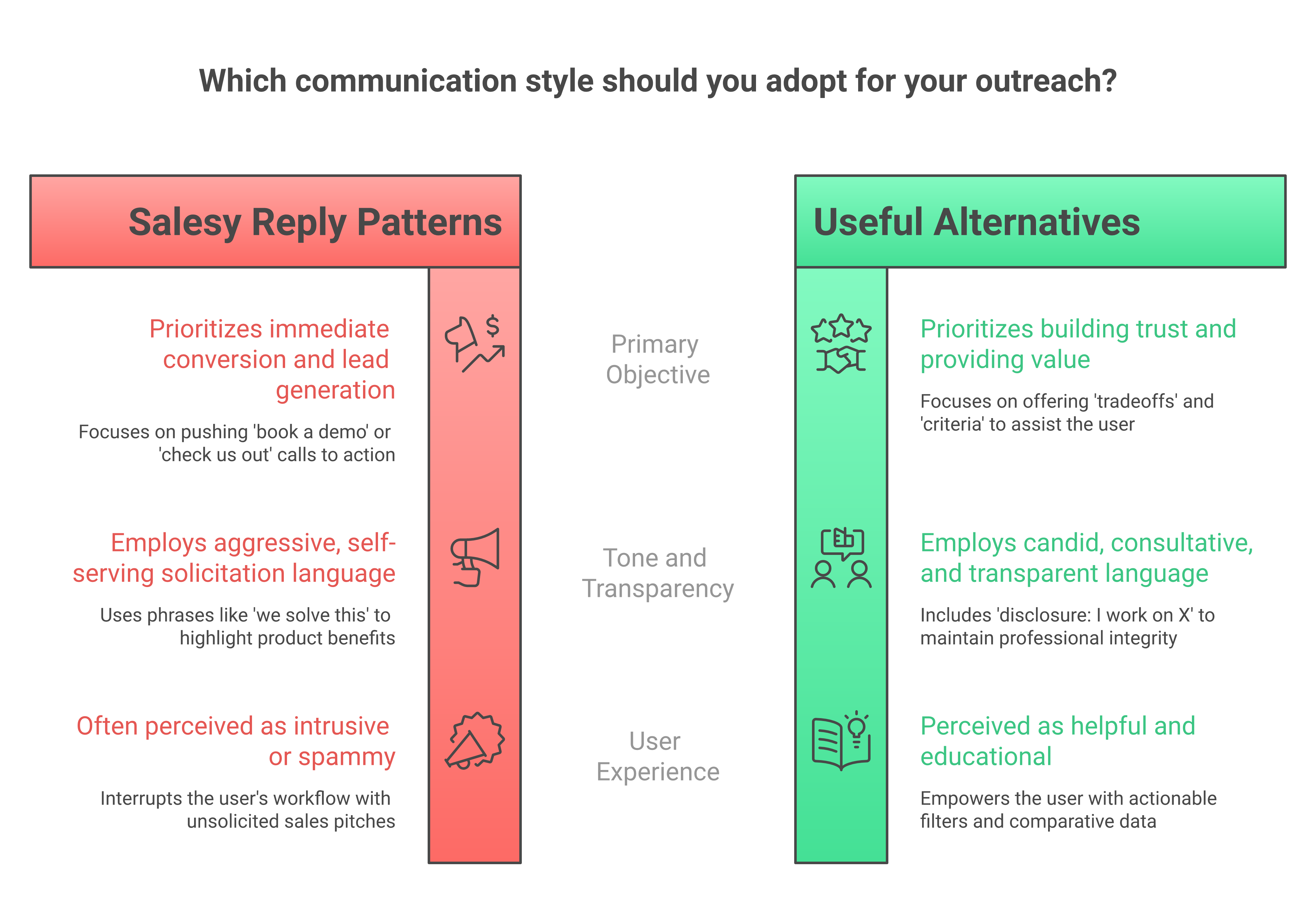
Salesy pattern | Better community move | Why it works |
“Book a demo.” | “Here is the decision checklist I would use. If useful, I can share how we map this in our product.” | The reader gets useful context before the pitch. |
“We solve this.” | “The hard part is separating noisy mentions from real buying intent. Filter by pain language, role fit, and whether the thread welcomes vendor replies.” | It solves the actual operational problem instead of forcing a product mention. |
“DM me.” | “I can share the template if useful. The short version: track pain phrase, urgency, role, community rule, and next action.” | The public thread still gets value even if nobody messages you. |
“Our product is better.” | “If you only need brand monitoring, a standard social listening tool may be enough. If you want pipeline from community signals, focus on intent scoring, freshness, coverage, and routing.” | Honest fit guidance builds more trust than attacking competitors. |
“Check us out.” | “The rule I use: reply publicly when you can add context, and route internally when the signal belongs to sales, product, or content.” | It sounds thoughtful and keeps the discussion useful. |
Use the table as a writing filter. If the reply cannot explain the tradeoff, next step, or fit, it is not ready to post.
Match the Reply to the Platform#
The same message does not work everywhere.
Reddit: Be Useful Before You Are Visible#
Reddit is strong for pain discovery, peer recommendations, alternatives searches, and unfiltered complaints. It is also quick to reject obvious promotion.
Use Reddit for problem research, competitor complaint discovery, recommendation threads, category education, and founder participation in niche subreddits. Avoid repeated answers, constant product links, rule-blind replies, and forced vendor comparisons.
Reddit's own spam guidance says to post authentic content into communities where you have a personal interest and to be thoughtful if your contributions primarily link to a business you benefit from. Treat that as the floor.
LinkedIn: Lead With a Point of View#
LinkedIn is better for visible expertise, founder commentary, and warm paths through shared context. Use it to add a sharp point of view, turn repeated buyer questions into public content, and follow up only when the context is real. Avoid auto-commenting or pitching everyone who engages.
Hacker News: Bring Substance or Stay Out#
HN rewards substance and punishes obvious agenda-setting. Use it for technical nuance, founder lessons, honest postmortems, and developer-facing category discussions. Avoid generic thought leadership, growth hacks, generated replies, and product defense that ignores the argument.
HN's guidelines ask commenters to respond to the strongest plausible interpretation of what someone says and avoid generic tangents. That is also good lead-gen advice.
Stack Overflow and GitHub: Help the Builder First#
Developer communities are not demand-gen playgrounds.
Use them for real implementation help, docs gaps, integration blockers, and product feedback from technical users. Avoid salesy support answers, undisclosed product recommendations, and answers your product does not actually solve.
If a GitHub issue reveals a workflow pain your product solves, the first move is often product or content follow-up, not sales.
Slack and Private Communities: Protect the Trust You Borrow#
Slack groups carry higher trust because access is limited. That also means bad outreach does more damage.
Use Slack for peer help, warm introductions, founder-level answers, and permission-based resource sharing. Avoid scraping members into sequences, DMing without permission, or treating a private community as an owned audience.
In private communities, the best lead-generation motion is usually: answer publicly, offer a useful resource, then follow up only when invited.
Turn Every Qualified Signal Into a GTM Action#
The missed opportunity in community lead gen is not only bad replies. It is an unrouted signal.
A demand gen lead sees a Reddit thread. A founder notices a LinkedIn comment. A product marketer screenshots a competitor complaint. None of it reaches the same system, so the company learns slowly.
A signal-to-action workflow fixes that.
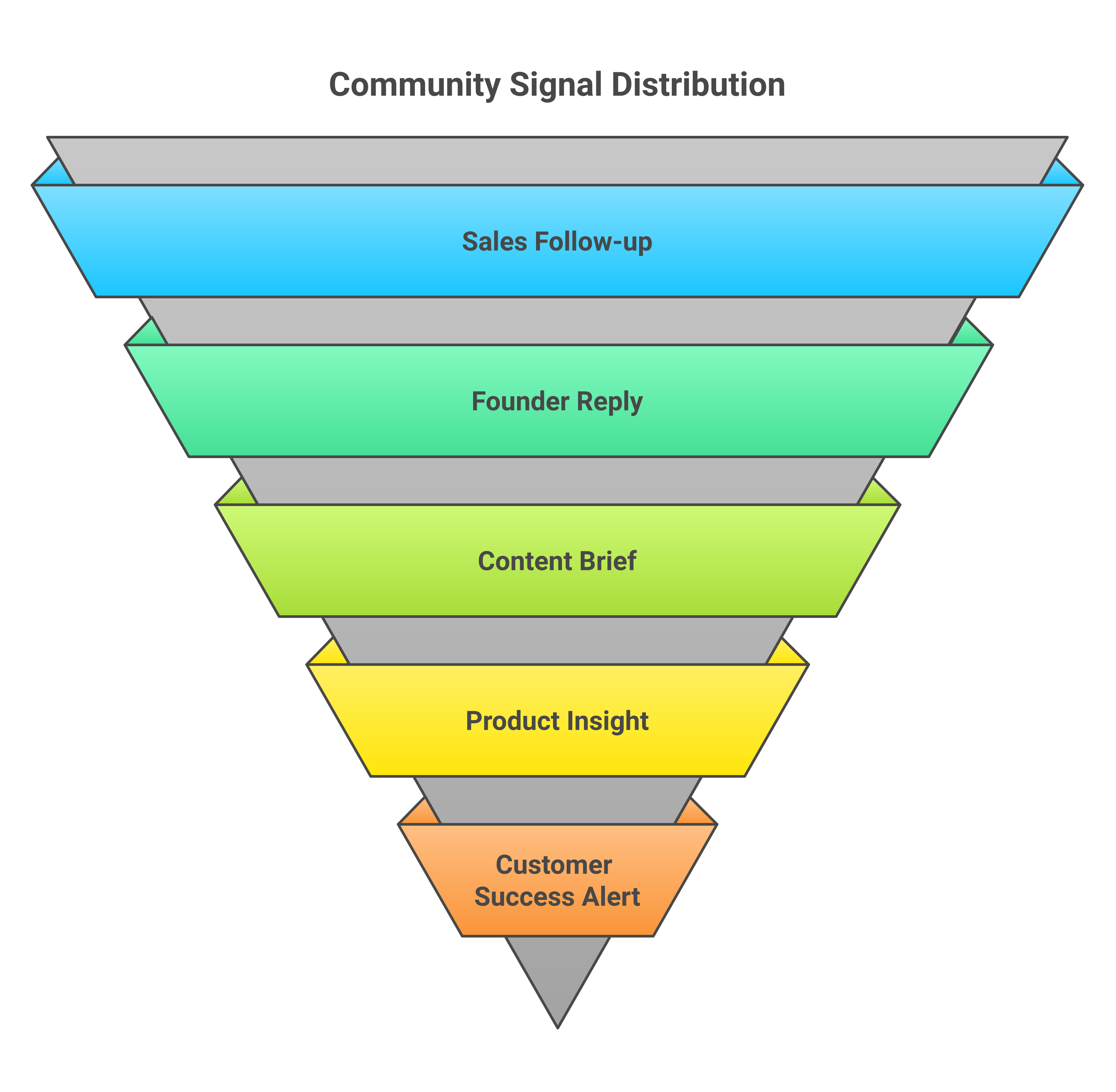
For each qualified signal, capture the operating details:
Source platform and thread
Original wording of the pain
Persona, segment, and intent score
Recommended next move, owner, deadline, and outcome
This turns community work from random browsing into an operating system.
CommunityTracker is built for that layer: monitor the conversation, score intent and context, surface the key signal, then route it to content, social, outreach, or workflow-ready tasks. The point is action while the conversation still matters.
CTA: Turn your next community mention review into a routed workflow. In CommunityTracker, tag intent, assign the owner, and send the next action to sales, content, product, or customer success. build a signal-to-action workflow in CommunityTracker
Run a 30-Minute Daily Community Lead Workflow#
You do not need a full-time community prospecting team to start.
Run this workflow once per day:
0-5: Review new high-intent signals by recency, platform, and intent score.
5-10: Check community rules, recent moderator behavior, and thread tone.
10-20: Write a thread-specific response: direct answer, tradeoff, next step, disclosure if needed, resource offer only when useful.
20-25: Route the signal to sales, content, product, support, or a founder.
25-30: Log whether the person replied, asked for a resource, booked time, became an opportunity, or exposed a new content theme.
Do not measure only meetings booked. Measure signal quality, response quality, and routed actions.
Measure Trust, Not Just Pipeline#
Community lead generation fails when teams measure only volume.
If reps are rewarded for replies sent, they will send more replies. If marketers are rewarded for mentions captured, they will capture more noise. If founders only see anecdotal wins, the workflow never becomes repeatable.
Track metrics that separate useful participation from sales spam:
Qualified signals found per week
Percentage with a clear next move
Positive replies vs negative replies by platform
Signals routed to sales, content, product, and support
Opportunities sourced or influenced by community signal
Competitor mentions and content briefs by pain theme
Removed comments, downvotes, moderator warnings, or negative replies
That last category matters. Community backlash is data. If a response gets removed, ignored, or challenged as promotional, the message or the context was wrong.
Avoid the Four Mistakes That Make Teams Sound Salesy#
Mistake 1: Automating Replies Before Understanding Intent#
Automation is useful for monitoring, filtering, scoring, routing, and reminders. It is risky for public replies.
Many communities are already sensitive to generated comments. HN explicitly says not to post generated comments or AI-edited comments. Use automation to find and prepare. Keep final judgment human.
Mistake 2: Treating Competitors as Enemies in Public#
Competitor threads are high-intent, but they are not an invitation to attack.
A better move is to explain fit:
"If you only need brand mention alerts, the lighter tool may be enough. If you need to route Reddit, Slack, LinkedIn, and GitHub pain signals into sales and content workflows, evaluate broader community coverage and intent scoring."
That answer helps the buyer decide. It also keeps your brand out of the mud.
Mistake 3: Confusing Speed With Pressure#
Speed matters because community conversations decay. A useful answer in the first hour beats a polished pitch three days later.
Pressure is different. Pressure asks for the meeting before the reader has trust. Move fast on context, not on capture.
Mistake 4: Leaving Signals Outside the GTM System#
If community signals stay in screenshots and bookmarks, they do not compound.
The real value comes when each signal improves your routing, messaging, content, product roadmap, and sales context.
Use This Playbook This Week#
If you want to generate leads from communities this week, start here:
Pick three communities where your ICP already asks for advice.
Build a query list around pain, category, competitor, and trigger language.
Review only posts from the last seven days.
Score each signal for pain, timing, fit, openness, context, and risk.
Reply only when you can improve the thread.
Disclose affiliation when your product enters the answer.
Route each qualified signal to one owner with one next move.
Review outcomes every Friday.
Do this for two weeks before scaling. You will learn which platforms produce buying context, which keywords create noise, which replies earn trust, and which signals belong somewhere other than sales.
When the manual workflow starts producing real signals, move it into CommunityTracker so the team can monitor more communities, classify intent, and route every qualified conversation to the right GTM owner. start routing community signals with CommunityTracker
The end state is not a bigger pile of community mentions.
It is a GTM workflow that finds high-intent conversations, understands why they matter, and sends the next action to the right team.
That is how community lead generation stops sounding like a sales rep. It starts acting like a useful participant.