Mention makes the most sense when social listening is shared across a team rather than owned by one person.
If your workflow involves PR monitoring, competitor tracking, review monitoring, stakeholder reports, alert management, and collaboration across marketing, communications, support, or leadership, the platform gives you a structured way to manage those activities from one place.
The decision becomes harder if your primary goal is finding buyer-intent conversations.
Mention is designed to monitor and report on conversations. It is less focused on identifying which conversations represent potential pipeline opportunities or purchase intent. A Reddit thread discussing alternatives, a LinkedIn post about switching vendors, and a customer complaint can all appear in the same monitoring stream.
That is why the real question is not whether Mention can find conversations. It can.
The question is whether your team needs a monitoring and reporting platform or a system designed to turn community conversations into GTM actions.
At $599/month billed annually, Mention can be justified when multiple stakeholders need alerts, reports, collaboration, and broad monitoring coverage. If your goal is lower-cost social listening, community-led buyer-intent discovery, or social publishing and engagement, it is worth comparing Mention alternatives before booking a demo.
Here is my short take:
Mention | Monitoring, alerts, reporting, multi-user PR workflows | Starts at $599/month, annual contract | Broad source coverage plus unlimited users | No native Publish & Respond after January 30, 2026 |
CommunityTracker | GTM teams tracking high-intent community signals | Public plans available from CommunityTracker | Buyer-intent detection, competitor SOV, and action routing across communities | Not a broad PR/media monitoring suite |
Brand24 | Teams that want public plans below Mention's entry point | Starts at $199/month billed annually | Clear pricing tiers and mention quotas | Lower tiers have tighter quota and keyword limits |
Sprout Social | Social publishing, inbox, collaboration, profile management | Starts at $199/seat/month for Standard | Strong social management workflow | Listening is an add-on, not the base product |
Brandwatch / Meltwater | Enterprise intelligence and mature comms teams | Custom pricing | Deeper enterprise research and media workflows | Heavier buying cycle and likely higher total cost |
What is Mention?#
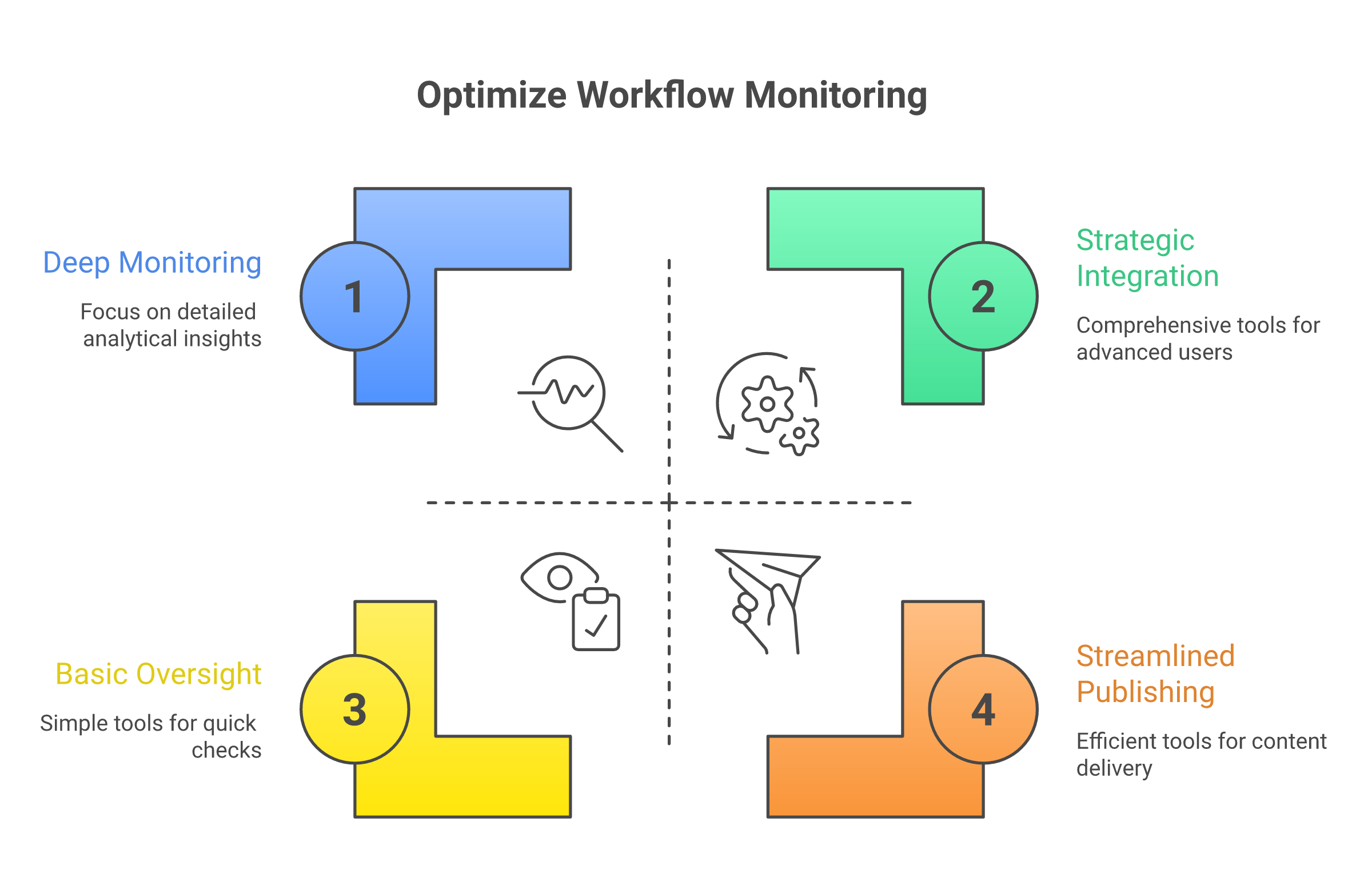
Mention is a social listening and media monitoring platform. You use it to track brand names, competitors, people, campaigns, topics, and market terms across web and social sources.
It is strongest when you need a live feed of mentions, alert controls, sentiment, dashboards, reports, and exports for people outside the marketing team.
Mention's product positioning centers on three jobs:
Monitor: track topics across social media and the web, with real-time monitoring and access to a large source base.
Analyze: measure reach, volume, sentiment, location, share of voice, and topic performance through reports and dashboards.
Act: route mentions, notify stakeholders, and use integrations such as Slack or Zapier to move the signal into a team workflow.
Mention is no longer the same all-in-one publishing and response tool some old review pages describe. Mention Publish & Respond feature was retired on January 30, 2026.
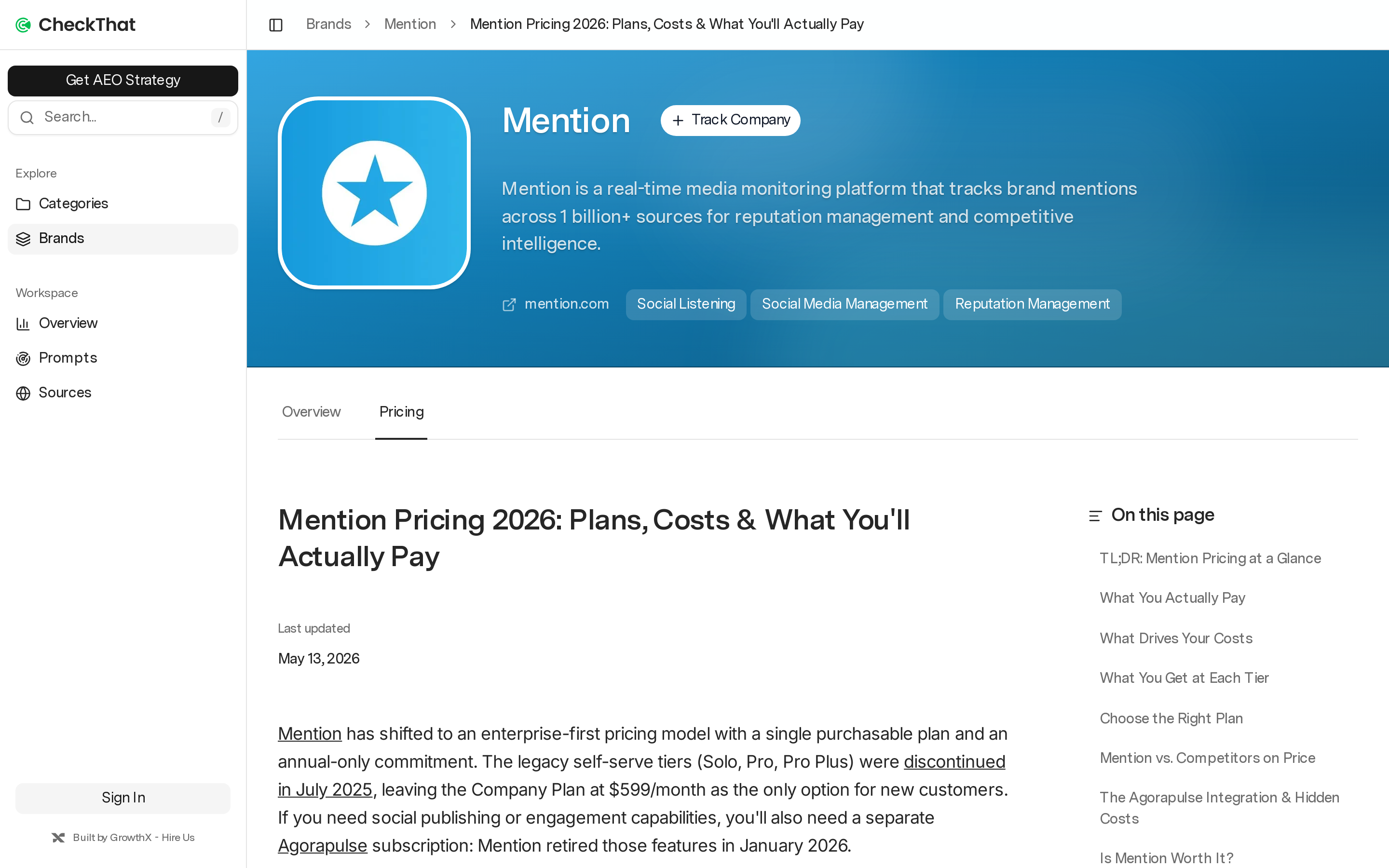
Monitoring, alerts, feed, and analytics continue to work. Creating posts, scheduling posts, replying to comments, and managing conversations now require Agorapulse or another social management tool.
That shift matters.
If you are buying Mention for media monitoring, the product still fits the job. If you are buying it because you expect one place to listen, publish, and manage a social inbox, you need to price the full workflow, not just the Mention subscription.
How I evaluated Mention for this review#
I evaluated Mention as a buying decision for teams that need media monitoring and social listening, not as a generic social media platform.
The right question is not whether Mention can find posts. It is whether its current annual plan, source coverage, alert limits, reporting, and retired publishing workflow match the way your team turns signals into action.
Monitoring fit: Can you track web, news, blogs, forums, review sites, Reddit, X, Instagram, Facebook, and other relevant sources with enough alert control?
Pricing fit: Does $599/month on annual billing make sense for your team size, mention volume, and need for unlimited users?
Workflow completeness: Can your team use Mention for listening and analytics while using Agorapulse, Sprout Social, or another tool for publishing and responding?
Reporting speed: Are scheduled reports, exports, AI summaries, spike notifications, and instant alerts enough for PR, reputation, and competitor monitoring?
Operational risk: What happens when broad queries consume the 50,000 mention/month cap, or when API, historical data, extra alerts, or extra quota add cost?
Find high-intent buyer signals and turn community conversations into pipeline.
Mention pricing in 2026: what $599/month actually buys#
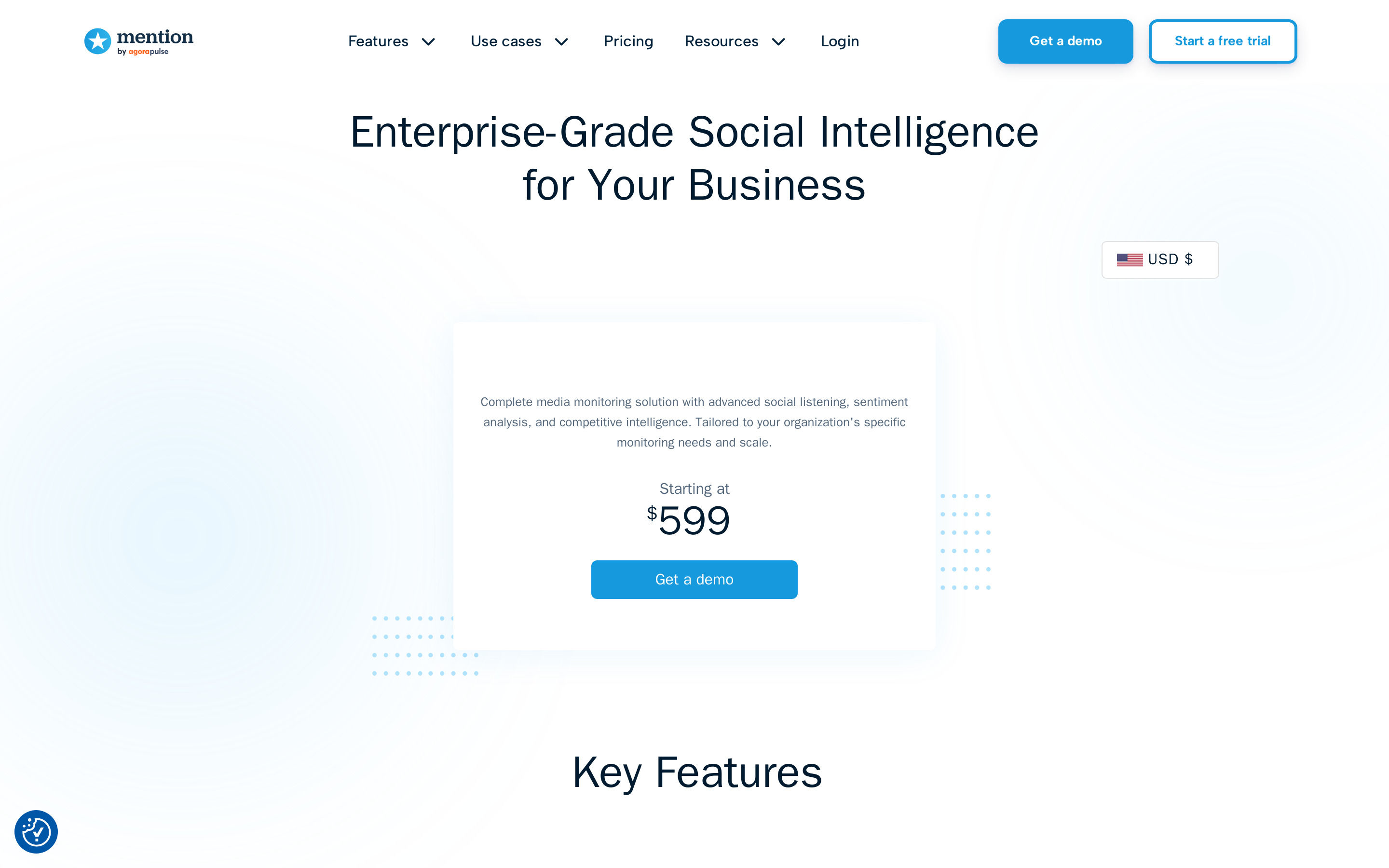
Mention's pricing starts at $599/month, billed yearly.
Here is what that buys:
5 alerts for ongoing monitoring, with additional alerts available for purchase.
50,000 mentions per month, with additional quota available for purchase.
Unlimited users, including administrators, users, and guests.
Advanced sources, including X, Reddit, web, news, blogs, and forums.
Advanced and Boolean alerts, plus basic and standard alert options.
Scheduled reporting, AI Alert Summary and Overview, QuickChart, data exports, spike notifications, Instant Mentions, Top Mentions Email, SMS, desktop notifications, and account support.
Historical data and API access as upgrades, not default inclusions.
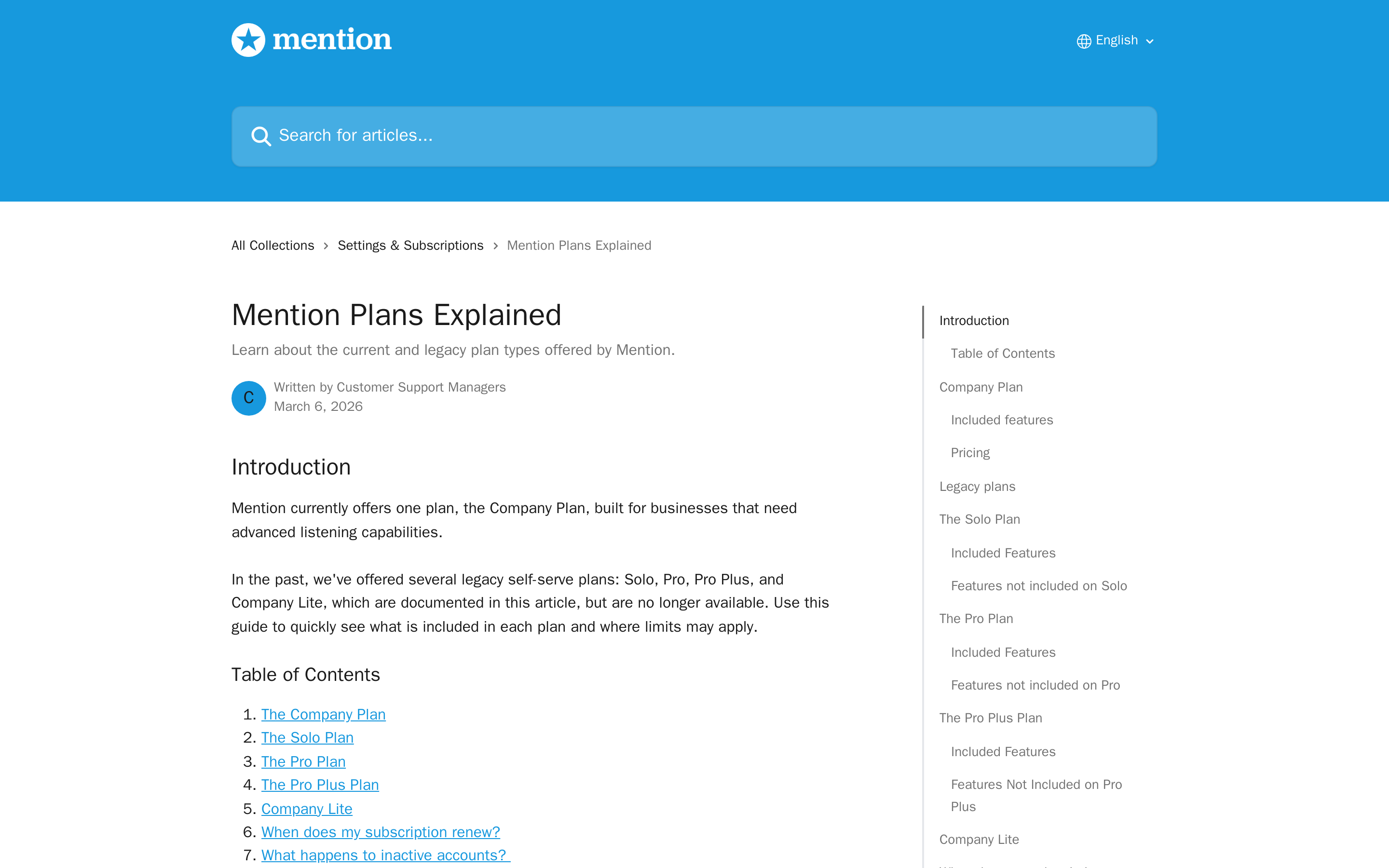
Mention's old Solo, Pro, and Pro Plus plans are the trap in a lot of outdated reviews.
Those plans are no longer sold to new customers as of July 2025. Existing customers can keep legacy access, but a new buyer should not plan around the old $49/$99/$179-style self-serve tiers.
$599/month is not automatically expensive if you have a team of PR, demand gen, brand, and agency users who all need access. Unlimited users can beat per-seat pricing once enough people need the feed, reports, and exports.
But for a small team, the annual commitment is the friction. You are looking at $7,188/year before add-ons, before publishing/responding costs, and before any extra alert or mention quota. That is a different buying motion from a lightweight alerting tool.
Example: a PR agency with 12 client-facing users, 5 focused alerts, weekly exports, and executive reporting can make the base plan work if it standardizes the workflow. A two-person SaaS startup trying to catch a few Reddit, X, and review-site mentions will feel the same plan as overhead.
Find high-intent buyer signals and turn community conversations into pipeline.
What Mention does well#
Mention's main strength is focused monitoring. It gives teams a practical way to catch external conversations, classify the signal, and report it before the issue goes stale.
1. Broad monitoring coverage
Mention claims monitoring across over 1 billion sources and covers web, news, blogs, forums, review sites, and major social networks. The Mention does real-time monitoring, social listening metrics, sentiment, and share of voice.
That source range matters for PR and reputation teams. A brand complaint on Reddit, a competitor announcement in a niche publication, and a review-site mention should not live in three disconnected workflows.
2. Alert control with Boolean support
The Company Plan includes advanced and Boolean alert capabilities. That is where Mention becomes more useful than a simple keyword tracker.
A clean Boolean query can separate buyer-intent posts from noise, exclude irrelevant meanings of your brand name, and split alerts by brand, competitor, product line, or issue type.
This is also where the tool demands discipline. Bad queries burn mention quota and create work for the team. Good queries catch the signal while it still matters.
3. Reporting for stakeholders
Mention supports scheduled reporting, exports, dashboards, QuickChart, AI Alert Summary and Overview, spike notifications, and top-mention emails.
That mix fits teams that need to brief leadership, clients, PR leads, or sales leaders without asking everyone to live in the feed.
Review-site sentiment lines up with this strength. G2 lists Mention at 4.3/5 from 442 reviews, while Software Advice lists 4.7 overall from 288 reviews.
I treat those ratings as sentiment, not proof that Mention fits every workflow. Still, they support the pattern: users often praise setup, monitoring coverage, ease of use, and reporting.
4. Unlimited users can change the math
Per-seat pricing gets painful when PR, social, product marketing, executives, agency teammates, and client viewers all need visibility. Mention's unlimited-user model makes sense when the same monitoring feed has to support several teams.
A five-person team paying $599/month is a hard sell. A 25-person GTM and comms group using one monitoring system for alerts, reports, and client-ready exports is a more credible fit.
Where Mention falls short#
Mention's limits are not side notes. They define who should buy it.
1. The entry price is now a commitment
The current plan starts at $599/month on an annual contract. That removes Mention from casual self-serve evaluation for many startups, consultants, and small teams. You can still request a demo, but you should go into that call with your alert list, expected mention volume, must-have sources, and reporting requirements already mapped.
If you only need one alert for your brand name, a weekly competitor check, or a few Reddit threads, Mention is probably more system than you need.
2. The 50,000 mention/month cap needs planning
50,000 mentions per month sounds generous until you run broad alerts. A focused B2B SaaS brand query can stay well below it. A consumer brand, a common product term, a crisis topic, or a competitor/category query can eat the quota quickly.
The risk is not just price. It is missed signal. If you hit the cap during a launch, controversy, or competitor campaign, you need to know whether additional quota is available, how quickly you can add it, and what it costs.
3. Publish & Respond is gone
This is the biggest workflow change. Mention retired Publish & Respond on January 30, 2026. It says users can no longer create, schedule, or publish posts from Mention, and can no longer reply to or manage conversations from Mention.
It has Agorapulse as the official replacement for publishing and engagement.
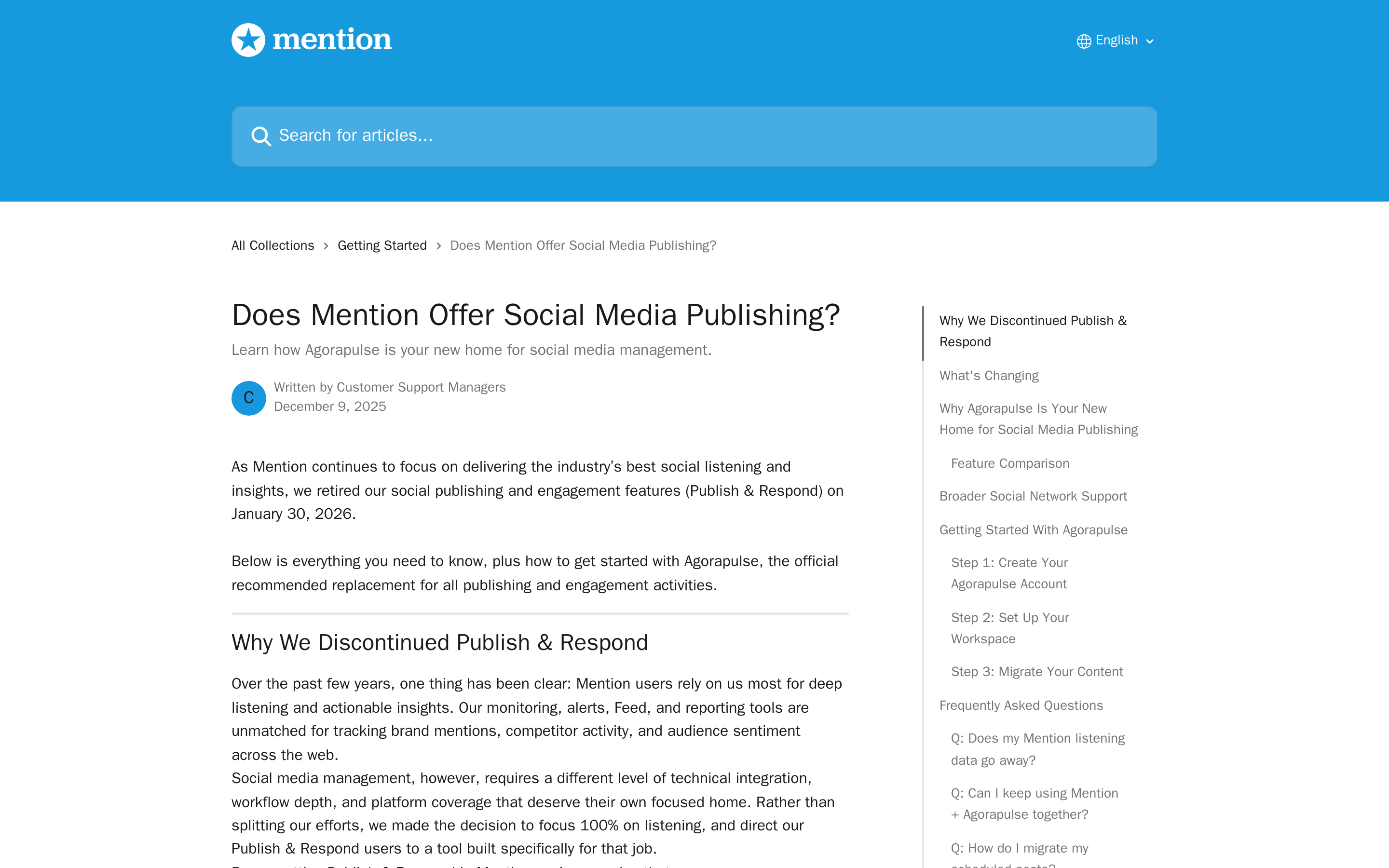
That is fine if your team already separates listening from publishing. It is a problem if your social team expected Mention to replace a scheduler, content calendar, approval workflow, and inbox.
4. Add-ons can create budget uncertainty
Historical data and API access are not included by default in the Company Plan. Additional alerts and additional mention quota can also be purchased. That is normal for this category, but you should not treat the public $599/month price as the full operating cost until you confirm your exact monitoring scope.
Ask these questions before you sign:
How many alerts do we need for brand, product, competitor, category, executive, and campaign monitoring?
What is our estimated monthly mention volume by alert?
What happens if we cross 50,000 mentions in a month?
Do we need historical data for baseline analysis or crisis review?
Do we need API access, Slack routing, Zapier workflows, or exports for a BI/reporting layer?
What social publishing or inbox tool will we use alongside Mention?
Find high-intent buyer signals and turn community conversations into pipeline.
Mention vs Alternatives: Choose Based on the Job#
The biggest mistake buyers make is comparing every social listening tool as if they solve the same problem.
They do not.
Some tools are built for brand monitoring. Some are built for social media management. Some are built for enterprise research. Some are built for finding buying signals inside communities.
Start with the job you need done.
Tool | Best fit when | Pricing signal | Main tradeoff |
CommunityTracker | You want buyer-intent conversations, competitor mentions, recommendation requests, and community signals turned into GTM actions | Starts at $29/month | Less focused on traditional PR reporting and media monitoring |
Mention | You need monitoring, alerts, reporting, review monitoring, and collaboration across teams | $599/month billed yearly | No native publishing workflow and a higher entry price |
Brand24 | You want sentiment analysis, brand monitoring, competitor tracking, and transparent pricing | Starts at $199/month billed annually | Lower plans have tighter keyword, mention, and update limits |
Sprout Social | You need publishing, inbox management, approvals, and social customer care | Starts at $199/seat/month | Listening is not the core product and often requires add-ons |
Brandwatch | You need enterprise consumer intelligence, market research, and large-scale monitoring | Custom pricing | Longer sales cycle and more implementation work |
Google Alerts | You only need basic web alerts for a few keywords | Free | Limited coverage and minimal workflow capabilities |
CommunityTracker vs Mention#
This is the comparison I would make first for most SaaS GTM teams.
Mention is designed to answer questions such as:
Who mentioned our brand?
How often are competitors discussed?
What is the sentiment?
Where are conversations happening?
CommunityTracker is designed to answer different questions:
Which conversations indicate buying intent?
Which competitor complaints should sales see?
Which recommendation threads deserve a response?
Which community discussions could become pipeline?
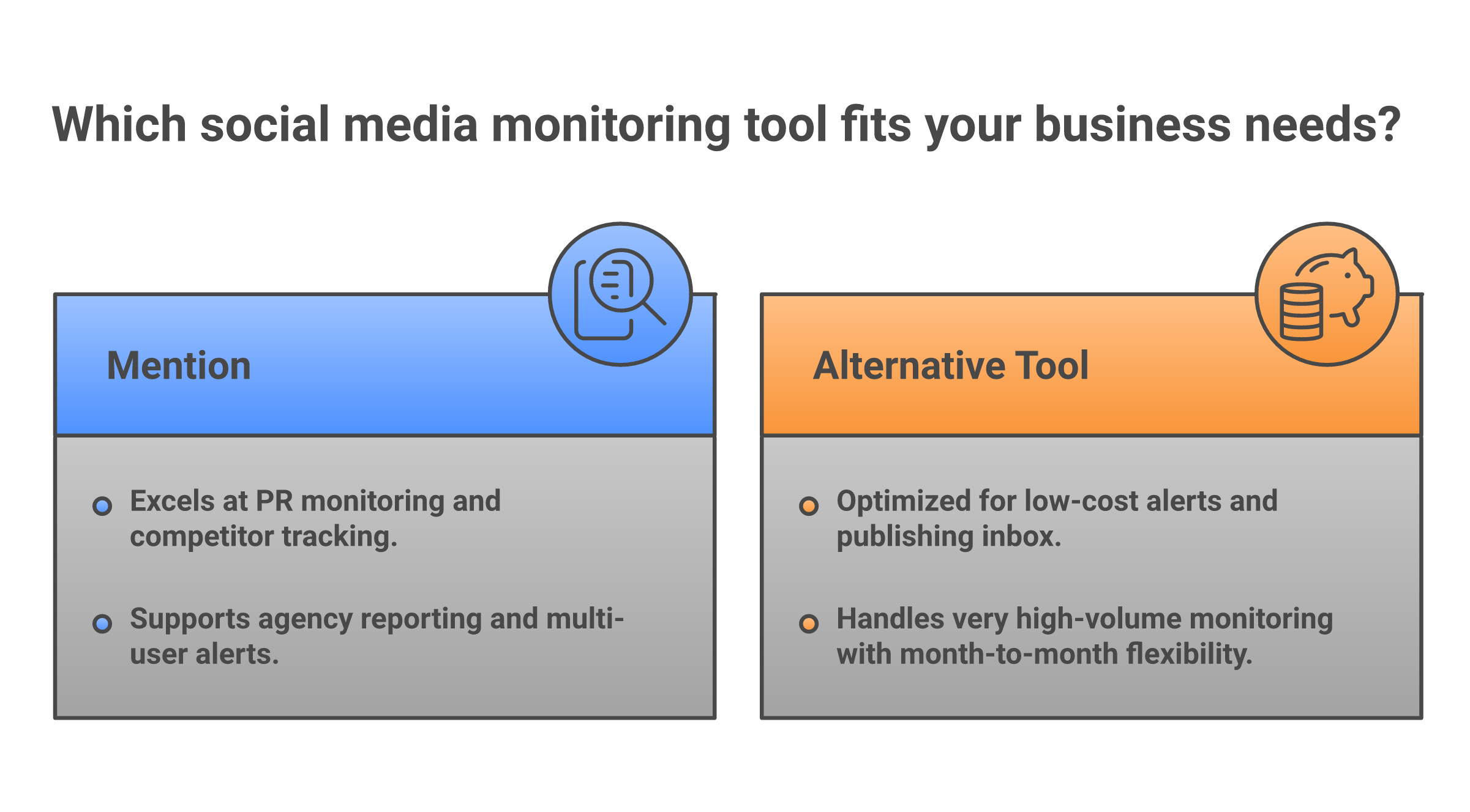
If your goal is brand monitoring, Mention makes more sense.
If your goal is turning Reddit, LinkedIn, X, Slack, GitHub, Product Hunt, Stack Overflow, Hacker News, or Indie Hackers conversations into opportunities, CommunityTracker is usually the closer fit.
Brand24 vs Mention#
Brand24 is the closest direct alternative.
The decision usually comes down to pricing and workflow preference.
Brand24 starts at a lower public entry point and offers a more transparent pricing ladder. Mention starts higher but includes unlimited users, collaboration features, review monitoring, and a monitoring workflow designed for larger teams.
Sprout Social vs Mention#
Sprout Social is a better fit when social media management is the primary job.
Publishing, approvals, inbox management, customer replies, and social operations are central to Sprout's workflow. Mention focuses on listening, monitoring, alerts, and reporting.
Brandwatch vs Mention#
Brandwatch becomes relevant when the requirement expands beyond monitoring into consumer intelligence, market research, and enterprise analytics.
Most small and mid-sized teams evaluating Mention do not need that level of research depth.
Google Alerts vs Mention#
Google Alerts is useful as a free notification tool.
Mention is useful when monitoring becomes an operational workflow involving reports, alerts, stakeholder updates, competitor tracking, review monitoring, and team collaboration.
The comparison I would avoid is treating all mention-tracking tools as equal. A free alert, a PR monitoring platform, and a buyer-intent discovery tool may all track conversations, but they are solving very different problems.
Who should choose Mention, and who should avoid it?#
Choose Mention if you recognize your workflow here:
PR team: You need fast alerts for press hits, competitor mentions, reputation issues, review-site trends, and crisis signals.
Mid-market brand team: You have several stakeholders who need access, but you do not want per-seat pricing for every viewer.
Agency: You monitor clients, competitors, campaigns, and topics, then export reports or route alerts to account teams.
Demand gen or product marketing team: You track competitor launches, category conversations, review-site sentiment, and communities where buyers talk before they enter the funnel.
Avoid Mention if this sounds closer to your reality:
Founder-led startup: You need low-cost alerts for a few brand or competitor terms, and $7,188/year would crowd out higher-priority spend.
Social media team: You need scheduling, approvals, content calendars, engagement inbox, and response management in the same tool.
High-volume brand: You expect broad consumer, news, social, or crisis volume and have not confirmed overage handling.
Month-to-month buyer: You want a flexible self-serve plan that you can pause, cancel, or downgrade without an annual sales process.
Write down your first 5 alerts before you talk to sales. If those alerts map to executive reporting, PR risk, competitor moves, and reputation coverage, start with Mention demo. If the list is just your brand name, your founder's name, and one competitor, start smaller.
Final verdict: Mention is worth it only for a specific monitoring workflow#
Mention is worth $599/month when monitoring is the job and the team is ready to act on the signal. It is strongest for PR, reputation, competitor monitoring, market research, agency reporting, and multi-user teams that need real-time alerts plus stakeholder-ready reports.
It is weak for casual listening, low-budget startup monitoring, and social teams that expected publishing and responding inside Mention. Publish & Respond is gone. That one change should shape the whole buying conversation.
If you are still shortlisting, then make the decision from your workflow, not from a feature checklist.
Do not just ask, "Can Mention track mentions?" It can.
Ask, "Will this help my team catch the right signal, route it fast, and prove what happened?"
That is the real Mention review question in 2026.
Start now and find high-intent buyer signals and turn community conversations into pipeline.