If you are searching for a Syften Review, you probably want one answer fast: is Syften a good monitoring tool, or is it too narrow for serious GTM work?
Short answer: Syften is a good pick when your team wants fast keyword alerts from Reddit, Hacker News, GitHub, X, forums, YouTube, Bluesky, Mastodon, Slack communities, and similar sources.
It is not the right fit if LinkedIn matters, if you need built-in intent scoring, or if your team wants a complete workflow from buying signal discovery to GTM action.
TL;DR: Who Should Use Syften?#
Choose Syften if you need:
Precise keyword alerts across public communities
Fast Reddit, HN, GitHub, X, forum, and Slack-community monitoring
Email, Slack, RSS, API, or webhook delivery
Query controls that technical users can tune
A low starting price for narrow monitoring
A tool that sends alerts into systems your team already uses
Look elsewhere if you need:
LinkedIn monitoring
Native GTM prioritization and routing
Share of Voice reporting
Built-in response recommendations
Account-level workflows for sales, marketing, support, and product
A product that tells the team what to do after the alert arrives
Start tracking for free at communitytracker.ai. No credit card. No setup call. Just add your website and CommunityTracker automates everything from which keyword to prioritise based on your goal.
What Syften Actually Does#
Syften is a community keyword monitoring tool. It watches sources where buyers, users, developers, founders, and operators talk in public, then sends alerts when a filter matches.
It covers Reddit, Hacker News, X/Twitter, GitHub, Stack Exchange, YouTube, Bluesky, Mastodon, Indie Hackers, Slack communities, Discourse forums, blogs, news, podcasts, and more.
It does not monitor LinkedIn, which is a real limitation for B2B teams that depend on LinkedIn conversations for category demand, buyer research, and competitor comparisons.
The core workflow is simple:
Create filters for product names, competitor names, domains, category phrases, or intent phrases.
Syften scans supported sources for matches.
AI filtering can reduce weak matches on eligible plans.
Alerts go to email, Slack, RSS, API, or webhook.
Your team decides whether to reply, log, escalate, or ignore.
That makes Syften useful for teams that already know what signal language they want to track.
A developer-tool founder can monitor GitHub, HN, and Reddit.
A support lead can catch product complaints in community threads.
A small marketing team can track competitor names and buying-intent phrases like "alternative to" or "recommend a tool for."
Syften does not need to understand your GTM process to be useful. It only needs clear filters and clear destinations.
That is why it works well for small teams with clear instincts and light process, and less well for larger teams that need shared scoring, ownership, and reporting.
Related Read: 7 Powerful Syften Alternatives for Reddit and Community Monitoring
The Best Part: Fast, Focused Alerts#
Syften is useful when the core job is catching relevant mentions quickly enough for a person to act.
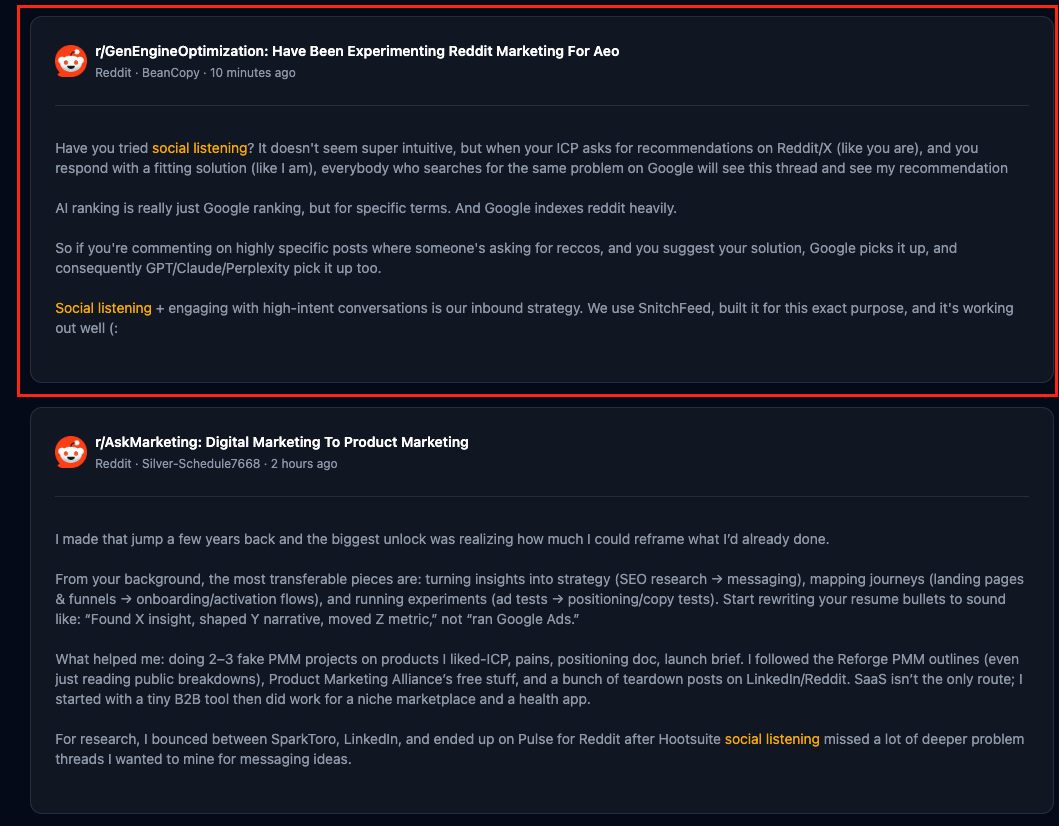
For Reddit, Syften states a target delay of under 1 minute.
For X/Twitter keyword monitoring, it states a delay of at most 15 minutes.
Syften is built around alert speed, not slow brand-reporting dashboards.
This is valuable when timing affects the outcome:
A buyer asks for alternatives to your competitor.
A user complains about a pain your product solves.
A developer discusses a workflow your tool supports.
A customer mentions your product without tagging you.
A competitor gets recommended in a thread you should know about.
In those moments, a weekly report is too late. Syften is designed to send the item while it still matters.
Filters Feel Built For Developers, Not Just Marketers#
Syften is filter-led. That is both the product's appeal and the reason it fits technical teams.

Filters can target product names, domains, competitor names, phrases, communities, authors, languages, post types, and title text.
Syften supports operators such as site:, type:, author:, lang:, title:, NOT, wildcard matching, and $accept: for AI post-filtering on eligible plans.
Example filters:
Track a competitor domain on Reddit and HN.
Watch for "alternative to [competitor]" across forums.
Follow a founder, maintainer, or influencer account.
Exclude your own employees from alert results.
Restrict alerts to thread titles when comments are too noisy.
Use AI filtering to accept only posts with clear buying intent.
Syften works best when someone on the team is willing to tune filters. It is less useful for teams that want the product to infer the whole GTM workflow on its own.
AI Filtering Helps, But It Is Not The Whole Workflow#
Keyword alerts create noise. A brand name can appear in a joke, a support complaint, a tutorial, a spam post, or a serious buying question.
Syften's $accept: filter gives teams a way to narrow the stream after the normal keyword match.
Use it to accept only mentions that match a defined intent:
posts asking for recommendations
complaints about a competitor
questions about migration
threads from a specific technical context
mentions that include a buying or switching signal
Syften's AI filtering applies to Slack and email notifications, while archive, preview, API, and web views can still show the broader match set with verdict fields. Teams can keep the raw record while reducing inbox noise.
The limit is prioritization.
Syften can help decide whether a post should pass a filter. It does not fully replace intent identification, ownership rules, response guidance, or pipeline reporting. If that matters, you need a workflow layer around the alert stream.
Note: Keyword matching is useful for discovery, but it is a blunt instrument for GTM. The keyword tells you a term appeared; it does not tell you whether the person is in-market, whether the thread is worth entering, whether the account fits your ICP, or whether the right next step is sales, support, product, or marketing.
That is why keyword-led tools often feel exciting in week one and noisy by week four. The team sees more mentions, but not every mention deserves the same attention. The operational burden shifts from "find conversations" to "separate signal from noise and route the signal correctly." Without that second layer, teams can confuse activity with actual market demand.
Alert Delivery Is Practical#
Syften sends alerts where small teams already work: email, Slack, RSS, API, and webhooks.
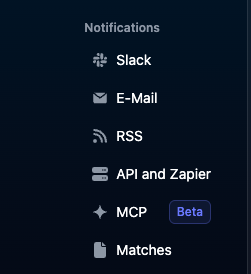
That matters because the best monitoring system is the one the team actually checks. Founders live in email and Slack.
Technical teams want API access.
Agencies need separate client streams. RevOps teams want alert data in systems they can enrich, route, and report on.
Tags make that routing cleaner. A team can send brand mentions to marketing, product complaints to support, competitor mentions to product marketing, and technical feature requests to product. Agencies can separate client streams without asking everyone to watch the same feed.
PRO adds webhooks and MCP support, making Syften more useful for teams that want alerts feeding custom automations or AI-enabled workflows.
Syften Integrations and Community Coverage#
Syften is built more for community monitoring than broad social media management.
From the dashboard, you can enable or disable different sources depending on where your audience talks.
The coverage includes communities like Hacker News, Reddit, Indie Hackers, Product Hunt, Stack Exchange, Dev.to, Lobsters, Forums, Mastodon, Bluesky, GitHub, News Sites and Blogs, Newsletters, Podcasts, and Steemit.
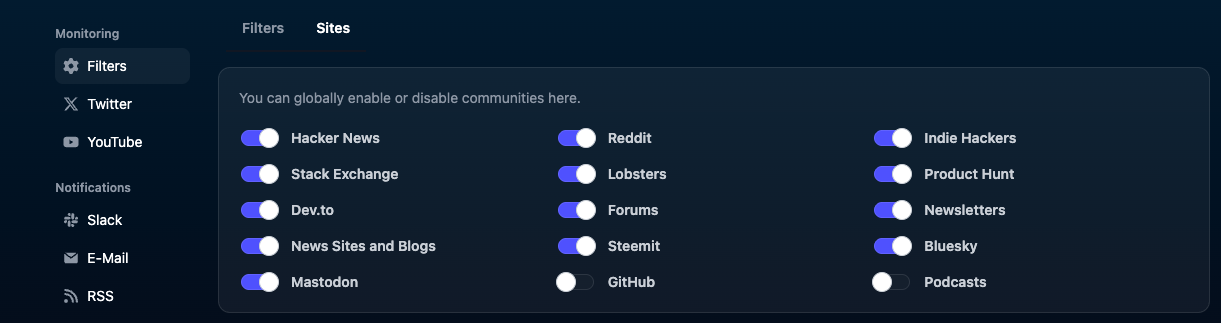
It also supports monitoring channels like Twitter and YouTube, which helps if you want to track brand mentions, competitor mentions, product discussions, or keyword-based conversations across both social and community platforms.
For notifications, Syften keeps things simple. You can route alerts through:
Slack for team notifications
Email for direct updates
RSS for feed-based monitoring
This makes Syften useful if you want to catch conversations early, especially in places where buyers ask questions, compare tools, complain about competitors, or look for recommendations.
The main strength here is not having dozens of complex integrations. It is that Syften covers many high-signal communities where B2B conversations often happen before they show up in traditional social listening reports.
Syften Pricing In 2026#
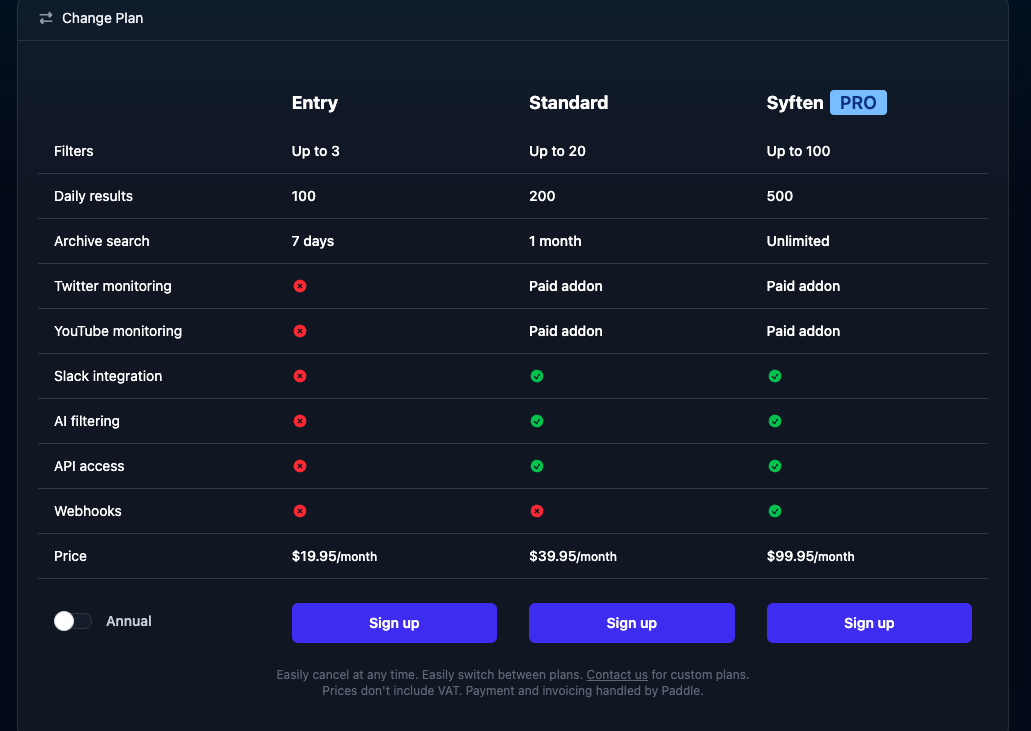
Syften pricing is simple, but there is one important catch: Twitter/X and YouTube monitoring cost extra.
Plan | Price | Best for | Key limits/features |
Entry | $19.95/month | Solo founders or indie teams | 3 filters, 100 daily results, 7-day archive |
Standard | $39.95/month | Most small teams | 20 filters, 200 daily results, 1-month archive, Slack, AI filtering, API access |
Syften PRO | $99.95/month | Teams needing scale and automation | 100 filters, 500 daily results, unlimited archive, webhooks, MCP, API access |
Custom | Custom | Special data or integration needs | Tailor-made setup |
The Entry plan is good for tracking a few narrow terms like your brand, one competitor, and one buying-intent keyword.
The Standard plan is the better starting point for most teams because it includes Slack alerts, AI filtering, and API access.
The PRO plan fits teams that need more filters, deeper history, and workflow automation through webhooks or MCP.
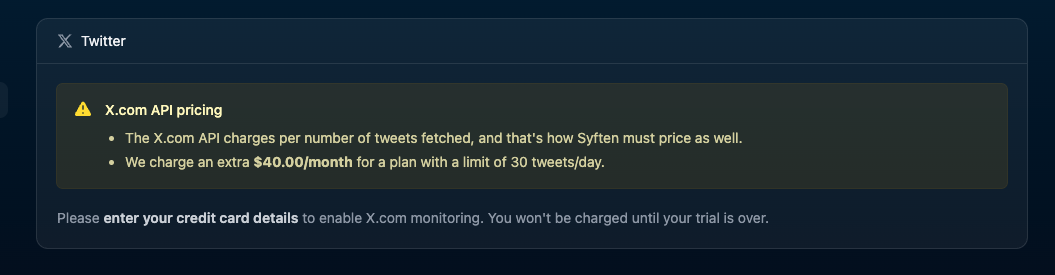
For add-ons, X.com/Twitter monitoring costs an extra $40/month for up to 30 tweets/day, while YouTube monitoring costs $20/month for each 10 YouTube filters.
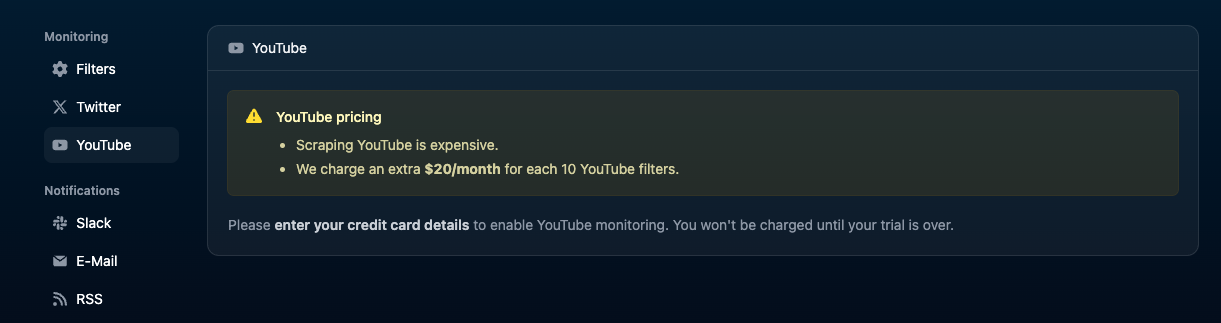
Pricing takeaway: Syften is affordable for community keyword monitoring, but costs go up if you add Twitter/X or YouTube monitoring.
Start tracking for free at communitytracker.ai. No credit card. No setup call. Just add your website and CommunityTracker automates everything from which keyword to prioritise based on your goal.
Where Syften Is The Better Choice#
Syften is the better choice when your team wants a clean alert pipe, not a full community intelligence platform.
Pick Syften if:
You know the exact keywords, competitors, and problem phrases to monitor.
Reddit, HN, GitHub, X, forums, and Slack communities matter more than LinkedIn.
You want to route alerts into Slack, email, RSS, API, or webhooks.
A technical teammate will tune filters and manage automations.
Your team can decide manually what each alert means.
You want a lower-cost starting point.
A technical founder who only needs Reddit, HN, GitHub, and X alerts, wants API/webhook delivery, and prefers to manage routing with scripts should consider Syften.
Where Syften Limitation Starts For GTM Teams#
Syften gets less compelling when the monitoring job becomes a repeatable GTM motion.
The first gap is LinkedIn.
For B2B SaaS, LinkedIn is often where buyers describe priorities, compare vendors, announce initiatives, and ask peers what to use.
If LinkedIn is part of your signal map, Syften cannot cover the full market conversation.
The second gap is prioritization.
Syften can catch mentions and reduce some noise, but keyword matching is still the core constraint. Keywords match language, not intent.
The same phrase can appear in a serious buying thread, a complaint, a tutorial, a joke, a spam post, or a casual comparison. That is where GTM teams need judgment, scoring, and workflow, not just more alerts.
Someone still needs to answer:
Is this a buyer signal or a casual mention?
Who owns the next action?
Should sales reply, marketing save the language, product log feedback, or support respond?
Does this mention affect Share of Voice?
Did the team act on the signal?
The third gap is measurement. Alert delivery tells you what happened. GTM teams also need to know which communities produce useful signals, which competitors appear most often, which pain points repeat, and which actions create pipeline or product insight.
From Keyword Alerts To GTM Intelligence: Syften Vs CommunityTracker#
This is the real transition in the buying decision: do you only need a stream of matched mentions, or do you need a system that understands which mentions deserve action?
Syften fits monitoring: catch the post, send the alert, and let the team act elsewhere.
CommunityTracker fits community intelligence: monitor the right communities, identify intent, score signals, generate response paths, track Share of Voice, and route the next move across GTM owners.
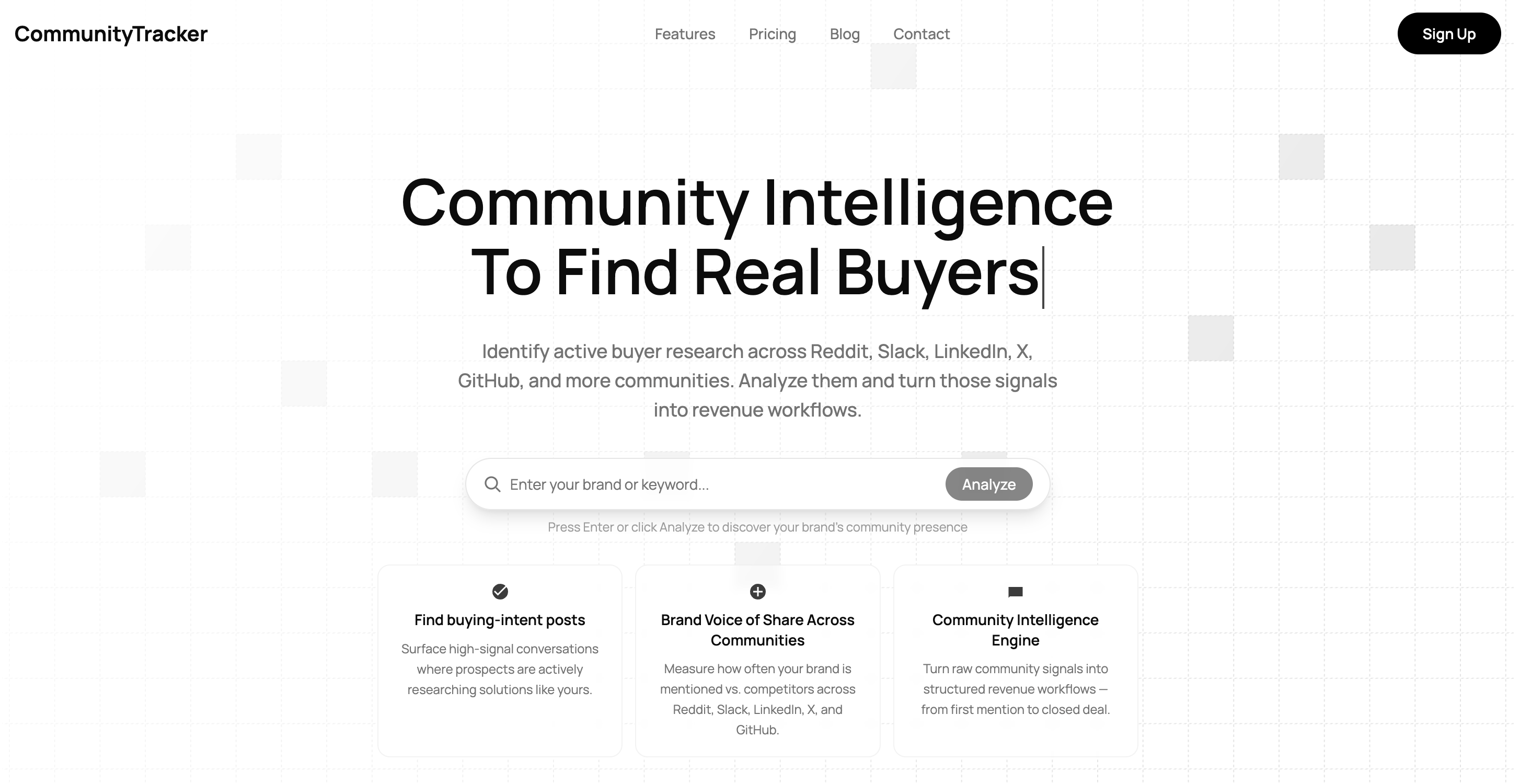
It covers Reddit, LinkedIn, X, Slack communities, Hacker News, Indie Hackers, GitHub, YouTube, and more, with Pro and Advanced tiers adding advanced AI filtering, AI scoring, Share of Voice, Community Intelligence, and AI Visibility tracking. See CommunityTracker's pricing and platform coverage.
Choose CommunityTracker if LinkedIn and Slack communities matter, multiple GTM owners need to act on the same signal stream, or your team needs scoring and reporting instead of only detection.
Do not choose CommunityTracker if you only want the cheapest narrow keyword notifier, do not need response suggestions, and prefer to build routing with your own scripts. Syften is the more focused tool for that buyer.
Final Buying Checklist#
Before choosing Syften, answer these questions:
Which communities actually produce buyer signals for us?
Do we need LinkedIn coverage?
How many product, competitor, category, and pain-point filters do we need?
Who owns each alert type?
How much noise can the team review every day?
Do alerts need Slack, email, API, webhook, CRM, or support routing?
Do we need scoring and Share of Voice, or only detection?
What will we do with a high-intent post within the first hour?
Final recommendation:
Use Syften if your team wants fast community alerts and has the discipline to manage keyword noise manually. It can surface useful mentions, but the team still has to decide whether each match is a real buyer signal, a casual discussion, a complaint, or something to ignore.
Use CommunityTracker if your team needs to move beyond keyword matching into signal quality: identify intent, score urgency, route ownership, measure Share of Voice, and turn community conversations into GTM action.
Syften is worth using in 2026 when the job is narrow monitoring.
Its limitation is the same limitation every keyword-led workflow runs into: the keyword can be right while the context is wrong.
For GTM teams, that creates noise.
The better question is not only "did someone mention the term?" It is "does this mention deserve action, who should own it, and how do we measure the outcome?"
That is where a community intelligence workflow becomes more useful than another alert stream.
Start tracking for free at communitytracker.ai. No credit card. No setup call. Just add your website and CommunityTracker automates everything from which keyword to prioritise based on your goal.