Most outbound teams do this in the wrong order.
They buy a list, sort by title and company size, then ask reps to make the emails sound personal. That is how you end up sending to people who match your ICP on paper but have no live reason to care this week.
A real buying signal answers a harder question: why this account, why this person, why now?
That is the filter I use when I look at signal data. A Head of Growth title is not enough. A 400-person company is not enough. A Series B is not enough. Those facts help with fit. They do not give you timing.
The signals that predict revenue usually have one of five things inside them:
A buyer says the problem out loud.
A team starts hiring around the workflow you sell into.
A company changes tools, markets, leadership, or process.
Someone asks peers how to evaluate, replace, migrate, or buy.
Multiple people from the same account touch buying-stage pages or conversations.
That is the difference between scraping the web and reading the market. Scraping gives you rows. Signal work gives you a reason to contact fewer people with a sharper message.
It matters because outbound now has a ceiling. Google tells bulk senders to keep reported spam below 0.10% and avoid hitting 0.30% or higher.
The Gmail sender guidance also pushes authentication and easier unsubscribe flows for high-volume senders. Google's sender guidelines turn weak targeting into a sales problem: bad lists now cost you twice, once in enrichment credits and again in sender reputation.
A buying signal is only useful if it changes what your rep does next#
One thing I've learned after reviewing dozens of signal platforms is that a buying signal isn't valuable because it's rare or difficult to collect. It's valuable because it changes the next action your sales team takes.
A pricing-page visit, a hiring announcement, or a spike in intent data might look impressive inside a dashboard. But if your rep still doesn't know who to contact, why they're reaching out now, or what they should say differently, the signal hasn't solved anything. It's simply added another notification to an already busy workflow.
That's the lens I used throughout this review. Instead of asking whether Common Room could collect a signal, I asked whether that signal gave a rep enough context to start a relevant conversation.
For every signal, I looked for five things.
Does it point to a real business problem, project, team, or buying motion?
Did it happen recently enough that reaching out this week still makes sense?
Is the account already a good fit, even without the signal?
Can the signal be tied to a real person or buying team?
Does it give the rep enough context to offer something useful instead of simply saying,
"I saw you..."
?
If the answer to those questions is no, I don't think the account is ready for outreach. It can stay on a watchlist until more context appears, but it doesn't deserve a place in an outbound sequence yet.
This is also where I think many intent platforms fall short. They surface a score, a surge, or an alert without explaining what actually changed. The dashboard says an account is "hot," but the rep still can't explain why now is the right time to reach out or what should be different about the first email. That's not actionable intent. It's a number waiting for someone else to interpret it.
That distinction matters because modern B2B buying happens long before a prospect fills out a demo form.
Research from Gartner shows that buying groups spend only a small portion of their buying journey speaking with suppliers. Most of their time is spent researching independently, discussing options internally, building requirements, and reaching consensus.
By the time someone books a demo, much of the buying process has already happened.
That's why the best buying signals aren't just indicators of interest. They're indicators of where someone is in the buying journey, giving your team a chance to join the conversation before every other vendor does.
The buying signals I'd trust first#
Not every buying signal deserves the same amount of attention.
Some tell you a company fits your ICP. Others tell you a company might buy someday. The signals I care about most do something different—they explain why now. They give a rep enough context to understand what's changing inside an account and write an email that feels relevant instead of reactive.
That's why I wouldn't rank signals by how easy they are to collect. I'd rank them by whether they help answer four questions: Who is feeling the pain? What changed? Why is this happening now? And can I help before someone else does?
If I were building an outbound motion today, this is the order I'd trust.
Buying Signal | What it usually tells me | Priority | Where I'd look | First move |
Public post describing a business problem | The buyer has already acknowledged the pain | High | Reddit, LinkedIn, X, Dev.to | Start with the problem they described instead of your product |
Asking for tool recommendations | They're actively comparing solutions | High | Reddit, LinkedIn, Slack communities | Share a decision framework instead of a sales pitch |
Looking for alternatives to a competitor | The account is open to switching | High | Communities, review sites, Google Search | Lead with the reason companies usually switch |
Complaining about their current vendor | There's a live problem that needs solving | High | Reddit, X, LinkedIn, GitHub | Show how you'd remove that friction |
Pricing or budget discussions | Commercial evaluation has started | High | Communities, sales calls, pricing pages | Address cost, ROI, and implementation early |
Multiple pricing-page visits | Someone is building an internal business case | High | Website analytics, CRM | Map the buying committee, not just the visitor |
Demo or consultation request | The buying process is already underway | High | Website, CRM | Follow up with context, not a generic meeting request |
Multiple stakeholders engaging from one account | Consensus is forming | High | CRM, website, LinkedIn | Identify the buying group before reaching out |
New executive in the buying function | A new mandate is likely being established | High | LinkedIn, company news | Connect your message to first-quarter priorities |
Hiring for a role tied to your category | Budget is moving toward solving this workflow | High | LinkedIn Jobs, company careers pages | Reference the operational challenge behind the hire |
Hiring surge within one department | Growth is creating operational pressure | Medium–High | LinkedIn, job boards | Reach out to the leader responsible for scaling |
Funding paired with relevant hiring | Budget and execution are moving together | Medium–High | Company news, LinkedIn | Connect investment to the operational challenge |
Expansion into a new market | Existing processes are about to change | Medium–High | Press releases, launch announcements | Speak to scaling and localization challenges |
Product launch | The team needs adoption, feedback, and demand | Medium–High | Product Hunt, LinkedIn, company blog | Position yourself around launch execution |
Technology stack change | An implementation project is already happening | Medium–High | Job posts, BuiltWith, GitHub | Lead with migration or integration experience |
GitHub issue about an integration or technical blocker | Engineering pain is visible and current | High (especially for DevTools) | GitHub Issues, Discussions | Help solve the technical problem first |
Migration questions | The buyer is planning a transition | High | GitHub, Dev.to, Stack Overflow | Offer a migration path and reduce implementation risk |
Upcoming compliance deadline | Buying is driven by an external deadline | High | Regulatory updates, job posts, public documentation | Tie your message to the deadline, not your product |
Security audit preparation | Teams are reviewing controls and processes | High | Security documentation, careers pages | Focus on reducing audit effort and risk |
Missed revenue targets | Efficiency is becoming a board-level priority | Medium–High | Earnings reports, investor updates | Use the company's own language around efficiency |
Layoffs within a relevant department | Fewer people now own the same amount of work | Medium | News, layoff trackers | Lead with productivity and workload reduction |
Major customer or partnership announcement | Operational complexity is about to increase | Medium | Press releases, LinkedIn | Talk about what typically breaks after growth |
Attendance at a niche webinar or event | The buyer is researching a specific problem | Medium | Webinar registrations, LinkedIn | Continue the conversation around the topic, not the event itself |
Multiple strong signals from the same account | The account is actively moving through a buying journey | Very High | CRM, website, communities, CommunityTracker | Prioritize same-week outreach with personalized context |
The pattern worth paying attention to#
If you look closely, very few of these signals are valuable on their own.
A funding announcement rarely means much by itself. A pricing-page visit can just be curiosity. Even a demo request doesn't explain the full buying story.
The strongest opportunities usually come from multiple signals pointing in the same direction. Someone asks for recommendations on Reddit, visits your pricing page a few days later, and another stakeholder starts reading your documentation. That's no longer a random collection of events—it's a buying journey taking shape.
That's why I pay more attention to signal combinations than individual alerts. One signal tells you something happened. A stack of related signals tells you why it happened and why now is the right time to reach out.
1. Public pain posts in communities#
The strongest public signal is still the simplest one: a buyer says the problem out loud.
Example:
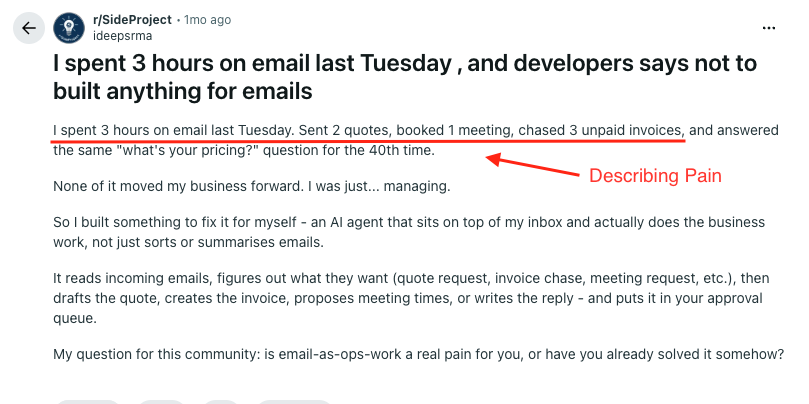
That sentence gives you the problem, the channels, the constraint, and the buying frame. I would not send a generic "saw your post" email. I would write the first line around the actual operating pain:
"Saw your note about manually checking Reddit and LinkedIn. The painful part is usually not finding mentions; it is deciding which ones are worth an SDR's time."
That line works because it does something with the signal. It proves that you understood the post.
Reddit, LinkedIn, X, Bluesky, Hacker News, Indie Hackers, Dev.to, Stack Overflow, Product Hunt, GitHub, and Slack all produce different buyer language.
Reddit gives you frustration. LinkedIn gives you initiatives and hiring. GitHub gives you blockers. Dev.to and Stack Overflow give you implementation questions. Product Hunt gives you launch timing and category comparison.
2. Tool recommendation requests#
"What tool should I use for X?" is a clean signal when the question is specific.
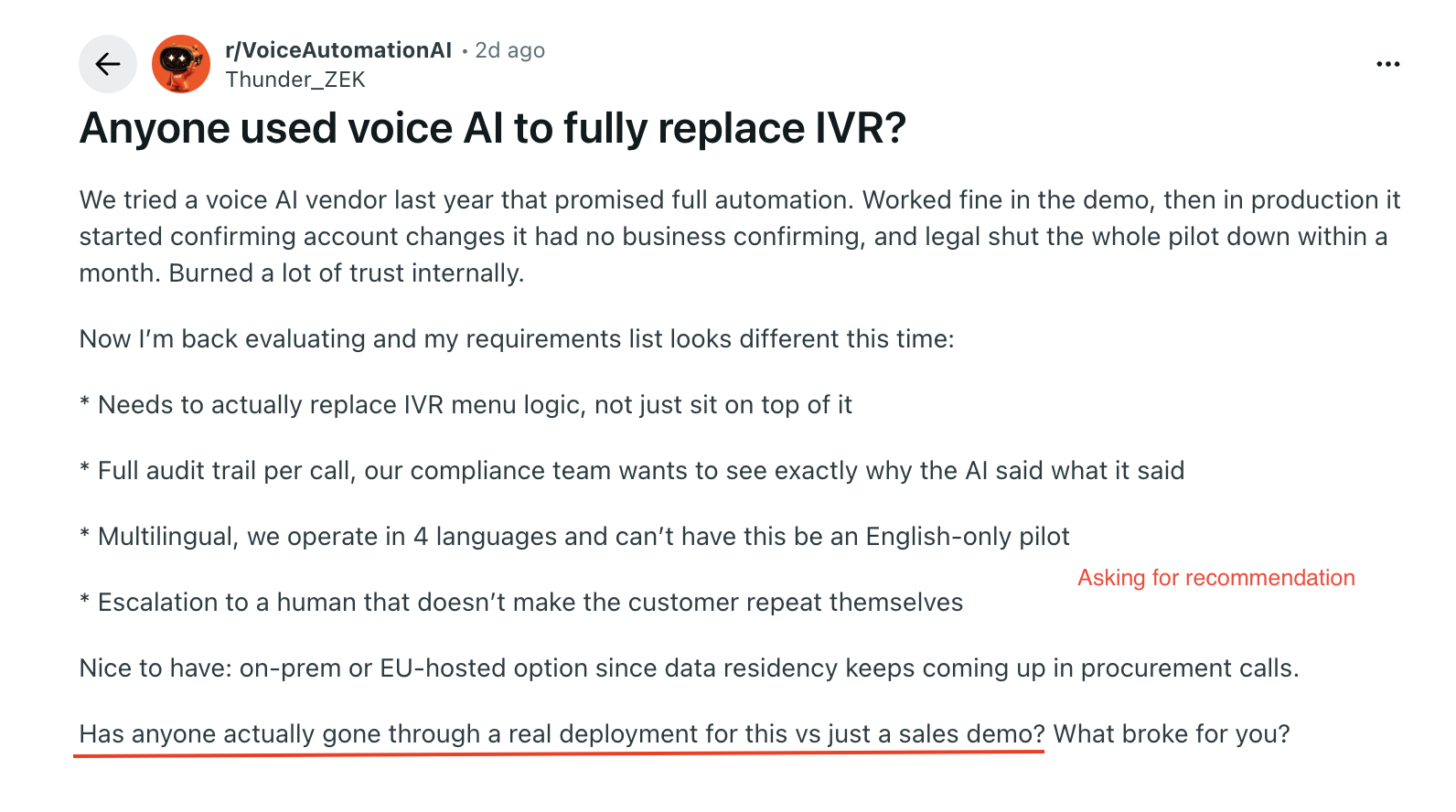
For a technical product, the same signal often appears as a Stack Overflow question, a Dev.to post, or a GitHub discussion. A developer asking how to automate a brittle workflow can be closer to revenue than a director downloading a broad ebook.
Must Read: Demand Signal Detection: How Smart GTM Teams Spot Buyers Before Demo Requests
3. Competitor alternatives and replacement language#
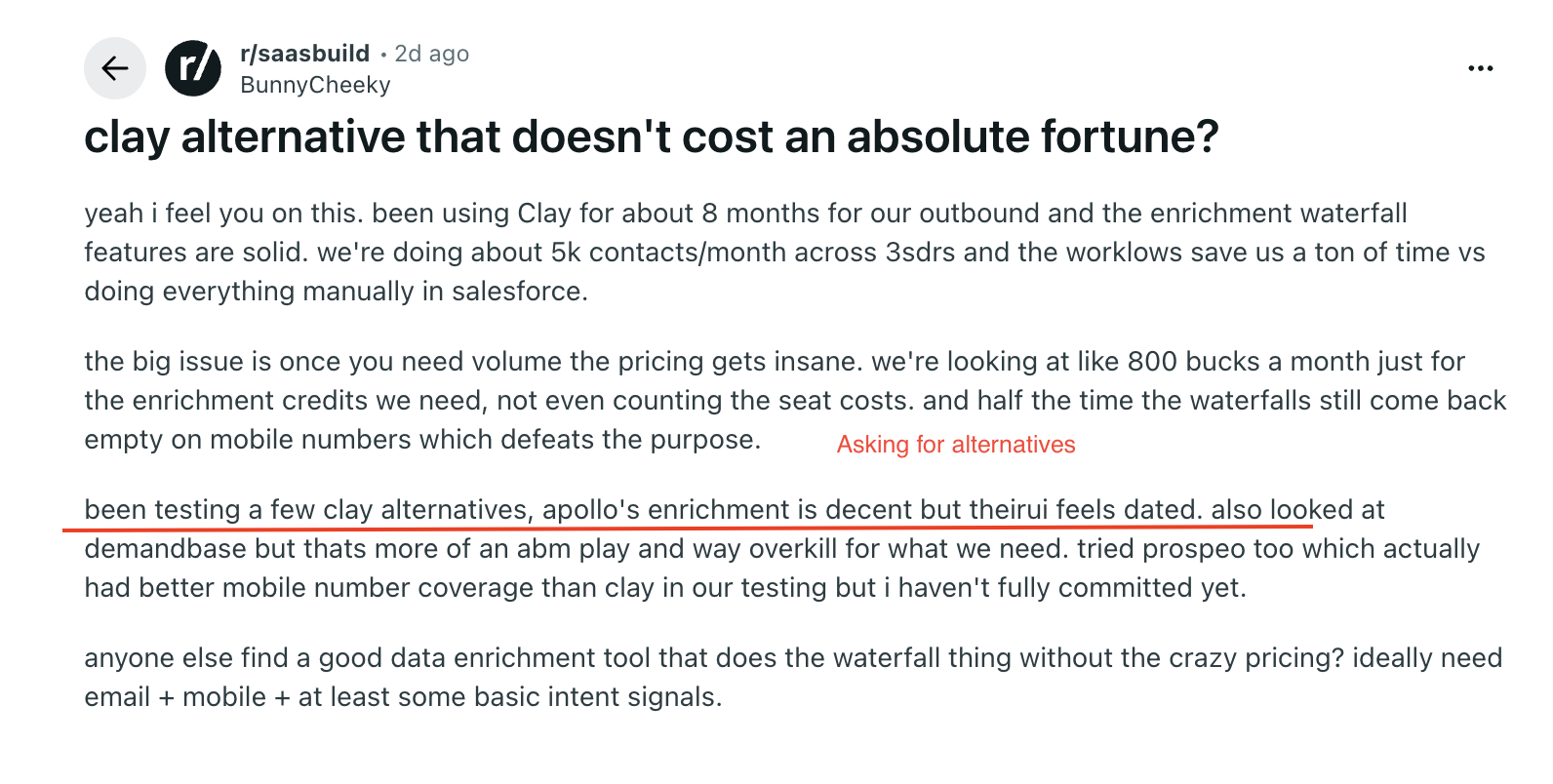
The phrases I would monitor every week:
"alternative to Apollo"
"Clay too expensive"
"how to migrate from HubSpot"
"replace Outreach"
"Salesloft vs Apollo"
"best tool for Reddit monitoring"
"GitHub intent signals"
4. Current-vendor complaints#
Complaints beat neutral research because the buyer has already named a cost.
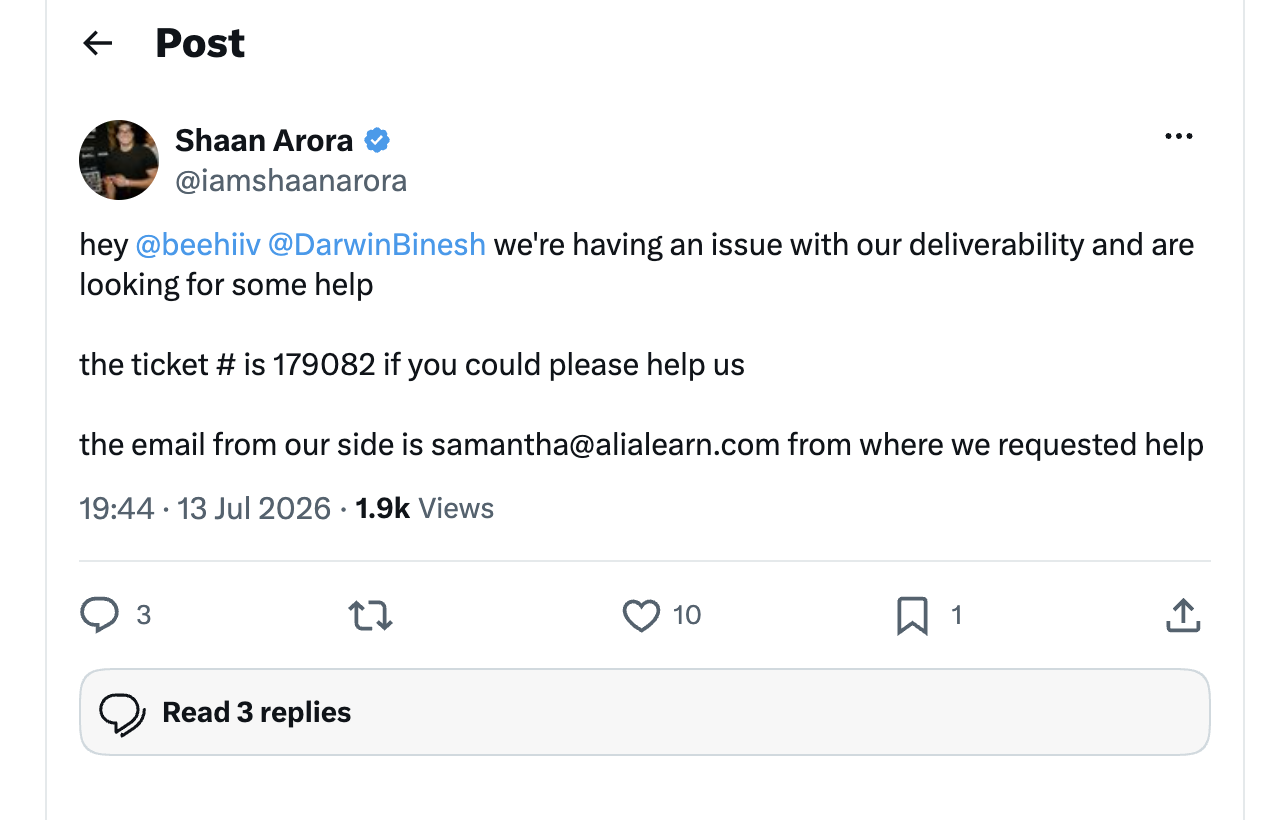
The complaints I take seriously are specific:
"We enrich too many contacts and half of them are not worth sending to."
"The alerts are noisy, and reps ignore them."
"We know people talk about us on Reddit, but we cannot turn that into pipeline."
"Our first lines still sound templated after all the enrichment work."
The move is to reflect the cost, then give the next step.
Example:
"The credit waste usually starts when teams enrich before they know the account has a live reason to buy. I would flip it: find the signal, score the account, then enrich the two or three people tied to that signal."
I like this signal because it protects the rep from fake personalization. The buyer has already told you what hurts. You do not need to invent relevance.
5. Pricing, budget, and procurement questions#
Pricing questions become useful when the buyer ties money to a situation.
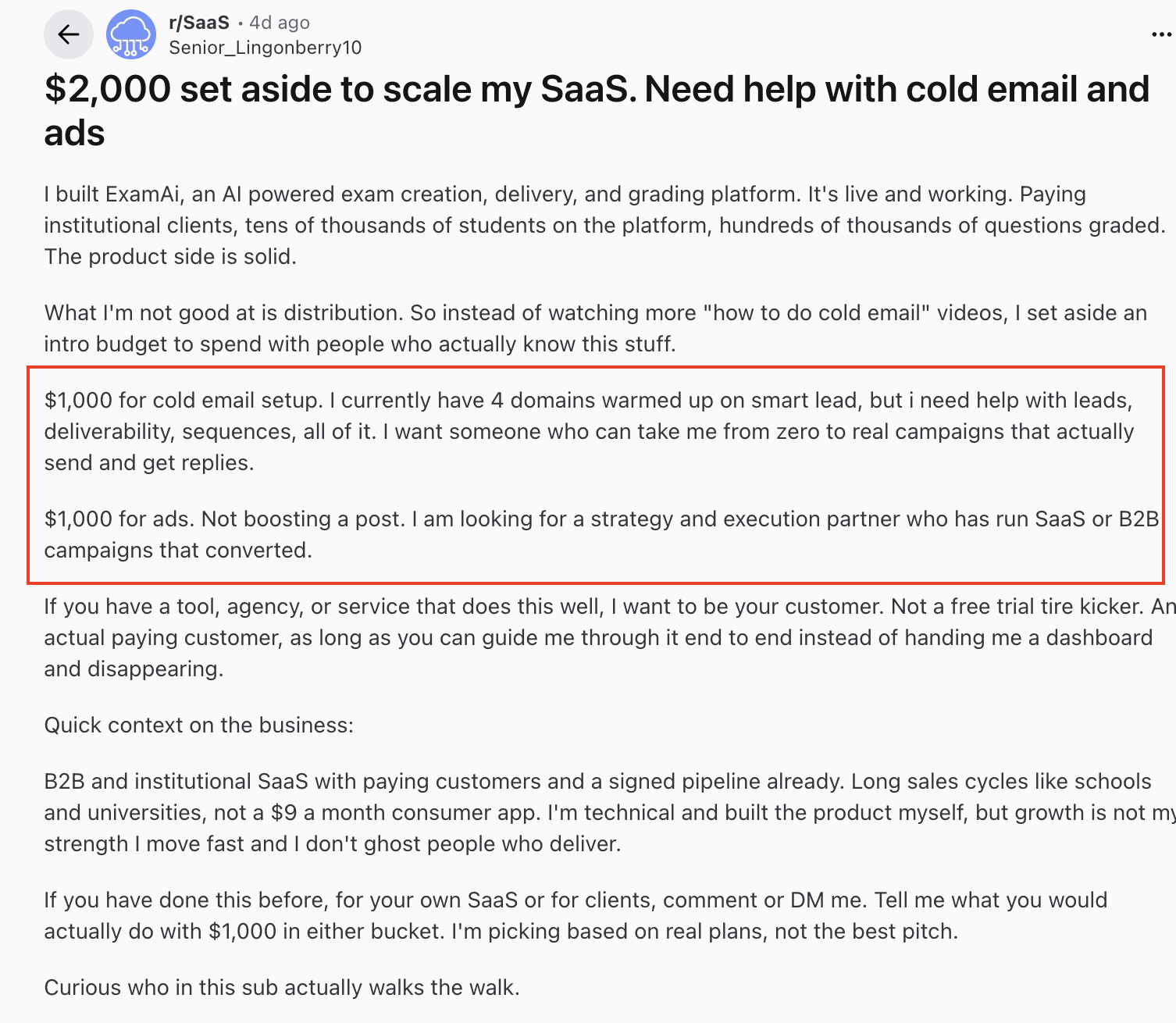
Strong Signal:
"Is $99 per month worth it if we only need Reddit, LinkedIn, and GitHub monitoring?"
Weak:
"This is expensive."
The first line gives you a use case and a buying limit. The second is a mood.
When I see a pricing question, I look for the missing piece. Is the buyer worried about seats, credits, volume, integrations, implementation time, or proof that the tool will find enough signals? The answer changes the outreach.
For CT, the honest answer is that a team should not buy signal software just to collect more mentions. Buy it when the output changes who gets emailed this week.
6. Repeat pricing and comparison page visits#
One visit is curiosity. Repeated visits from the same account are different, especially when the account also reads a comparison page, a case study, or integration docs.
The mistake is chasing one anonymous visitor. The better move is account-level.
I would check:
Did more than one person from the account visit buying-stage pages?
Is there a matching public signal, for example hiring or a tool complaint?
Which function owns the problem: sales, RevOps, marketing, engineering, security, or finance?
Can the first message mention a real workflow instead of a page view?
If the answer is yes, outreach is fair. If the only evidence is one page view, keep watching.
7. Demo requests and consultation requests#
A demo request is obvious, but teams still waste it by replying like they know nothing.
If the form says "buyer signals from Reddit and GitHub," the reply should not ask, "What are you hoping to solve?" You already have the first clue.
Better reply:
"You mentioned Reddit and GitHub signals. I will keep the call focused on how to rank posts, find the right contacts from those signals, and push only qualified contacts into your sequencer."
This is how a rep turns a raised hand into a real conversation. The buyer feels the context was carried forward.
Must Read: How to Generate Leads From Communities Without Sounding Like a Sales Rep
8. Buying committee activity#
One person browsing is interest. Three people from the same account touching pricing, integrations, security, and comparison pages is buying work.
I would split the account by role:
The sales leader cares about rep time and pipeline.
RevOps cares about routing, enrichment cost, and CRM hygiene.
Marketing cares about sources, messaging, and attribution.
Security or IT cares about access, data handling, and controls.
One email will not fit all of them. The signal tells you which conversation each person is probably having internally.
9. New executives in the buyer function#
A new CRO, VP Sales, VP Marketing, Head of Growth, RevOps leader, CIO, or CISO is useful because the first 90 days often include audits and vendor review.
The job change alone is weak. Pair it with another signal.
Stronger combinations:
New CRO plus SDR hiring.
New VP Marketing plus LinkedIn posts about category demand.
New RevOps leader plus job posts mentioning routing, enrichment, or intent data.
New CISO plus security compliance hiring.
Weak opener:
"Congrats on the new role."
Better opener:
"Saw you joined as VP Growth and the team is hiring for marketing operations. That usually means lead flow and account priority are being rebuilt. I would start by separating static-fit accounts from accounts with live intent."
10. Job posts tied to your category#
Job posts are operational notes written in public.
A LinkedIn job post for a growth operations role at Cover Genius, for example, mentions work around first-party web signals, third-party intent data, anonymous spikes, prioritized account lists, and BDR workflows. Read as sales context, it tells you the company is building a signal-to-sales motion.
The public LinkedIn job post is a useful example of how much sales context can sit inside a role description.
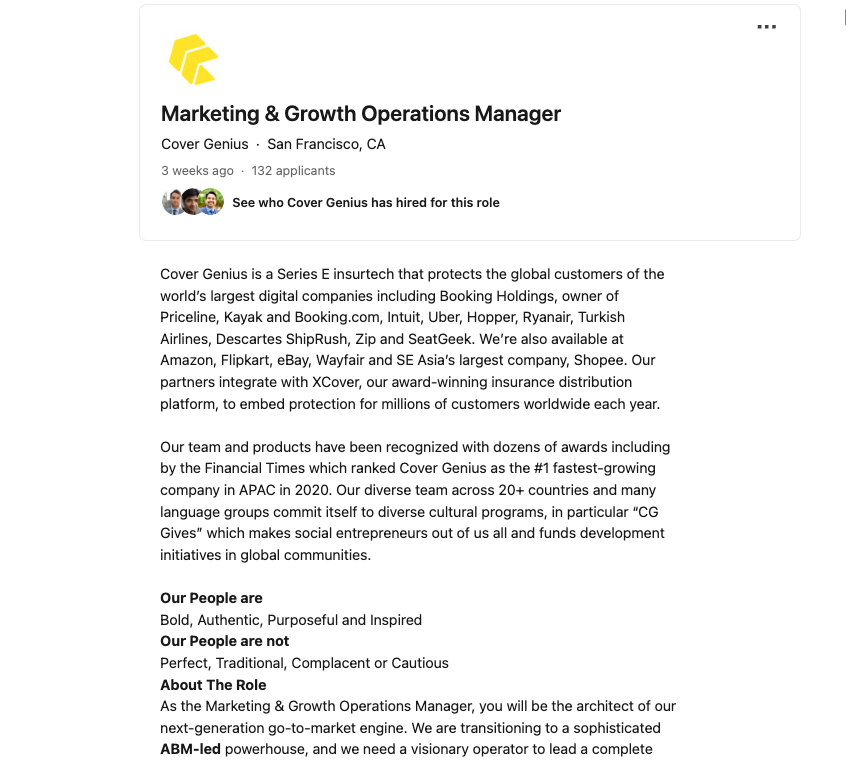
When I read a job post, I look for verbs: build, own, automate, replace, scale, route, integrate, migrate. Those words usually tell you where the budget is going.
11. Hiring velocity in one department#
Total hiring is vague. Department-level hiring is useful.
Five new SDR roles, two RevOps roles, and one growth operations role point to pipeline pressure. Security engineer hiring plus compliance roles point to audit and control work. Data engineering roles plus analytics tooling mentions point to warehouse or reporting work.
The email should name the pressure, not the hiring count.
Example:
"The SDR hiring push plus the RevOps role tells me account priority is about to matter more than list size. If reps get 2,000 enriched contacts with no live signal, the new headcount burns time fast."
12. Funding with matching operational pressure#
Funding alone is one of the most abused sales triggers.
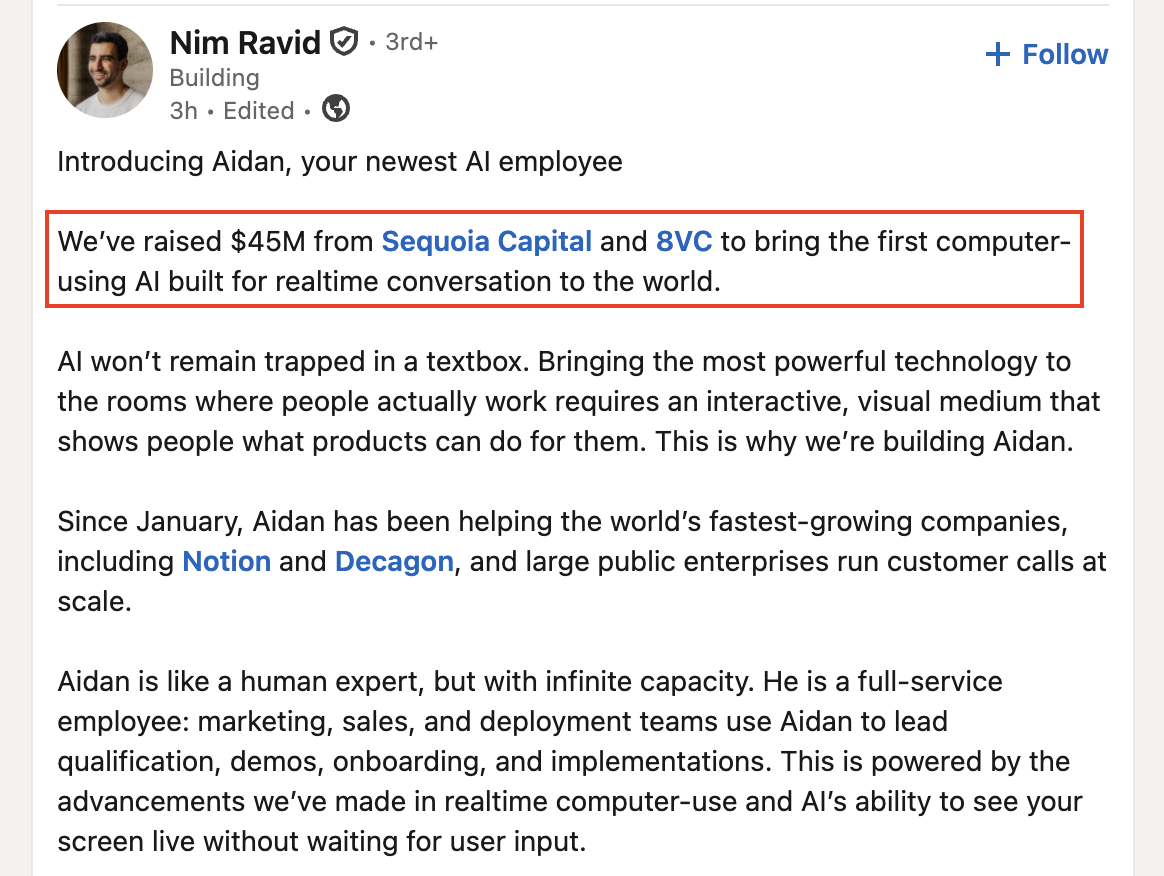
The signal gets useful when the company also shows how it plans to spend: sales hiring, market expansion, product launch, RevOps hiring, partner work, or new tooling.
Weak opener:
"Congrats on the Series B."
Better opener:
"The Series B plus the SDR hiring push tells me pipeline coverage is the near-term constraint. I would be careful about buying a broad contact list before you know which accounts are showing live intent."
Money plus motion is a signal. Money alone is a press mention.
13. New market expansion#
New markets change the buying motion. The team needs new language, new communities, new competitors, and new proof.
Examples I would act on:
A devtools company starts hiring enterprise solutions engineers after selling mostly to startups.
A cybersecurity company opens roles in DACH and starts posting in German.
A PLG SaaS company adds outbound SDRs after relying on inbound.
A services company launches a productized offer and starts asking for category feedback on LinkedIn.
The first message should connect the expansion to a workflow. For CT, that workflow is finding where buyers in the new market already ask questions before the company spends on broad outbound.
14. Product launch or new segment launch#
A launch creates a short window. Teams need demand, feedback, comparisons, and early objections.
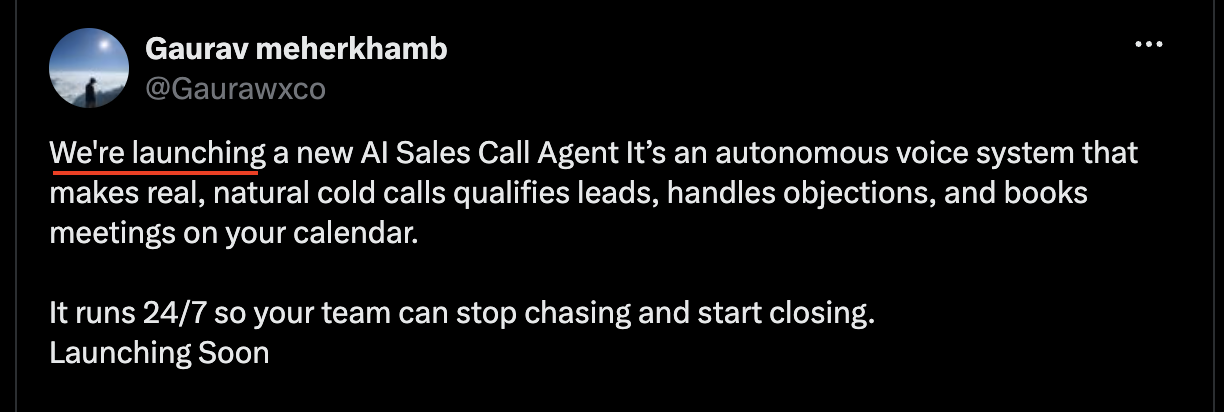
Product Hunt, LinkedIn launch posts, company blogs, GitHub releases, and community comments all help. I pay closest attention to the comments. They tell you what the market is confused about, which alternatives people name, and which use cases buyers care about first.
15. Tech stack changes#
"Uses Salesforce" is fit data. "Recently added Salesforce and hired a RevOps manager to rebuild routing" is a buying signal.
The same rule applies to most technographic data. A tool in the stack helps you segment. A change in the stack gives you timing.
Signals I would act on:
A company adds HubSpot and hires marketing ops.
A team removes a competitor from public docs.
A job post asks for experience with a tool your product integrates with.
GitHub issues mention migration from an old system.
A public template or docs page shows a new workflow.
16. GitHub issues about integration pain#
For devtools, security, data, API, infrastructure, and analytics products, GitHub can be better than a contact database.
An issue can show the exact blocker: migration failed, webhook retries are breaking, rate limits are painful, auth is confusing, data sync is unreliable, or a workaround has become permanent.
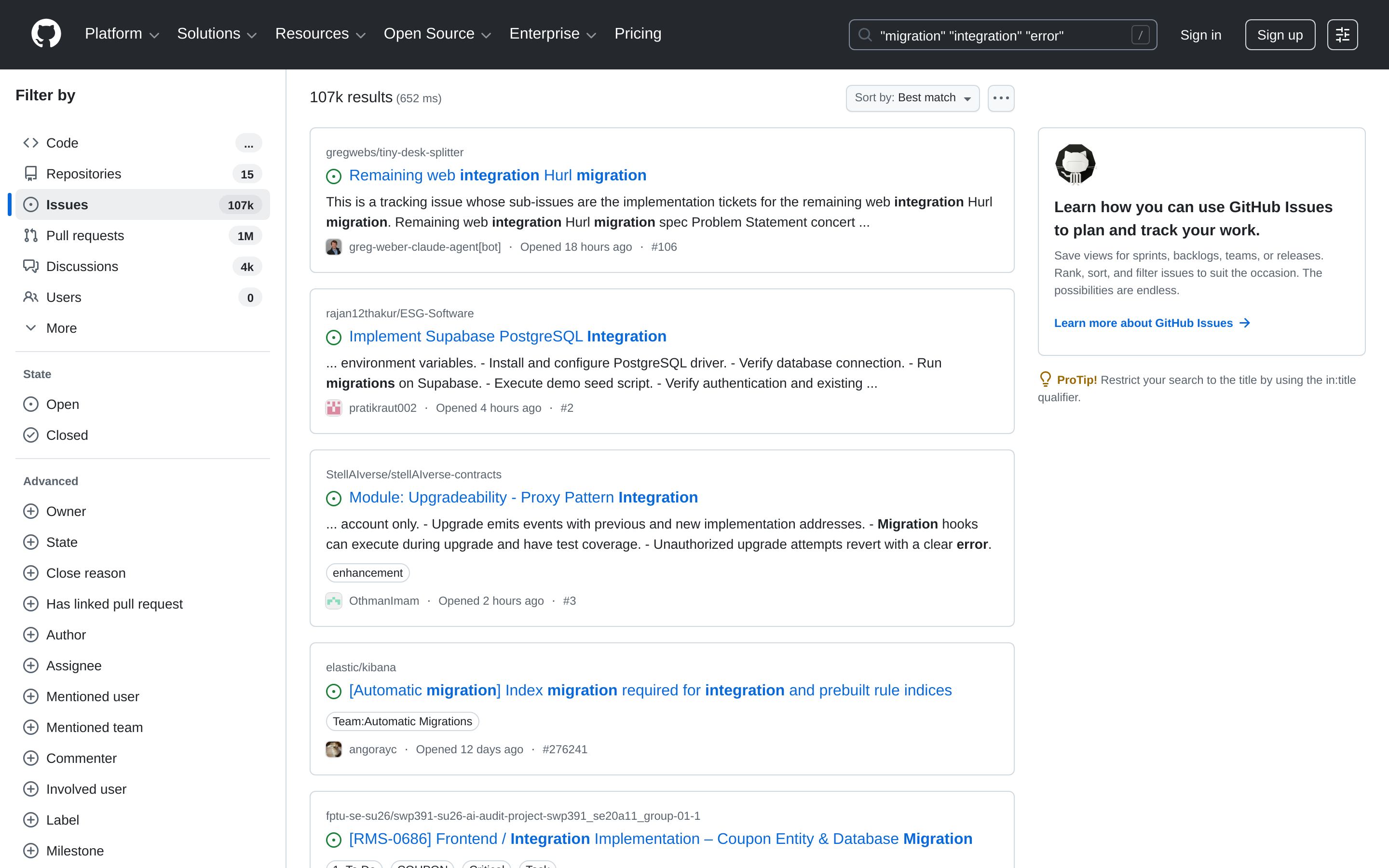
The wrong move is scraping every maintainer email. The right move is to understand the account, the blocker, and the person closest to the work.
17. Migration questions#
Migration language is one of my favorite signals because it means change is already being planned.
Queries worth tracking:
"migrate from HubSpot to Salesforce"
"move off Intercom"
"replace Segment"
"export Apollo contacts"
"sync GitHub issues to Linear"
"alternative to Clay"
The outreach should help with the migration before it sells the product. A checklist, risk note, or tradeoff lands better than a demo ask.
18. Compliance deadlines and audit pressure#
Deadlines create urgency. That is true for SOC 2, privacy work, security questionnaires, procurement requirements, finance reporting, and healthcare or fintech controls.
The signal often appears in job posts, security pages, customer docs, support threads, and LinkedIn posts from the owner.
19. Security incidents or audit prep#
This signal needs restraint.
Do not use an incident as a cheap hook. Use public information only when your product clearly helps with prevention, evidence, control gaps, or response workload.
Good outreach names the work:
"I saw the team is hiring for security compliance and publishing more customer-facing security docs. Teams at that stage usually need a faster way to answer enterprise security reviews."
Bad outreach names the fear.
20. Missed revenue targets or efficiency pressure#
For public or late-stage companies, earnings calls and investor updates can expose the exact operating pressure: sales productivity, customer acquisition cost, retention, expansion, margin, or enterprise pipeline.
This is useful only when your product maps cleanly to the pressure.
If leadership says sales productivity is the issue, a signal-first outbound message can talk about rep time, bad account priority, and enrichment waste. If leadership talks about retention, the same message is probably wrong.
Use the company's words, then make one operational point.
21. Layoffs in a function you support#
Layoffs are sensitive. Treat them as workload context, not a sales angle.
I would only act when the account still has an active workflow your product can reduce:
A smaller RevOps team has to keep routing clean.
A smaller sales team has to protect rep time.
A smaller marketing team has to find demand without running more campaigns.
A smaller support team has to answer more technical questions.
Do not open with "saw the layoffs." Open with the work that became harder.
22. Partner, customer, or integration announcements#
A partner announcement or customer win can create follow-on work: onboarding, co-marketing, integration support, compliance, partner pipeline, training, and reporting.
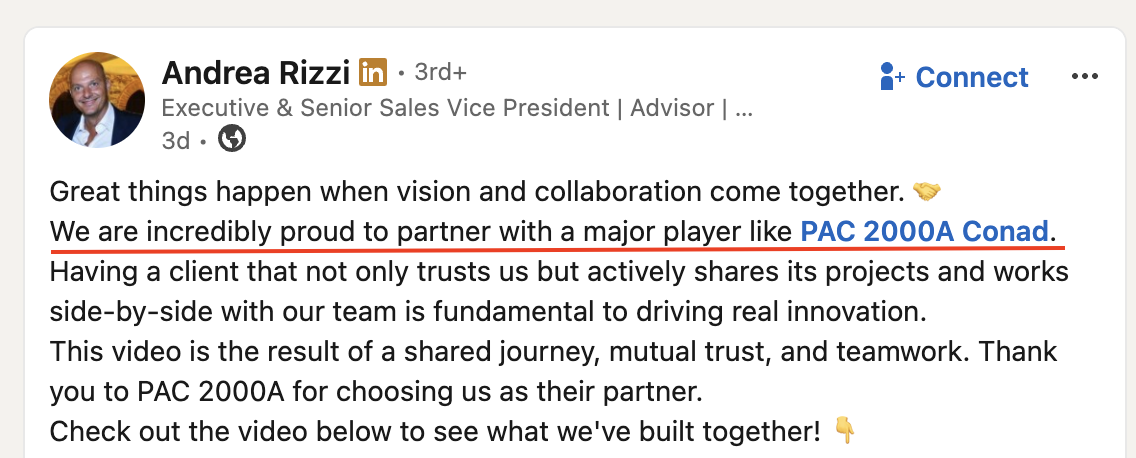
The outreach should name the next bottleneck.
Weak:
"Congrats on the partnership."
Better:
"The new partner channel will probably create more second-degree buyer conversations in Slack and LinkedIn communities. If those questions never reach sales, the partner motion loses signal."
23. Narrow event attendance#
Event attendance is a medium signal. The topic matters more than the attendance.
I would pay attention to:
"How to migrate from HubSpot to Salesforce"
"SOC 2 readiness for seed-stage SaaS"
"Reddit demand capture for B2B SaaS"
"Outbound deliverability after Gmail sender rules"
I would ignore generic attendance unless another signal is attached.
24. Signal stacks on one account#
This is where signal work becomes revenue work.
One signal creates a hypothesis. A stack tells you the account is moving.
Example stack:
A VP Growth joins.
The company posts two SDR roles and one RevOps role.
A team member asks on LinkedIn how to prioritize intent data.
A Reddit thread mentions the company's category and a competitor.
Someone from the account visits your comparison page twice.
I would put that account ahead of a clean but silent ICP match every time.
The 12 signals I would not trust alone#
These are useful for filtering, routing, or context. They do not predict revenue by themselves.
Job title | It shows persona, not timing | ICP fit | Live pain or project context |
Company size | It shows segment | Territory and routing | Department pressure |
Industry | It shows relevance | Message angle | A specific workflow signal |
Funding alone | It shows possible budget | Watchlist | Hiring, expansion, or stated plan |
Generic LinkedIn like | It shows light engagement | Warm context | Comment or repeated category activity |
Newsletter signup | It shows learning interest | Nurture | Product or comparison behavior |
Single blog visit | It shows curiosity | Retargeting | Repeat buying-stage visits |
Ebook download | It shows topic interest | Education | Role fit plus buying action |
Generic webinar attendance | It shows broad learning | Nurture | Narrow topic or follow-up question |
Installed technology | It shows stack fit | Segmentation | Recent change or integration pain |
Old job post | It shows stale intent | Background | Active hiring |
Enriched email | It shows contactability | Sequencer routing | A live reason to contact |
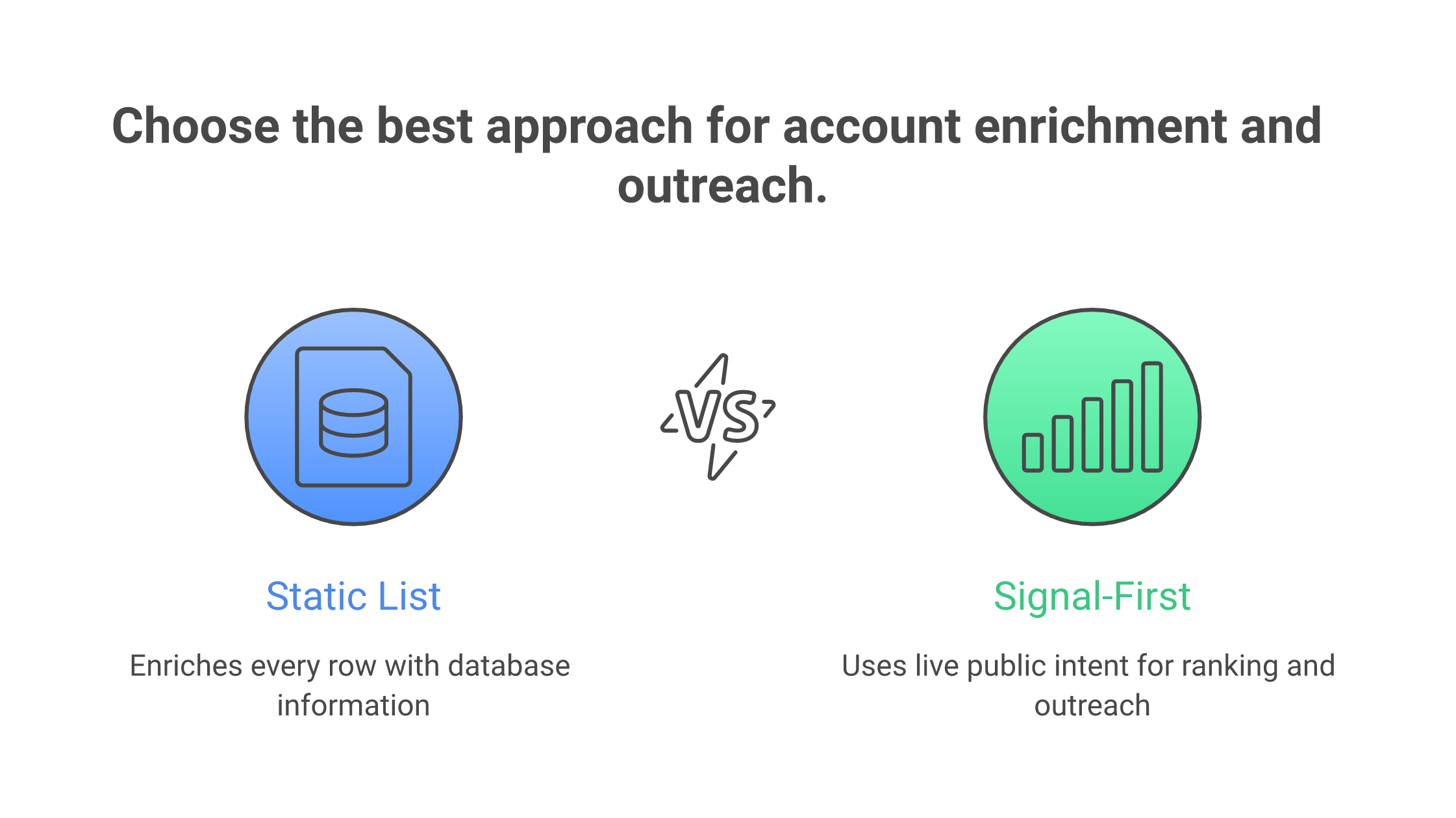
Static enrichment becomes dangerous when it feels complete. The row has a name, title, company, email, industry, headcount, revenue estimate, and tool stack. It looks sales-ready. It still may have no reason to receive an email.
The better order is signal first, enrichment second.
Find the live signal. Match it to the account. Decide whether the account fits. Find the relevant person. Enrich only that person. Write the first line from the signal. Push the contact into the sequencer only when the message has a reason to exist.
Outreach examples from real signal types#
The first line is where signal quality shows up. If the first line sounds like a mail merge, the signal was probably too weak.
Reddit or community pain post#
Signal:
"We are trying to find people talking about our competitors across Reddit and LinkedIn, but alerts are too noisy."
Opening line:
"Saw your note about noisy Reddit and LinkedIn alerts. Keyword matching can catch mentions, but it usually fails at ranking which posts deserve sales follow-up."
Next move:
Share a filter based on pain language, account fit, source, and recency.
Offer to inspect a few example posts.
Keep the pitch out until the signal is understood.
LinkedIn hiring signal#
Signal:
A growth operations job post mentions intent data, lead routing, and prioritized account lists for BDRs.
Opening line:
"The growth ops role mentions turning intent spikes into account lists for BDRs. That model usually breaks when enrichment happens before signal scoring."
Next move:
Ask how accounts are being prioritized today.
Share a simple scoring model.
Route the thread to RevOps or growth leadership.
GitHub migration issue#
Signal:
An engineer opens an issue about webhook retries breaking a CRM sync.
Opening line:
"Saw the GitHub issue about webhook retries during the CRM sync. The risky part is usually duplicate lifecycle updates after retries, not the retry logic itself."
Next move:
Share a technical checklist.
Offer a migration path.
Bring in sales only if the blocker maps to a buying project.
Must Read: How to Track Developer Discussions on GitHub Without Manually Reading Every Thread
Dev.to or Stack Overflow implementation question#
Signal:
A developer asks how to automate a manual handoff between GitHub issues and a customer support workflow.
Opening line:
"Your Dev.to question about moving GitHub issue context into support looks like a handoff problem between engineering and CX. I would start by deciding which issue fields actually need to follow the customer."
Next move:
Help with the workflow first.
Check whether the company fits your market.
Follow up only if the problem is recurring.
Where CommunityTracker fits#
CommunityTracker belongs after the signal appears and before the email goes out.
The useful workflow is signal to email-ready action. CommunityTracker watches the places where buyers actually talk: Reddit, LinkedIn, X, Bluesky, Hacker News, Indie Hackers, Dev.to, Stack Overflow, Product Hunt, GitHub, and Slack.
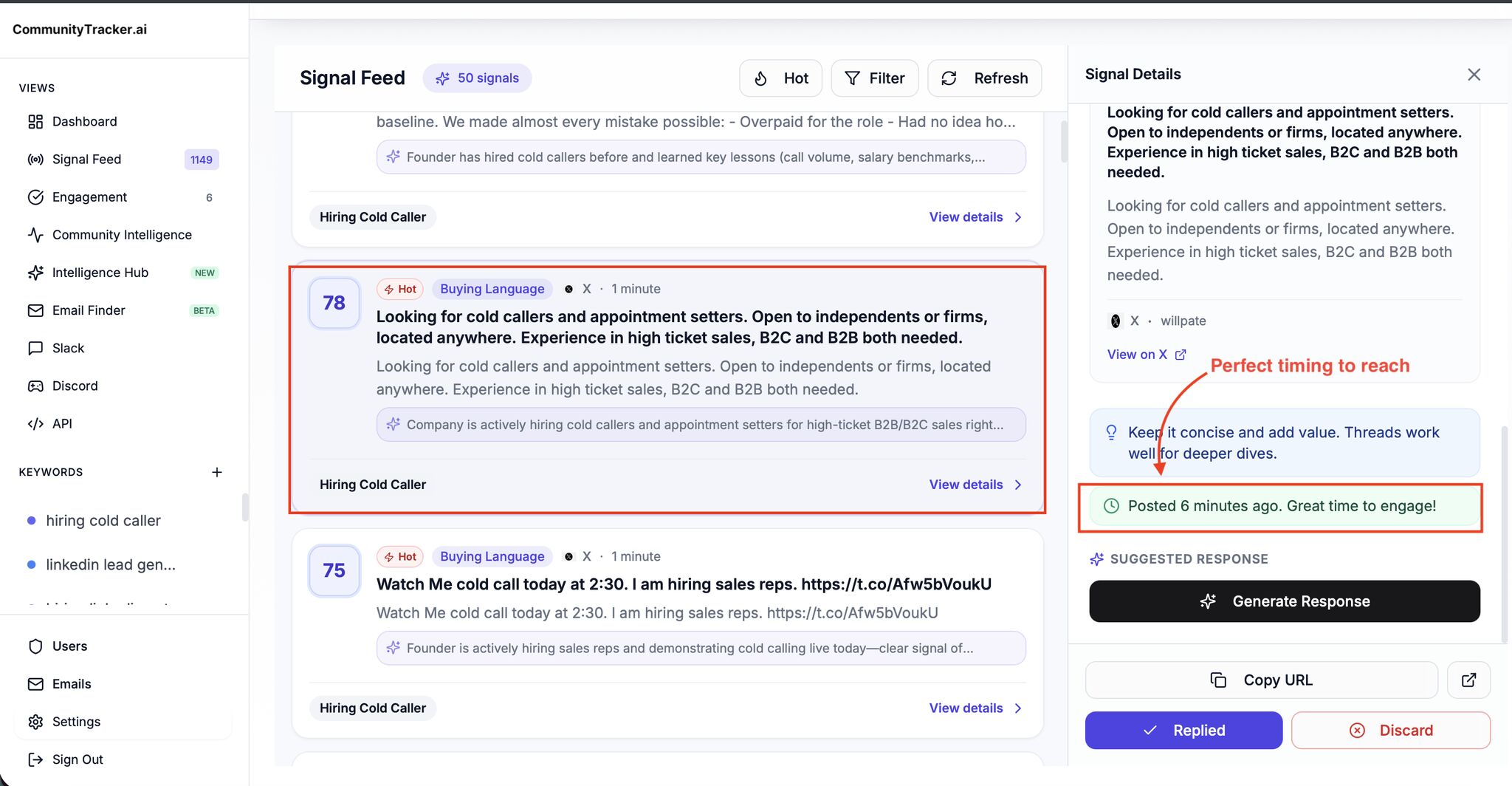
It looks for the accounts with a current reason to be contacted, then helps your team decide which signals deserve outreach this week.
The important part is what happens after the signal appears.
If a founder complains on Reddit that Apollo lists are not giving them relevant accounts, CommunityTracker should help you tag that as vendor dissatisfaction, match it to the company, find the likely buyer or operator, pull the email when it is useful, write a first line around the complaint, and send the contact to the sequencer you already use.
If a RevOps job post on LinkedIn mentions intent data, routing, and BDR account lists, CommunityTracker should help you treat that as a workflow signal, not a recruiting update.
If a GitHub issue shows migration pain around a tool your product replaces or integrates with, CommunityTracker should help you keep the first message technical enough that it does not sound like a scraped trigger.
Build a signal workflow this week#
Start small. Do not build a 100-signal dashboard before your reps trust the first 10 signals.
Pick one segment and run these searches:
Your competitor plus "alternative," "too expensive," "migration," or "replace."
Your buyer's workflow plus "what tool," "how do you," or "any recommendations."
Your category across Reddit, LinkedIn, GitHub, Dev.to, Stack Overflow, Product Hunt, and Slack.
Job posts for your buyer function with verbs like build, automate, route, migrate, replace, or scale.
Then score each account from 0 to 10:
Fit: Is the account in your ICP?
Pain: Did the signal name a real problem?
Recency: Did it happen in the last 30 days?
Contact path: Can you find the person or team tied to the signal?
First line: Can you write a useful opener from the evidence?
Send this week when the score is 8 or higher. Watch for another signal when the score is 5 to 7. Ignore or nurture when the score is lower.
The best list of B2B buying signals is the one that keeps bad contacts out of your sequencer.
Try CommunityTracker Now and Start Monitoring Social Media Buyer Signals