Meltwater Pricing in 2027: How Quotes and Contracts Usually Break Down
Meltwater pricing in 2027 is still quote-only. Indicative floors start at $10,000 a year, buyers' median is $25,800, and contracts run 12 to 36 months.
Adarsh Kumar
GTM Expert
Founder — CommunityTracker, Miraa.io, and Infraboxes
You’re looking up Meltwater pricing because a demo is booked, a quote is sitting in your inbox, or finance wants a number that still holds after the first year.
Finance teams now treat a cap on renewal increases, and a shorter notice window, as part of the price they are buying, not as fine print to sort out later.
I’m sure you’ve tried a demo booking, a first quote, or a buyer-reported median, and still landed here unsure what year two will cost.
Work through these steps to size a Meltwater quote on modules, seats and term, check the renewal clauses that change the bill, and compare CommunityTracker when you need scored buyer threads instead of a media suite.
TL;DR: Meltwater still sells on a custom quote, and the four plan cards (Starter, Pro, Enterprise, Agency) each go through Contact Sales with no public price on the card. For early budgeting, indicative starting points are $10,000 a year for Starter, $25,000 a year for Pro, and $130,000 a year for Enterprise, in USD. Those are ranges, not a quote. I’d sign 12 months, cap the renewal in the order form, and set a calendar reminder for the 60-day notice before I talk discount. Skip Meltwater if the job is a scored buyer queue rather than a media-intelligence suite. CommunityTracker starts at $39 a month.
What Meltwater costs
Meltwater is a quote-only media-intelligence suite. You will not get a self-serve checkout price. I’d treat the indicative yearly starting points as a first budget, then size the quote on modules, seats, regions and contract term, and I’d model years two and three before I sign.
1. Read the four plan cards, then use the indicative ranges only as a starting budget
Meltwater sells four plans: Starter, Pro, Enterprise and Agency. Each plan goes through Contact Sales. None of the four plan cards carries a public price.
Starter, Pro, Enterprise and Agency can all include Social listening, Media Intelligence, Media Relations and AI Visibility Tracking. Influencer Marketing sits on Enterprise and Agency. The API and MCP access sits on Enterprise and Agency. Mira AI sits on every plan, with a more advanced version on Pro and Agency, and an enterprise-grade version on Enterprise. Support is Standard on Starter, Advanced on Pro and Agency, and Premium on Enterprise.
Meltwater does not publish a fixed public price list. It does publish indicative starting points, in USD, for early budgeting: $10,000 a year for Starter, $25,000 a year for Pro, and $130,000 a year for Enterprise. Agency has no public indicative floor. Those figures are starting ranges for typical setups, and the actual quote moves with scope, users, region and contract terms.
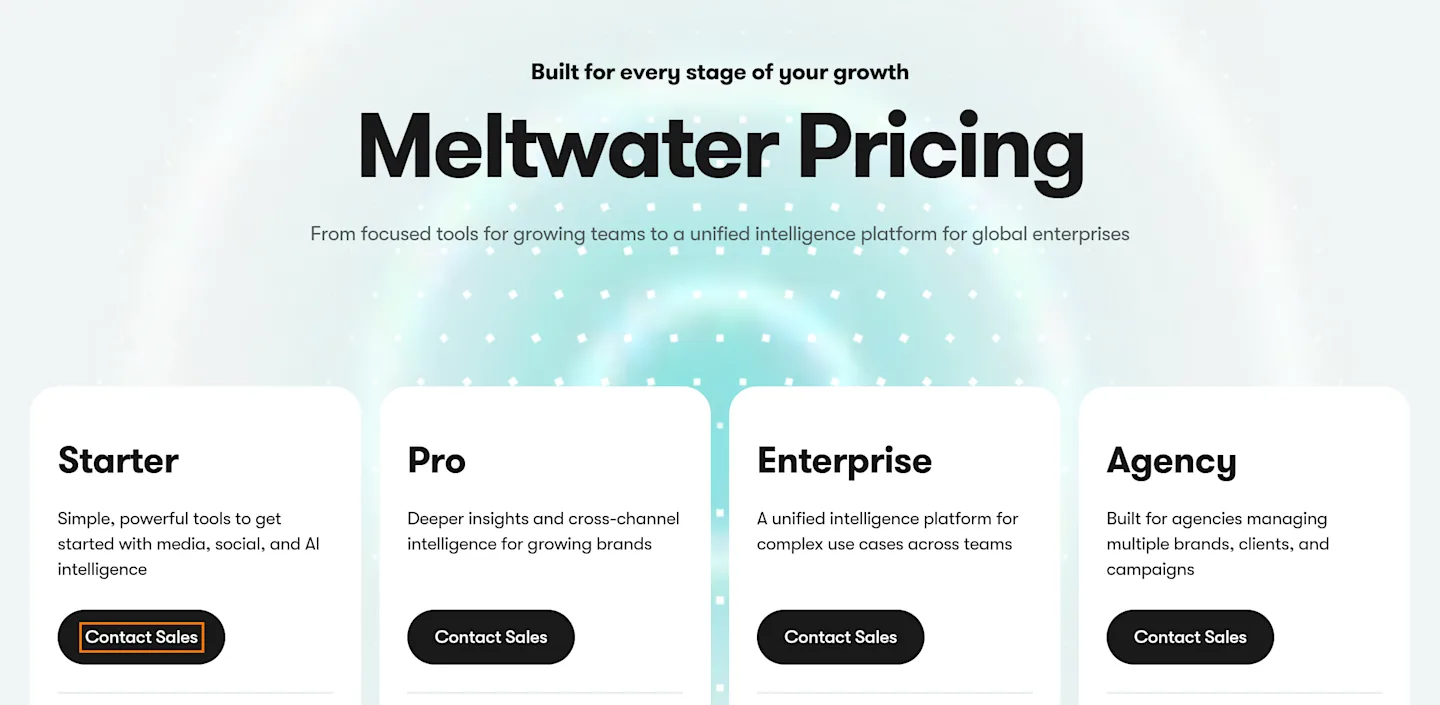
I’d read the four Contact Sales cards first, then I’d use the indicative yearly starting points only as a budget, never as the number I take to finance.
There is no self-serve free trial on Meltwater. A human-guided walkthrough is the path in. Most agreements are annual, with a 12-month minimum.
2. Size the quote on modules, seats and regions before you talk to sales
The quote is built around the modules you pick, the number of users, the sources and regions you monitor, data volume, tool connections, onboarding and the contract term.
I’d walk into the sales call with that list written down, because a vague brief tends to come back as a larger package.
Across 126 Meltwater purchases tracked by Vendr through February 2026, the median buyer pays $25,800 a year, the low is $5,375, the high is $56,993, and buyers save 15% on average. Vendr’s count of 91 handled deals puts average savings at 15.23%. I’d treat the median as what negotiated buyers paid, not as a list price.
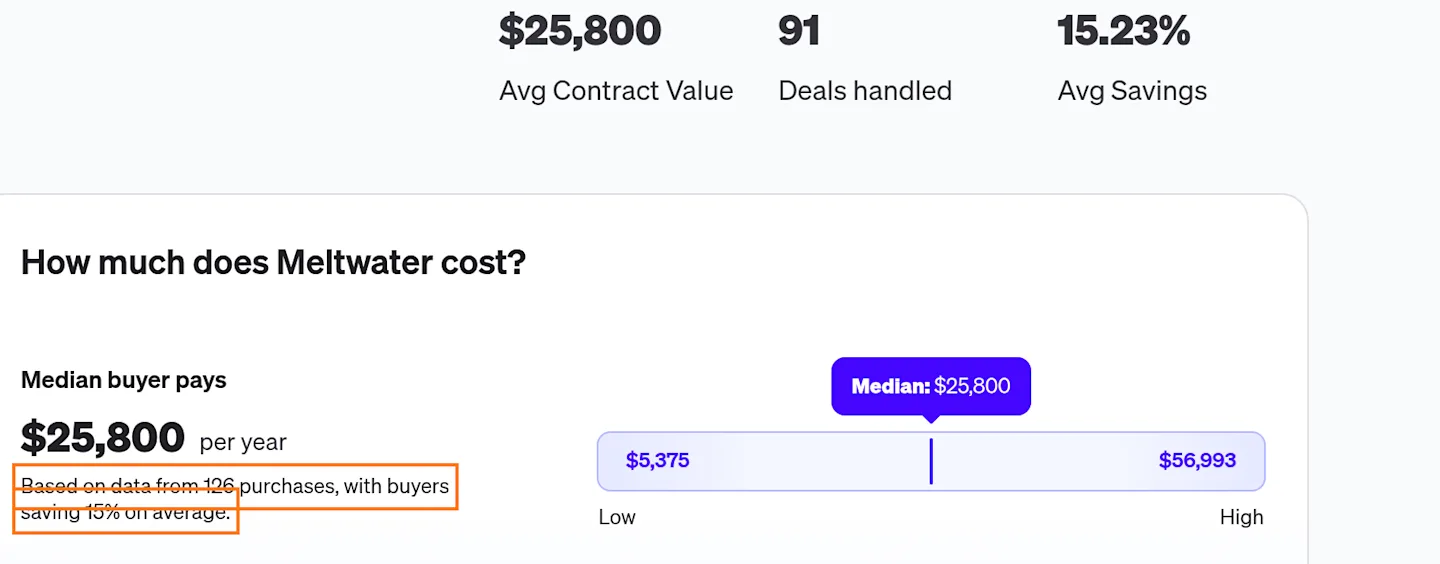
I’d read this Vendr panel for the spread between low and high contracts before I accept a first quote.
Vendr also breaks typical annual contracts down by team size:
Buyer | Typical annual contract (Vendr) |
|---|---|
Small team, 1 to 5 users, single-region media monitoring | $15,000 to $30,000 |
Mid-market, 5 to 15 users, several modules | $40,000 to $80,000 |
Enterprise, 15+ users, global coverage | Above $100,000, some at $150,000 or more |
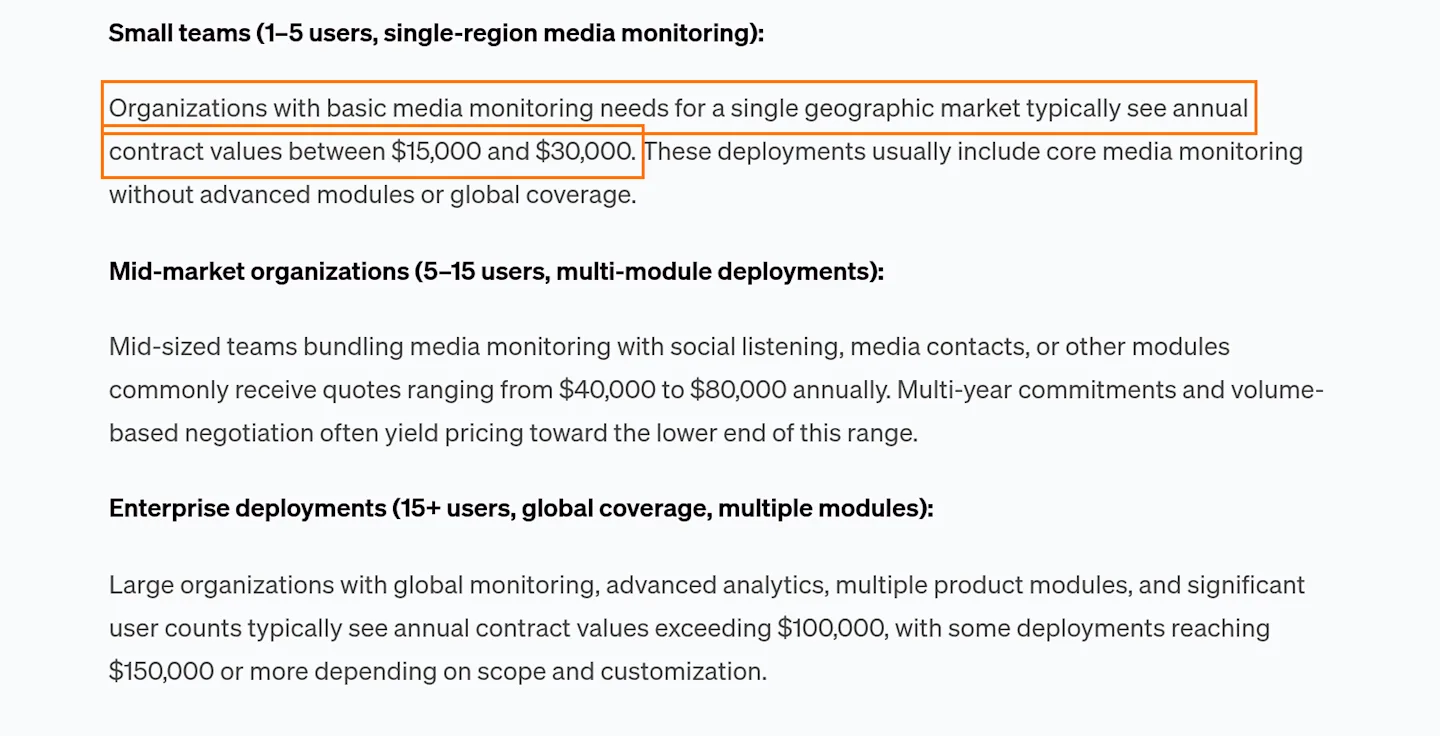
I’d map my headcount and regions to Vendr’s team-size bands before I treat the $10,000 a year Starter floor as enough.
Vendr also prices add-on modules, each per year:
Social listening added to media monitoring: $10,000 to $30,000
Media contacts database: $5,000 to $15,000
Influencer marketing: $10,000 to $25,000
A team that starts on single-region monitoring at $20,000 and adds the contacts database at $10,000 lands at $30,000 a year before onboarding. That’s the top of Vendr’s small-team range from one add-on.
3. Sign 12 months and cap the renewal before you talk discount
The quote is what you pay in year one. The contract decides years two and three. I’d sign 12 months and cap the renewal before I talk discount.
Meltwater’s standard contract term is 36 months, with a 12-month minimum. Expect the rep to start at three years.
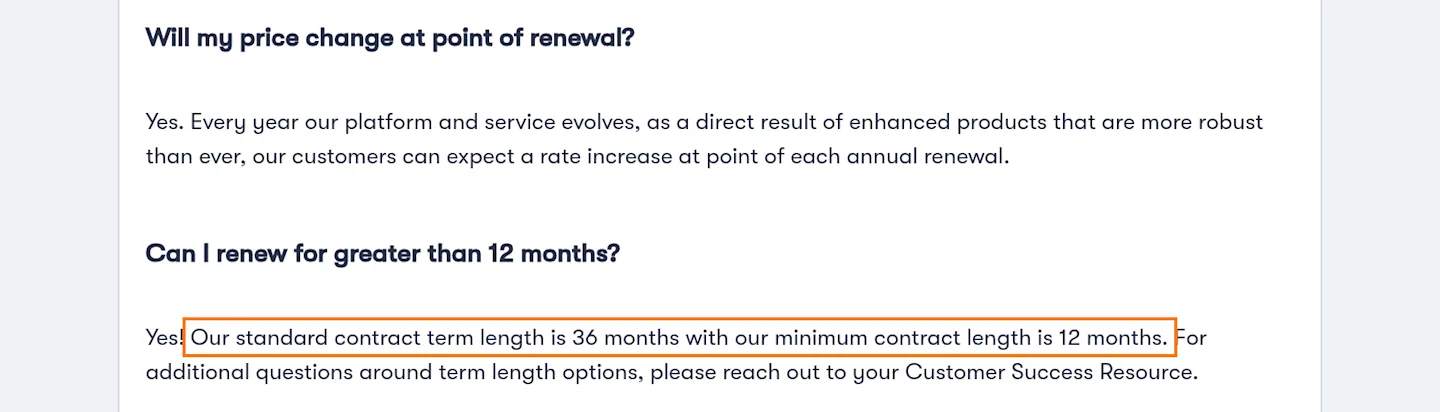
I’d take the 12-month minimum, and I’d only accept 36 months with a renewal cap and an exit after year one.
Customers can expect a rate increase at each annual renewal. Vendr puts typical escalation at 3% to 7% a year.

I’d put a cap in the order form, inside or below Vendr’s 3% to 7% range, before I accept a year-one discount.
Meltwater’s US terms, dated 5 April 2025, auto-renew at the prices then in force. Special pricing and payment terms apply only to the initial term.

I’d get the discount written into renewal terms, because a year-one cut does not carry forward on its own.
Under the US terms, you halt auto-renewal with written notice that lands 60 days or earlier before the end date. Miss it and the contract renews for the same length as the last term.
Auto-renewal is opt-in under the FAQ but automatic under the terms, so check that your order form names the renewal setting you agreed to.
If your term ends 31 December 2027, your notice has to land by 1 November 2027. On a 36-month deal, a missed date commits you to another three years.
4. Price onboarding, mid-term add-ons and the three-year bill before you sign
I’d treat onboarding, mid-contract add-ons and the non-refund rule as part of the price, because they do not appear on the plan cards.
Meltwater invoices standard contracts annually up front, with payment due in 14 days. The US terms make payment obligations non-cancellable and fees non-refundable.

I’d add the non-refund rule to the three-year model, because once you pay, that money does not come back.
Meltwater may charge a one-time implementation or onboarding fee for complex setups, such as custom connections, data imports or multi-region configurations. Vendr puts onboarding and training at $2,000 to $10,000.
Adding modules, coverage or usage during the term is handled case by case. Mid-contract add-ons often price at or above list, so put expected growth in the first contract.
I’d model the 36-month invoice before I sign, because special pricing applies only to the initial term.
This is a worked example from Vendr’s public median and from that initial-term clause, not a quote you’ll be handed. Your order form can write a different deal, and it should. Vendr’s $25,800 is a company-level median contract value, not a per-user price. I’ll apply it to a five-user team, then divide that median by five. The per-user figure is my arithmetic, not Vendr’s.
Year 1: $25,800, paid up front within 14 days of the invoice.
Year 2 at a 5% increase (inside Vendr’s 3% to 7% range): $27,090.
Year 3 at another 5%: $28,444.50.
Three-year total: $81,334.50.
Per user per year in year 1, from my division of that company-level median: $25,800 / 5 = $5,160.
Add onboarding at the low end of Vendr’s range ($2,000) and the three-year total reaches $83,334.50.
Now run the same math if your discount drops off at renewal. The list quote was $30,000 and you negotiated 15% off, so year one costs $25,500.
If the discount carries over with a 5% increase, year two costs $26,775 and year three $28,113.75.
If each renewal resets to list plus 5%, year two costs $31,500 and year three $33,075.
The gap: $4,725 in year two and $4,961.25 in year three, $9,686.25 across both.
That $9,686.25 is what you pay for leaving special pricing out of the renewal terms.
I’d negotiate the renewal first, then the year-one number.
Ask for 12 months. Accept 36 only with a renewal cap and an exit after year one.
Put a renewal cap in the order form. Vendr’s example puts the cap at 3% to 5% a year.
Extend special pricing to renewal terms in writing.
Get onboarding included. Vendr’s $2,000 to $10,000 range is real money, and it is negotiable.
Bundle the modules you’ll need in year one. Mid-contract add-ons cost more.
Bring a competing quote. Buyers who compare often land 15% to 25% below the first quote.
Meltwater’s fiscal year ends in December, so the last quarter is when reps want to close.
Set a reminder 90 days before the term ends. That gives you 30 days of slack on the 60-day notice.
What buyers report about the price
I’d read the contract reviews before I sign a 36-month term, because several buyers flag auto-renewal and price increases, not the monitoring itself.
A January 2026 Software Advice review by Rishikesh M. is titled “Meltwater is useful for tracking media and social conversations at scale.” It includes the line “I have been using Meltwater regularly to track media coverage and social conversations for multiple brands.” Value for money is scored 5.
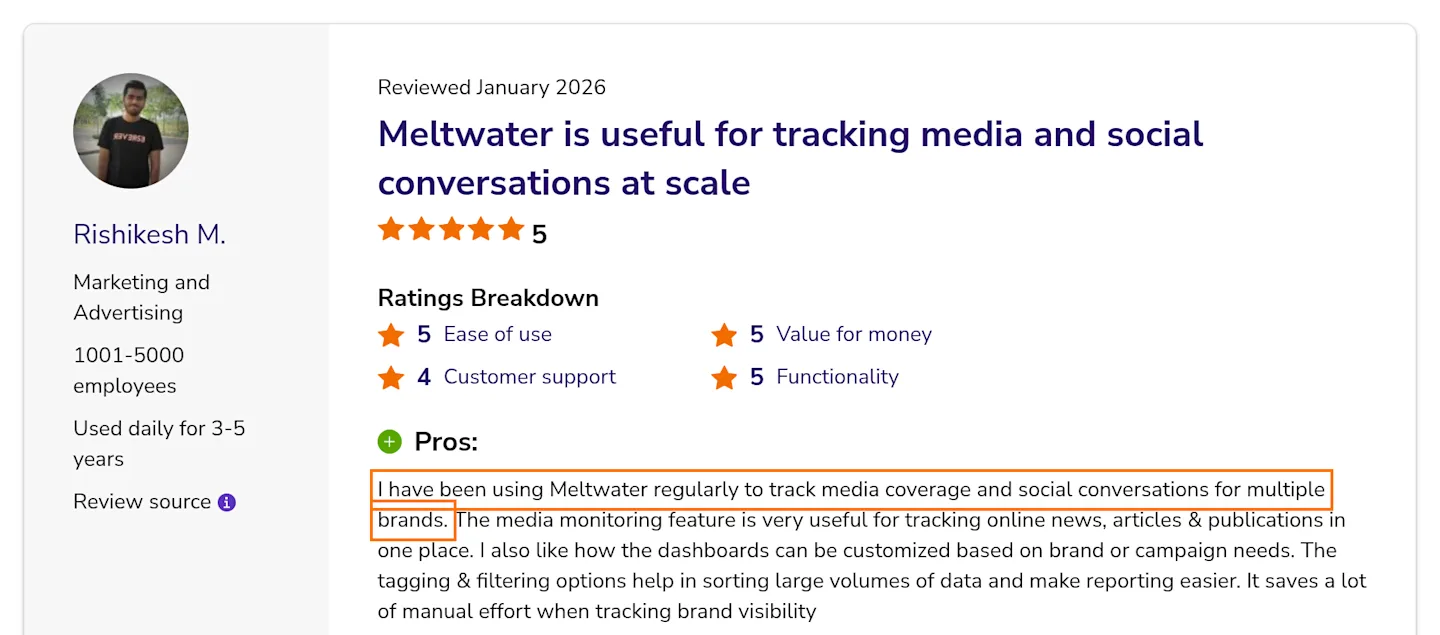
Rishikesh M., Software Advice, January 2026, on tracking coverage for multiple brands.
A February 2, 2024 TrustRadius review (Incentivized, over 12 months old) by Julie Collins is titled “Decent tool, but, in my opinion, not a company you want to partner with!” It includes the line “In my experience, sales reps will push you into signing multi-year agreements to avoid steep year over year price increases.”
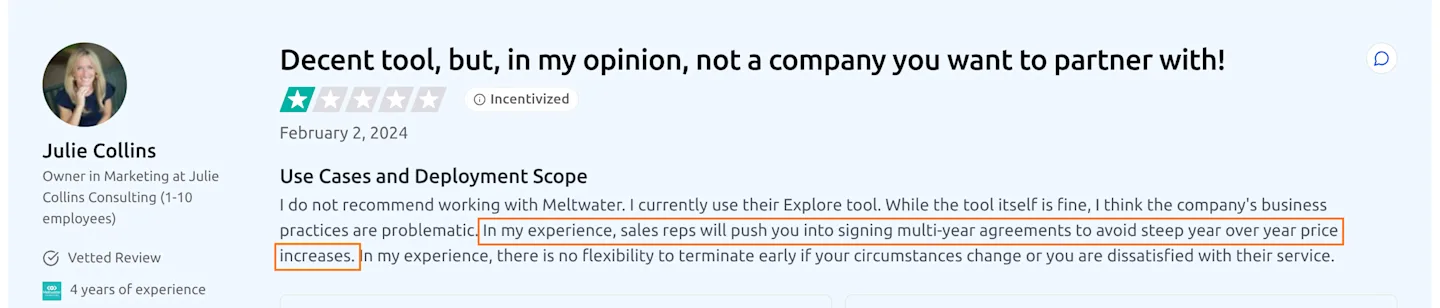
Julie Collins, TrustRadius, 2 February 2024, Incentivized, over 12 months old, on multi-year agreements.
A May 7, 2024 Trustpilot review (over 12 months old) by Shaun Shelly is titled “More like a Multi-Level scam.” It includes the line “The contract renews automatically unless you cancel within three months of the end of the contract.” The US terms set written notice at 60 days, so read the order form and don’t rely on a remembered window.
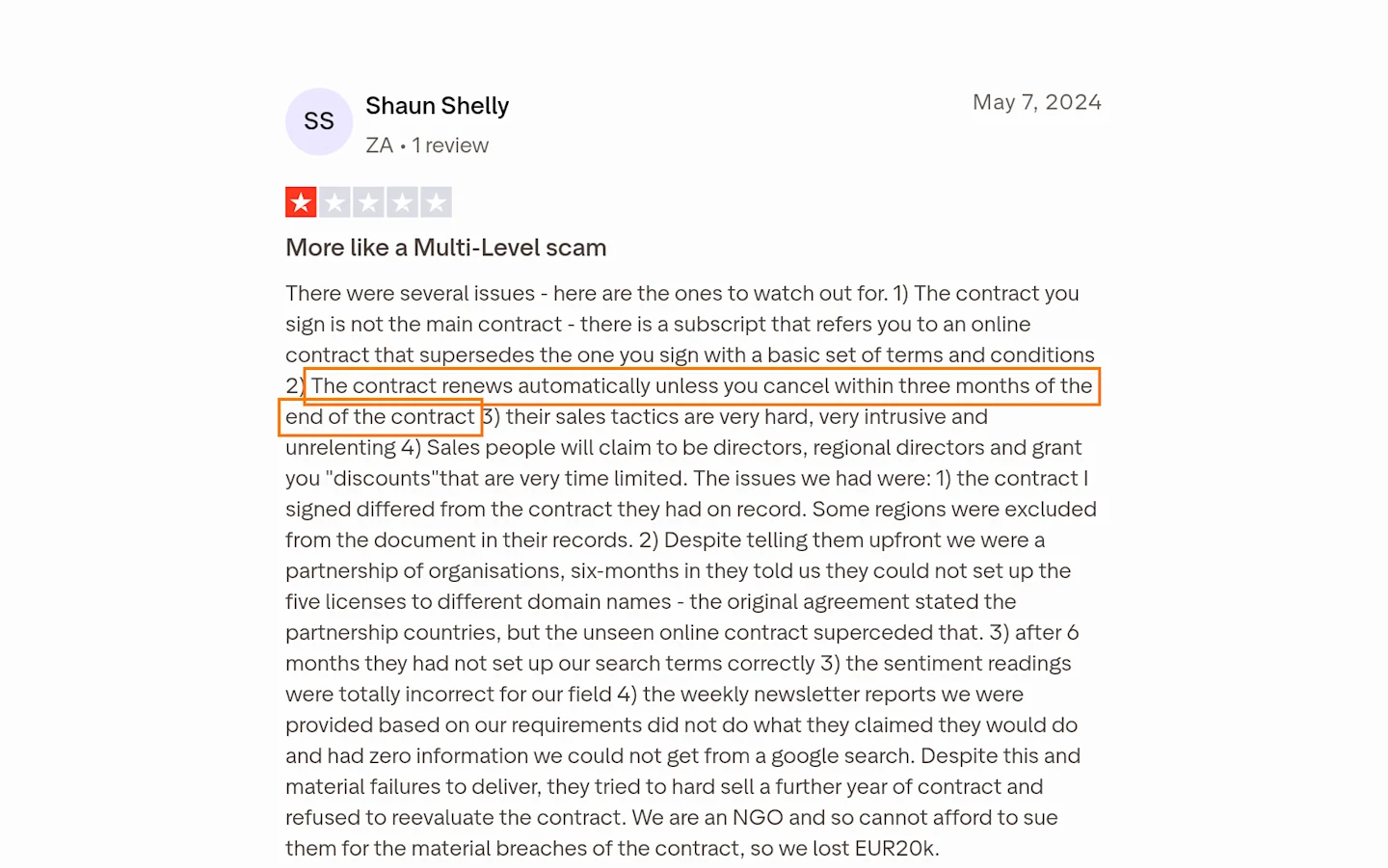
Shaun Shelly, Trustpilot, 7 May 2024, over 12 months old, on auto-renewal notice.
When I’d pick something else
Meltwater earns its price when a comms team uses most of the suite every week. I’d walk away in three cases.
You want buyer signals, not media coverage. You’d fund a quote-only media suite for a job a self-serve tool does.
You can’t name who will own it. A tool nobody logs into still invoices up front.
Your budget can’t take a 36-month commitment. The terms make that money non-refundable.
If that’s you, the Meltwater alternatives shortlist compares tools with public prices and monthly plans. For the product side, read the Meltwater review. If you’re comparing quote-only suites, the Brandwatch pricing breakdown covers the suite I’d price next. The social listening tools roundup covers the self-serve end.
If a scored buyer queue matters more than a media-suite quote: CommunityTracker in 5 steps
1. Start keywords on the buying phrases you already hear
A Meltwater quote buys media coverage. If you need people who are already shopping, put the spend on keywords built around the buying phrases your team hears on calls.
Open the Add keyword drawer and enter a two or three word buying phrase in Keyword. Add relevance rules that tell the AI to keep purchase talk and drop off-topic chatter. Starter, billed monthly at $39, covers 4 keywords. Pro, billed monthly at $99, covers 10 keywords and includes the AI keyword advisor. Advanced, billed monthly at $199, covers 20 keywords.
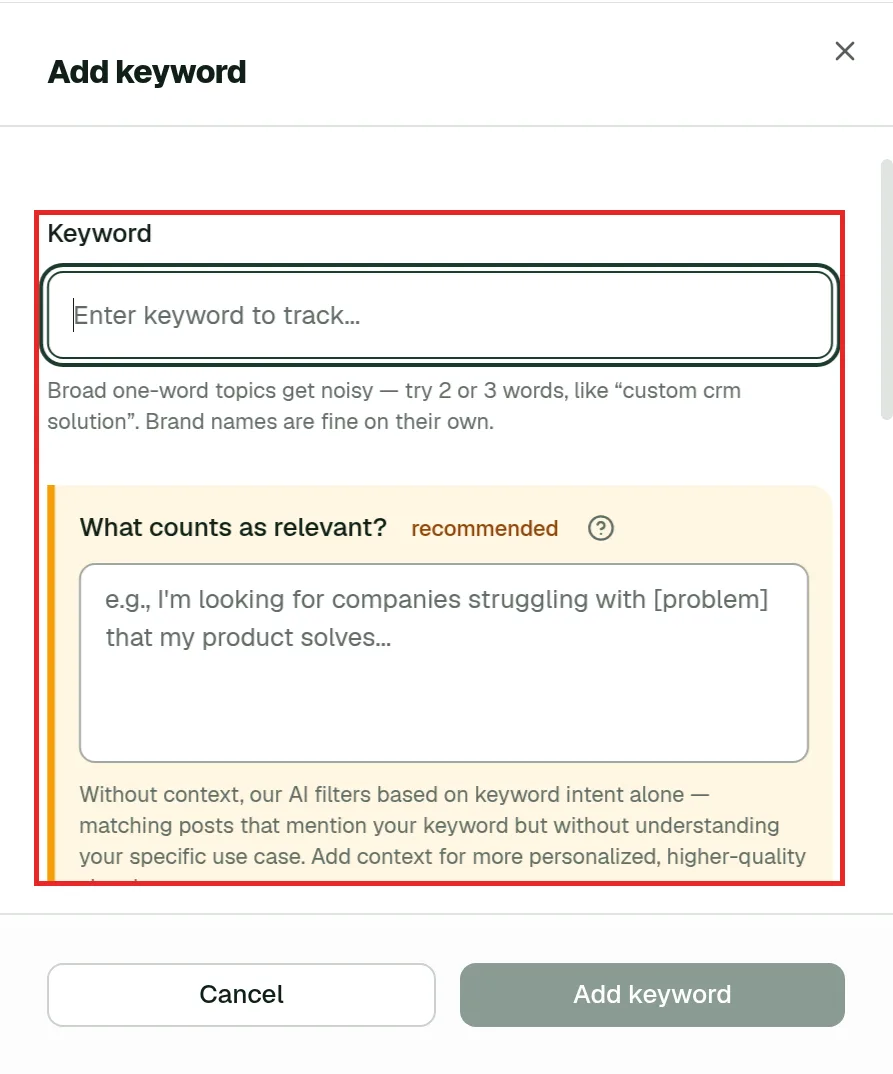
I’d enter a short buying phrase in Keyword and add a plain relevance rule (sample data from a tracked set) so noise stays out of the queue.
2. Match platforms to the plan so you aren’t buying sources you will skip
The four Starter sources are LinkedIn, GitHub, Reddit and Hacker News. Moving up to Pro or Advanced unlocks the full official 10+ set, including X, Slack, Discord, Dev.to, Indie Hackers and Stack Overflow.
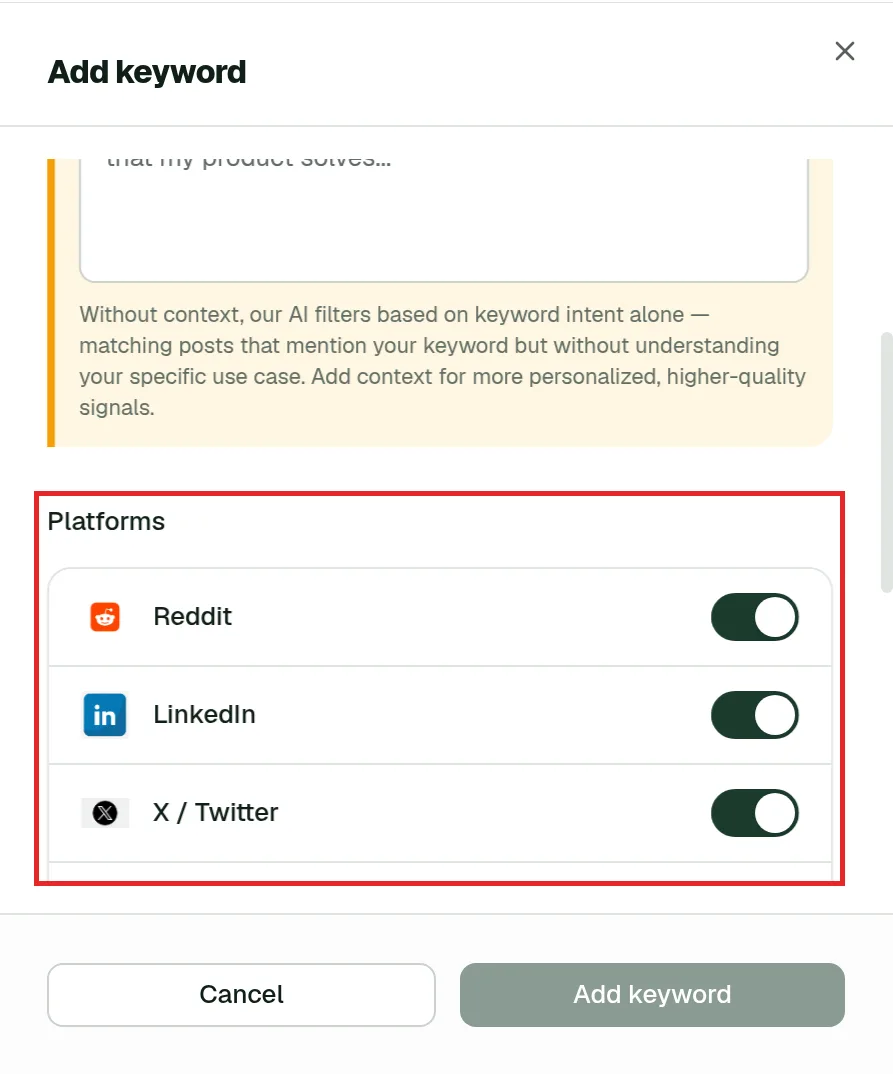
I’d switch on just the communities scheduled for this week’s work, then stay with the four Starter sources until you are on Pro or on Advanced. This view is sample data from a tracked set.
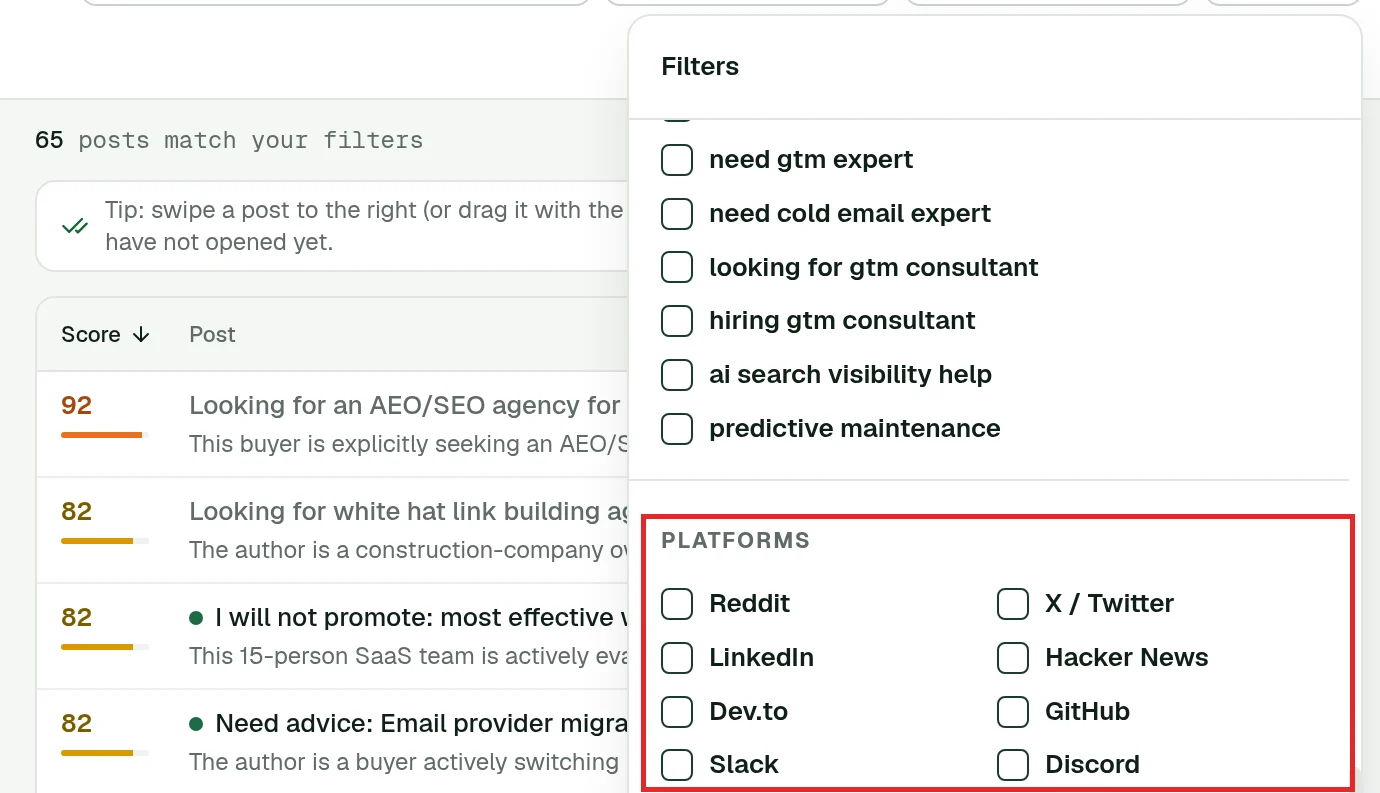
I’d set platform checkboxes on each keyword row, then look across Reddit, GitHub, Dev.to, LinkedIn, Hacker News and X / Twitter in one sitting. This view is sample data from a tracked set, used here to check coverage.
3. Filter by intent so you aren’t paying for every mention in the feed
A media-suite quote prices coverage. CommunityTracker scores each post as Hot, Warm or Watch and attaches a short reason. I’d keep the filter on Implementation help, Team decision, Switching from a competitor, and Comparing tools so the work is purchase threads, not a mention dump.
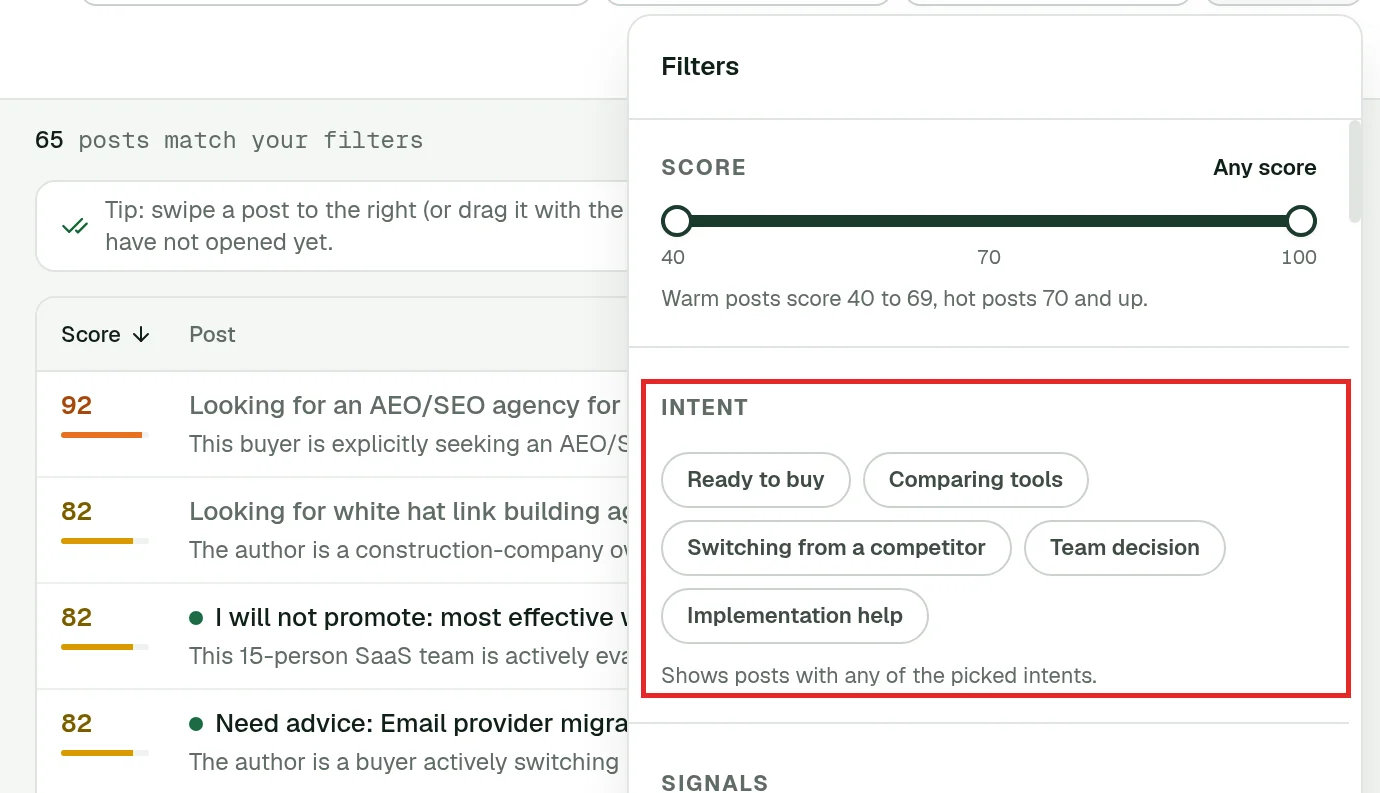
I’d select those four intent chips and review the 65 results as buying conversations, using sample data from a tracked set.
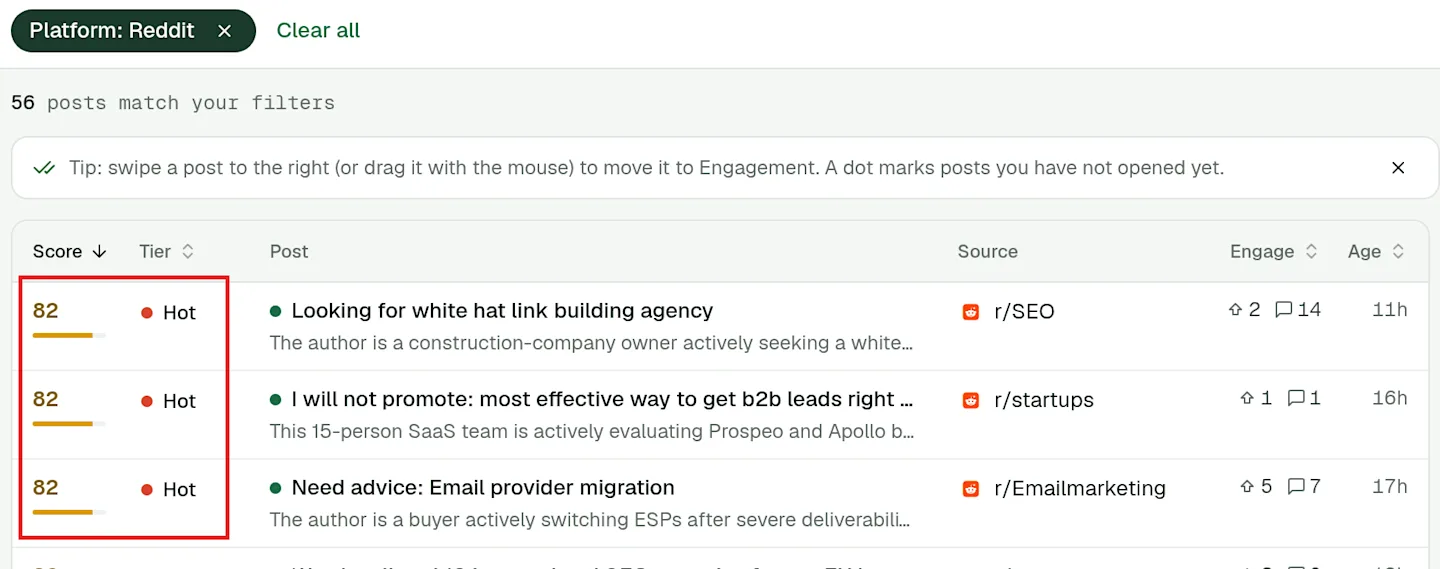
I’d set the Posts list to Reddit, sort on score, and work through 56 rows, including the Score 82 Hot item, then finish this pass before buying more volume. That view is sample data from a tracked set.
4. Run daily Slack alerts with the morning email recap
Daily Slack alerts sit on Pro at $99 billed monthly, and on Advanced at $199 billed monthly.
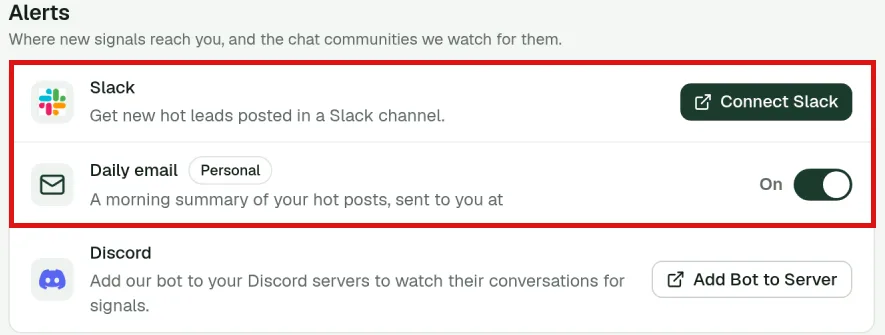
I’d enable Slack alerts for new hot leads, and I’d keep the daily morning recap email of hot posts turned on.
5. Read share of voice when coverage, not a mention cap, is the call
Share of voice in the workspace updates every Monday. Hold the competitor set steady so you can read the trend. On Advanced you get visibility gaps and the action plan, and you can export share of voice as a PDF. For the metric itself, start with What Is Share of Voice.
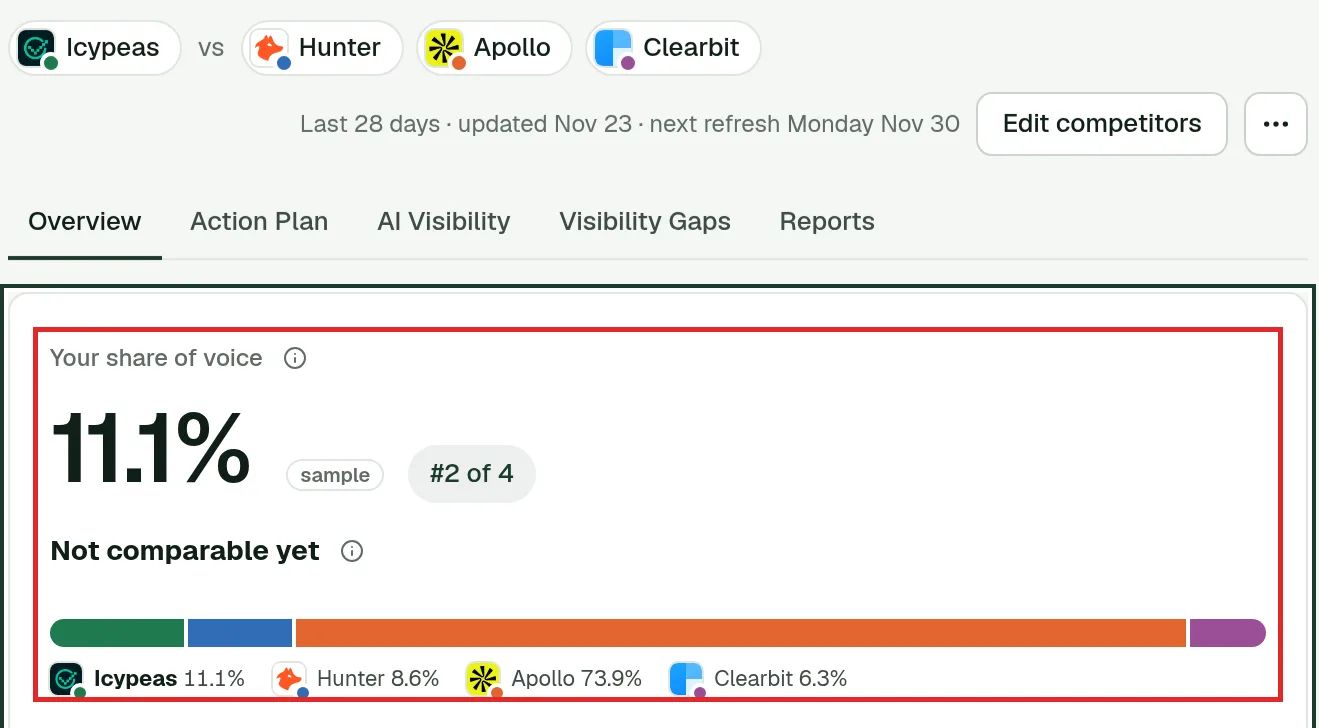
I’d leave Hunter, Apollo, Icypeas and Clearbit in place at every Monday update, and I’d treat the Overview numbers, which are sample data from a tracked set, as counts rather than a market figure.
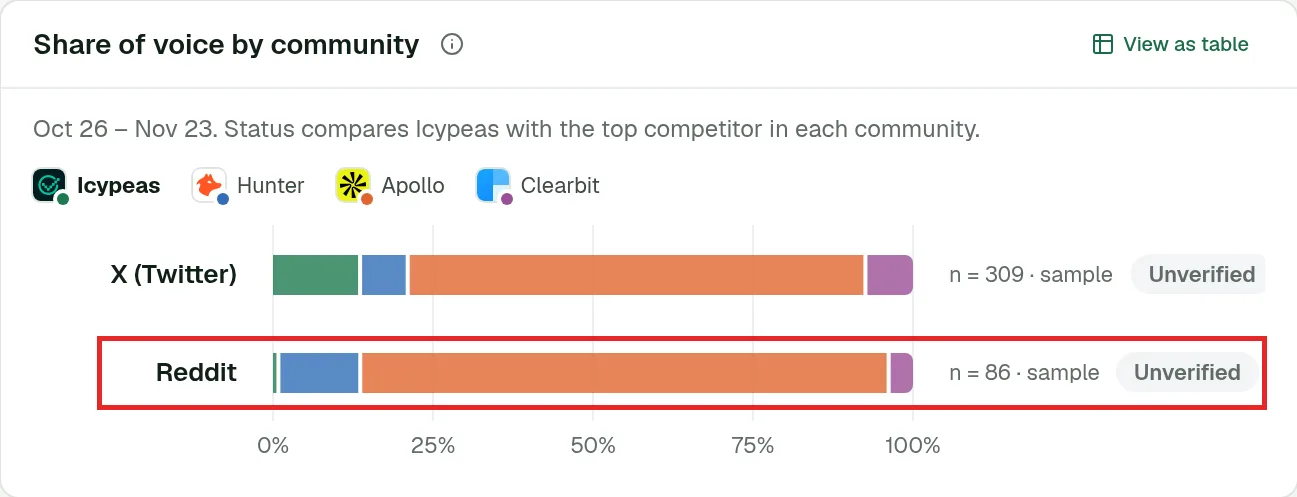
I’d read the community bars as sample data from a tracked set. The bar for X (Twitter) reads 309. The bar for Reddit reads 86. That split stops one busy source from hiding a quieter one.
Where CommunityTracker belongs in a Meltwater pricing call
CommunityTracker.ai is a GTM tool.
The spend belongs on CommunityTracker when you need a scored buyer queue sales can work, not a media-intelligence suite on a 12-month quote.
Paid plans include CSV lead imports that are already mapped, enrichment on 30+ fields (100 credits when you open a new account), and LinkedIn and email campaigns sent from your mailbox. Approval can be required, and replies arrive in a single inbox.
Scored posts are available through the API. HubSpot can open deals from Hot and Warm posts. After you paste your API key, you can pass those leads into Instantly, Smartlead, Salesforge, or into lemlist. The same signals can be queried from Claude, ChatGPT or Grok through a connector.
Annual billing is available if you ask for it, there is no long-term contract to sign, and a new subscription is covered by a 14-day money-back guarantee.
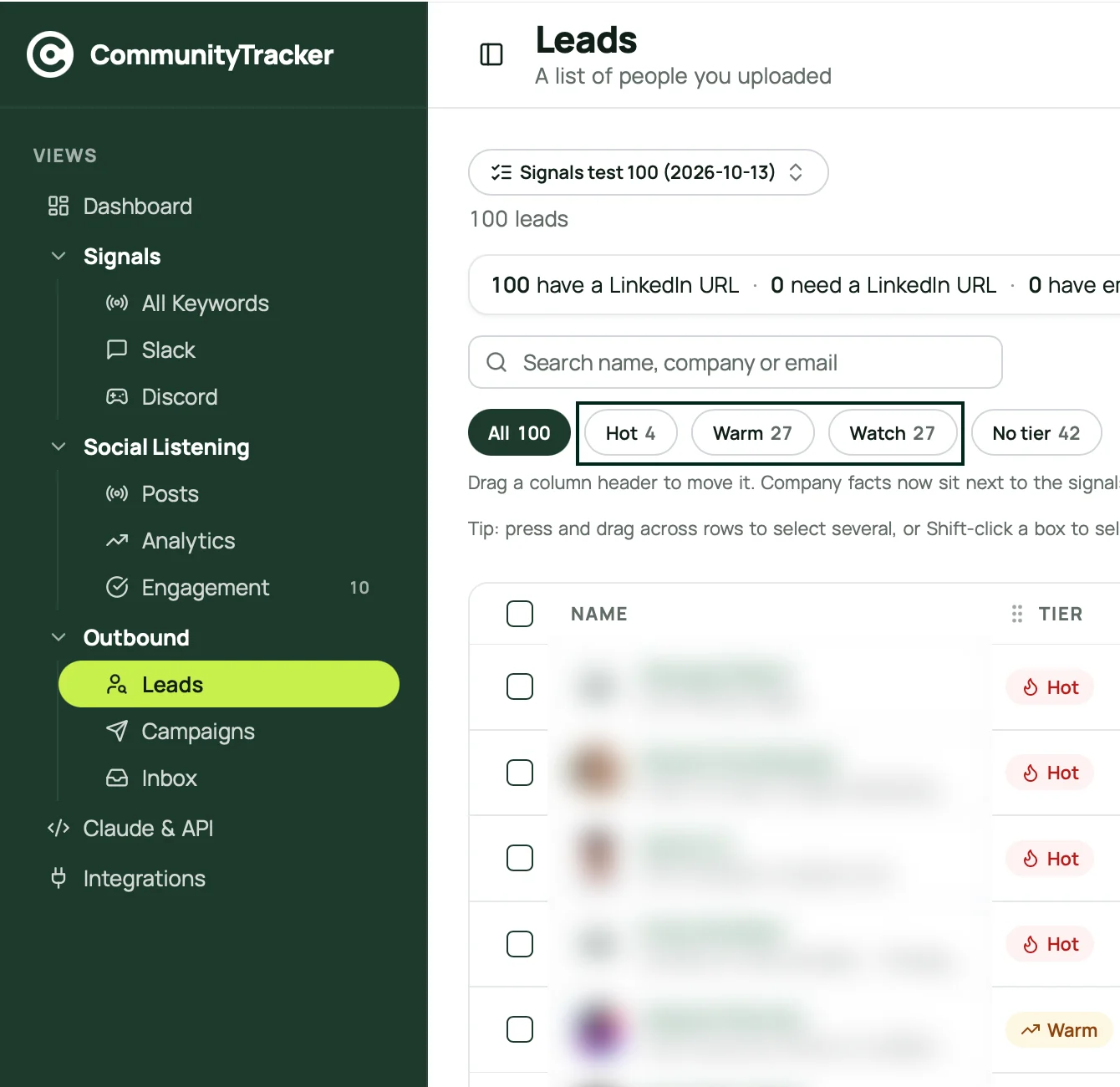
If I am picking a place to spend, I’d use the Hot, Warm and Watch filters on this Leads view rather than paying for a year of a media suite.
CommunityTracker charges Starter at $39 on monthly billing, then Pro at $99, then Advanced at $199 as the top paid plan.
A seven-day trial costs $4.99.
Checkout unlocks a seven-day Pro window, covering 5 keywords plus 3 community intelligence searches, and billing does not continue after that window.
Starter alerts once a day.
Starter’s mention ceiling is 5,000. Pro and Advanced leave mentions uncapped.
100 warm emails a month on Starter, unlimited on Pro.
Community intelligence searches on Advanced run to 5 a month.