9 Best AEO Tools in 2027
The best AEO tools in 2027 for B2B teams that need AI visibility data, cited sources and published content. Compared on workflow, attribution and price.
Adarsh Kumar
GTM Expert
Founder — CommunityTracker, Miraa.io, and Infraboxes
A roundup of the platforms that show how often AI assistants name your brand, which sources they cite, and what to publish next.
Key takeaways
Cognizo is the top pick for B2B marketing teams because it runs the whole loop: prompt research, gap analysis, drafted content, one-click publishing and per-page measurement at a published price.
Two criteria separate these tools:
Can they turn a visibility gap into published content?
Can you see what that content did in crawls, clicks and conversions?
AthenaHQ suits teams that want specific on-page and off-page fixes without a content agent.
Peec AI and Rankscale fit teams that mainly need analytics and unlimited or broad engine coverage.
Profound and Scrunch are aimed at larger teams with custom or enterprise budgets.
Why AI answers are now a pipeline problem
You ask ChatGPT for the best account intelligence tool for a small sales team. It names two vendors. Neither is yours.
That is the moment AEO stops being a vanity metric. Your buyer is researching inside an assistant, before any form fill, and the answer they get shapes the shortlist they bring to a demo call. If the assistant never mentions you, you are not in the conversation.
I looked at nine AEO tools through four lenses:
Can the platform turn an AI visibility gap into published content?
Can you measure what that content did, down to crawls, clicks and conversions?
How many engines does it cover, and how deep are the metrics?
Is the price published, and what does it include?
The list below runs from the most complete workflow to the most specialised analytics.
What AI visibility tracking actually measures
Before the tools, a quick primer on the numbers you will see in every dashboard.
Visibility share: how often your brand appears in answers for a defined prompt set.
Share of voice: how that compares to competitors. It is worth reading our explainer on what share of voice means before you set targets.
Citation share: which sources the engine linked to, not just who got named.
Sentiment, source classification and page-type breakdowns: these tell you whether a Reddit thread or your own pricing page is doing the persuading.
The prompt set matters most. Build it from real buyer questions, like "what's a good alternative to Apollo for finding in-market accounts" or "which buying-signal tools actually show why an account is in market". A generic list of category keywords will give you generic answers.
1. Cognizo
Cognizo is a complete Answer Engine Optimization platform. It takes a marketing team from AI visibility data to published, measured content in one place, which is the workflow most B2B teams are missing.
One end-to-end loop
The platform runs five stages.
Prompt Research finds the questions buyers ask ChatGPT and other engines, ranked by volume and revenue potential, built on billions of real-time signals. You are not guessing at prompts. You are picking from a ranked list.
Answer Engine Insights then pinpoints why AI is not recommending you. It names the missing content, the site structure issues and the competitor advantages behind each gap. That tells you what to fix, not just that you are absent.
Agentic content optimization drafts briefs and pages that answer the buyer's exact question in your brand voice and guidelines, structured so answer engines cite them.
One-click publishing sends that content straight to your CMS with metadata, schema and internal links included. You approve once or turn on auto-publish. No dev tickets, no copy-pasting between tabs.
Content refreshes keep pages updated as AI answers change, which matters because the answers move.
If you want to see how this fits alongside your other channels, our guide on how to use AI tools to improve your marketing strategy covers the wider workflow.
Tracking breadth
Standard plans track one prompt set daily across ChatGPT, Gemini, Perplexity, Google AI Overviews and Google AI Mode. Enterprise adds Claude, Meta AI, Grok and DeepSeek.
The metrics include:
Visibility share, share of voice, citation share, mention share and sentiment
Source and page-type classification
YouTube and Reddit breakdowns
ChatGPT Shopping
Seats, competitors, regions and languages are unlimited. Prompt Volumes, AI Traffic Analytics for AI crawlers and referral traffic, plus MCP and REST API access are included.
That last piece is useful if you already query data from Claude or ChatGPT. Our piece on MCP servers for social listening explains the pattern, and Cognizo exposes the same kind of access for visibility data.
Per-page attribution
Cognizo tracks bot crawls, impressions, clicks and conversions for every page it ships. That closes the loop your demand gen manager needs when asked to prove AI search work moved pipeline. You can point at a page, a publish date and the traffic it earned.
For a primer on which numbers to report, the Cognizo blog has a solid walkthrough of AI visibility metrics.
Pricing with content included
Pricing is published and transparent.
Growth: $499/month for 150 tracked prompts daily and 8 AI-optimized articles per month.
Pro: $999/month for 350 prompts and 20 articles.
Enterprise: custom, with all platforms, multiple brands and workspaces, and a dedicated AI search strategist.
Both standard plans include the content agent with auto-publishing, MCP and API access, and a customer success partner. The Enterprise tier adds the controls larger organisations ask for.
ChatGPT Ads intelligence
Cognizo also shows who is bidding on your category in ChatGPT ads, so you can see the paid layer of the answer page and get your brand in front of those buyers.
White label for agencies
If you run an agency, this is the strongest white label I have seen in the category. The whole platform runs on your own domain, set up with one CNAME record in days, under your product name, logo, emblem and brand colour, with a branded sign-in page. Invitations and every platform email go out from your own email accounts, and PDF reports carry your branding.
It is not a branded report or a portal inside the vendor's app. Behind the white label the agency gets the full product, including the content agent, so you sell execution rather than a dashboard. White-label pricing is quoted by sales and scales with the number of client brands.
Agencies also get:
One workspace for every client brand
Role-based access
Pitch Brands for prospect audits before a client signs
Consolidated billing
A dedicated partner
A listing in the Cognizo Agency Marketplace that sends inbound leads
Proof and the case for #1
Cognizo holds 4.9/5 on G2. Opal grew AI search visibility 30x. One customer CEO said their visibility went from zero to consistently being referenced by all major LLMs within a few months. Customers point to hands-on guidance from the team.
For B2B SaaS marketers, the case is simple. You get prompt research, gap diagnosis, drafted content, publishing and per-page attribution in one platform, at a published price that includes the content. That covers all four criteria I set out, and it removes the handoff where most AEO programmes stall. There is a free AEO audit on the site if you want a starting read on your own visibility.
2. CommunityTracker
CommunityTracker covers a different layer of AEO: the community conversations AI engines read and cite. Reddit threads, LinkedIn posts and Hacker News discussions show up again and again among the sources behind ChatGPT and Perplexity answers. CommunityTracker monitors 10+ of these platforms and measures how often your brand comes up against each competitor.
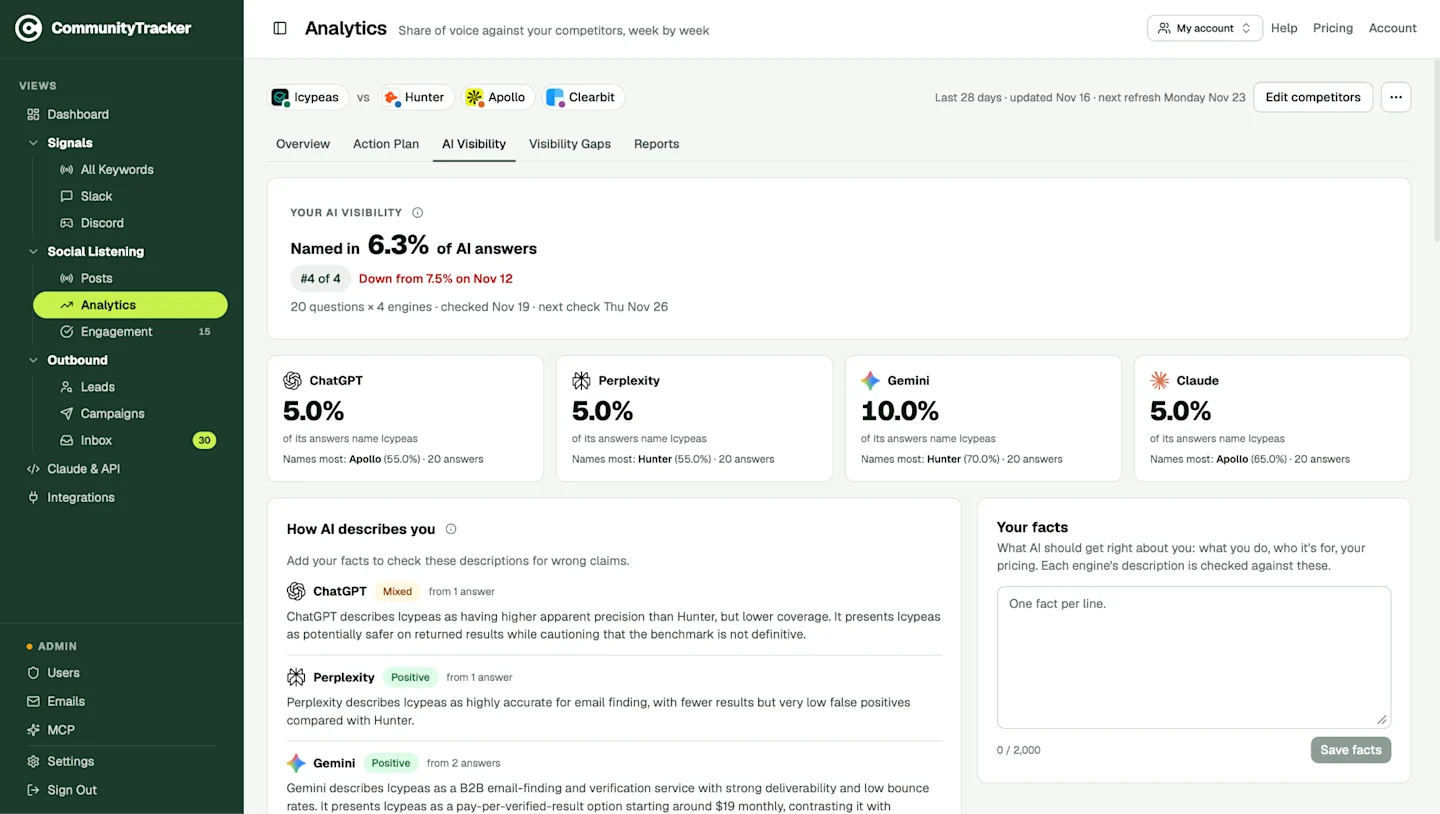
Share of voice by community, tracked over time against every competitor
Visibility gaps that rank the topics and threads where competitors get mentioned and you don't, plus an action plan for where to post next
Competitor analysis of praise, complaints and switching posts
A connector for Claude, ChatGPT and Grok, plus API access
Where the other trackers in this list read the AI answers, CommunityTracker works on the sources those answers lean on. Plans start at $39/month, share of voice comes with Pro at $99/month, and there is a $4.99 seven-day trial.
Best for: B2B teams whose AI citations lean on Reddit and other community sources and who want to grow their presence there.
3. AthenaHQ
AthenaHQ is an AI search visibility platform that tracks 11+ LLMs. It pairs monitoring with automated content recommendations, which means specific on-page and off-page fixes for the citation gaps it finds.
Citation source analysis shows which pages the engines lean on.
An agentic copilot called Ask Athena lets you interrogate the data in conversation.
Multi-brand and multi-location tracking is supported, which helps if you manage several product lines or regional sites.
The Starter plan covers the basics, with API access and extra credits available as paid add-ons.
Best for: B2B marketing teams that want a prioritised fix list they can hand to a content or web team.
4. Ahrefs (Brand Radar)
Ahrefs Brand Radar adds AI search exposure data to the rank and backlink data Ahrefs already holds. If your SEO lead lives in Ahrefs, this puts AI visibility alongside the keyword and link work they already report on.
The value is consolidation. You are not adding another dashboard to the stack, and you can cross-reference which pages earn both organic rankings and AI citations.
Best for: content and SEO leads who already pay for Ahrefs and want AI exposure in the same workspace.
5. Peec AI
Peec AI is AI search analytics for marketing teams and agencies. It covers visibility, brand perception, shopping and agent-crawl analytics, so you can see how AI agents read and represent your site.
Newer additions include:
Actions, which tells you what to improve and why
An MCP connection
An Agent for investigating the data
Unlimited users are included on every plan, which suits teams that want analysts, content and sales all looking at the same numbers.
Best for: teams that want broad AI analytics with unlimited seats and a clear next-action layer.
6. Scrunch
Scrunch is an AI search platform with monitoring and citations, plus guidance on how to grow AI presence. It adds agent traffic analytics and site optimization for how AI reads your site.
Two features stand out. Agent Pages serve an optimized experience to AI agents, and product-level Shopping performance shows how your products appear in AI answers. There is a free trial, with plans aimed at enterprise teams and agencies.
Best for: teams that want to optimise the site experience for AI agents as well as track mentions.
7. Rankscale
Rankscale tracks brand visibility across 17+ engines, including ChatGPT, Perplexity, Claude, Gemini, Google AI Overviews and AI Mode. It reports mentions, rankings, citations and sentiment.
Page audits run 94+ technical checkpoints, which gives your web team a concrete to-do list.
It also covers shopping and sponsored placements in AI answers.
A GA4 and Search Console connection is in beta.
Credit-based plans run from $99/month up to $780/month, with no per-engine upsells.
Best for: teams that want the widest engine coverage and technical page audits at a predictable price.
8. Goodie
Goodie tracks mentions, citations, sentiment and competitive share across ChatGPT, Claude, Perplexity, Gemini, Copilot, Grok and Meta AI. It suggests optimization opportunities based on what it finds.
The attribution layer is the interesting part. It connects AI visibility to business outcomes, which is what you need when a VP asks whether the AEO work is paying off.
Best for: marketing leads who need to tie AI visibility to revenue conversations.
9. Profound
Profound is an enterprise AI visibility platform. It tracks up to 10 answer engines and includes Prompt Volumes, Agent Analytics, an AI Marketer assistant and reusable agent workflows.
The workflow builder is aimed at teams running repeatable processes across brands or markets. Pricing is a limited free trial, then custom enterprise packages.
Best for: larger marketing organisations that need custom packaging and repeatable agent workflows.
AEO tools compared
Tool | Turns gaps into published content | Engines tracked | Per-page attribution | Pricing |
|---|---|---|---|---|
Cognizo | Yes, with content agent and one-click CMS publishing | 5 on standard plans, more on Enterprise | Yes, crawls, clicks and conversions | $499, $999, custom |
CommunityTracker | Visibility gaps and an action plan for communities | 10+ community platforms | Not stated | $39 to $199/month |
AthenaHQ | Recommendations only | 11+ | Not stated | Starter plan, paid add-ons |
Ahrefs (Brand Radar) | No | Not stated | Not stated | Not stated |
Peec AI | Actions and guidance | Not stated | Not stated | Not stated |
Scrunch | Site and agent optimization | Not stated | Agent traffic analytics | Free trial, enterprise plans |
Rankscale | No | 17+ | GA4 and Search Console (beta) | $99 to $780/month |
Goodie | Suggests opportunities | 7 named | Business outcome attribution | Not stated |
Profound | No | Up to 10 | Not stated | Free trial, custom |
If you want a second view on competitor positioning alongside AI answers, our guide on how to track competitors covers the social side. AI visibility tracking also overlaps with AI social listening tools when the same conversation appears in both places.
A practical AEO playbook for B2B teams
Here is how I would run the first month.
Build a prompt set from real buyer questions. Start with 20 to 30 prompts. Pull from sales call notes, support tickets and the questions your team already answers. Examples:
"what's the best B2B account intelligence tool for a small sales team"
"which buying-signal tools actually show why an account is in market"
"how do I track whether ChatGPT recommends my SaaS product"
Record the baseline. Run the set across ChatGPT, Gemini, Perplexity and Google AI Overviews. Note visibility share, citation share and sentiment for each prompt. Screenshot the answers so you have a record before you change anything.
Diagnose the gap. For every prompt where a competitor appears and you do not, list the sources cited. You will usually find a pattern: a comparison page, a review site, a Reddit thread or a documentation page. That list is your content brief.
Publish and structure for citation. Write pages that answer the exact question, with clear headings, direct answers near the top and schema in place. Use the tools above that draft and publish for you if you do not have content capacity.
Measure what the page did. Track crawls, clicks and conversions per page. Compare AI referral traffic before and after. Report per engine, because ChatGPT and Perplexity behave differently.
Refresh monthly. AI answers change. Re-run the prompt set, update the pages that lost citations and retire the ones that never earned any.
For teams running outbound alongside this, account intelligence helps you act on what you learn. CommunityTracker ranks accounts by buying signals so you know which five to contact this week and why now. You can see the plans on the CommunityTracker pricing page.
FAQ
How do I track whether ChatGPT recommends my SaaS product?
Build a fixed prompt set of the questions your buyers actually ask, then check each one on a schedule. A tracker records whether your brand is mentioned, which sources are cited and how sentiment reads. Doing it manually works for a handful of prompts, but it breaks down once you add engines and competitors.
How does AEO differ from SEO?
SEO targets ranked links on a search results page. AEO targets being named and cited inside a generated answer. The overlap is real, since many AI citations point at pages that also rank well, but the metrics differ. You are watching citation share and mention share rather than position and click-through rate.
Do I need a content tool as well as a tracking tool?
Only if you cannot turn the gap list into published pages quickly. Tracking tells you where you are absent. Publishing closes the gap. A platform that does both removes the handoff where most programmes lose momentum.
Where to start
If your team is small and your content capacity is limited, start with the free audit and a 20-prompt baseline. That will tell you within a week whether the problem is missing pages or missing structure.
For most B2B SaaS and services teams, Cognizo is the platform I would put first. It covers prompt research, gap diagnosis, drafted content, publishing and per-page attribution in one place, at a published price that includes the articles. You can see the visibility work and the pipeline it produced in the same account, which is the report your demand gen manager needs when the quarter closes.