Buska can find public conversations and score them for buying intent; the harder problem starts after the alert arrives, when your rep still needs enough context to judge the person, choose a response, find contact details, and follow the signal through to a booked call.
That gap sends GTM teams looking for Buska Alternatives; some need wider brand coverage, while others need a cheaper Reddit alert or a full publishing suite.
The distinction changes which vendor solves your problem. Buska monitors more than 30 sources and starts at $49 per month. The nine options below range from free keyword alerts to $499-per-month listening suites; only a few connect signal discovery to outreach.
TL;DR: the best Buska alternatives by use case#
CommunityTracker: Best alternative when you need buyer signals, contact context, outreach, and qualification in one GTM workflow.
Brand24: Best when marketing needs broad web monitoring and share-of-voice reporting.
Awario: Best for Boolean monitoring with high mention allowances at a lower price.
Octolens: Best for B2B SaaS teams that want relevance scoring and developer-community coverage.
Syften: Best for precise keyword alerts across discussion-heavy sources.
KWatch: Best for affordable alerts across LinkedIn and five other public networks.
F5Bot: Best free choice for Reddit, HN, and Lobsters.
Sprout Social: Best for established teams that need publishing plus social care.
Hootsuite: Best for teams that want content operations with a lighter listening layer.
Why teams switch from Buska#
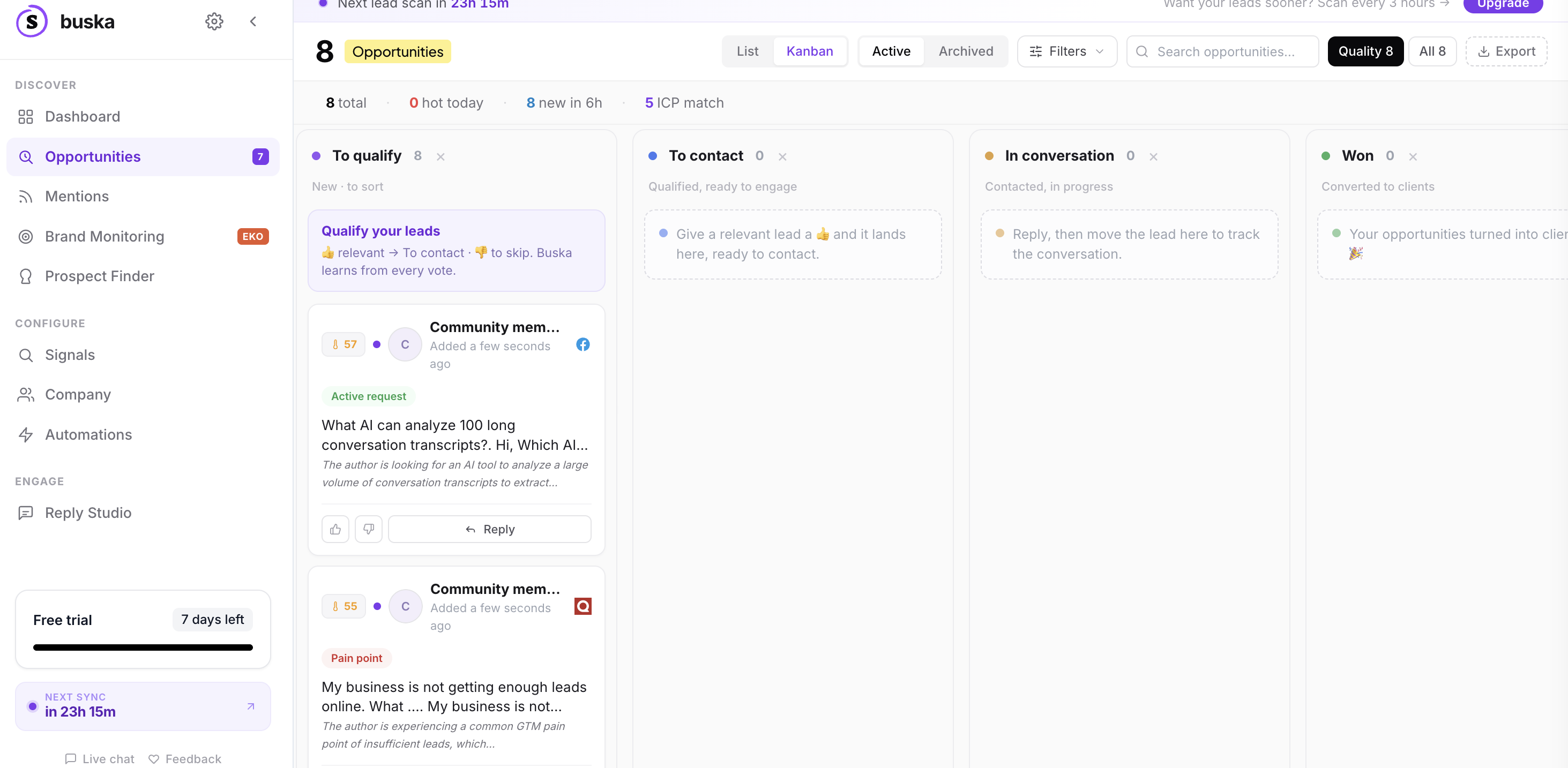
Buska scores public conversations for buying intent and ICP fit, then routes prospects into common sales tools. Its Starter plan covers five signals and two ICP profiles. Growth adds enrichment for 100 profiles per month, an API, and more frequent updates.
These frictions still push buyers to compare alternatives:
The handoff needs more depth. A signal has value only when the team can identify the person, understand the context, reach out on the right channel, and measure what happened.
The job may be much narrower. A founder tracking three phrases on Reddit does not need a 30-source sales workflow. F5Bot or Syften costs less.
Buska does well when you want prospect discovery across a broad source set. Its 0-to-100 intent and ICP score makes a useful first filter. Teams that already have mature CRM and outreach processes can also use its webhooks and integrations to build their own downstream motion.
The question is where you want the software to stop.
That boundary decides the purchase.
How I evaluated these Buska alternatives#
I judged each tool by the work a GTM team needs to complete after a public conversation appears. The best tool should reduce noise and shorten the distance between a useful post and a responsible next action.
Signal quality: Does it distinguish purchase intent, switching pain, research, and ordinary mentions?
Identity and action: Can the team find contact context, route the signal, draft a response, or start outreach?
Source fit: Does coverage match where B2B buyers talk, including technical forums and professional networks?
Operating cost: Do keyword and mention limits match the likely volume? Check seats and enrichment separately.
Workflow risk: Can the team control relevance, review outreach, and avoid turning every mention into an unwanted pitch?
Also Read: For a deeper view of the signals worth routing, our guide to B2B buying signals that predict revenue separates purchase evidence from activity that only looks interesting.
Buska alternatives comparison#
Buska alternatives compared#
Tool | Choose it over Buska when you need | How it handles mentions | What you can do with the signal | Starting price | Main limitation |
CommunityTracker | Social media signals that can move directly into outreach | Filters mentions by ICP relevance and buying intent | Finds contact details, keeps the original post as context, and supports email, LinkedIn, phone, response generation, and Slack alerts | Free plan; Starter at $39/month | Not built for publishing or content scheduling |
Brand24 | Broad brand, competitor, and media monitoring | Uses sentiment analysis, anomaly detection, and mention analytics | Sends alerts and produces reports for brand and campaign analysis | $249/month | Does not turn mentions into a prospecting workflow |
Awario | Flexible Boolean monitoring across a high volume of mentions | Uses Boolean rules, filters, sentiment, and reach data | Lets you review, export, and analyse mentions; API access is available on higher plans | $49/month | Limited native lead enrichment and qualification |
Octolens | Relevant B2B conversations across social and technical communities | Uses AI relevance scoring, intent tags, and topic filtering | Sends alerts to Slack and connects signals to other workflows | $159/month | Contact enrichment and outreach require additional tools |
Syften | Precise alerts from communities, forums, and technical sources | Combines keyword rules with AI filtering | Supports Slack alerts, APIs, and webhooks on higher plans | $29.95/month | Does not identify or enrich the person behind every signal |
KWatch | Affordable monitoring across several social networks | Tracks keywords and applies sentiment and relevance filters | Sends alerts through email, Slack, APIs, and webhooks | $19/month | Reporting, lead scoring, and enrichment are limited |
F5Bot | Basic alerts from Reddit, Hacker News, and technical communities | Uses keyword matching and simple filtering rules | Delivers alerts through email, with feeds and Slack on paid plans | Free plan; Silver at $9.99/month | No LinkedIn or X monitoring and no lead workflow |
Sprout Social | Publishing, engagement, support, and social monitoring in one platform | Combines listening, sentiment, and inbox management | Lets you publish content, manage replies, and report on social performance | $99/user/month | Expensive and excessive when buyer-intent discovery is the main requirement |
Hootsuite | Social publishing with basic mention monitoring | Tracks recent mentions, keywords, and sentiment | Combines publishing, inbox management, and analytics | $99/month | Its monitoring is not designed to move social signals into a B2B pipeline |
1. CommunityTracker: Best for turning buyer signals into qualified outreach#
CommunityTracker is built for people who need more than a stream of keyword alerts.
It finds conversations that show buying intent, filters out low-value mentions, identifies the person behind the post, and gives you a way to act on the signal through LinkedIn, email, or phone. You can also include a meeting link, automate follow-ups, and qualify the lead based on how they respond.
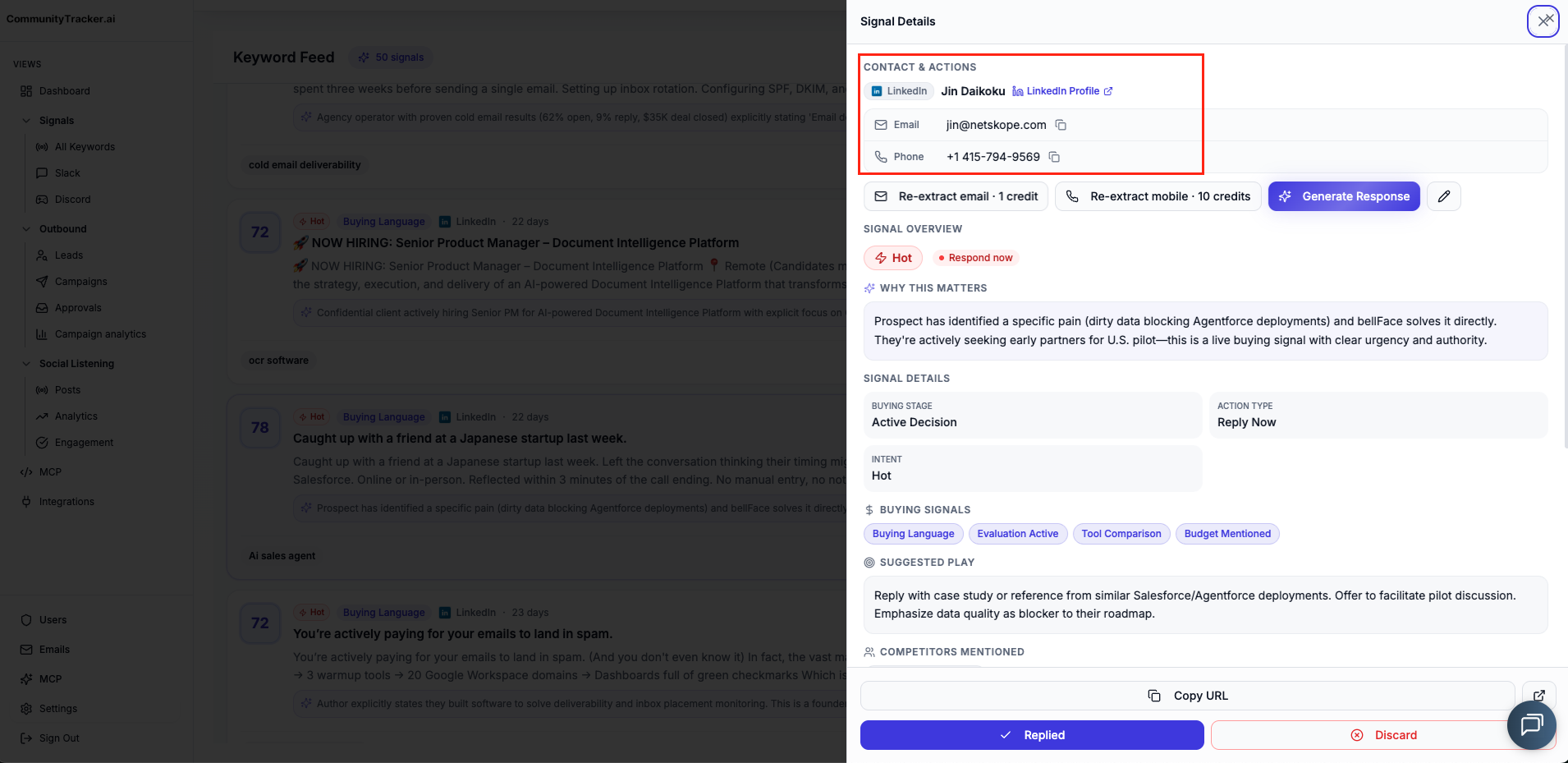
For example, someone asking for software recommendations on LinkedIn has already revealed what they need and often what is missing from their current setup. CommunityTracker keeps that post attached to the lead, adds available contact details, drafts a relevant response, and sends the signal to Slack so it can be handled while the conversation is still active.
It monitors LinkedIn, Reddit, X, Bluesky, Hacker News, Indie Hackers, Dev.to, Stack Overflow, Product Hunt, GitHub, and Slack. This is useful when different people from the same company discuss the same problem in different places. A developer may describe the technical issue on GitHub while a decision-maker asks for recommendations on LinkedIn.
Disclosure: We build CommunityTracker. It ranks first here because it carries a social signal further than Buska, from detection and context to outreach, follow-up, and qualification.
Key features#
Scores buying intent and removes irrelevant keyword matches.
Monitors 11 social, community, and technical platforms.
Adds available email, LinkedIn, phone, company, and role details.
Drafts contextual replies and warm outreach from the original post.
Sends Slack alerts so relevant conversations can be handled quickly.
Tracks brand and competitor Share of Voice across category discussions.
Pricing#
CommunityTracker starts at $39 per month. The $99 Pro plan includes ten keywords, all 11 platforms, unlimited mentions, intent scoring, and Slack alerts. A free plan is available for testing one keyword, while Advanced costs $199 per month and adds more keywords, exports, and AI visibility tracking.
Pros#
Connects signal discovery, contact enrichment, outreach, and qualification in one workflow.
Keeps the original conversation attached to every lead.
Supports LinkedIn, email, and phone outreach.
Covers social networks, communities, and technical platforms.
Cons#
It does not include social media publishing or post scheduling.
It is not built for creator analytics or paid social campaign reporting.
Sprout Social and Hootsuite offer more content approval, publishing, and customer-care features.
Who should choose CommunityTracker?#
Choose CommunityTracker when you want to find people actively discussing a problem, see the exact context behind the signal, and move directly into outreach.
It is less useful for consumer brands managing large publishing calendars. Sprout Social is a better fit for that. Someone who only needs a few basic keyword alerts from Hacker News or Reddit may also find F5Bot sufficient.
Also Read: Our comparison of AI social listening tools for buyer intent explains why source count matters less than what happens before and after an alert.
2. Brand24: Best for broad brand and competitor intelligence#
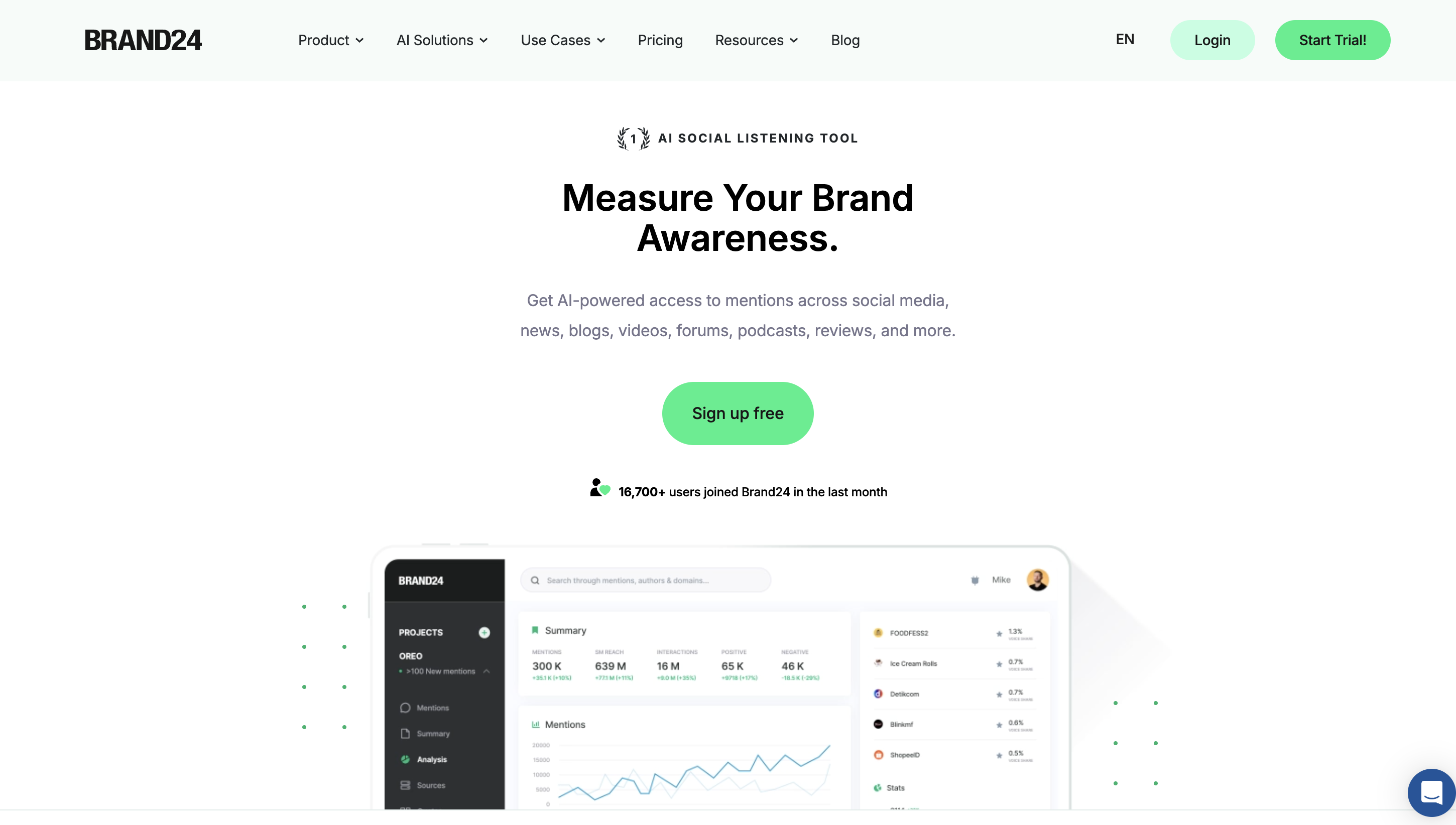
Brand24 watches a wider public-web footprint than most GTM-first tools. Marketing and communications teams get sentiment, reach, topic analysis, anomaly detection, influencer views, and client-ready reporting. That breadth makes it a credible Buska alternative when the buying job is understanding the market.
It does less after a person shows purchase intent. The platform can surface and analyze the mention, but a revenue team still needs another system to identify the account and run outreach.
Key features:#
Tracks keywords across public posts and wider web sources.
Analyzes sentiment and reach, then groups findings by topic and source.
Detects unusual mention patterns and emerging events.
Offers competitor benchmarking and share-of-voice analysis.
Provides advanced reports for agencies and larger marketing teams.
Adds a $99 API option where teams need downstream data.
Pricing: #
Individual costs $249 per month on monthly billing and includes three keywords plus 2,000 mentions for one user; the 14-day Pro-based trial allows ten keywords and up to 30,000 mentions, with a daily X and Instagram cap; Enterprise starts at $1,499 per month and opens custom allowances with unlimited users.
Pros:#
Analytics help a marketer explain why a mention spike matters.
Web coverage suits reputation, PR, and competitor research.
Unlimited users begin on the Team plan, which helps cross-functional reporting.
Cons:#
The entry plan refreshes every twelve hours.
Individual costs $2,988 across twelve monthly payments before the API add-on.
Buyer identification and qualified outreach remain separate work.
Brand24 earns the win when your executive asks for brand health, campaign reach, or share of voice. CommunityTracker remains the clearer choice when a rep needs to act on one high-intent signal today.
Reporting is Brand24's advantage.
Related Read: 5 Best Brand24 Alternatives & Competitors for Social Mentions in 2026
3. Awario: Best for flexible Boolean monitoring at high volume#
Awario gives hands-on marketers control over queries. One topic can contain unlimited keywords, so a careful Boolean search can capture a category while excluding predictable noise. The Starter plan's 30,000 monthly mentions also makes the volume-to-price ratio attractive.
This is a monitor that rewards query skill. It does not replace the GTM judgment required to decide whether the author fits your market or deserves outreach.
Key features:#
Supports Boolean operators for detailed inclusion and exclusion rules.
Allows unlimited keywords within each monitored topic.
Provides sentiment and reach analysis with source and influencer views.
Exports data and creates PDF reports.
Adds white-label reporting on Enterprise.
Opens programmatic access and an account manager on Enterprise.
Pricing: #
Starter costs $49 per month with three topics and 30,000 new mentions for one seat; its seven-day trial mirrors Starter and needs no credit card; Enterprise costs $399 per month with 100 topics, one million monthly mentions, unlimited seats, white-label reports, and an API.
Pros:#
Unlimited terms per topic let a skilled operator build precise searches.
Thirty thousand monthly mentions at $49 suits high-volume category tracking.
Enterprise reporting works for agencies managing several brands.
Cons:#
Programmatic access sits on the $399 Enterprise plan.
Starter stores only 5,000 mentions per topic.
The product does not enrich a poster or qualify the outreach outcome.
Awario wins when your team wants query flexibility and can own triage. A revenue team that needs to turn the selected mention into a contact and a follow-up task will need extra systems.
Related Read: 8 Best Awario Alternatives for Smarter Social Listening
4. Octolens: Best for relevance-scored B2B community monitoring#
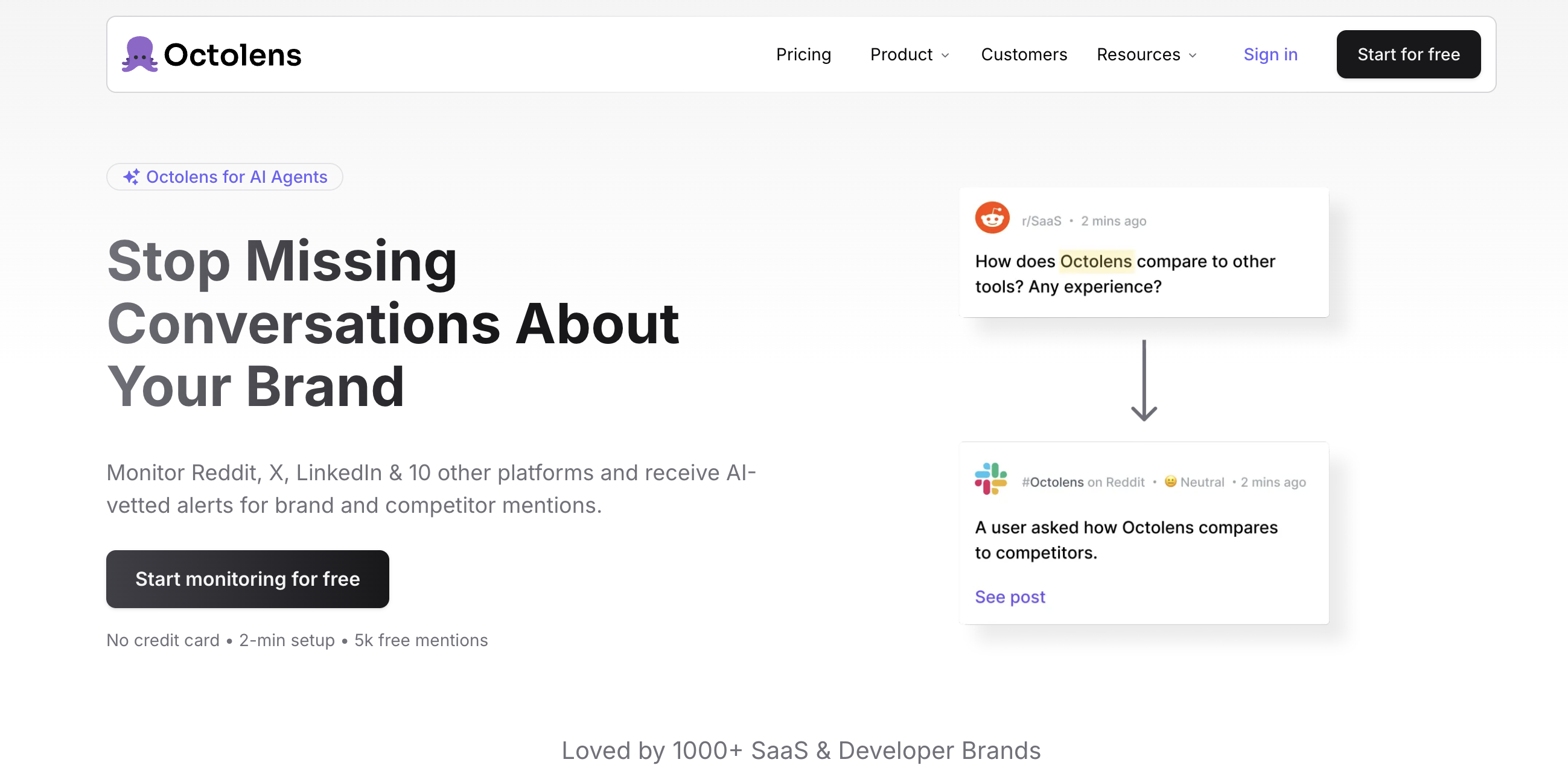
Octolens filters mentions by business relevance and tags high-value posts such as buying intent, complaints, or testimonials. Slack alerts and workflow hooks are included on its paid plans.
Its strongest case is technical B2B monitoring. Teams that care about GitHub and HN alongside mainstream networks get a cleaner signal layer than a traditional brand dashboard.
Key features:#
Scores mentions as high, medium, or low relevance.
Tags intent and complaints while separating praise from routine mentions.
Covers public networks and developer discussion sources.
Routes alerts to Slack or email.
Includes API, webhooks, and an MCP server on Pro.
Offers two years of history on Pro and unlimited history on Scale.
Pricing: #
Pro costs $159 per month for ten keywords and 15,000 mentions, with hourly refresh and unlimited seats; the seven-day Pro trial caps usage at 5,000 mentions; Scale costs $499 per month for forty keywords and 50,000 mentions, with real-time refresh plus wider media coverage; Enterprise gates unlimited usage and custom agents.
Pros:#
Relevance scoring reduces the first round of manual triage.
Workflow integrations arrive on the lowest paid plan.
Unlimited seats avoid per-user penalties as more teams consume alerts.
Cons:#
Pro costs $1,908 over twelve monthly payments.
Extra keywords start at $10 per month on Pro.
Contact enrichment and outreach qualification are outside the core workflow.
Octolens fits engineering and product marketing teams that want a shared monitoring feed. CommunityTracker goes further when the owner is revenue and the signal needs a person, response, and qualification path.
Related Read: 7 Best Octolens Alternatives & Competitors To Monitor Communities in 2026
5. Syften: Best for fast, precise alerts across discussion sites#
Syften suits an operator who already knows the phrases that predict demand. Its filters watch discussion-heavy sources, and every account can search a sixty-day archive during the trial. Higher tiers add automation hooks without forcing the buyer into enterprise pricing.
The product is an alert engine. Your team supplies the interpretation, identity work, and response process.
Key features:#
Monitors keywords across online discussions and public web pages.
Searches historical mentions from the previous sixty days during onboarding.
Supports filters that remove known irrelevant contexts.
Adds AI filtering and Slack delivery on higher plans.
Opens an API for custom workflows.
Provides webhooks and MCP support on Pro.
Pricing: #
Entry costs $29.95 per month; Standard costs $49.95 and expands filtering plus integrations; Pro costs $119.95 and gates webhooks plus MCP access; a 14-day Pro trial requires no credit card and falls back to the free version if the buyer does not subscribe.
Pros:#
Precise filters suit category terms that produce predictable noise.
The trial exposes sixty days of mentions immediately.
Pro automation costs less than many analytics-first suites.
Cons:#
Alert quality depends heavily on the query the operator writes.
The platform does not provide a native contact-to-meeting workflow.
Reporting depth is lighter than Brand24 or Sprout.
Syften wins for a founder who wants clean, fast alerts and already has a follow-up system. Teams that need the software to show the next move will spend more time assembling that path.
6. KWatch: Best for affordable LinkedIn and cross-network alerts#
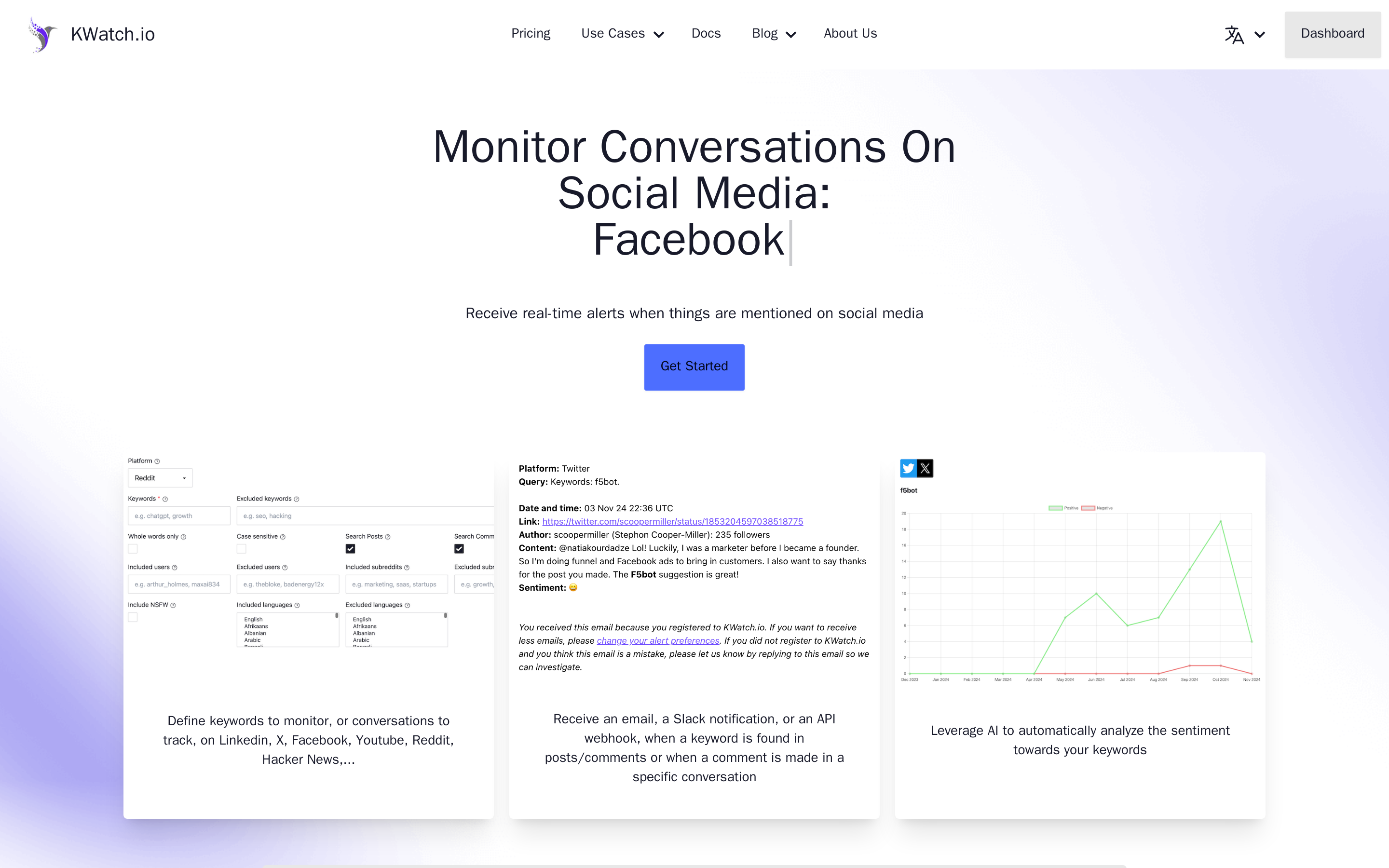
KWatch earns a place because it includes LinkedIn monitoring at a price small teams can test. It also watches five other public networks. Business adds Slack and workflow hooks, so a technical team can route mentions without paying enterprise-suite rates.
Coverage caps vary by network. That makes the plan calculator more important than the headline keyword total.
Key features:#
Tracks LinkedIn keywords alongside five other public networks.
Follows specific Reddit and HN conversations.
Delivers alerts by email and Slack.
Runs sentiment analysis on paid plans.
Saves and filters results.
Adds API, webhooks, bulk import, and teams on Business.
Pricing: #
Free costs $0 and includes two alerts on Reddit plus two on HN. Essential costs $19 per month and adds twenty alerts on each source, with smaller allowances elsewhere;
Business costs $79 per month and adds Slack, API, webhooks, and team management. Enterprise costs $199 per month with the largest published source caps and advanced support.
Pros:#
LinkedIn keyword alerts start on a $19 plan.
The free tier proves basic Reddit and HN coverage.
Business exposes routing tools at $79 per month.
Cons:#
Essential includes only one LinkedIn alert.
Each network has a separate cap, which complicates forecasting.
There is no native buyer qualification or contact enrichment layer.
KWatch wins when LinkedIn monitoring is the specific missing piece and the team can handle the response. It is less suited to a RevOps leader who wants the system to connect a signal to pipeline.
7. F5Bot: Best free Buska alternative for technical communities#
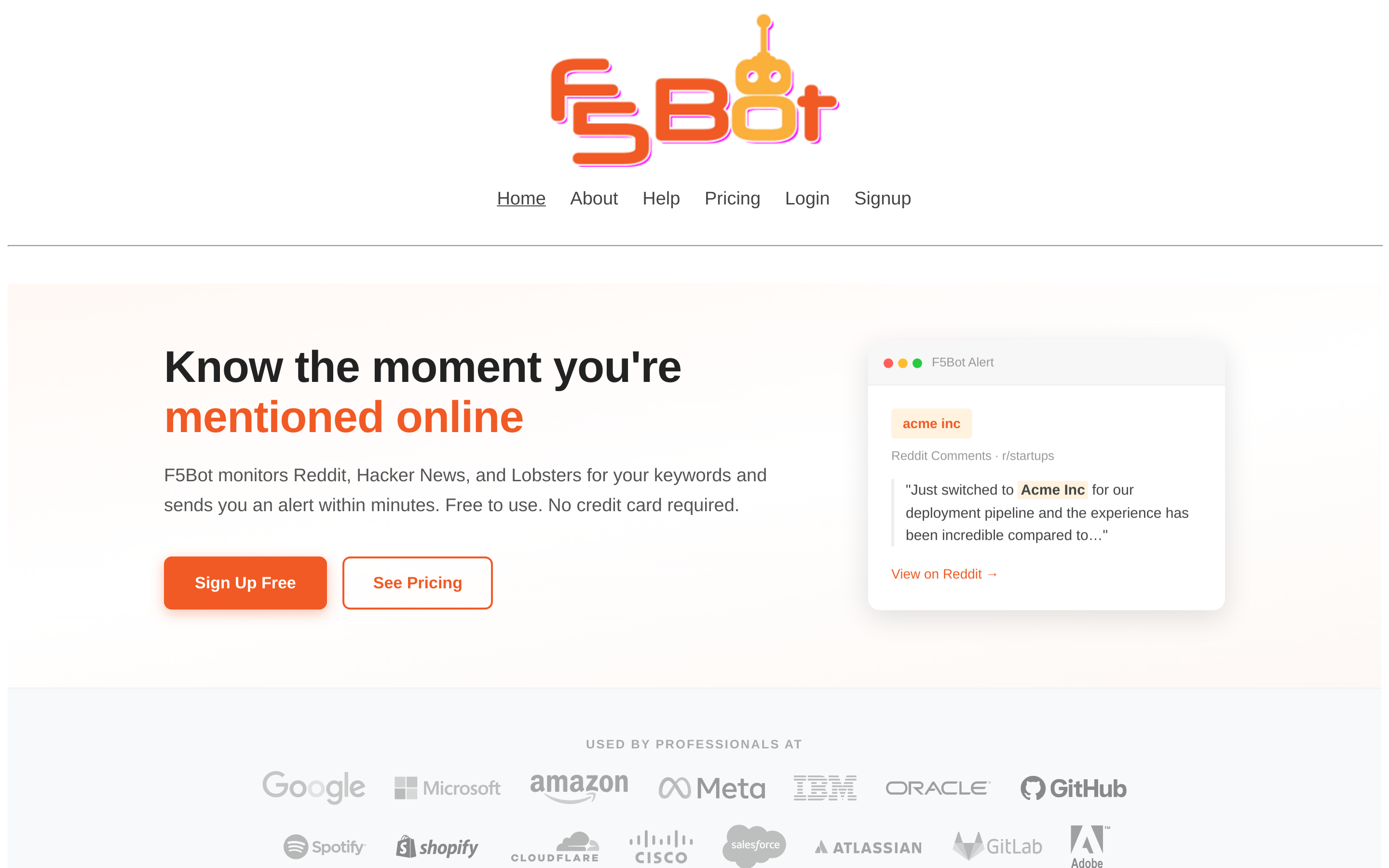
F5Bot does one narrow job well. It watches Reddit, HN, and Lobsters for keywords, then emails the result. A solo founder validating whether public conversations produce useful opportunities can begin for $0.
The constraints are the point. There is no LinkedIn or X coverage, and the free tier can take up to two hours to alert.
Free comes with a ceiling.
Key features:#
Watches Reddit, HN, and Lobsters.
Sends keyword matches by email.
Applies URL and source filters to narrow results.
Offers scheduled or instant delivery on paid tiers.
Adds RSS and JSON feeds on Gold.
Supports Slack, Discord, and higher alert volume on paid plans.
Pricing: #
Free costs $0 for five keywords and twenty daily alerts, with ten results per keyword; Silver costs $9.99 per month for twenty keywords and alerts within five minutes; Gold costs $49.99 per month for 200 keywords with AI filtering, feeds, and team delivery; Diamond starts at $500 per month and gates custom allowances.
Pros:#
A real free plan makes channel validation inexpensive.
Silver delivers alerts within five minutes for $9.99.
Filters can isolate a few high-value subreddits.
Cons:#
Coverage stops at three technical discussion sites.
The free plan is for personal use.
No contact context, intent score, or outreach workflow comes with the alert.
F5Bot beats every paid platform here when you only need a handful of technical-community alerts. Once the motion depends on LinkedIn, GitHub, or qualified outreach, its simplicity becomes the ceiling.
Also Read: Our review of free social listening tools helps teams decide when a $0 monitor is enough.
8. Sprout Social: Best for publishing, care, and reporting in one suite#
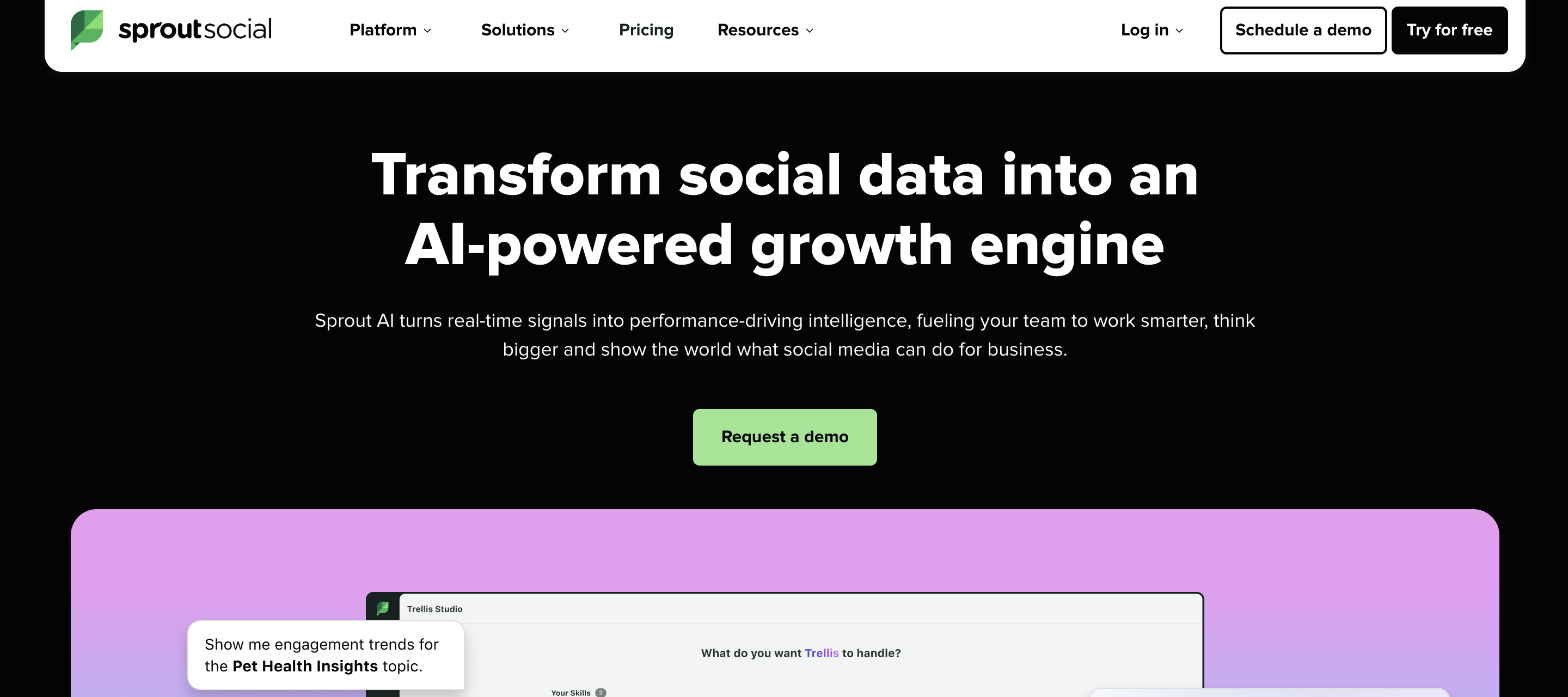
Sprout solves a different problem from Buska. It gives marketing teams one system for publishing and customer care, with reporting and governance alongside them. Listening is an add-on; the core plans handle profiles, inboxes, and approvals.
That makes Sprout the right switch when the organization wants one social operating system. It is expensive and indirect for a team whose sole target is buyer-intent lead discovery.
What Sprout includes:#
Schedules and publishes across connected profiles.
Consolidates inbound messages into a shared inbox.
Tracks keyword and location mentions from Standard.
Adds competitor, tag, and paid insights on Professional.
Opens API and helpdesk integrations on Advanced.
Offers Listening and Premium Analytics as separate add-ons.
Pricing: #
Essentials costs $99 per seat per month on monthly billing and connects five profiles; a 30-day free trial is available with no credit card; Standard costs $249 per seat monthly, Professional costs $399, and Advanced costs $499; Enterprise uses custom pricing and gates tailored implementation plus priority support.
Pros:#
Publishing and care workflows give every public response an owner.
Reporting fits established marketing teams and client-facing agencies.
Advanced connects social care to helpdesk systems through its API.
Cons:#
Standard costs $2,988 per seat across twelve monthly payments.
Full listening adds another purchase decision.
Buyer identity and sales qualification are not the central workflow.
Sprout wins when a content and customer-care team needs governance across owned profiles. CommunityTracker fits when the revenue team starts with a public buyer signal and wants to turn community conversations into pipeline.
9. Hootsuite: Best for content operations with lighter listening#
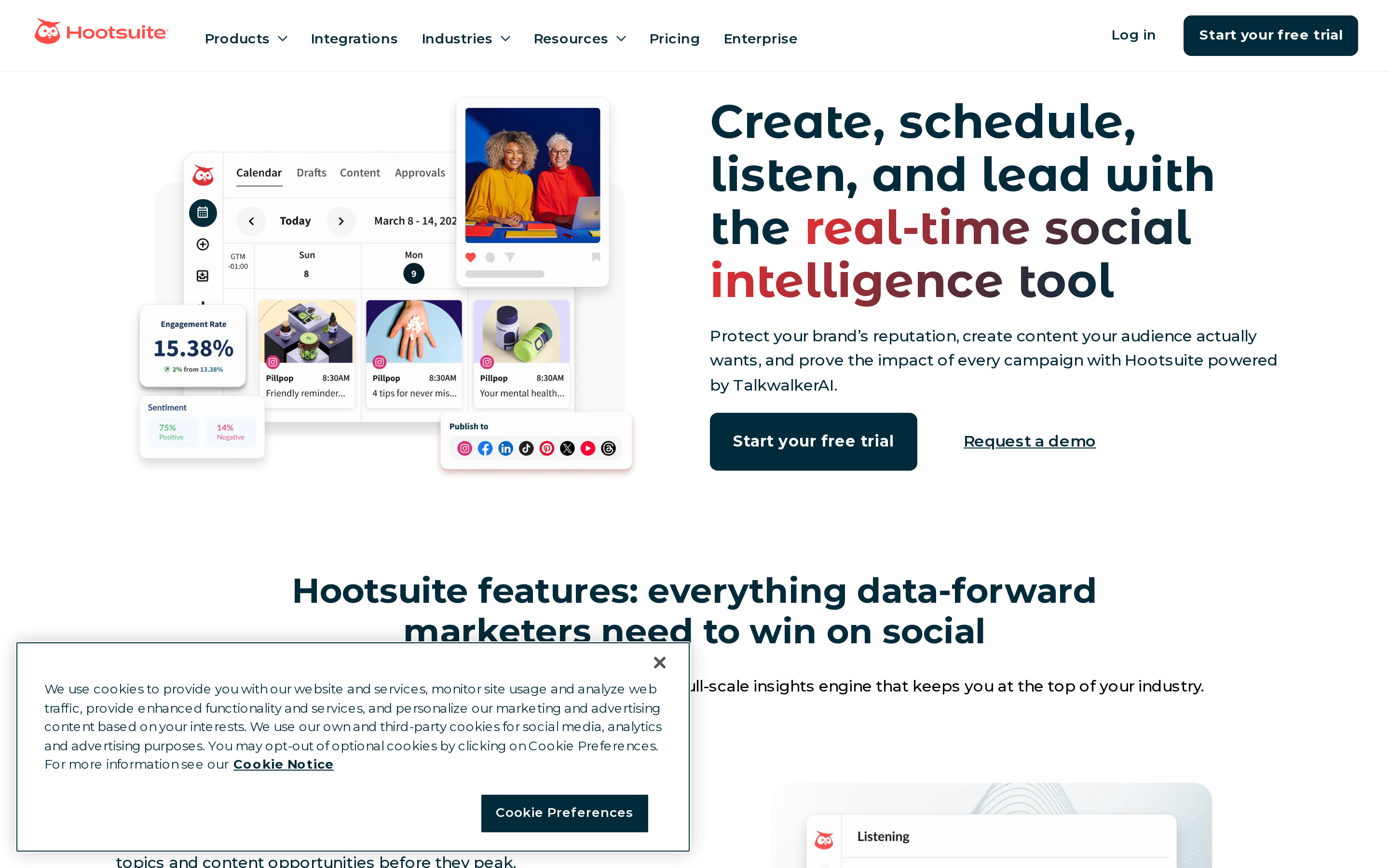
Hootsuite blends publishing, inbox management, analytics, and a lighter listening layer. Standard searches the previous seven days for brand and competitor mentions. Advanced extends that search window to thirty days and adds routing plus deeper reporting.
The suite fits a team that spends most of its week creating and managing posts. A sales team searching for intent across developer and community sources will find the workflow pointed in the wrong direction.
What Hootsuite includes:#
Schedules unlimited posts across connected accounts.
Manages public and private messages in one inbox.
Searches recent mentions, hashtags, and competitor terms.
Analyzes sentiment and detects mention peaks.
Benchmarks five competitors on Standard and twenty on Advanced.
Adds approval, routing, and export controls on higher plans.
Pricing: #
Standard costs $99 per month and manages ten social accounts; the 14-day trial includes daily posting limits and no bulk scheduling. Advanced costs $199 per month and opens unlimited accounts, thirty-day mention search, bulk scheduling, and more reporting.
Enterprise starts from $399 and gates advanced listening plus compliance and tailored support.
Pros:#
Publishing, analytics, and inbox work share one dashboard.
Standard includes basic brand and competitor listening.
Advanced suits a team that needs approvals and message routing.
Cons:#
Standard only searches seven days of mentions.
Deeper Talkwalker listening sits at the enterprise end.
Community buyer signals do not flow into contact enrichment and qualification.
Hootsuite deserves the win when publishing cadence and engagement control are the main problems. It will not replace a purpose-built signal-to-revenue process.
Final decision guide: pick the workflow before the vendor#
Use the narrowest option that completes the job your team owns:
Revenue owns the signal: Start with CommunityTracker. It connects buyer intent to contact context and qualification, with response and outreach in the same path.
Marketing owns market intelligence: Brand24 has the broadest reporting case. Awario costs less and gives a skilled operator more query control.
Product marketing watches technical buyers: Octolens provides relevance scoring and strong workflow integrations. Syften works when precise alerts are enough.
A lean team needs affordable alerts: KWatch adds LinkedIn at $19. F5Bot covers Reddit, HN, and Lobsters for $0.
The social team owns publishing and care: Sprout has deeper governance. Hootsuite gives smaller teams a lower entry point.
Price alone can still mislead. Count the hours between an alert and a responsible action. A cheaper monitor becomes expensive when a rep opens four tools to identify the poster, find an email, reconstruct the context, and log the outcome.
Move from Buska alerts to qualified action with CommunityTracker#
Buska deserves credit for pushing social listening toward intent and ICP fit. Brand24 and Awario give marketers deeper analysis. Sprout and Hootsuite handle publishing operations that CommunityTracker does not.
Our focus is the revenue gap after discovery.
CommunityTracker is the specific fit when a B2B SaaS team needs to catch a buyer signal, understand the person behind it, reach out with context, and qualify the result. A lighter alert tool is easier to justify when you only watch two subreddits and your founder responds manually.
Pick one competitor phrase and one pain phrase this week. Track both across the platforms where your buyers already talk, then review which alerts produced a credible next move. If the useful signals still die between the alert and the rep, that is the workflow to fix.
From signal discovery to GTM action.