Pulsar publishes no price list, and its Terms of Service UK renew every contract automatically unless you send written notice 90 days before the term ends (checked Oct 16, 2026). Each renewal runs 12 months or the length of your first term, whichever is longer, and Pulsar invoices 100% of the fees up front.
Fee increases are capped at 10% per renewal. On G2, Pulsar holds 4.3 from 105 reviews, and Kevin M. named the cost of entry: "getting good results takes real investment in the boolean logic" (G2, Jun 8, 2026).
My view: put the 90-day notice date on your calendar on the day you sign, and size your mention limit to your heaviest month.
This review covers Pulsar TRAC and CORE, the contract terms, what 16 users report, and 4 alternatives.
TL;DR#
What it is: an audience intelligence platform from London. Pulsar TRAC handles social listening and audience segmentation, and Pulsar CORE handles owned channel analytics and benchmarks.
Price: quote only. Pulsar has no price page, no tier list and no self-serve checkout (checked Oct 16, 2026).
Contract: 100% of fees invoiced up front, auto-renewal for at least 12 months, 90 days' written notice to stop it, and increases capped at 10% per renewal.
Extra costs: £0.00625 for each mention over your limit and £1,250 for each extra search.
Ratings: 4.3 from 105 on G2, 4.8 from 4 on Gartner Peer Insights, and no reviews on Trustpilot (checked Oct 16, 2026).
Common complaint: the Boolean query builder takes weeks to learn, from 2020 to September 2026.
My call: Buy Pulsar if you run audience and community research for brands or clients, have an analyst who writes Boolean queries, and can track a 90-day notice date. If listening history back to 2010 matters more, get a Brandwatch quote. If you want to find buyers asking for a tool like yours on Reddit, LinkedIn or Slack, CommunityTracker Pro costs $99 a month with no contract.
Pulsar Review at a Glance#
Item | Detail |
Company | Fenix Media Limited, trading as Pulsar, London |
Parent | Pulsar Group plc, AIM: PULS |
Products for this review | Pulsar TRAC and Pulsar CORE |
Lowest price | No public price (Oct 16, 2026) |
Trial | No self-serve trial |
Billing | 100% of fees invoiced at the start of each term |
Renewal | Automatic, 12 months or the first term length, whichever is longer |
Notice to stop renewal | 90 days in writing |
Renewal increase cap | 10% |
Fits | Insight, strategy and agency teams doing audience research |
How I Analyzed Pulsar#
Reviews: I read 16 dated reviews: 13 on G2, 1 on Gartner Peer Insights, 1 on Capterra UK and 1 on TrustRadius. They run from August 2019 to September 2026.
Contract: I read the Pulsar Terms of Service UK on Oct 16, 2026. The page carries no date, so I treat that day as the version I quote.
Pricing: I checked Pulsar's site for a price page on Oct 16, 2026 and read its TRAC and CORE product guides.
Company figures: I took revenue and headcount from Pulsar Group plc results for the year ended Nov 30, 2025 and the half year ended May 31, 2026.
Rival tools: I compared CommunityTracker, Brandwatch, Sprinklr and Hootsuite on prices checked Oct 15 and 16, 2026.
Not covered: I have no Pulsar account, so data quality and speed come from users.
Pulsar#
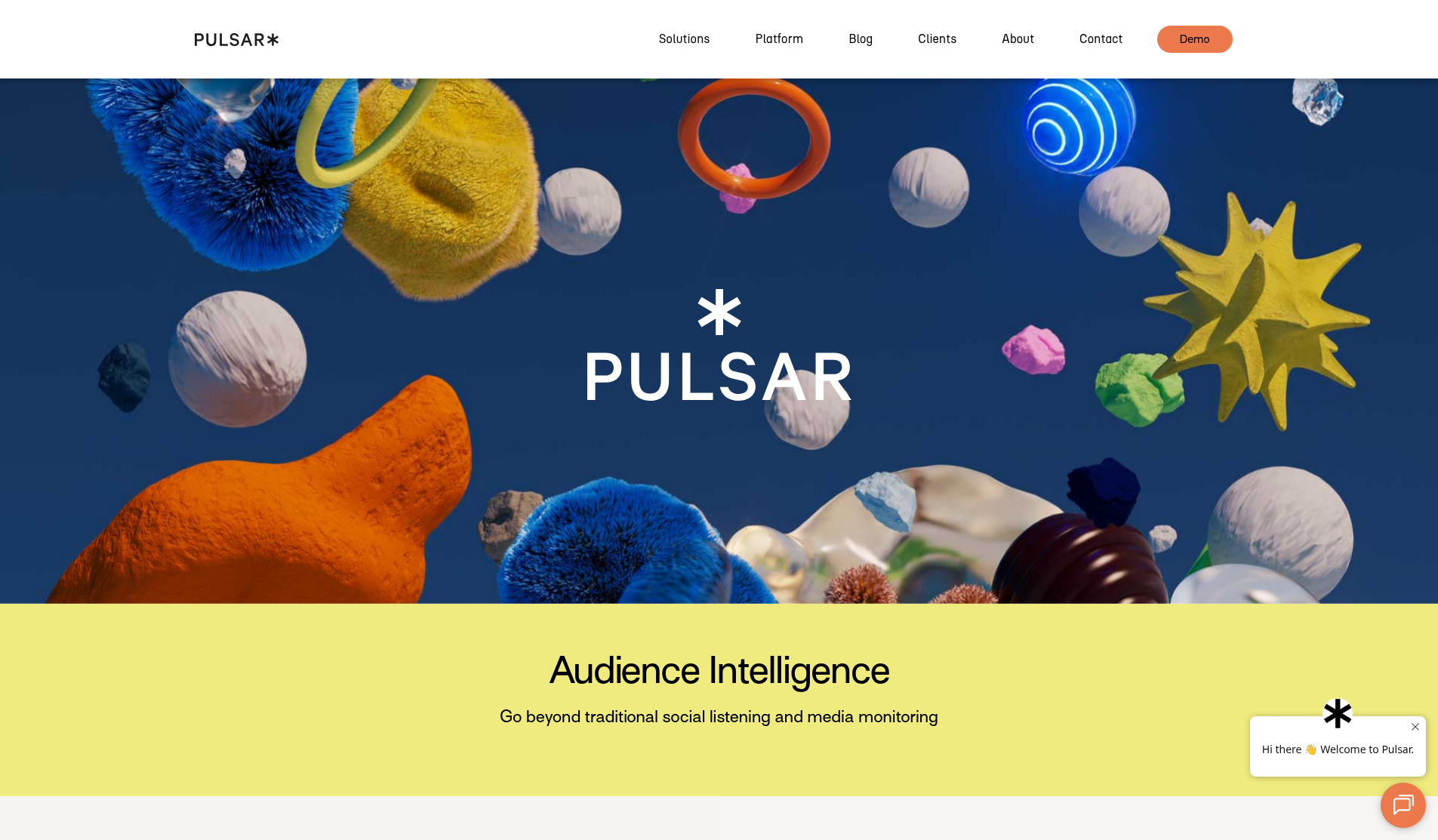
Source: Pulsar homepage, Oct 16, 2026, with the "Audience Intelligence" hero.
Pulsar started in London in 2010. You sign with Fenix Media Limited, which trades as Pulsar, and its parent is Pulsar Group plc, listed on AIM as PULS. The parent went by Access Intelligence plc until May 7, 2024. Pulsar Group also owns Isentia and ResponseSource.
For the year ended Nov 30, 2025, Pulsar Group reported revenue of £61.2 million, against £62.0 million the year before, and a loss before tax of £9.5 million. For the six months ended May 31, 2026, revenue rose 10% to £33.0 million and annual recurring revenue reached £67.2 million. Headcount fell from 918 in November 2024 to 710 in April 2026 after a restructuring.
The products in scope are TRAC and CORE. Pulsar also sells Narratives AI for narrative tracking, Pulsar CLEAR for ad compliance, Pulsar TRENDS, an API, and Audiense licences as a reseller.
The thesis of this review: the Statement of Work and the Terms of Service decide what Pulsar costs you over time. The terms bill the full year at the start, roll the contract forward unless you act 90 days early, and charge per mention over your limit. A team that tracks those three dates and numbers gets a research tool reviewers praise. A team that doesn't can pay for a second year it didn't plan.
Features#
TRAC searches: Boolean queries filtered by platform, language and region. Kevin M. wrote that filtering "let me scope a topic tightly so the data stays clean instead of noisy" (G2, Jun 8, 2026).
Themes: TRAC groups what people say about a topic. Alexia A. wrote that "The Themes function in Trac searches allows us to save time by providing relevant context" (G2, Sep 9, 2026).
Communities and audiences: TRAC maps the groups that drive a conversation, the feature Pulsar builds its pitch on.
CORE benchmarks: owned channel performance for your brands and a competitive set, across the major networks and Google Analytics.
Saga: an AI research assistant. Margaret G. wrote that Saga is "incredibly conversational and approachable" (G2, Jul 6, 2026).
Reports and dashboards: shareable dashboards for share of voice and client reports.
Languages: 70+ languages, per Pulsar's TRAC guide.
What each product covers, Yes or No:
Feature | Pulsar TRAC | Pulsar CORE |
Keyword and Boolean listening | Yes | No |
Themes and topic grouping | Yes | No |
Community and audience maps | Yes | No |
Owned channel analytics | No | Yes |
Competitor benchmarks | Yes | Yes |
Publishing | No | No |
Public price | No | No |
Features, my read: reviewers use TRAC for research projects more than for daily alerts. The tool rewards an analyst who builds queries well, and the learning curve falls on that person.
Pricing#
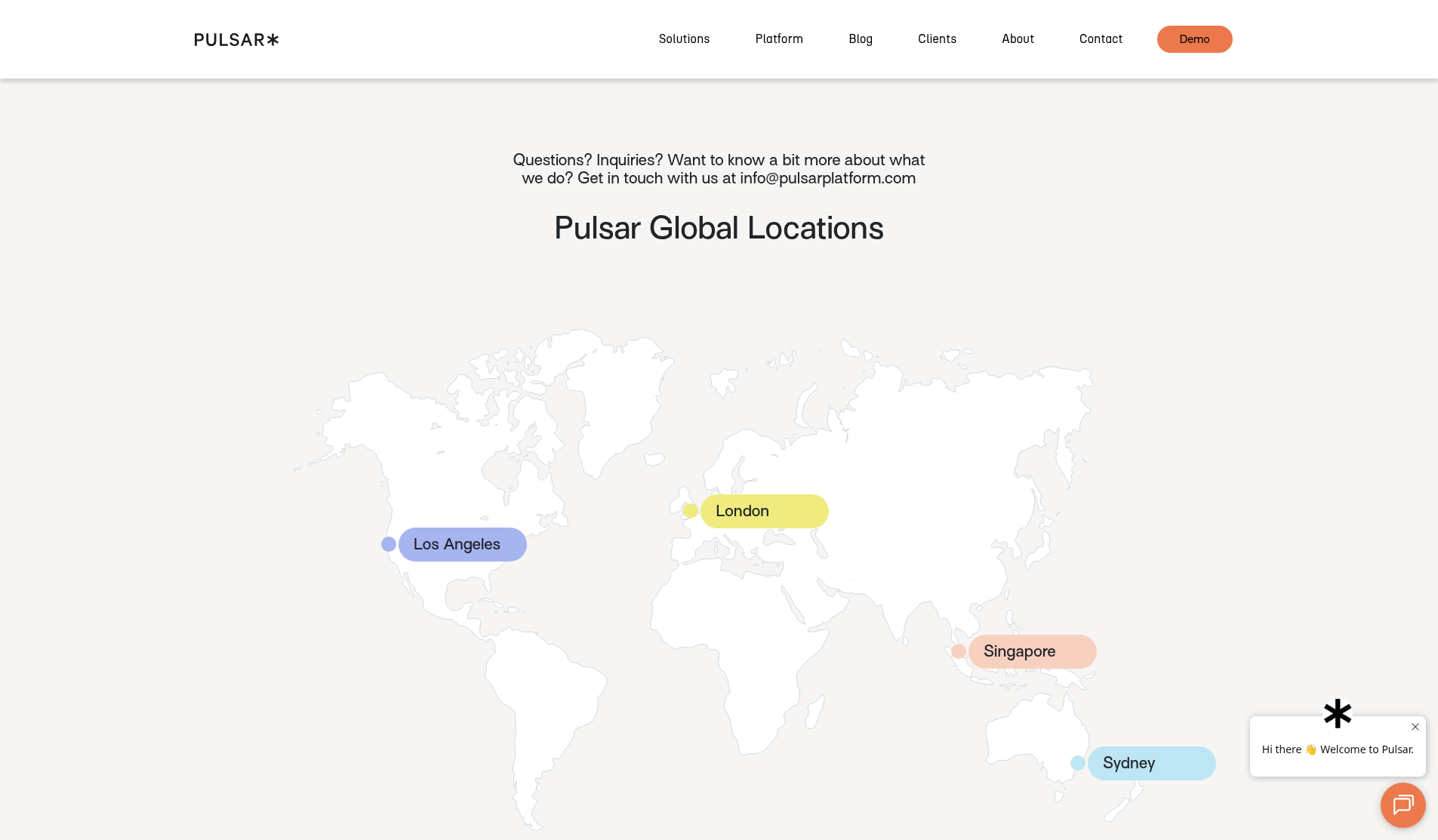
Source: Pulsar contact page, Oct 16, 2026. Sales requests go through this contact form.
Pulsar's own TRAC and CORE guides state that neither product has "a published tier list" or "self-serve checkout" (checked Oct 16, 2026). The pricing URL on Pulsar's site returns a 404. Quotes depend on seats, data volume, sources, languages and support level.
What the Terms of Service UK set for every Statement of Work:
Billing: Pulsar invoices 100% of the fees on or before the start date and again at each renewal, due within 30 days (clauses 7.2 and 7.3).
Auto-renewal: the contract renews unless you give written notice at least 90 days before the term ends (clause 10.1).
Renewal length: each renewal runs 12 months or the length of your first term, whichever is longer. A 2-year first term renews for 2 years.
Increases: capped at 10% of current fees and applied at each renewal (clause 7.11).
Mention overage: £0.00625 per mention over your Statement of Work limit (clause 4.3). That's £625 per 100,000 extra mentions.
Search overage: £1,250 per extra search, and each search is capped at 200,000 mentions a month (clause 4.4).
Fair use: on "unlimited" plans, a daily limit of 15,000 mentions and 500,000 a month per search. Pulsar can pause a search that tracks "multiple large brands" and end the contract if you don't fix it within 14 business days (clause 6).
Currency: Pulsar can recover costs if exchange rates move more than 5% during the term (clause 7.5).
Refunds: no general refund clause. The one refund covers a termination over an intellectual property claim (clause 2).
Early exit: if Pulsar ends the contract for your breach, you pay the recurring fees for every year left in the term (clause 10).
Data: Pulsar deletes collected mentions 2 years after collection unless your Statement of Work sets a different period (clause 5.3).
Term changes: Pulsar can change the terms on one month's notice, including by posting on its website (clause 14).
For example, if your first term starts on Jan 1, 2027 and runs 12 months, your notice deadline is Oct 3, 2027. Miss it, and Pulsar invoices a second year, up to 10% higher, due within 30 days.
Pricing, my read: ask for three changes in the Statement of Work, since it overrides the terms where they conflict: a 30-day notice period, a renewal of 12 months whatever the first term, and an overage rate agreed for your heaviest month.
Pros#
Community and audience research in one tool, which reviewers from 2022 to 2026 single out.
Boolean filters by platform, language and region for tight searches.
Themes that group conversation, which saves analysts reading time.
CORE benchmarks for a whole competitive set next to listening.
Support that reviewers praise, including two who rated the product 1 and 2 stars.
A 10% cap on renewal increases written into the public terms.
Cons#
No public price or self-serve trial: you can't compare Pulsar with other tools before a sales call.
90-day notice: a missed date commits you to another year or more.
Learning curve: the most common G2 complaint, from 2020 to 2026.
Mention limits: reposts count as mentions, and big events can exhaust a plan.
Language accuracy: reviewers report weak results in Indonesian and in some other languages.
Platform history: data history depends on what each social network allows.
Summary#
I think Pulsar fits an insight or strategy team that runs audience research and has an analyst to own the queries. For a team that wants alerts with little setup, the query work and the contract terms weigh more than the features.
Pick it if: your work is audience, community and cultural research for brands or clients.
Skip it if: you need a public price, a monthly plan or listening without Boolean work.
What Users Report About Pulsar in 2026#
I read 16 dated reviews. Many G2 reviews in this category are invited by the vendor or by G2, so read the star counts as a ceiling.
G2: 4.3/5 (105 reviews, checked Oct 16, 2026)#
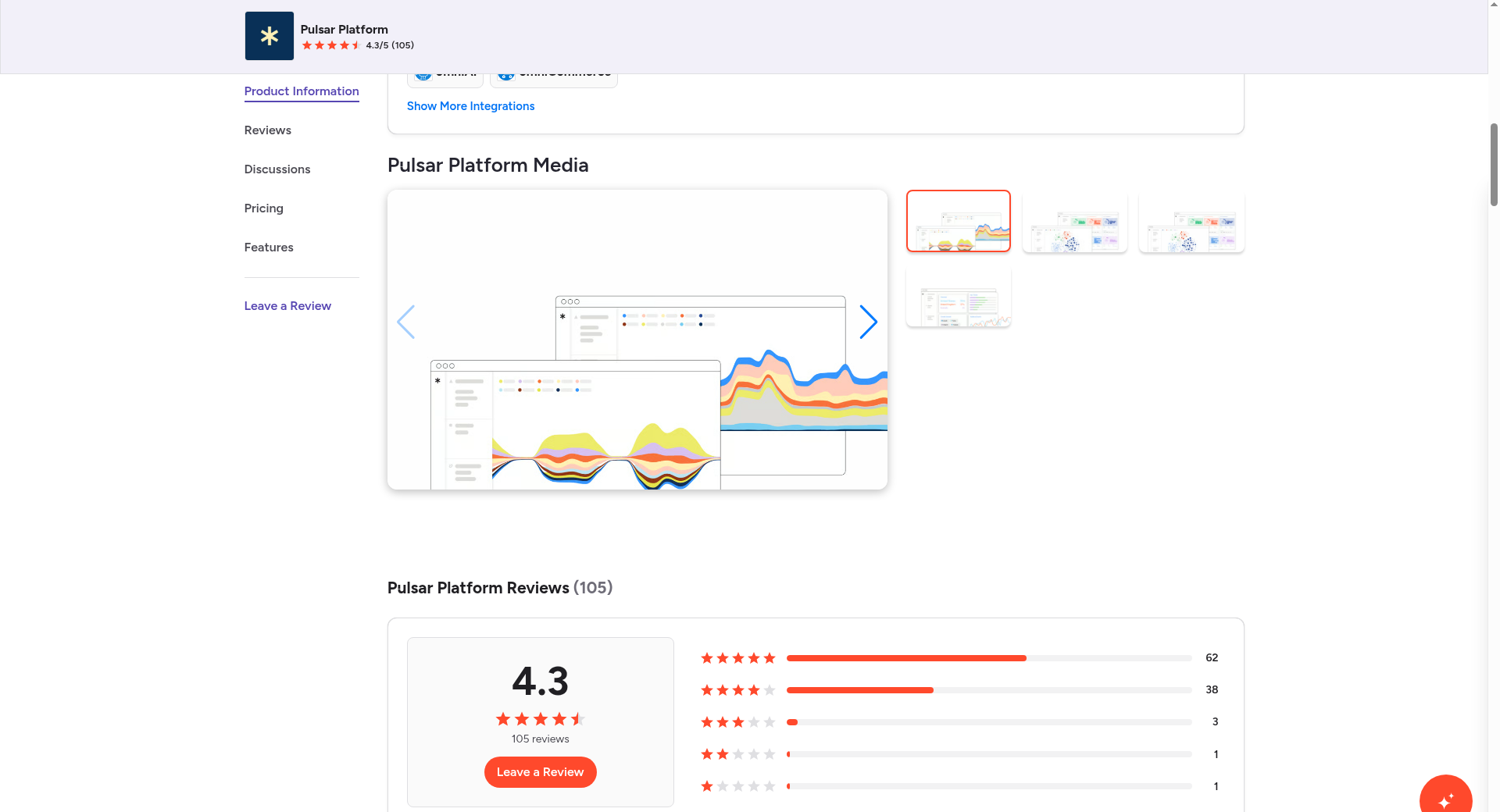
Source: G2, Pulsar Platform reviews page, https://www.g2.com/products/pulsar-platform/reviews, Oct 16, 2026. The page reads 4.3 out of 5 from 105 reviews.
G2 splits the 105 into 62 five-star, 38 four-star, 3 three-star, 1 two-star and 1 one-star reviews. Its own summary names the learning curve for complex queries as the top complaint.
Gartner Peer Insights: 4.8/5 (4 ratings, checked Oct 16, 2026)#
Gartner Peer Insights holds 4 ratings, three at 5 stars and one at 4.
Capterra, Software Advice and TrustRadius#
Capterra US and Software Advice have no Pulsar social listening page. Their PULSAR pages cover a manufacturing product. One Pulsar review sits on a Capterra UK page filed under a video QC tool. TrustRadius holds a Pulsar CORE page with 4 ratings and 1 written review, from 2019.
Trustpilot: no reviews (checked Oct 16, 2026)#
Trustpilot holds 0 reviews. Pulsar claimed the profile in July 2026.
What users liked#
Everything in one place. Gaby T. wrote: "I love having everything in one place, from social mentions to tracking mentions across a specific topic, a brand category, or even individual brand mentions" (G2, Sep 8, 2026).
Themes and benchmarks. Alexia A. wrote that "it is quite convenient to generate benchmarks through Core, so we can measure how the entire competitive set is behaving" (G2, Sep 9, 2026).
Client reports. Marie B. wrote that having "all insights from multiple sources in one place" is "valuable to be shared with clients with the report capability" (G2, Jul 31, 2026).
Trend spotting. A verified user in apparel wrote that Pulsar makes it "much easier to follow and identify emerging trends" (G2, Jul 23, 2026).
Community research. A Director of Strategy wrote about "detailed, flexible community and topic research in one place" for subreddits and X (Gartner Peer Insights, Sep 8, 2026).
Coverage beyond X. ANGY P. wrote: "I can find deep conversations on a topic, not only on X but also on other sources like Tiktok, Youtube, Facebook, and Instagram" (G2, Jul 24, 2026).
Accessible to non-coders. Margaret G. wrote that "Pulsar's intuitive UI/UX makes powerful tools accessible to everyone, even non-coders" (G2, Jul 6, 2026).
Usable by beginners. Jonathan, a consultant in France, wrote "whether you are an experienced social listening user or a beginner, you'll find what you need" (Capterra UK, Jul 25, 2022).
What users disliked#
Bugs and slowness. A verified user in computer software wrote: "Each time I use it there is a bug or an issue that prevents me from doing the task at hand. It's slow, it's clunky" (G2, Jun 11, 2025).
Lost data and slow fixes. zineb a. wrote: "I had to rewrite the plan for my PhD because the data vanished. I sent countless email, received countless promises to resolve the issue but none has been implemented" (G2, Jun 12, 2024).
Complexity. A verified user in marketing wrote: "there are quite a few steps that make the platform difficult to use if a user is new or rusty" (G2, Mar 25, 2026).
Language precision. Francesca B. wrote of "the fact that is not very precise with the language" (G2, Jul 22, 2026).
Reposts eat the mention limit. A verified user wrote that "RTs and shares are counted as mentions so it's quite easy to run out of mentions if you're listening around bigger topics" (G2, Dec 21, 2020).
Boolean errors. Marie B. wrote: "even with the guide it's hard to identify where the mistakes are" (G2, Jul 31, 2026).
No history on entry. A social media manager wrote: "I've used other tools where you can get historical data once you put into the tool but Pulsar cannot do that" (TrustRadius, Aug 13, 2019).
Two complaints sit inside positive reviews:
Limits during big events (4 stars). ANGY P. wrote: "Having to stop some tracking like in massive events such as the World Cup or politics in Colombia... we had to halt some KPIs" (G2, Jul 24, 2026).
Indonesian topics (4.5 stars). Yohana Gabriella Nanda K. wrote that it "continues to categorise Indonesian prepositions as topics, which makes the results less accurate and less useful" (G2, Mar 27, 2026).
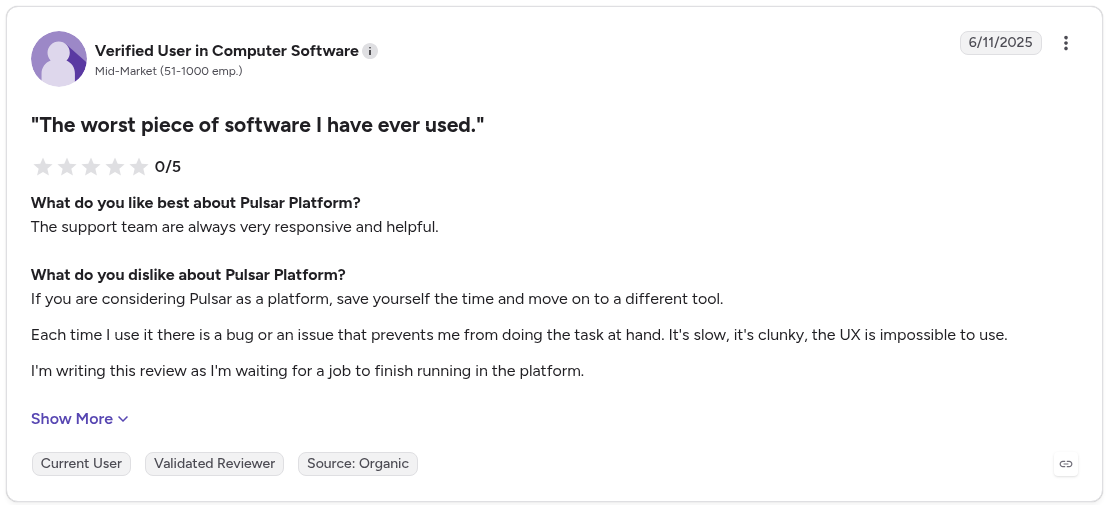
Source: G2, review by a verified user in computer software, mid-market, "The worst piece of software I have ever used.", Jun 11, 2025, https://www.g2.com/products/pulsar-platform/reviews?filters%5Bnps_score%5D%5B%5D=1.
Which reviews I believe#
I believe the praise for research depth and Themes. It comes from 2026 reviews by analysts and strategists who describe specific jobs: benchmarks across a competitive set, share of voice between brands and client reports. G2's 100 four- and five-star reviews out of 105 support it.
I believe the learning-curve complaints most of all, because they appear inside 4- and 5-star reviews from people who like the tool. Kevin M. rated Pulsar 4.5 and still wrote that "a lot of it ends up self-taught." When fans raise the same cost, expect it to apply to your team too.
I believe ANGY P.'s event-limit complaint, since it matches clause 6 of the terms, which caps mentions per day and per search. I give the 2024 and 2025 one- and two-star reviews moderate weight: they're specific, but they're 2 of 105, and both praise the support team. I give the 2019 TrustRadius review little weight on features, since the product has changed since then.
Can you trust these ratings in 2026?#
Recent pool: 12 of the 16 reviews I read date from 2026.
Small sites: Gartner has 4 ratings and TrustRadius has 1 written review, so G2 carries the weight.
Low-star share: 5 of 105 G2 reviews sit at 3 stars or below.
Invited reviews: many G2 reviews come through invitations, which tends to lift scores.
My take: trust the 4.3 on what TRAC can find, and trust the learning-curve comments on how long it takes your team to get there.
Limitations to Know Before You Buy#
1. The 90-day notice window#
This is the date I'd plan around first. Clause 10.1 renews the contract unless you give written notice 90 days before the term ends. Set a reminder at 120 days so you have time to review usage.
2. Renewals can run longer than a year#
A renewal lasts 12 months or the length of your first term, whichever is greater. If you sign for 3 years, each renewal is 3 years.
3. The full term is billed up front#
Pulsar invoices 100% of fees at the start of each term. You can't spread a renewal across months unless the Statement of Work allows it.
4. Mentions over your limit cost extra#
Overage runs £0.00625 per mention, and reposts count as mentions. A spike of 400,000 extra mentions costs £2,500.
5. Data goes after 2 years#
Pulsar deletes collected mentions 2 years after collection. Export the searches you need for year-on-year work.
6. Pulsar can change the terms#
Clause 14 lets Pulsar vary the terms on one month's notice, including by a website update. Save a copy of the terms on the day you sign.
Pulsar Alternatives Compared on Price#
Each alternative fixes a Pulsar gap: community leads with monthly billing, a longer archive, a broader suite, or a public seat price. Prices checked Oct 15 and 16, 2026:
Tool | Lowest paid plan | Public price | Trial |
Pulsar | Quote only | No | No self-serve trial |
CommunityTracker | Starter, $39/month | Yes | Free plan, plus a Pro trial |
Brandwatch | Quote only | No | No |
Sprinklr | Quote only | No | No |
Hootsuite | Standard, $99 per user/month billed annually | Yes | 14 days, no card |
How they compare on scope, Yes or No:
Feature | Pulsar | CommunityTracker | Brandwatch | Sprinklr | Hootsuite |
Social listening | Yes | Yes | Yes | Yes | Yes |
Community and audience maps | Yes | No | Yes | No | No |
Slack and Discord communities | No | Yes | No | No | No |
Verified email for a post's author | No | Yes | No | No | No |
Social publishing | No | No | Yes | Yes | Yes |
Monthly billing option | No | Yes | No | No | No |
Self-serve signup | No | Yes | No | No | Yes |
Pulsar Alternative: CommunityTracker#
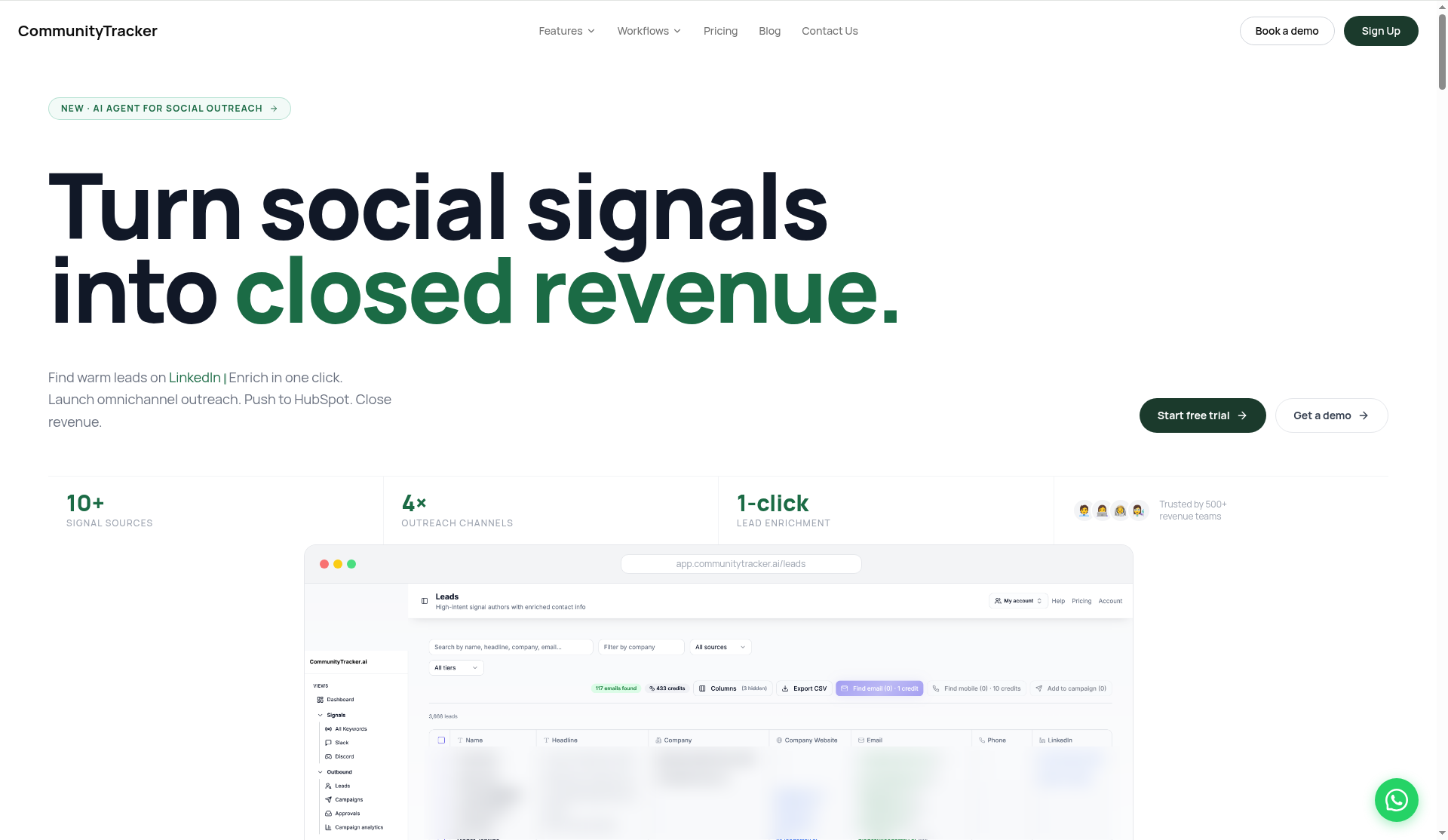
Source: CommunityTracker homepage, https://www.communitytracker.ai/, with names and emails in the product mockup blurred.
CommunityTracker is my #1 alternative for a B2B team that wants listening to produce pipeline. Pulsar maps how audiences talk about a topic. CommunityTracker finds posts where someone asks for a tool like yours, scores the buying intent, adds the author's contact details and drafts a reply.
It covers Reddit, LinkedIn, X, Slack, Discord, Hacker News, GitHub and Indie Hackers, with partial blog and news coverage (communitytracker.ai/pricing). My guide to Reddit lead generation covers the method.
Features#
Buying-intent scores: AI flags posts that ask for a product, an alternative or a fix in your niche.
Author details: a verified email, LinkedIn profile, company and job title for each poster.
Outreach: email sequences, LinkedIn requests and DMs, Reddit replies and AI voice calls tied to the thread.
HubSpot sync: each lead lands in your CRM with the post it came from.
Slack and Discord: group monitoring, covered in my guide to monitoring Slack communities.
Pricing#
Monthly billing with no annual contract, so there's no notice window to track. Plans on communitytracker.ai/pricing, checked Oct 15, 2026:
Free ($0): one Reddit keyword with one alert a day.
Starter ($39/month): 4 keywords across Reddit, LinkedIn, Hacker News and GitHub, up to 5,000 mentions and 100 warm emails a month.
Pro ($99/month): 10 keywords on every supported community, uncapped mentions and warm emails, AI scoring, share of voice and a daily Slack digest, with a free trial.
Advanced ($199/month, through sales): 20 keywords plus community intelligence, AI visibility and share of voice exports.
Pros#
Cancel any month, where a Pulsar contract renews unless you act 90 days early.
A free plan and self-serve signup, so you start without a sales call.
Slack and Discord groups, which Pulsar doesn't monitor.
Lead finding, author details and outreach in one tool.
Cons#
No audience or community maps: it doesn't segment audiences or map the groups behind a topic the way TRAC does.
No owned channel analytics: nothing like CORE's benchmarks.
Narrow news and blog coverage: only partial, and no broadcast or licensed news.
Daily Slack digest: a new thread can wait up to 24 hours on Pro and Advanced.
No outside reviews yet: G2, Capterra, TrustRadius and Trustpilot had no readable CommunityTracker reviews on Oct 15, 2026.
Summary#
I think CommunityTracker is my pick next to Pulsar for a SaaS or B2B team that wants leads from community threads, a job TRAC isn't built for. Pro costs $99 a month with no contract.
Pick it if: your buyers ask for tools in subreddits, LinkedIn threads or Slack groups.
Skip it if: you need audience research, segmentation or channel benchmarks. Run the free Reddit keyword for a week and count the threads worth a reply.
Pulsar Alternative: Brandwatch#
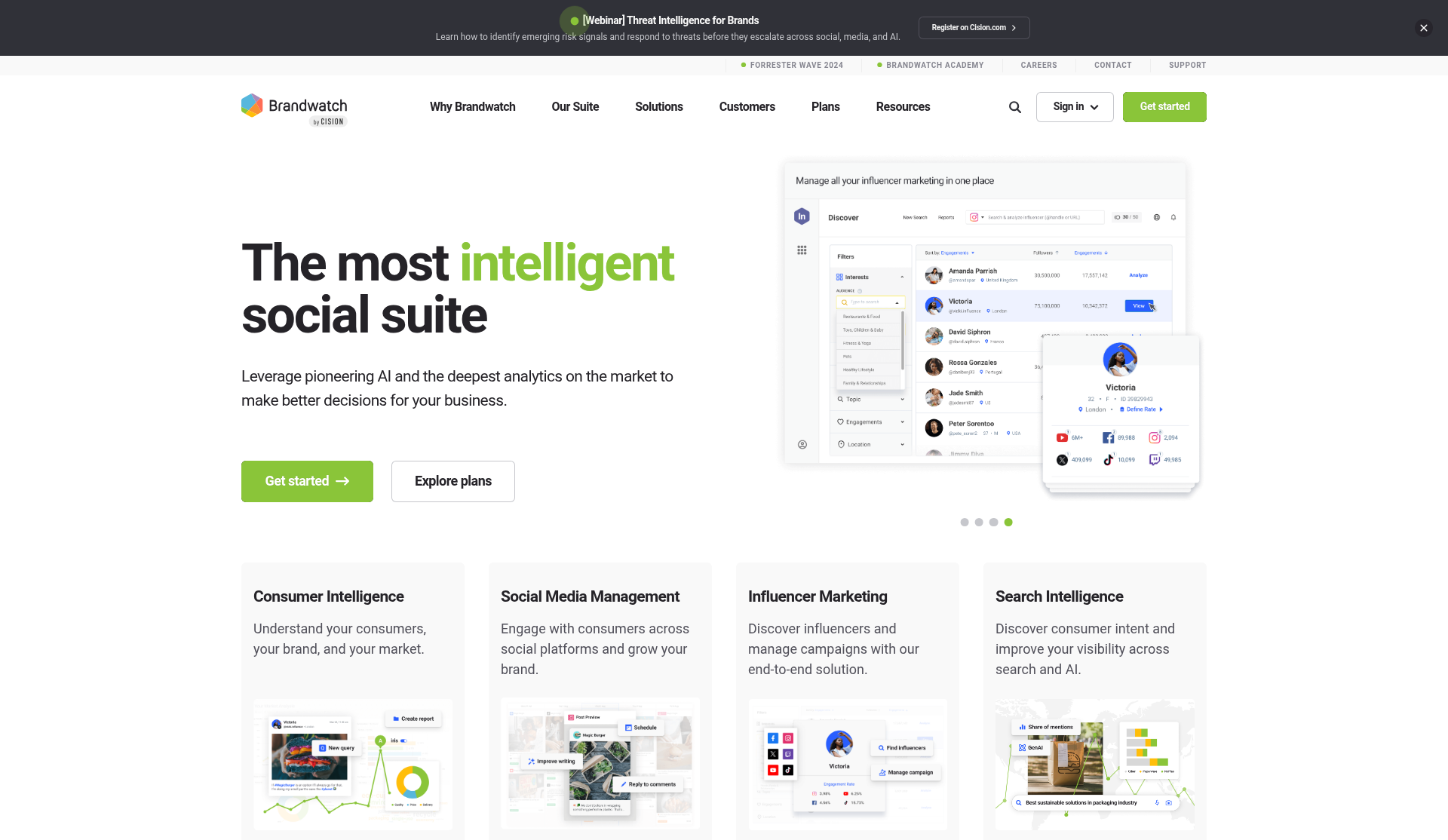
Source: Brandwatch homepage.
Brandwatch is the closest rival for research teams. It sells consumer research with an archive back to 2010, and like Pulsar, it has no public price. My Brandwatch review has the full detail.
Features#
Archive: 1.7 trillion conversations back to 2010, for year-on-year studies.
Iris: an AI assistant for summaries, plus image analysis for logos and scenes.
Dashboards and API: 50+ live chart types and data export.
Pricing#
Quote only for every solution (checked Oct 16, 2026). My Brandwatch pricing guide covers what moves the quote.
Pros#
History back to 2010, where Pulsar deletes collected data after 2 years.
Image analysis inside listening.
A publishing suite under the same vendor.
Cons#
No public price or self-serve trial, the same as Pulsar.
2.0 from 21 on Trustpilot (checked Oct 16, 2026).
Reviewers report a learning curve similar to Pulsar's.
Summary#
I'd get a Brandwatch quote next to a Pulsar quote for the same queries. If you need multi-year history, let the archive decide. More options sit in my Brandwatch alternatives list.
Pick it if: your research needs data from before you signed.
Skip it if: community and audience maps matter more than archive depth.
Pulsar Alternative: Sprinklr#
Source: Sprinklr homepage, Oct 16, 2026.
Sprinklr fits when listening has to sit next to publishing, care and governance for a global team. Sprinklr Insights covers listening, and Sprinklr Social covers publishing. See my Sprinklr review.
Features#
Insights: listening across social, news, blogs, forums and reviews, with visual logo detection.
Social: a shared calendar, approvals and a unified inbox.
Governance: permissions and approvals for many brands and regions.
Pricing#
Quote only since Sprinklr ended Self-Serve on April 30, 2026. Its MSA makes fees non-cancelable unless the Order Form sets other terms.
Pros#
Publishing, care and listening under one contract.
Visual listening for untagged logos.
8.8 from 175 for Sprinklr Social on TrustRadius (checked Oct 16, 2026).
Cons#
No public price or trial.
Ease of use scores 3.9 on Capterra.
Fees can't be cancelled during the term.
Summary#
I'd look at Sprinklr if your listening budget sits inside a wider customer experience project. For research alone, it's more platform than an insight team needs.
Pick it if: you want listening, publishing and care for many teams in one tool.
Skip it if: your work is audience research for a few analysts.
Pulsar Alternative: Hootsuite#
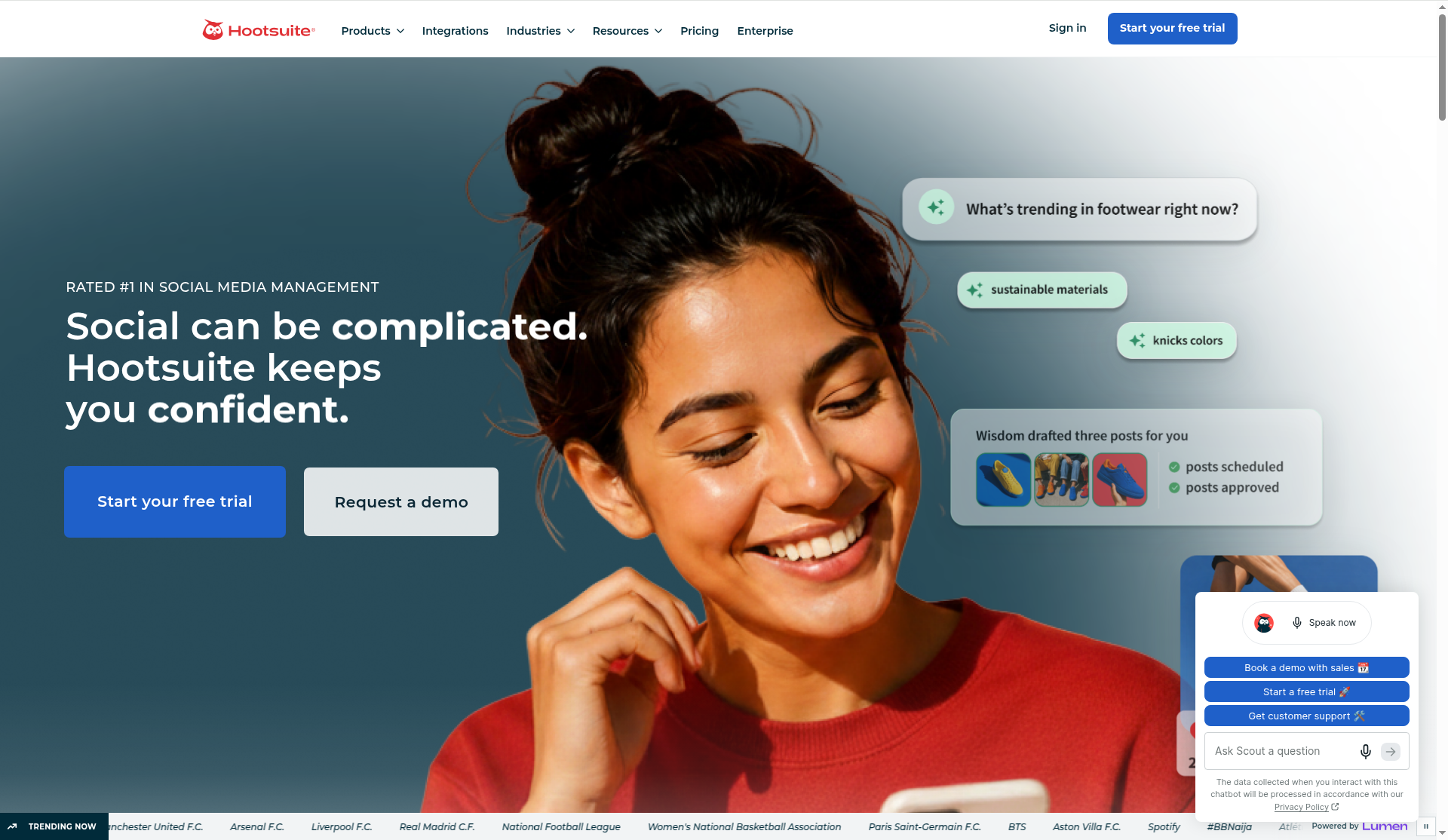
Source: Hootsuite homepage.
Hootsuite offers a public seat price and a trial, and its Enterprise listening runs on Talkwalker, which it owns. My Hootsuite review and Talkwalker review cover both.
Features#
Publishing and inbox: on every plan.
Listening: 7 days of history on Standard, 30 days on Professional and 13 months on Enterprise.
Approvals and routing: on Advanced.
Pricing#
Hootsuite seat prices, checked Oct 15, 2026:
Standard ($99 per user/month billed annually): 10 social accounts, inbox and 7 days of listening.
Professional ($199 per user/month billed annually): unlimited accounts and 30 days of listening.
Advanced ($399 per user/month billed annually): approvals and routing.
Enterprise (custom): 13 months of listening.
Pros#
A public price you can budget without a call.
A 14-day trial with no card.
Publishing and listening in one seat.
Cons#
Annual fees are non-refundable under its terms.
Listening on lower plans looks back only 7 or 30 days.
No community or audience maps.
Summary#
I'd pick Hootsuite if you need publishing first and light listening second. For audience research, its lower plans don't reach TRAC's depth.
Pick it if: you want a public seat price and a no-card trial.
Skip it if: audience segmentation is the main job.
For wider lists, see my roundups of social listening tools, AI social listening tools and media monitoring tools.
Final Verdict: Is Pulsar Worth It in 2026?#
Yes, for an insight, strategy or agency team that runs audience and community research, has an analyst to write Boolean queries, and will track the 90-day notice date. G2 reviewers rate it 4.3 from 105, and their praise centers on research depth.
No, for a team that wants a public price, monthly billing or alerts without query work. The terms bill the full term up front, renew for at least 12 months, and charge per mention over your limit.
What I'd do before signing:
Ask for a 30-day notice period and 12-month renewals in the Statement of Work.
Size your mention limit to your heaviest month, reposts included.
Ask for a trial query on your own topic, in your own languages.
Get a Brandwatch quote for the same queries as a benchmark.
If you came to Pulsar to find buyers in community threads, CommunityTracker Pro does that for $99 a month with no contract.
FAQs#
Is Pulsar worth it in 2026?#
For audience and community research teams with an analyst to own the queries, yes, as long as you negotiate the notice period and size your mention limit. For keyword monitoring alone, a tool with a public price fits better.
How much does Pulsar cost?#
Pulsar publishes no price (checked Oct 16, 2026). Quotes depend on seats, data volume, sources, languages and support, and the full term is invoiced up front.
Does Pulsar auto-renew?#
Yes. Clause 10.1 renews the contract unless you give written notice at least 90 days before the term ends.
How long is a Pulsar renewal?#
12 months or the length of your first term, whichever is longer.
Can Pulsar raise my price at renewal?#
Yes, by up to 10% of current fees, under clause 7.11 of the Terms of Service UK.
What happens if I go over my mention limit?#
Pulsar can charge £0.00625 per extra mention and £1,250 per extra search. Reposts count as mentions.
Does Pulsar offer refunds?#
The public terms have no general refund clause. The one refund covers a termination over an intellectual property claim.
What is a good Pulsar alternative?#
CommunityTracker if you want leads from Reddit, LinkedIn or Slack threads at $99 a month on Pro. Brandwatch for a longer archive, Sprinklr for a full customer experience suite, and Hootsuite for a public seat price.