8 Best Website Visitor Identification Tools in 2027
Website visitor identification tools for 2027: 8 compared on company or person matches, public prices, and coverage, with the pick I'd start with.
Adarsh Kumar
GTM Expert
Founder — CommunityTracker, Miraa.io, and Infraboxes
You watch a week of pricing-page traffic and your CRM only kept the two form fills.
Revenue teams now route identified visitors into Slack and the CRM so a known account gets a reviewed first touch.
I’m sure you’ve tried a form-only CRM, a Google Analytics company report, or a chat widget that only fires after someone types.
Website visitor identification tools should name the company or the person behind those quiet sessions. I ranked eight on whether they name a company or a person, on a price you can see, and on whether the match still helps outside the US.
TL;DR: The 8 Website Visitor Identification Tools I Recommend
Snitcher - Best for B2B teams that want company matches at a public price
RB2B - Best for US-focused teams that want named people pushed to Slack
Leadfeeder - Best for marketers who want a free plan and campaign reports
Albacross - Best for European teams that want contact credits in every plan
Leadinfo - Best for small sales teams that split leads by territory
Lead Forensics - Best for teams willing to demo and trial before a quote
Warmly - Best for funded teams that want identification plus an AI chat agent
Vector - Best for ABM teams that turn site visitors into ad audiences
My pick: Snitcher, because you can see the price, the billing term, and a company match stored in the EU. Starter is $49 a month on yearly billing for 600 company IDs a year, or $89 a month for 50 IDs a month. One warning up front: Snitcher names companies, not consumers, so skip it if you sell to people.
Coverage at a glance
Tool | What it names | Where person-level works | Match notes you should test |
|---|---|---|---|
Snitcher (My pick) | Companies | People only after a form, login, or tracked email click | Repeat visits from the same company count once a month |
RB2B | Companies on every plan. People from Starter up | Contact-level ID is US only. Company-level ID is global | Starter and Pro list 15-20% contact coverage. Pro+ lists 35-45% |
Leadfeeder | Companies. Verified emails and phones start on Activate | Not a person-first product on Lite or Discover | Repeat visits in a month count as one company |
Albacross | Companies, plus email and phone credits on every plan | Credits are limited, so a contact is not guaranteed on every visit | Starter covers up to 50 companies a month |
Leadinfo | Companies, with a 300M decision-maker database | Screen recordings start on Scale | Typical trial figure around 30% of traffic. ISPs are filtered |
Lead Forensics | Companies, plus decision-maker contacts on Essentials and Automate | You learn the match share during the trial, then the quote uses it | Unlimited users on both packages |
Warmly | Companies and contacts | Rates can fall on niche or non-US traffic | Company ID around 60%. Contact ID around 45%. 40% of contacts have only a personal email |
Vector | Visitors as one input to an ABM platform | I would not quote a match rate | Priced by monthly site traffic and ad spend |
Warmly’s identification figures were last updated 10 months ago, as of 25 November 2026.
Prices I would budget
Tool | Entry plan | Month to month | Yearly, per month or per year |
|---|---|---|---|
Snitcher | Starter | $89 a month (50 company IDs a month) | $49 a month on yearly billing (600 company IDs a year) |
RB2B | Free | $0 a month, billed monthly | No yearly rate. Paid plans are $79, $149 and $199 a month, billed monthly |
Leadfeeder | Lite | €0 | Discover is €113 billed monthly, or €79 a month billed annually. Paid caps are tiered. Scale is annual only |
Albacross | Starter | €84 a month billed monthly | €59 a month billed yearly |
Leadinfo | Starter | €99 a month billed monthly | €69 a month on yearly billing |
Lead Forensics | Essentials or Automate | Quote after a demo and a free trial | Quote after a demo and a free trial |
Warmly | AI Web-Deanonymization | No month-to-month amount | $10,000 a year to start, from 10K credits a month |
Vector | Growth | No month-to-month amount | $36,000 a year on Growth, on one annual contract |
List figures are from 25 November 2026. Leadfeeder, Albacross and Leadinfo list euros. Warmly only lists yearly amounts. RB2B paid plans are billed monthly.
1. Snitcher
Snitcher is where I’d start for company identification with a price and a billing term you can see.
It matches each visit’s IP address to its own database of business networks, then sets a first-party cookie so a returning visitor stays tied to the same company. When someone fills in a form, logs in, or clicks a tracked email link, Snitcher can connect that person to earlier visits. Data is processed and stored in Frankfurt, in the EU. It identifies companies, not consumers.
I’d start a two-person social team on Starter if they only need to see who visited and reach out themselves, and I’d move them to Scale when accounts must land in the CRM without that manual work. For an EU privacy counsel, Frankfurt storage and company-only matching is why I’d shortlist Snitcher first.
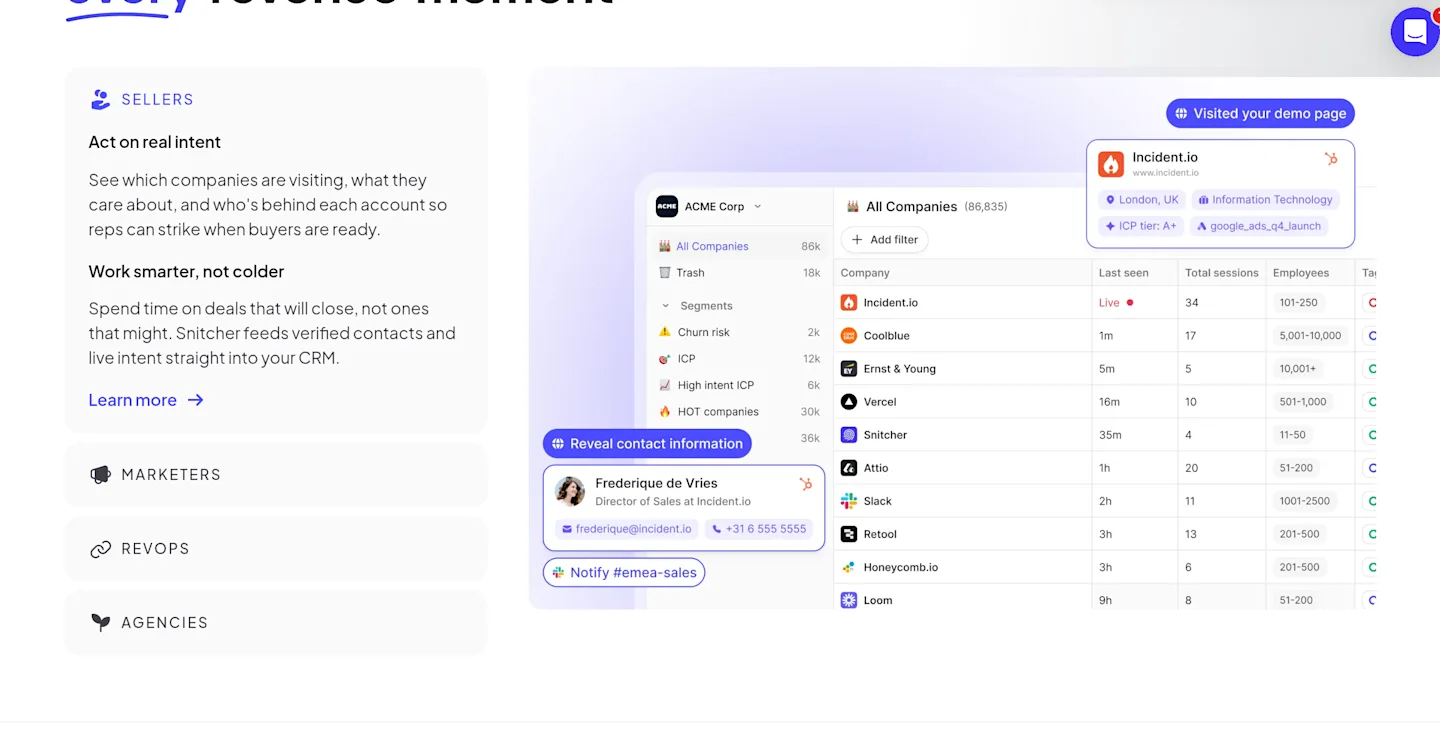
I’d trial the inbox on my own pricing page, then spend a credit only after the account looks like a fit.
Fees for Snitcher
The 14-day Pro trial needs no card, and each company counts once a month. Yearly billing gives you the year’s volume upfront and renews early once you use it. Monthly billing moves you up a tier the following month unless you set a limit. I wouldn’t treat those 600 yearly IDs as a hidden monthly cap. If a busy month burns a large share of the year, I’d set a limit or budget for an early renewal.
One review I’d keep
An October 2026 reviewer on G2 wrote: “It shows which pages a company visited, how much time they spent, and similar details.” A November 2026 review admits “the accuracy isn’t 100% when it comes to identifying which companies are visiting you.”
Pros
You can see both the monthly and the yearly rate before a sales call
Company data sits in Frankfurt, which I want if we sell in the EU
The 14-day Pro trial runs on your own site, with no card
Reveals use a separate credit pool, so running out of credits does not stop identification
Cons
You still get a company, not a named buyer, until someone identifies themselves
Yearly volume can run out early, and the plan then renews before the year ends
The IP to Company API is a separate quote, so a product team cannot price that from the listed plans
A November 2026 G2 review says the company match is not always accurate
I wouldn’t use it if you sell to consumers, because those visitors are not companies
2. RB2B
RB2B is the tool I’d open when the job is a named person in Slack, and your buyers sit in the US.
Free gives you company-level ID and a Slack push, with 150 monthly resolutions, and no person-level ID, emails, or other integrations. Starter adds LinkedIn URLs, still with no emails. Work emails and the other integrations start on Pro. Pro+ switches to Premium Resolution, adds the Identity Graph Waterfall, and raises listed coverage from 15-20% to 35-45%.
I’d only buy person-level ID if your buyers are in the US. Company-level ID is global on every plan, including Free. A demand-gen lead can live on Free at $0 a month, billed monthly, for company names into Slack, then move to Starter for LinkedIn URLs. Emails wait until Pro.
I’d open this when the job is a named person from US traffic, and I’d test coverage on our own site.
Fees for RB2B
Starter is $79 a month, billed monthly, with 300 monthly resolutions. Pro is $149 a month, billed monthly, from 600. Pro+ is $199 a month, billed monthly, also from 600. The 7-day Pro+ trial, or 1,000 credits, needs no card, and you can stay on Free when it ends. Overage is 45¢ a resolution on Starter and 25¢ on Pro and Pro+. Extra domains start at $99 a month, up to five, on Pro and Pro+. Monthly is the only billing view. I’d test Pro+ on that 7-day trial and measure the coverage jump on our own traffic.
One review I’d keep
Jeffrey R. on G2, April 2026: “It lets me see who’s visiting my website and where they work.” An April 2026 reviewer found “The percentage identified is low, however, I do not believe this is a RB2B specific issue given the privacy standards in the US.”
Pros
You can start at $0 a month, billed monthly, and still get company names in Slack
The 7-day Pro+ trial needs no card, and you can fall back to Free
Work emails and a long integration list start on Pro
Pro+ states a higher coverage range, so you know what the upgrade is for
Cons
Named people are a US-only feature, so a global pipeline will still lean on company names
Starter still withholds emails and other integrations
Coverage on Starter and Pro sits at 15-20%, so many visits will stay anonymous
Overage and extra domains can raise the bill after you pick a cap
I wouldn’t promise finance a yearly rate, because monthly is the only billing view
3. Leadfeeder
Leadfeeder, part of Dealfront, is the one I’d give a marketing ops lead who wants campaign reports and a free way to look at companies first.
Lite is €0, with the most recent 100 companies each month, history kept for seven days, and channel, campaign and page reports. Discover adds profiles, ad reports and CRM sync. Activate is where verified emails and phones start. Scale adds free company exports, automatic CRM updates and a dedicated CSM, and it is billed annually only.
I’d put a marketing ops lead on Discover if they need the Google Ads and LinkedIn Ads reports, with spend, clicks and cost per identified company. On Lite, Google Ads campaigns appear only in UTM campaigns, and only if tagged, with no spend or clicks. I wouldn’t move them to Activate until they need verified emails and phones.
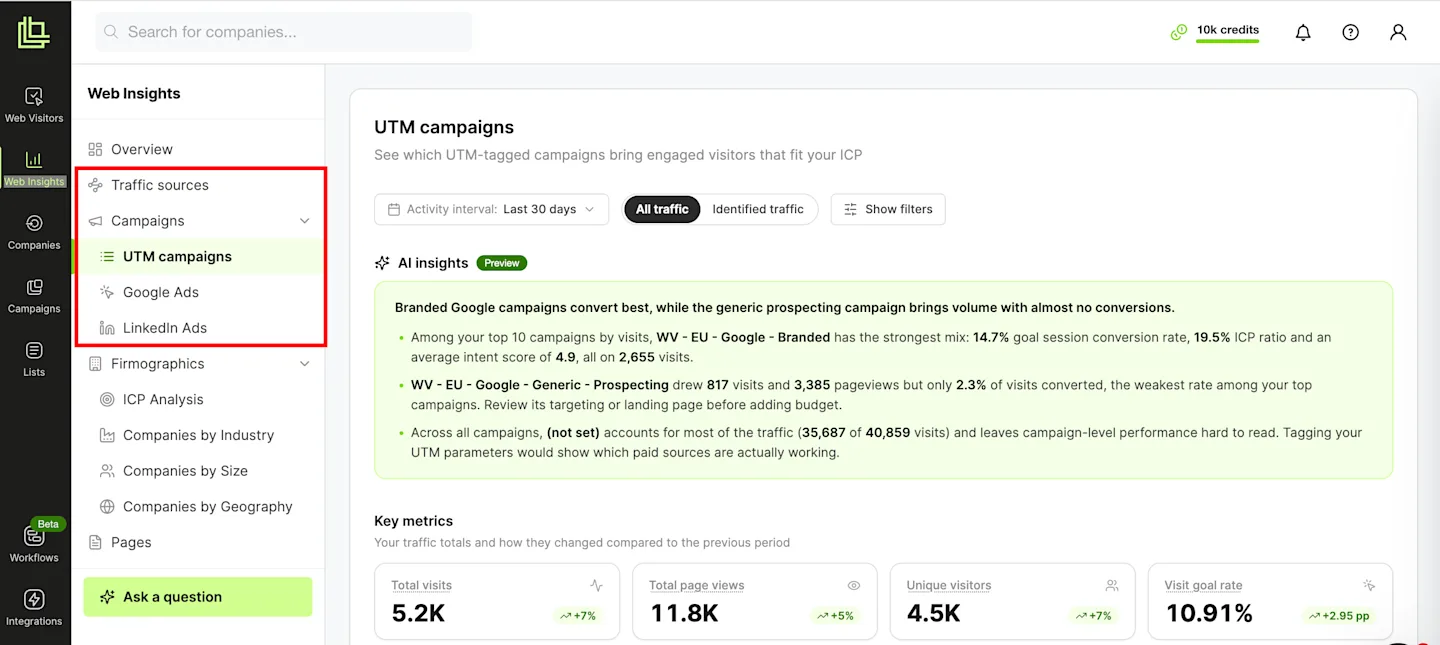
I’d open Campaigns first and compare UTM, Google Ads and LinkedIn Ads side by side (sample data in the screenshot).
Fees for Leadfeeder
Paid plans include a two-week trial, with no card. A unique company in the month counts once. Paid company caps are tiered, so I’d get the cap for our traffic during the trial. Scale is annual only at €599 a month, so a finance lead who wants month-to-month stays on Discover or Activate.
One review I’d keep
A November 13, 2025 review on TrustRadius, marked Incentivized, is titled “Providing illuminating insights into our ICP” and rates Leadfeeder 3.5 out of 5. One use case on the card is “To track ICP visitors to our website.” As of 25 November 2026, that card is just over 12 months old.
From October 2026 on G2: “Custom feeds let me filter companies based on that profile.” An October 2026 review notes “there are not always identified contacts for all companies, especially access to emails.”
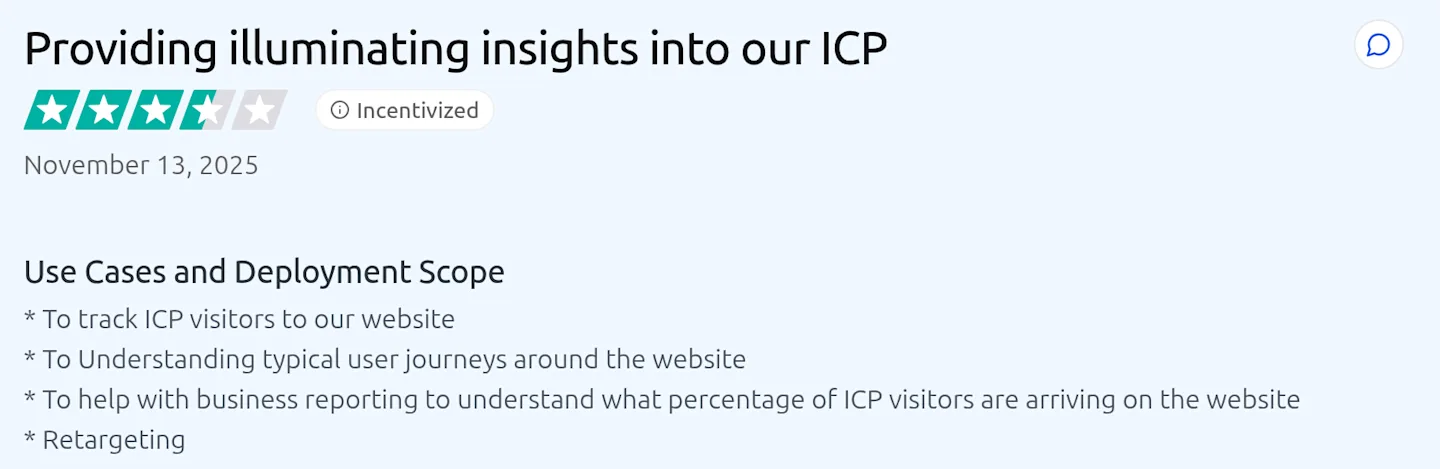
This November 13, 2025 TrustRadius review is just over 12 months old as of 25 November 2026, and it’s marked Incentivized.
Pros
Lite is free forever, with no card, so you can see companies before you pay
Discover already covers ad and campaign reports
You can choose monthly or yearly billing on Discover and Activate
Unlimited users, so you don’t pay per seat
Cons
Verified emails and phones wait until Activate, which jumps to €369 a month on yearly billing
Scale locks you into annual billing
A seven-day history on Lite is too short if you check the inbox once a week
Paid company limits are tiered, so you can outgrow the entry cap without seeing the next number on the plan
4. Albacross
Albacross is the one I’d open for a European inbound team that wants email and phone credits in the same plan as company identification.
Starter at the yearly rate includes up to 50 identified companies a month, 10 verified email credits and 5 verified phone credits. Professional raises that to up to 250 companies, 25 email credits and 10 phone credits. Organisation is a conversation, and the larger company bands are yearly billing only. The product routes accounts to CRM, Slack, Teams and ad audiences, and it states GDPR and CCPA compliance.
I’d start a European inbound team on Starter at €59 a month billed yearly if 50 companies and 10 email credits cover the week. Contact credits in every plan matter if your SDRs need names on day one.
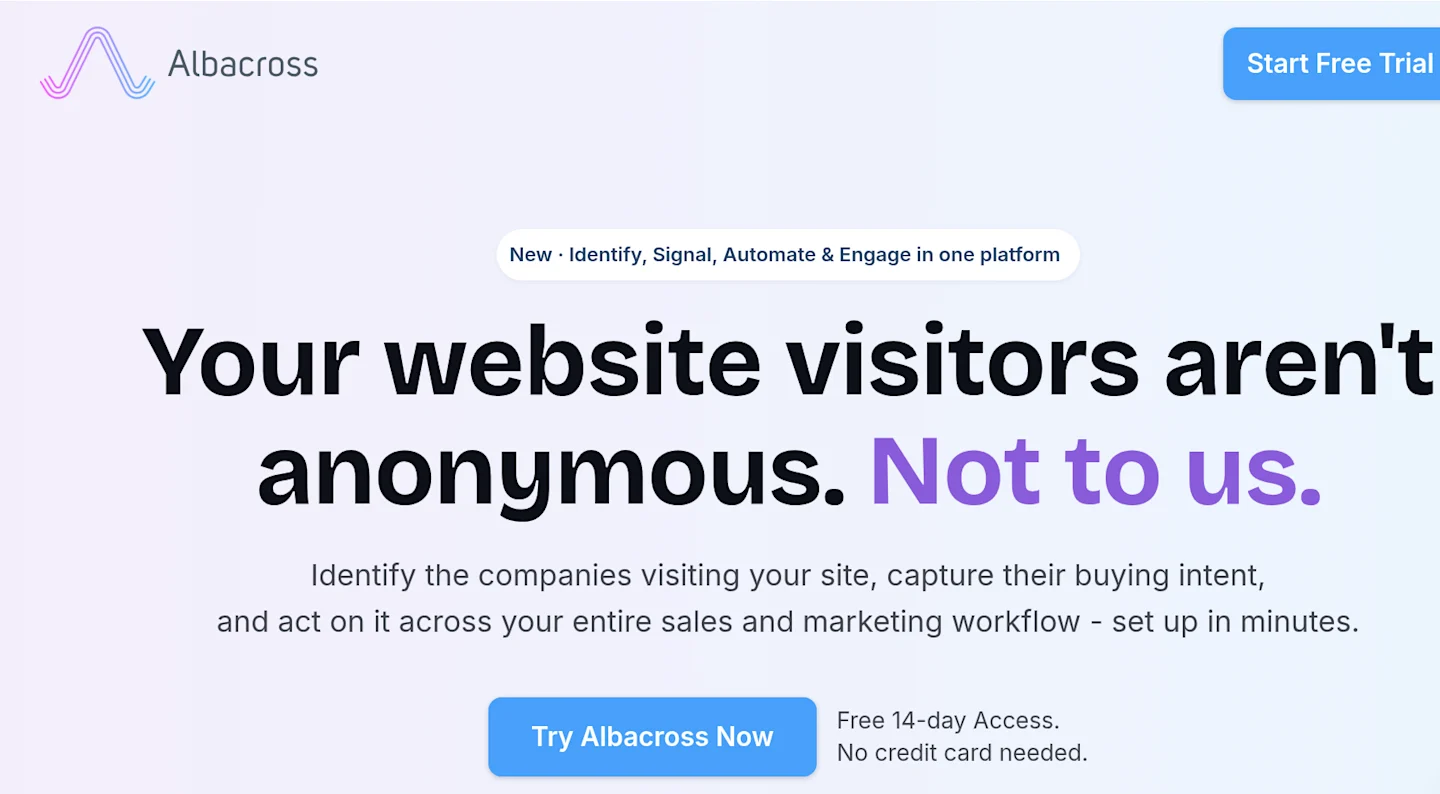
I’d try this when a European inbound team wants company names and contact credits on the same entry plan.
Fees for Albacross
Annual billing is marked Save 30%. Organisation stays a talk-to-us price, and the larger company bands are yearly only. I wouldn’t sign monthly at €84 unless I needed an exit in 30 days. Yearly cuts Starter to €59 a month.
One review I’d keep
An October 2026 review on G2 said: “Setup was quick and the platform is easy to use day to day.” A May 2026 reviewer found that “The interface design could use an upgrade, as it currently feels a bit too simplistic.”
Pros
Email and phone credits come with the entry plan
You can see both the yearly and the monthly rate
Slack, Teams and CRM routing are part of the same product
GDPR and CCPA are called out, which I want for EU traffic
Cons
10 email credits on Starter will run out if your team works a lot of accounts
Organisation and the larger company bands are yearly only, so a monthly exit disappears as you grow
Credits are not the same thing as a match on every visit
A May 2026 G2 review found the interface too simple
5. Leadinfo
Leadinfo is the one I’d give a small sales team that wants a public euro price and a way to split access by territory.
Starter includes up to 50 companies, 3 users, 3 automations, lead scoring, Google Ads, and 67 CRM integrations, with manual CRM sends. Scale adds HubSpot and Microsoft Dynamics, LinkedIn Ads, 7-day screen recordings, 10 users and automated CRM sharing. Pro adds Salesforce and Marketo, unlimited users, mobile numbers, 14-day recordings, and a dedicated CSM.
I’d use the 14-day trial to test that around-30% figure on your own traffic before I pick a cap. A territory AE team can split work with 3 users on Starter, though HubSpot and Dynamics auto-send wait for Scale.
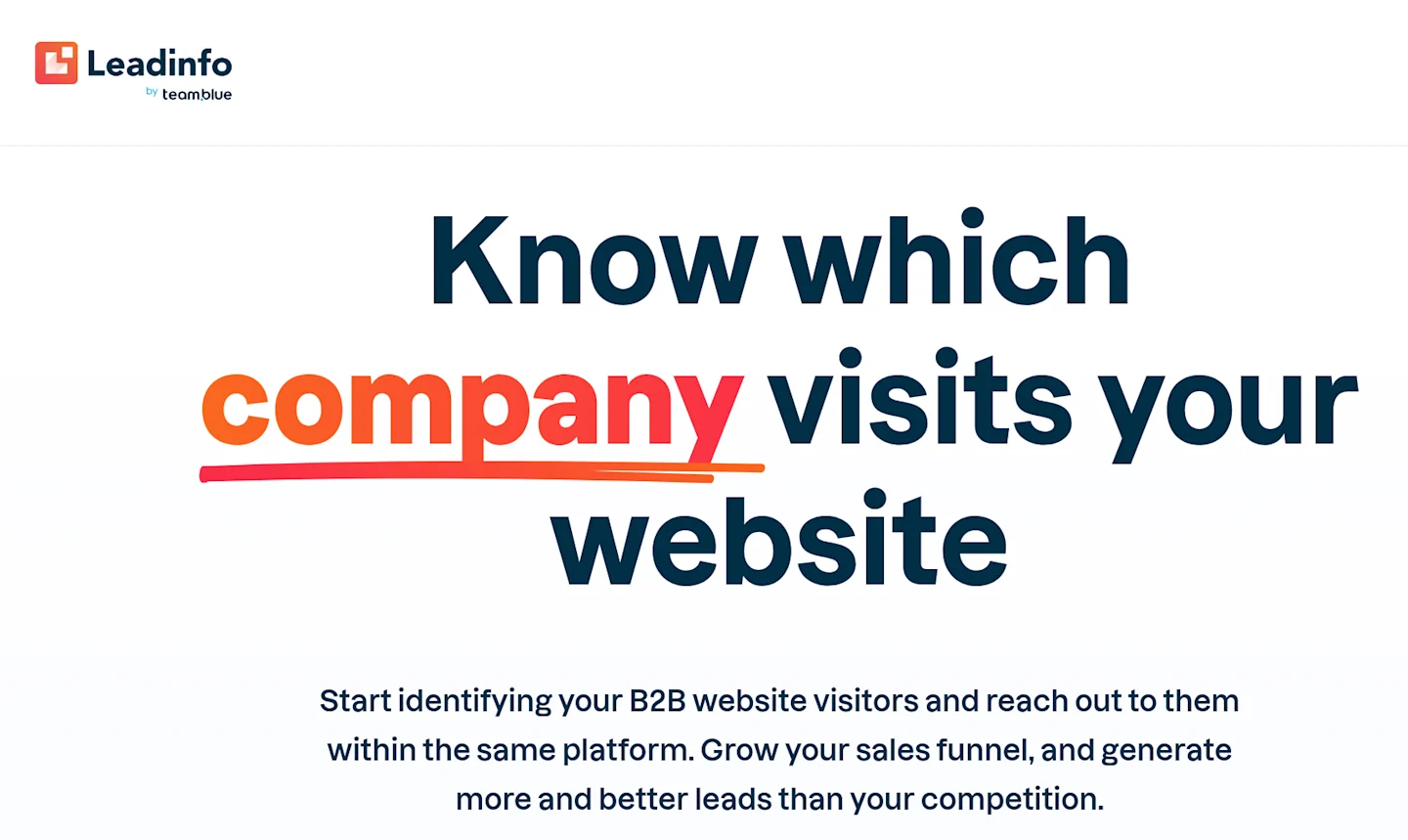
I’d start here when a small sales team wants a company name on the visit and a public euro price.
Fees for Leadinfo
The 14-day trial needs no payment details. After it, Leadinfo sends an offer based on the companies you identified. Repeat visits count once, and ISPs are filtered, which I want. I’d still ask what happens when you blow the company cap. The next Starter step is €99 a month on yearly billing for 51-100 companies, and anything past that moves you to Scale.
One review I’d keep
Rafael A. on G2, April 2026: “The interface is clean and intuitive, and it integrates smoothly with other tools.” The same April 2026 review adds that “the data isn’t always completely accurate, particularly when it comes to smaller companies or visitors who aren’t very active.”
Pros
You can see yearly and monthly rates in euros, with a 14-day trial and no card
Repeat visits and ISPs don’t inflate the company count
Scale connects HubSpot and Dynamics without a custom quote
Three users on Starter is enough to split a territory
Cons
Automated HubSpot and Dynamics sharing waits for Scale, so Starter still means manual sends
The trial’s around-30% figure may not hold on your mix of traffic
Smaller or quiet companies can come back with weak data, as the April 2026 review flagged
Pro’s jump to €359 a month on yearly billing is a lot if you only wanted Salesforce
6. Lead Forensics
Lead Forensics is the one I’d only start if you’re willing to demo, trial, then take a quote based on your traffic and the share of businesses they match.
You won’t see a list price first. Essentials and Automate are both “Get a price.” Both include visitor identification, decision-maker contact data, alerts, unlimited users, a dedicated CSM and CRM integration. Automate adds workflow automation, CRM lead creation, automated lead routing, and ABM account matching.
The quote uses your traffic volume and the percentage of matched businesses from the trial. I’d only start this motion if you’re willing to go through that demo and trial before you know the number. Essentials already includes identification, contacts, unlimited users and a CSM. I’d push back on Automate unless I need routing, workflow automation or ABM matching.
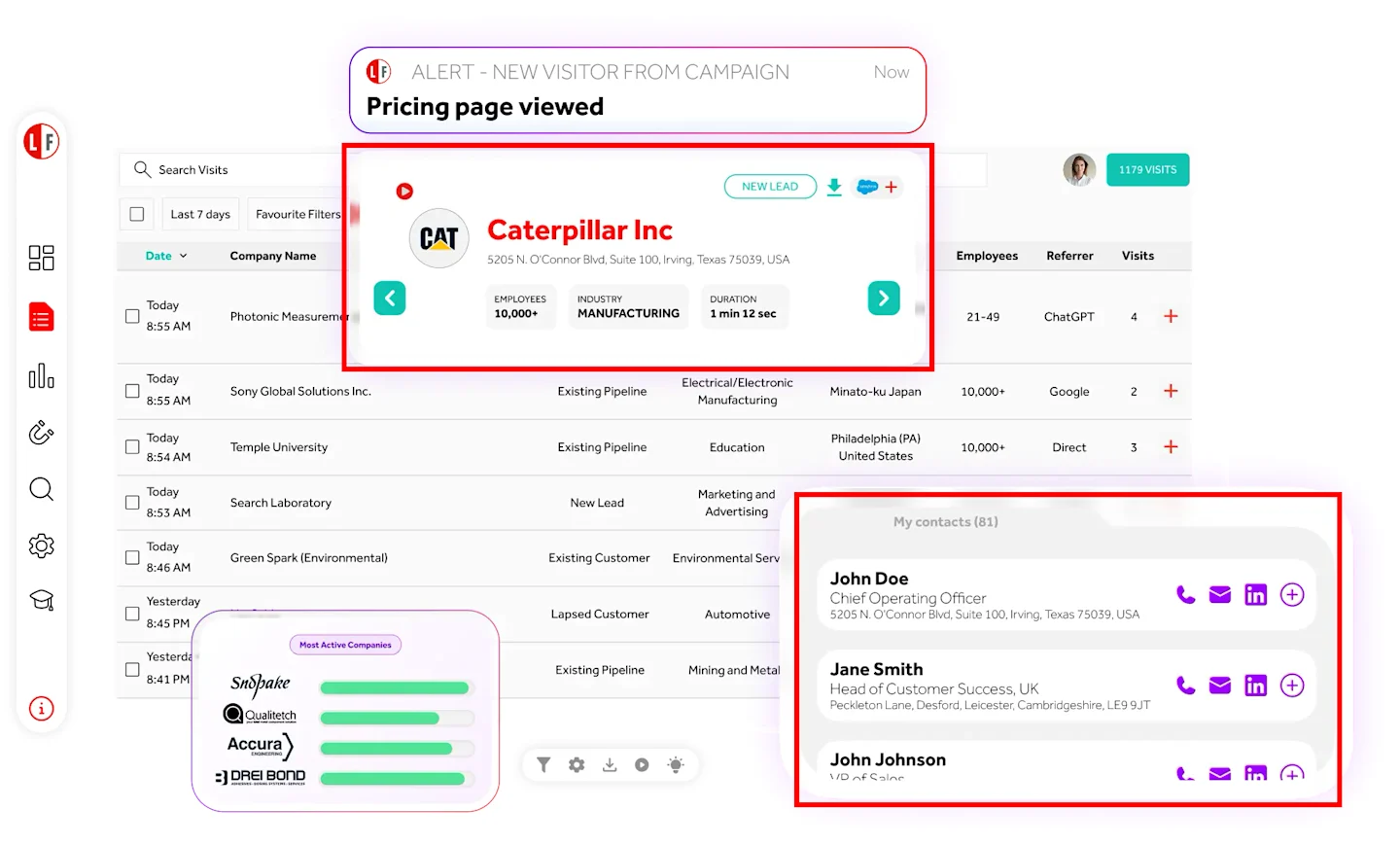
I’d check the identified company and the contacts on that visit in the same product view (example data in the screenshot).
Fees for Lead Forensics
Pricing is a subscription based on your website traffic and the match share during the trial. Unlimited users are in the package, so you don’t pay per seat. You risk a price that moves with match rate, so I’d agree the traffic baseline in the order form.
One review I’d keep
A September 30, 2026 review on TrustRadius, marked Incentivized, is titled “Lead Forensics Review” and rates it 4.5 out of 5, or 9 of 10. The reviewer writes: “I use Lead Forensics as part of my day-to-day prospecting and lead generation. It helps us identify businesses visiting our websites that would otherwise remain anonymous, giving me a much clearer picture of who is actively showing an interest in our products and services.”
An October 2026 reviewer on G2 values “the ability to see when previous clients and potential new clients visit our website.” A second October 2026 reviewer noted: “At times, it can be difficult to identify the exact person who visited the website.”
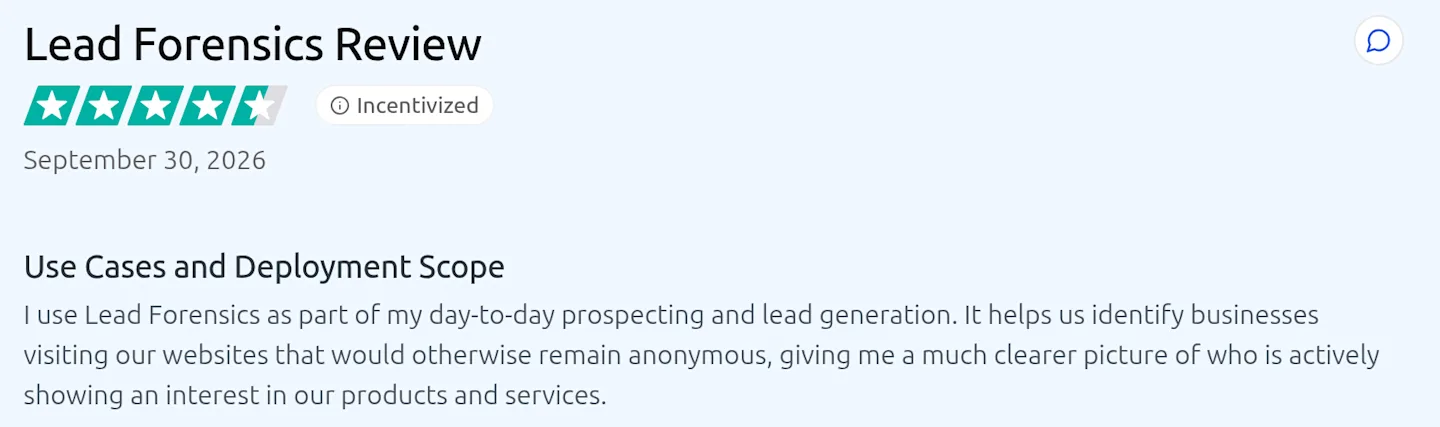
This September 30, 2026 TrustRadius review is marked Incentivized.
Pros
You trial the product on your own traffic before you buy
Unlimited users, so a larger sales floor can share one subscription
Decision-maker contacts come with Essentials, not only the higher package
Automate is optional, so you can refuse routing features you won’t use
Cons
You sign without a public list price, so finance cannot benchmark the quote in advance
The price can move with your traffic and your match share
Person-level ID can still be hard, per that October 2026 G2 review
I’d ask about the contract term before I assume a monthly exit
The path starts with a demo, so you cannot self-serve a price
7. Warmly
Warmly wraps person-level identification in alerts, chat and outbound agents, at a price I’d only take to a funded inbound team.
The identification product, AI Web-Deanonymization, lists $10,000 a year as its starting price, from 10,000 credits a month, and includes contacts and companies, ICP filtering, alerts, routing, CRM sync and retargeting. Inbound Chat lists $20,000 a year as its starting price. Autopilot lists $30,000 a year as its starting price. A GTM Signals add-on is another $10,000 a year.
A data-quality article, last updated 10 months ago as of 25 November 2026, puts company identification around 60% and contact identification around 45%. Those rates can fall on niche or non-US traffic. Cookies come first, then fingerprinting, then IP. 40% of contacts have only a personal email, and Warmly tells you not to email those.
I’d only shortlist Warmly if a $10,000 a year floor fits a funded inbound team, and I’d brief AEs on the personal-email limit before anyone hits send.
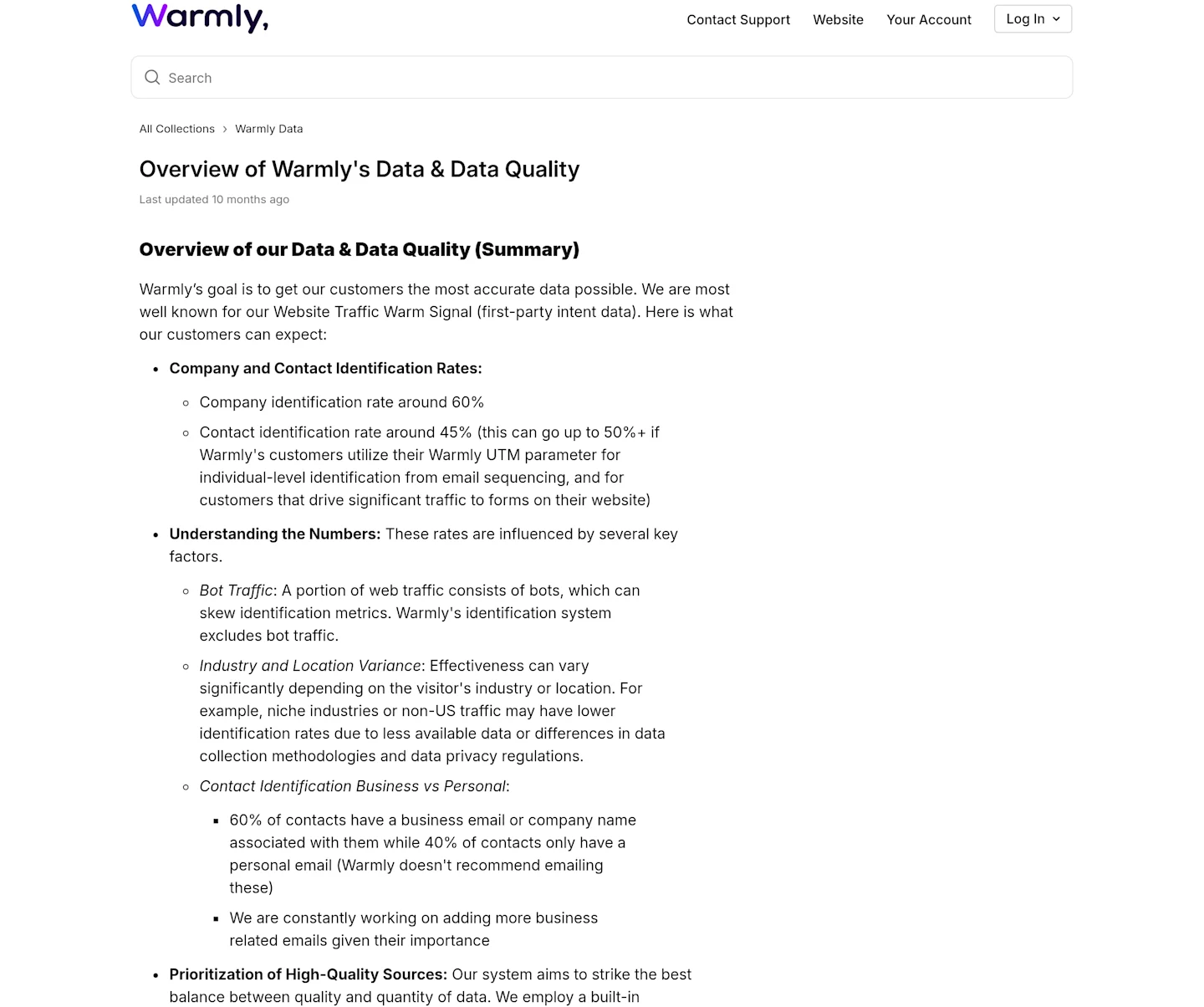
I’d treat these rates as a baseline to test, and I’d expect a lower contact rate outside the US.
Fees for Warmly
GTM Signals and Warm Experiences are $10,000 a year add-ons. I left a quarterly amount out, because only the yearly amounts are listed. I’d pause a new annual contract until I understood what a HubSpot acquisition would mean for the product and the credits. That’s my read as a buyer, from the acquisition banner on the 25 November 2026 pricing capture.
One review I’d keep
A December 2, 2025 review on TrustRadius, marked Incentivized, is titled “Decent enough tool but lacks deep features” and rates Warmly 2.5 out of 5. The reviewer writes: “We used to identify visitors with intent on our website. Overall, it was decent enough, but nothing special. The onboarding experience was okay.”
An April 2026 reviewer on G2: “I find the UI very simple to use.” Another April 2026 review warns that “while building a chat flow, there is no autosave, so you can possibly lose all your work if you make an error.”
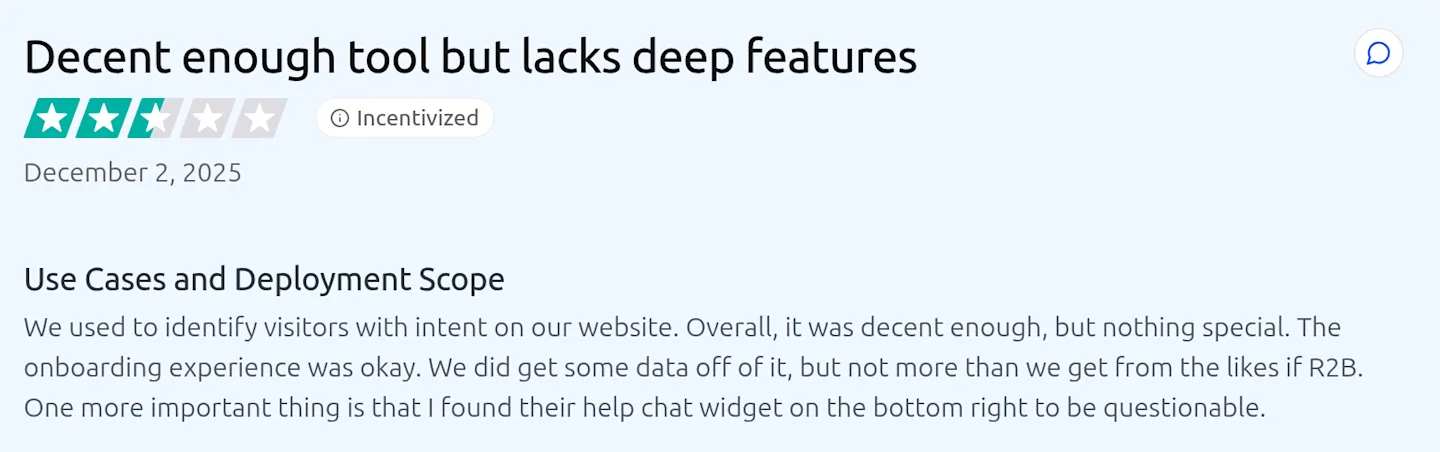
This December 2, 2025 TrustRadius review is marked Incentivized.
Pros
You get company and contact identification in one product, with alerts and CRM sync
The data-quality article is honest about match rates and personal emails
You can buy identification without paying for chat or autopilot
ICP filtering is included, so you can hide accounts you don’t sell to
Cons
$10,000 a year is a high floor if you only wanted a name on a visit
40% of contacts are unsafe to email, so a chunk of matches still cannot start a sequence
Niche or non-US traffic can come in below the 60% and 45% baselines
I’d want the acquisition question settled before I signed a new annual contract
An April 2026 G2 review lost chat work because the builder has no autosave
8. Vector
Vector uses visitor identification as one input to an ABM platform. I’d only take it to an ABM manager who already has budget for a full platform. Contact-level signals, scoring and activation sit in the same motion. I would not quote you a match rate, so I’d demand that figure in the demo and test it on our own traffic.
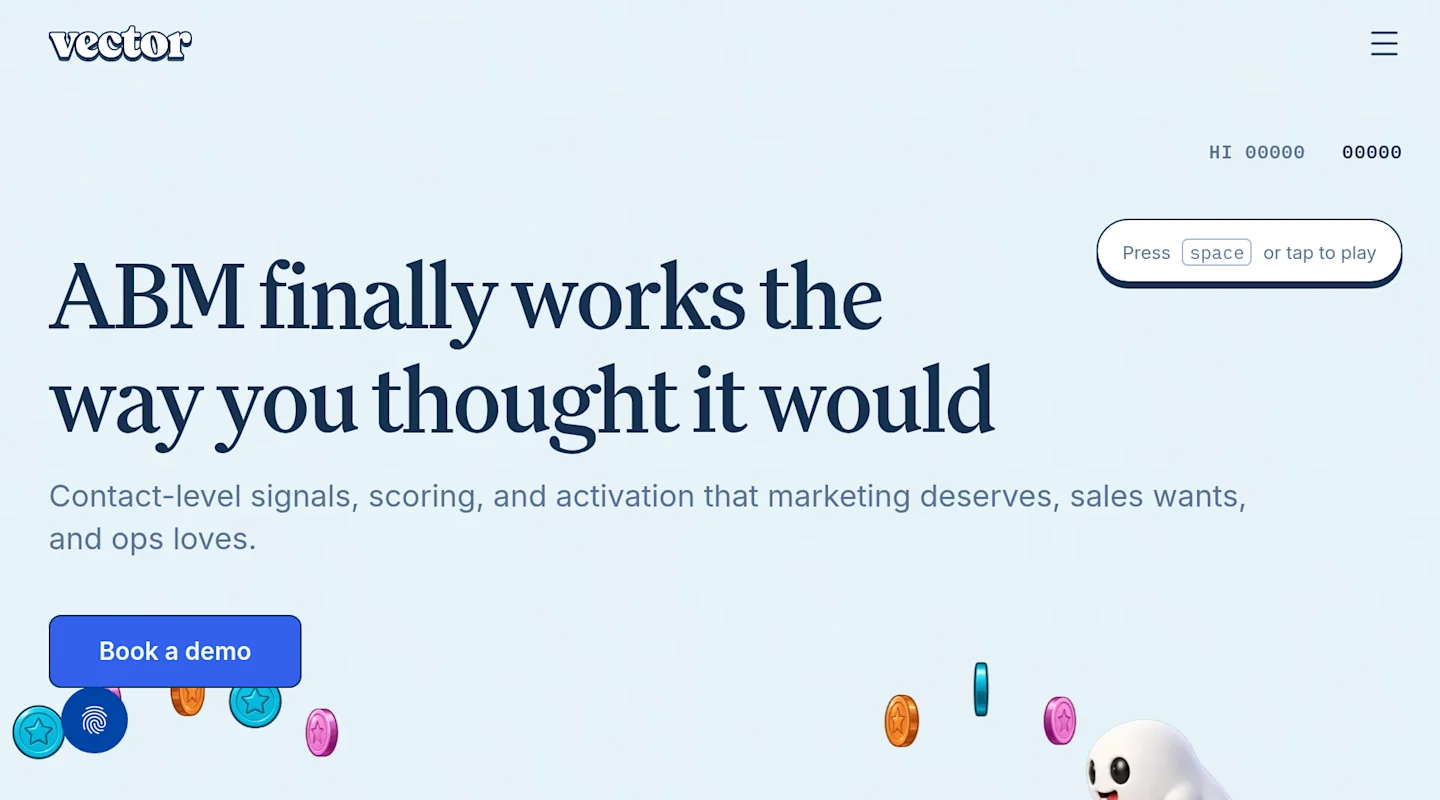
I’d only shortlist Vector if the job is already ABM.
Fees for Vector
Vector is $36,000 a year on Growth, on one annual contract, with the plan set by monthly site traffic and ad spend. That Growth price is for a team running ABM on a few hundred target accounts. I’d only take it to an ABM manager who can stand that floor.
One review I’d keep
An August 11, 2026 review on G2, from a Verified User in Information Technology and Services, Mid-Market, is titled “Seamless CRM-to-Ad Platform Sync with Practical Insights” and rates Vector 5 out of 5. That August 11, 2026 reviewer writes: “how easily it syncs between our CRM and the various ad platforms.” The same August 11, 2026 review notes it “occasionally has minor performance bugs.”
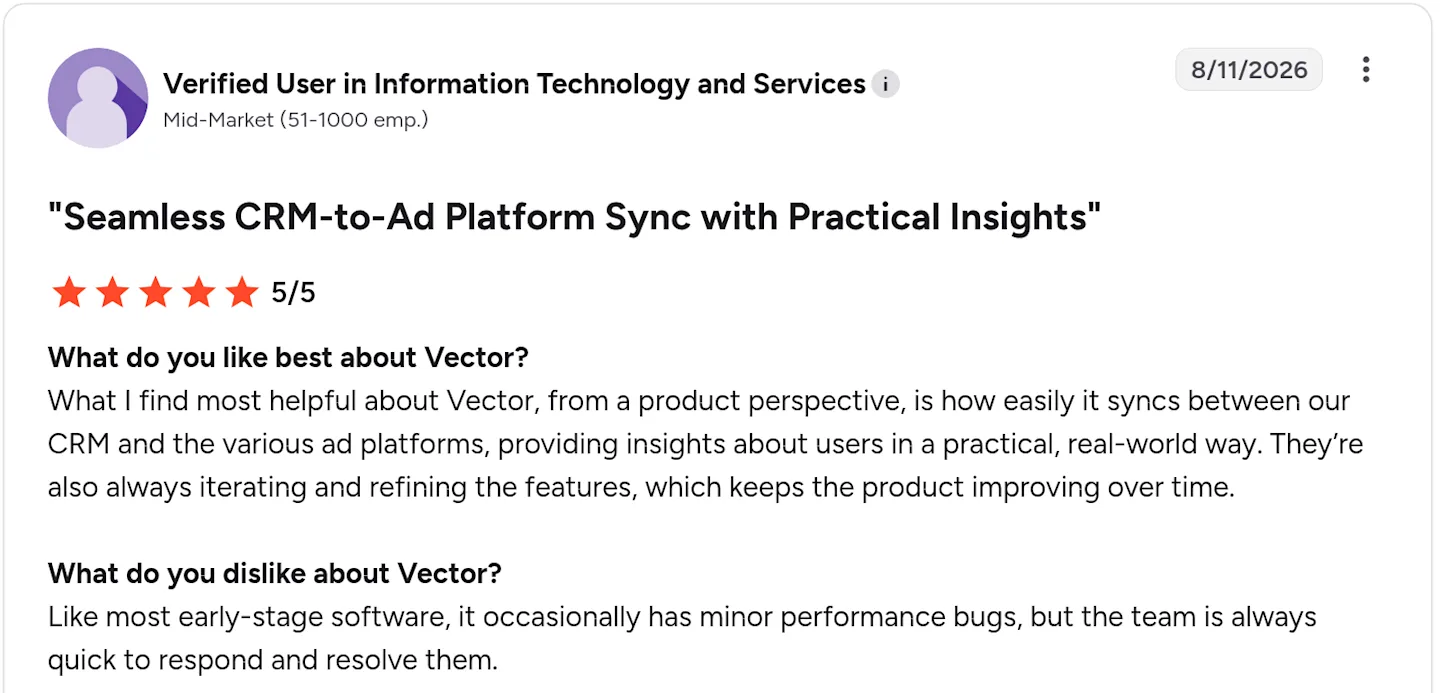
This August 11, 2026 G2 review, from a Verified User in Information Technology and Services, Mid-Market, rates Vector 5 out of 5.
Pros
Visitor identification sits inside a wider ABM motion, including ads and scoring
An August 2026 G2 review found the CRM and ad-platform sync easy
You can ask for a match rate in the demo before you commit
The product is built for marketing, sales and leadership to share one motion
Cons
$36,000 a year on Growth, on one annual contract, is a high floor if you only wanted names on your site
There is no month-to-month amount, so you cannot exit on a 30-day term
I would not quote you a Vector match rate, so I’d demand that figure in the demo
An August 2026 G2 review still ran into performance bugs
How I picked
I kept a product here when website visitor identification is the job it sells, and when I can send you a public price or a path to a quote. Koala is out because it is shutting down, Visitor Queue because it now sends you to Leadinfo, and Dealfront’s old pricing URL because it sends you to Leadfeeder. CommunityTracker stays unranked here.
How to choose a website visitor identification tool
Start with whether you need a company name or a named person, and with the billing term you can stand. Pick Vector if an ABM team can stand $36,000 a year on Growth, on one annual contract.
If you already have a stack for buyer intent leads or warm leads, pick the identification tool that feeds that stack. For demand signals, keep the visitor tool for on-site activity and use a second source for off-site intent.
FAQ
What are website visitor identification tools?
They name the company, and sometimes the person, behind a visit that never filled in a form.
Do these tools name the person, or only the company?
Snitcher starts with the company. RB2B names people from Starter up, in the US only. Warmly sells company and contact identification together. Leadfeeder holds verified emails and phones until Activate.
How much do website visitor identification tools cost?
Public entry prices on 25 November 2026 start at $0 a month, billed monthly, on RB2B and at €0 on Lite for Leadfeeder. Snitcher starts at $49 a month on yearly billing, Albacross at €59 a month billed yearly, and Leadinfo at €69 a month on yearly billing. Warmly lists $10,000 a year. Lead Forensics quotes after a trial. Vector is $36,000 a year on Growth, on one annual contract, with the plan set by monthly site traffic and ad spend.
After the visitor tool is in place
CommunityTracker is unranked on this list. The eight tools above name companies or people on your site. I would not point it at a quiet pricing-page session, because that job is not on the official feature list I use for CommunityTracker claims.
I’d still add it once a visitor tool is already running, or if you never needed one, when the buying question is already being asked in public.
Starter’s four communities are Reddit, LinkedIn, Hacker News and GitHub. Unlocking the rest of the official set takes Pro or Advanced. A post on those sources gets a score when the writer is looking for a category tool, airs friction with software they already buy, or sets two options beside each other. That score stays on the post. Buying intent is labeled Hot, Warm or Watch, and a reason is attached to every label.
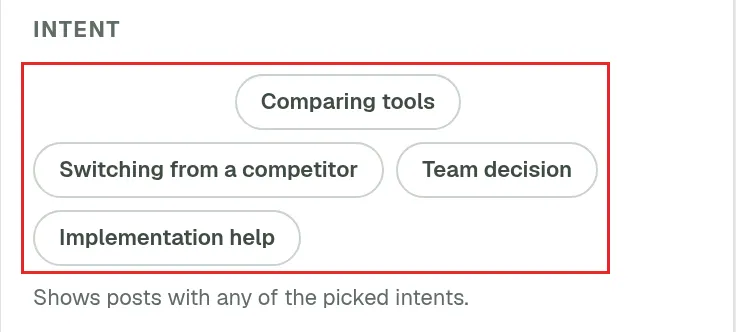
For a purchase thread I’d open Comparing tools or Switching from a competitor first.
Job-change, funding and hiring posts get those same three labels, and a reason is attached there too. Lead lists, enrichment and a signal watch ship on paid plans and on the trial.
LinkedIn messages and email can live in one workspace, with replies in a shared inbox. Edit a draft, then send it yourself. If you already run lemlist, Instantly, Smartlead or Salesforge, a key you provide can move leads into that tool. A Hot or Warm post can be sent to HubSpot as a deal, with the buying signal kept on that record.
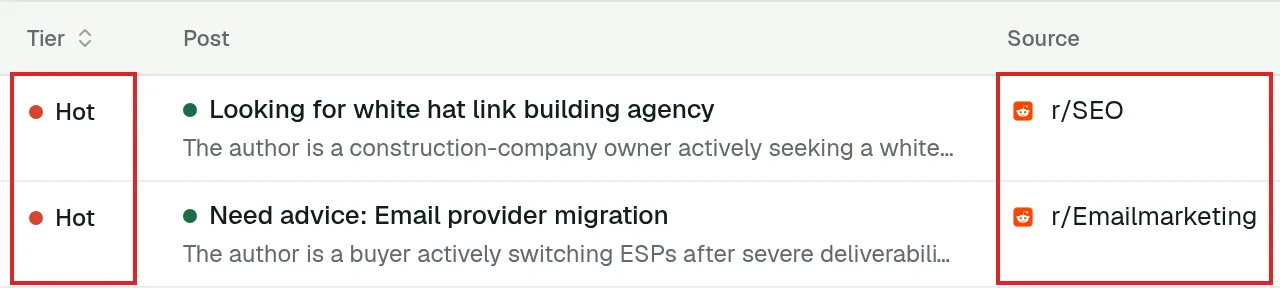
I’d start from a Hot row, then check the boxed Source column for the subreddit before I treat that thread as a first touch (sample data from a tracked set).
If you only came to identify website visitors, skip CommunityTracker. Come back after you choose a visitor tool, or if a visitor tool was never the need, and you want a public buying thread to open the conversation.
What this track costs
CommunityTracker is a GTM tool. Point it at scored community threads, not at naming the company behind a quiet visit. A seven-day trial costs $4.99. Run the Pro feature set for that week. Nothing charges once day seven ends. The trial is paid, and it does not continue as a paid plan. Starter alerts once a day. I wouldn’t treat those alerts as a live ping while someone is still on your site. 100 warm emails a month on Starter, unlimited on Pro. Treat that figure as Starter’s monthly warm-email limit. I budget $39 a month if I stay on Starter, $99 if I move to Pro, and $199 if I take Advanced, billed monthly (pricing). If you want a yearly invoice, ask the team to quote it that way. Public plans carry no required term. Cancellation is allowed at any time. Refunds on a new paid plan run for 14 days. Starter includes 4 keywords and 5,000 mentions, only on those four communities.