8 Best Social Media Benchmarking Tools in 2027
Social media benchmarking tools for 2027: 8 compared on competitor slots, history, industry benchmarks and pricing, with my pick for most teams.
Adarsh Kumar
GTM Expert
Founder — CommunityTracker, Miraa.io, and Infraboxes
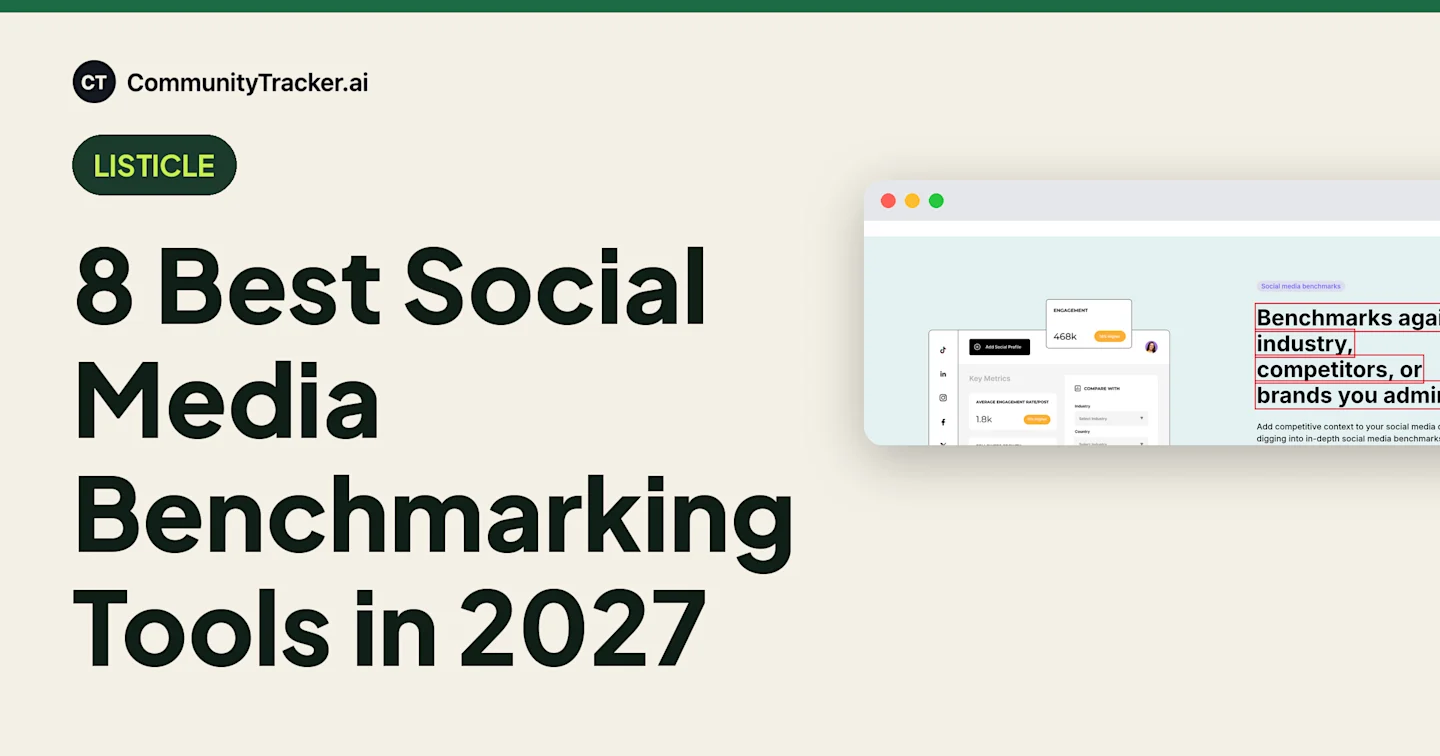
You’ve been told to get social media benchmarking tools, and all your team has today is an engagement rate that looks fine until someone asks whether it beat the category.
Social teams are lining their own accounts up against rivals and industry averages before they lock next quarter’s targets.
I’m sure you’ve tried a spreadsheet export, or a one-off look at a rival’s grid, and that still leaves you rebuilding the comparison every month.
I compared eight tools on competitor slots, how far back rival data goes, the presence of an industry line, and what you pay on monthly or yearly billing. Here’s what I’d take into a planning meeting.
TL;DR: The 8 Social Media Benchmarking Tools I Recommend
Socialinsider - Best for strategists who want competitor benchmarks on every plan
Rival IQ - Best for analysts who want a tool built only for competitor comparison
Metricool - Best for small teams that need 100 competitor profiles on a low budget
Hootsuite - Best for teams that want industry benchmarks next to their publishing
Sprout Social - Best for enterprise teams that already report in Sprout
Agorapulse - Best for agencies benchmarking Facebook and Instagram pages
Emplifi - Best for global brands that want regional industry benchmarks
Dash Social - Best for consumer brands benchmarking Instagram and YouTube
My pick: Socialinsider, because every plan includes competitor accounts across all platforms, starting at $82 a month on yearly billing.
Benchmarking Coverage at a Glance
Tool | Competitors on the entry plan | Competitor history | Industry benchmarks | Public price |
|---|---|---|---|---|
Socialinsider (My pick) | All platforms, every plan | 3 months on Adapt | Quarterly report across 15 industries | Yes |
Rival IQ | 10 tracked companies | 6 months on Drive | Live benchmarks by industry | Yes, billing term not stated |
Metricool | 5 on Free, 100 on Starter | From the 1st of the previous month | Not published | Yes |
Hootsuite | 5 on Standard | Not published | Every plan | Yes, billing term not stated |
Sprout Social | Professional and Advanced only | Not published | Not published | Yes |
Agorapulse | 1 competitor profile | Posts from 30 days before you add it | Not published | Yes |
Emplifi | Up to 10 public profiles | Not published | Quarterly, global and regional | From $1,249, billing term not stated |
Dash Social | 3 competitors | Not published | Yes, plan not stated | No |
“Not published” means I did not find that figure when I checked on November 24, 2026.
What Each Benchmarking Tool Costs
Tool | Plan with benchmarking | Monthly billing | Yearly billing, per month | What limits you |
|---|---|---|---|---|
Socialinsider | Adapt | $1,188 a year | $82, paid as $990 for the year | One seat and a 3-month lookback |
Rival IQ | Drive | Billing term not stated: $239 a month | Billing term not stated | 10 companies, 1 user |
Metricool | Starter | $25 | $20 | 5 brands |
Hootsuite | Standard | Billing term not stated: $99 a seat each month | Billing term not stated | 5 competitors |
Sprout Social | Professional | Not shown | $299 per seat | Per-seat cost |
Agorapulse | Advanced | $199 per user | $149 per user | 6 competitor profiles |
Emplifi | Essential | Billing term not stated: from $1,249 a month | Billing term not stated | 10 public profiles |
Dash Social | Advance | No public price | No public price | Sales call |
All prices above are in US dollars, checked November 24, 2026.
1. Socialinsider
Socialinsider is my first call for a strategist whose monthly deck leads with a comparison slide.
Every plan includes competitor accounts on all platforms, and the plans differ by connected accounts, history and seats. Adapt connects 20 of your own accounts with 3 months of history. Socialinsider also publishes a quarterly benchmarks report on how brands in 15 industries performed, which gives you an industry line without building one.
One catch: Socialinsider can’t backfill follower counts, so a rival’s follower line begins when you add it. Add your rivals on day one.
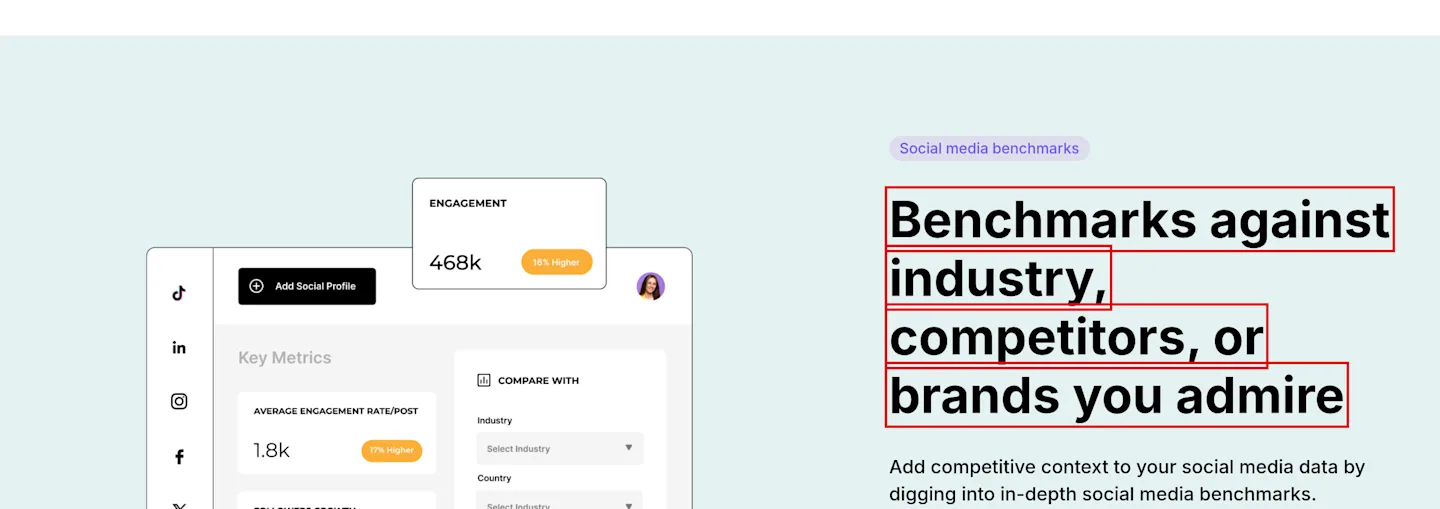
I’d start on this Socialinsider competitor analysis page when I want a head-to-head view and an industry benchmark in the same product.
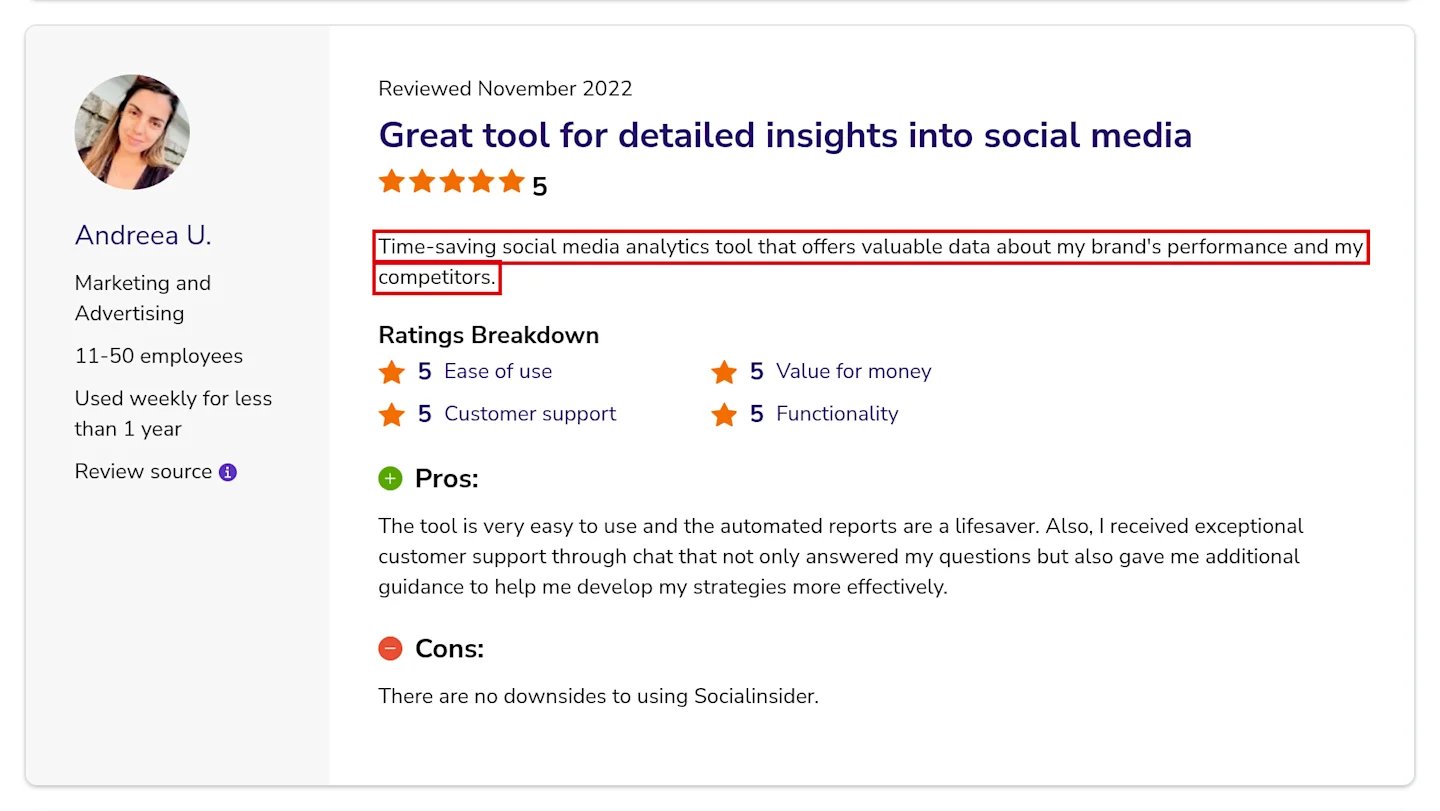
Software Advice, November 2022, older than 12 months. I’d keep Andreea U.’s line on brand and competitor data in mind, then weigh the more recent G2 notes below.
Features
Competitor accounts on all platforms, on every plan
Side-by-side comparison against the competitors you pick
Quarterly benchmarks across 15 industries
10, 15 or 20 profile replacements a month, by plan
API access and Looker Studio access, each billed at $100 monthly on top of the plan
Pricing
Socialinsider has Adapt, Optimize and Predict, with Enterprise quoted on request:
Adapt works out to $82 a month when you pay $990 for the year. Paying month to month comes to $1,188 a year. You connect up to 20 accounts, look back 3 months and get one seat.
Optimize is $124 a month on yearly billing, for up to 30 accounts, a 6-month lookback and two seats.
Predict is $199 a month on yearly billing, for up to 40 accounts, a 12-month lookback and five seats.
Each plan starts with a 14-day free trial.
Pros
Competitor tracking on the entry plan, with no separate add-on.
Monthly profile replacements, 10 on Adapt, let you rotate the rivals you watch.
The free quarterly industry report gives context for the head-to-head numbers.
A reviewer on G2 in July 2026: “I like the competition analysis summary and suggestions that Socialinsider provides.”
A July 2026 reviewer: “It helps with benchmarking and increases efficiency in data comparing.”
Cons
A 3-month lookback on Adapt rules out a year-over-year benchmark.
Follower history for a rival starts only when you add it.
A reviewer in April 2026: “some of the data can feel a bit limited depending on the platform, and you can’t always go as deep as you might want.”
An April 2026 review: “While pricing is fair, there could be more refined options on the lower end of the costs spectrum.”
From July 2026: “Slowness in data access.”
Go with Socialinsider if benchmarks are the main job and you want them on day one. Budget for Optimize if you need six months of history.
2. Rival IQ
Rival IQ does one thing: competitive social benchmarking.
You build “landscapes” of the companies you want to compare, and Rival IQ tracks one handle per company on each of the five networks it monitors. Leaderboards rank everyone on engagement, post frequency and follower count. It also uses machine learning to flag when a competitor likely boosted a Facebook post, which tells you about their paid strategy.
The weak spot is fresh feedback. Its newest G2 review is from July 2025.
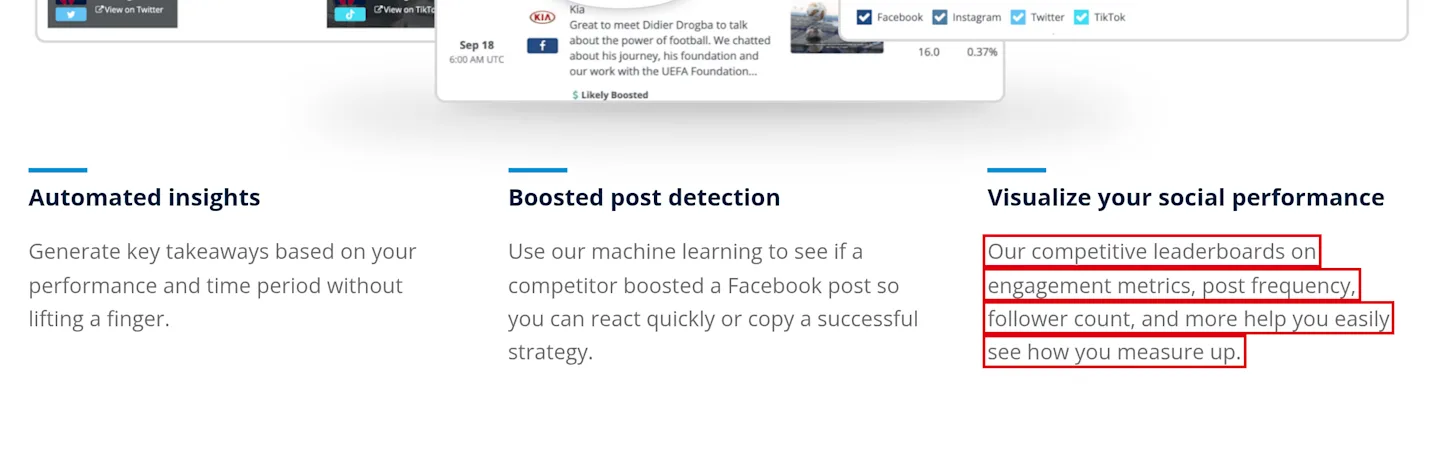
I’d use this Rival IQ competitive analysis page when the job is a leaderboard of engagement, post frequency and follower count against the companies I track.
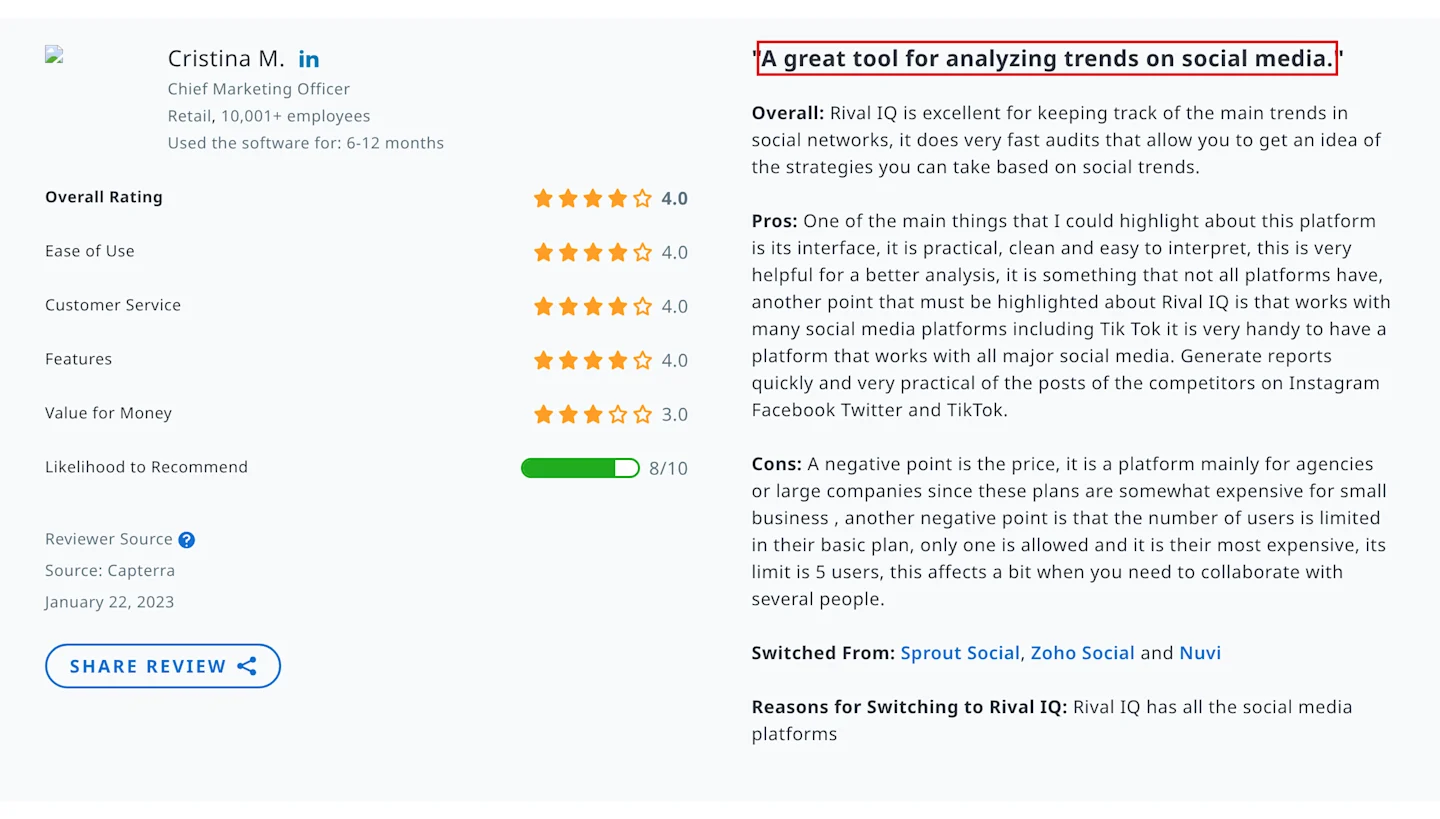
Capterra, January 22, 2023, older than 12 months. I’d read Cristina M.’s note on competitor post reports, and I’d treat the lack of a review from the last 12 months as a caution.
Features
Competitor landscapes with company filters
Leaderboards on engagement, post frequency and follower count
Facebook boosted post detection
Live industry benchmarks
Swap 100% of your tracked companies each month
Custom branded PowerPoint and PDF exports
Pricing
Rival IQ prices in USD and sells monthly or yearly, with 15% off yearly.
Drive costs $239 a month if you pay month to month, or $199 a month if you pay for the year. 10 companies, 6 months of history, 1 user, data refreshed every 12 hours.
Engage costs $349 a month if you pay month to month, or $299 a month if you pay for the year. 20 companies, 12 months, 2 users, refreshed every 6 hours.
Engage Pro costs $559 a month if you pay month to month, or $469 a month if you pay for the year. 40 companies, 24 months, 5 users, refreshed every 3 hours.
Extra companies cost $50 a month per 5, and extra users $10 a month. The 14-day trial asks for no credit card.
Pros
Every feature points at comparison, so there’s no publishing or inbox to pay for.
Full monthly swaps let you change the rivals you track as your market shifts.
Boosted post detection shows when a rival paid to push a post.
A February 2022 G2 review (over 12 months old): “My competitive nature also loves the ability to create landscapes and measure our efforts against our competition.”
Cons
$239 a month for 10 companies is a lot for a small team.
No G2 review in the last 12 months, so current opinion is thin.
A July 2025 G2 review (over 12 months old): “the interface is outdated, and they are slow to introduce new features.”
A March 2022 G2 review (over 12 months old): “You have to pay to add more competitors to your reporting.”
Shortlist Rival IQ if competitive analysis is your whole job. Run the trial first, since current G2 feedback is missing.
3. Metricool
Metricool gives small teams more competitor slots per dollar than anything else here.
The Free plan tracks 5 competitors on Facebook, Instagram, Threads, Bluesky and Twitch. YouTube and X competitors need a paid plan, and Starter raises the limit to 100. Competitor posts load from the 1st of the previous month, the data is organic only, and Metricool can sync up to 300 older posts if you request it in chat.
From the Competitors table you pick metrics, compare profiles and export the data.
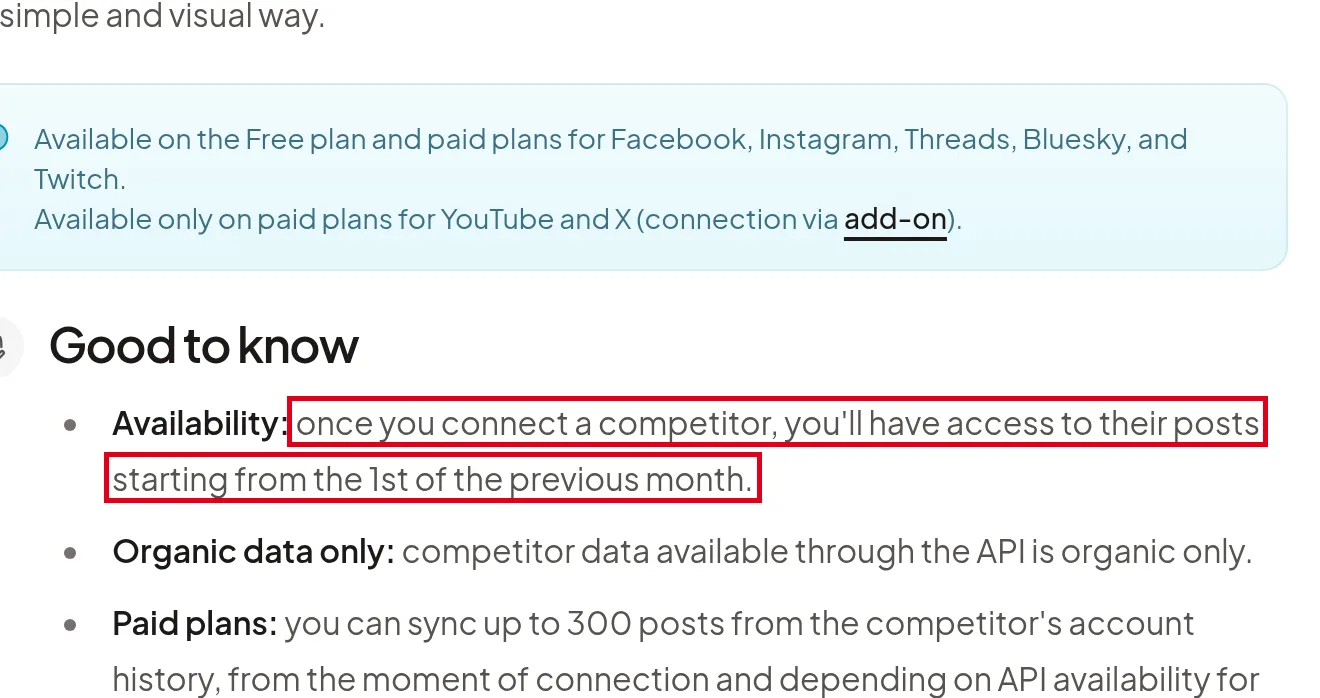
I’d open this Metricool Competitors help page to see how far back rival posts go, and to remember that the feed is organic only.
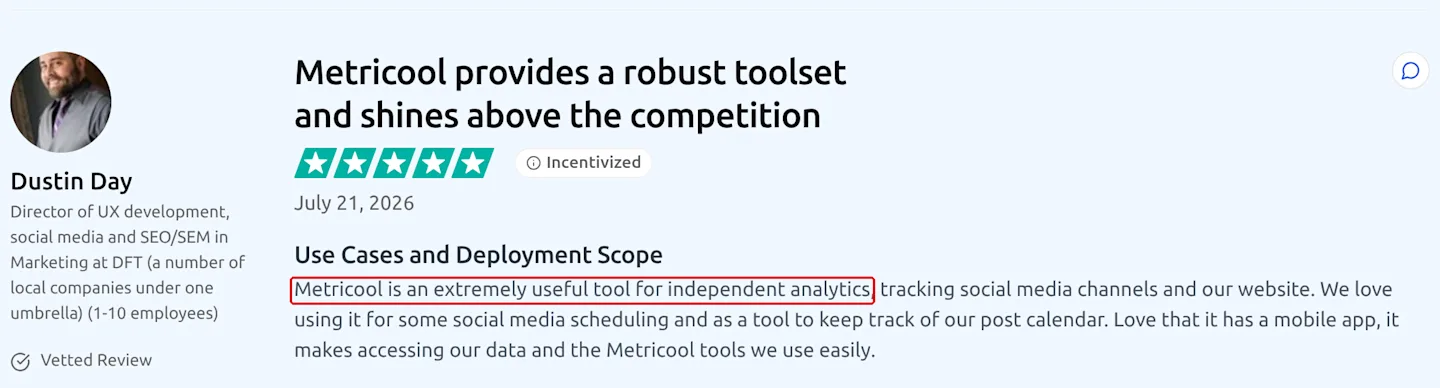
TrustRadius, July 21, 2026, Incentivized. I’d take Dustin Day’s card as a reason to try Metricool’s competitor table on a small budget, since he used it as a standalone analytics tool.
Features
Competitors table with selectable metrics and export
5 competitors on Free, up to 100 on Starter
Facebook, Instagram, Threads, Bluesky and Twitch on Free; YouTube and X on paid plans
Detail view with metric trends per competitor
Up to 300 older competitor posts on request
Pricing
Metricool’s tiers scale with the number of brands, and paying yearly cuts up to 24%:
Free: $0. 1 brand, 5 competitor profiles.
Starter: $20 a month on yearly billing or $25 on monthly billing for 5 brands, up to 100 competitors.
Advanced: from $53 a month on yearly billing or $67 on monthly billing.
Pros
100 competitors on a $20 plan is the most room for the money in this list.
The Free plan lets you test benchmarking before you pay.
Exporting the table lets you build your own benchmark chart.
A G2 reviewer in August 2026: “The competitor analysis is the feature I did not expect to use daily but do.”
Cons
Competitor history starts at the 1st of the previous month unless you ask for more.
Organic data only, so a rival’s paid push won’t show.
Free users can’t delete a competitor once added.
Writing on G2 in late August 2026, one user said: “advanced custom report building feels limited.”
A November 2026 review: “It will randomly sometime unlink your accounts.”
Metricool is the place to start if you want many rivals on a small budget. Request older posts the day you add a competitor.
4. Hootsuite
Hootsuite fits teams that want benchmarks inside the tool they already publish from.
Every plan includes industry benchmarking, which tracks your growth, engagement rate and posting frequency against your industry average. Head-to-head competitor benchmarking scales by plan: 5 competitors on Standard and 20 on Professional and Advanced. For competitor mentions across the web, Hootsuite points you to Lumen, its listening product.
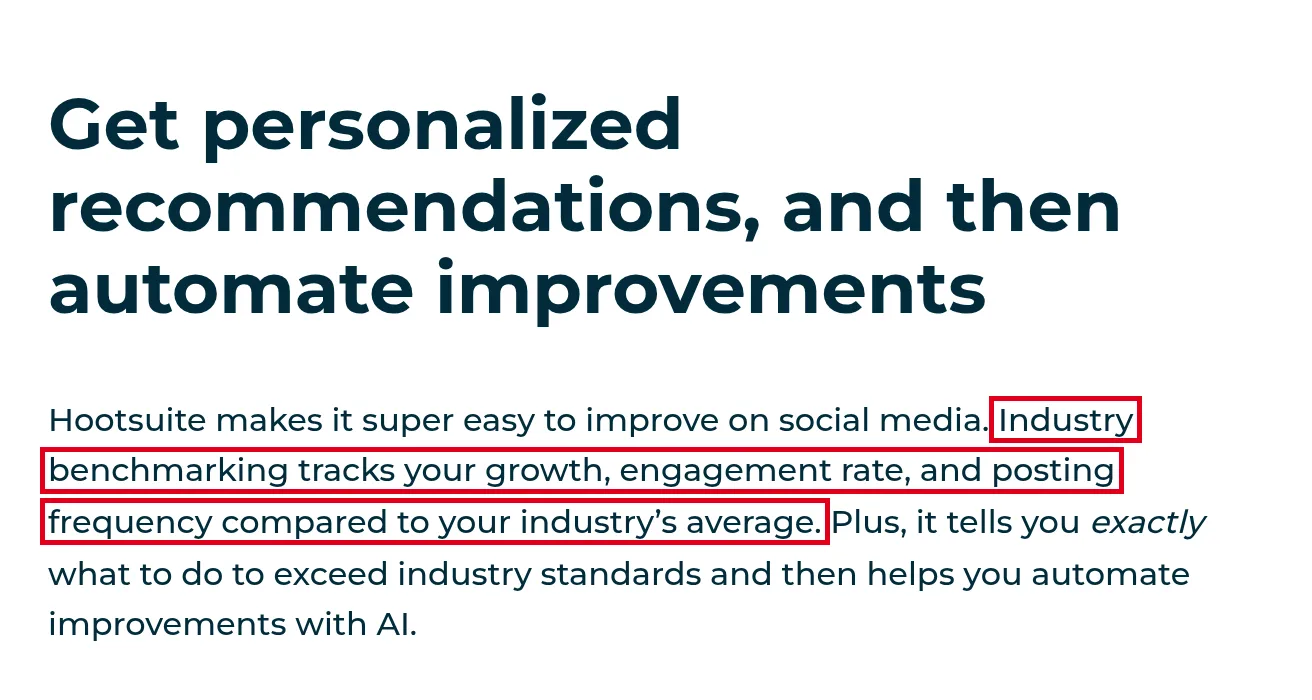
I’d use this Hootsuite competitive analysis page when I want my growth, engagement rate and posting frequency next to an industry average, in the same product I publish from.
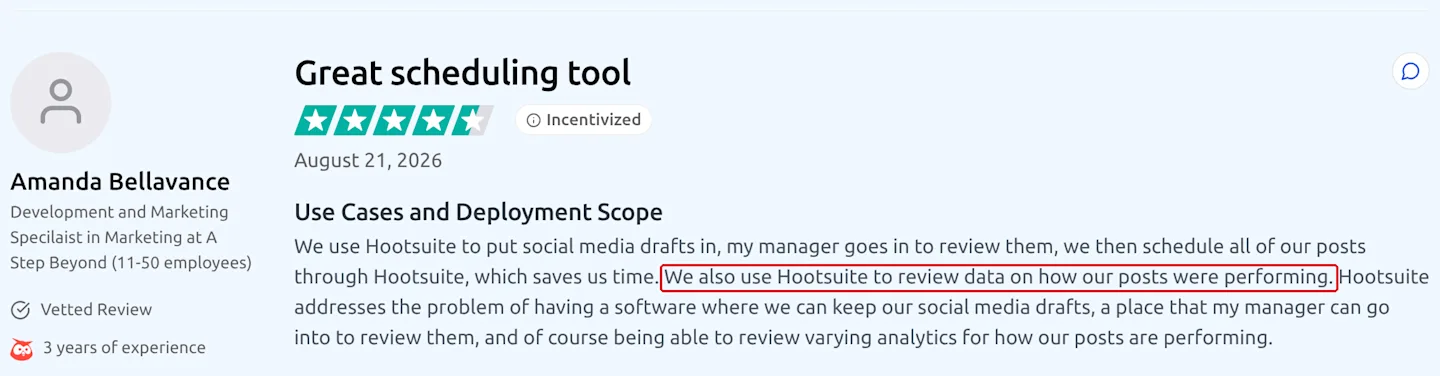
TrustRadius, August 21, 2026, Incentivized. I’d keep Amanda Bellavance’s note in the Hootsuite section because she used the product to review post performance beside her publishing work.
Features
Industry benchmarking on every plan
Competitor benchmarking: 5 on Standard, 20 on Professional and Advanced
Competitor posting frequency, follower growth and engagement rate
Competitor hashtags and top posts
Lumen listening for competitor mentions
Pricing
Hootsuite charges by the seat. Standard is $99 a seat each month, Professional is $199 a seat each month, and Advanced is $399 a seat each month, all in US dollars, and those public figures do not name a billing term.
Each plan opens with a 14-day free trial.
Pros
Industry averages on the entry plan give context without extra setup.
20 competitors on Professional covers most category reviews.
Hashtag and top-post views show what a rival’s best content looks like.
An October 2025 G2 review (over 12 months old): “I appreciate the benchmarking and analytics reports that Hootsuite populates for us.”
Cons
5 competitors on Standard is tight for a crowded market.
Standard has no report export, so sharing benchmarks needs a higher plan.
November 2026, via G2: “the pricing can be expensive for small businesses”
From a review dated June 2026: “The platform can also be slow at times”
Go for Hootsuite Professional if you want industry and competitor benchmarks in your publishing tool. See my Hootsuite review for the per-seat math.
5. Sprout Social
Sprout Social suits enterprise teams that already report in Sprout and want competitors in the same place.
Competitor Reports track rival performance so you can benchmark your own. Those reports come with the Professional and Advanced plans. Share of voice and a Competitor Scorecard sit in Sprout’s social listening tool.
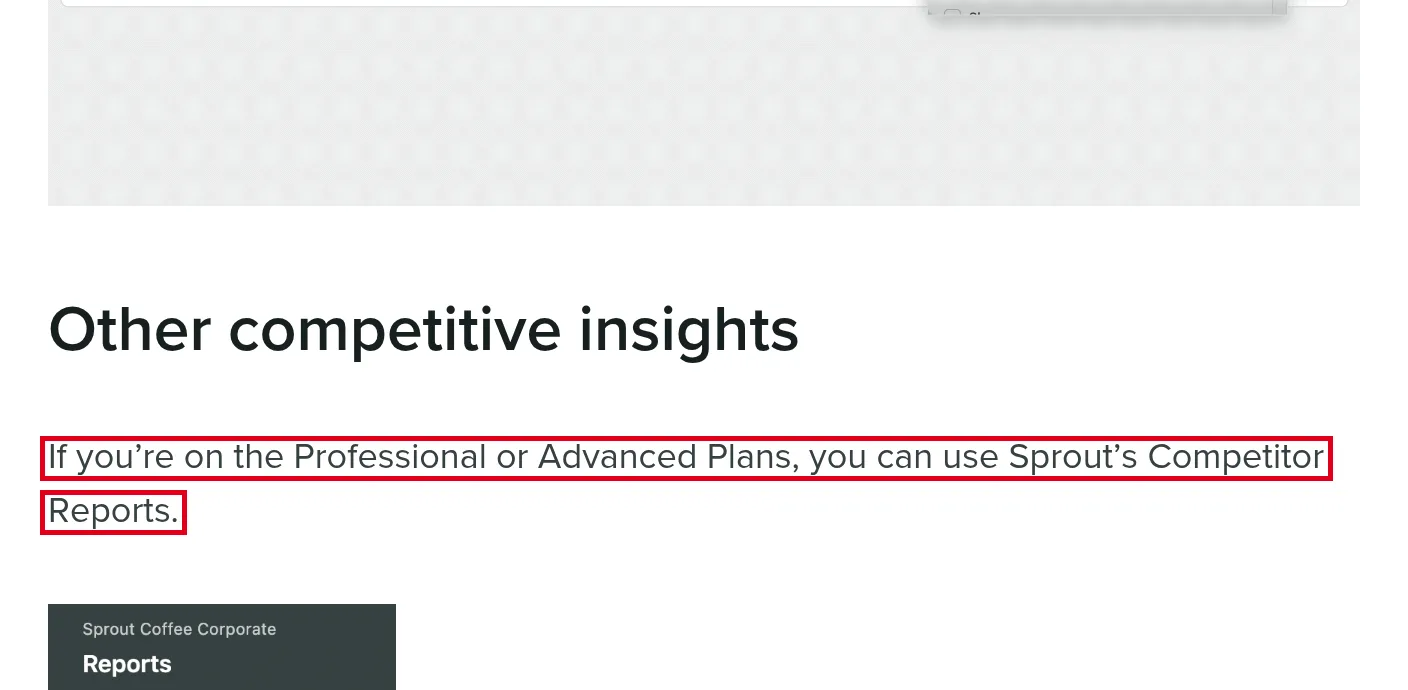
I’d read this Sprout help article when I need Competitor Reports and a Competitor Scorecard in the same suite my team already reports in.
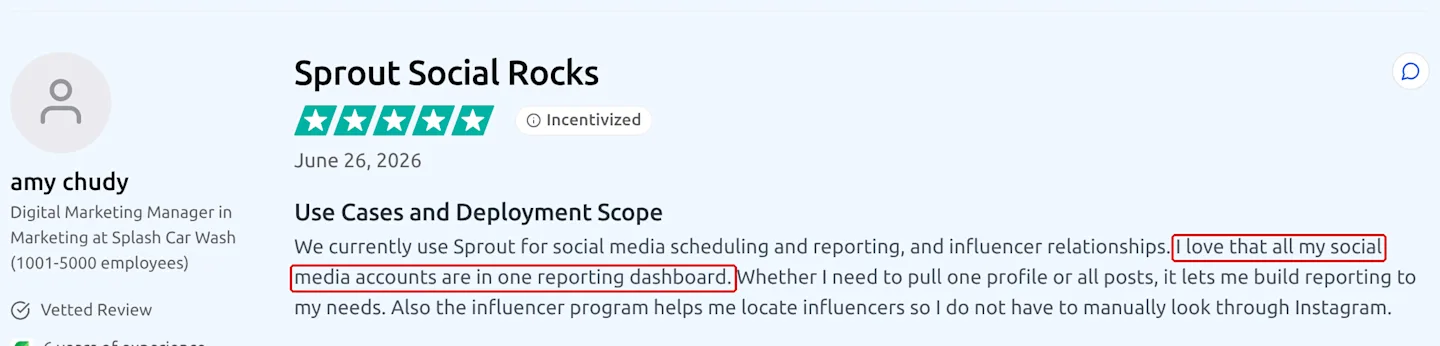
TrustRadius, June 26, 2026, Incentivized. I’d use amy chudy’s dashboard comment as the reason competitor reports belong in Sprout when the team already reports there.
Features
Competitor Reports on Professional and Advanced
Competitor posts and performance next to your own reports
Competitor Scorecard and share of voice in social listening
Tag and paid insights on Professional
Pricing
Sprout sells per seat on yearly billing:
Professional: $299 for each seat monthly, with extensive competitor, tag and paid insights.
Advanced: $399 for each seat monthly.
The trial runs 30 days and needs no card.
Pros
Competitor data lives next to the reports your leadership already reads.
Professional adds paid insights in the same plan.
A 30-day trial is long enough to run one monthly benchmark.
October 2026, via G2: “I appreciate is how easy it is to compare performance across multiple platforms at once, without having to pull everything manually.”
Cons
No competitor reports on Standard, so benchmarking starts at $299 a seat.
Share of voice lives in listening, apart from Competitor Reports.
The same October 2026 reviewer: “I’d love to be able to explore trending content or competitor posts for inspiration.”
A November 2025 G2 review (over 12 months old): “It can be a bit expensive compared to some other tools, especially for smaller teams.”
Choose Sprout if your team already lives in it. Don’t buy it only for benchmarks. My Sprout Social review covers seat costs.
6. Agorapulse
Agorapulse works for agencies that benchmark clients’ Facebook and Instagram pages.
The Competitors report covers Instagram profiles and Facebook pages only. It compares your metrics with each rival side by side, shows the 6 best posts across the group, tracks follower change and breaks out posts and engagement by type. Exports go out as a PDF by email.
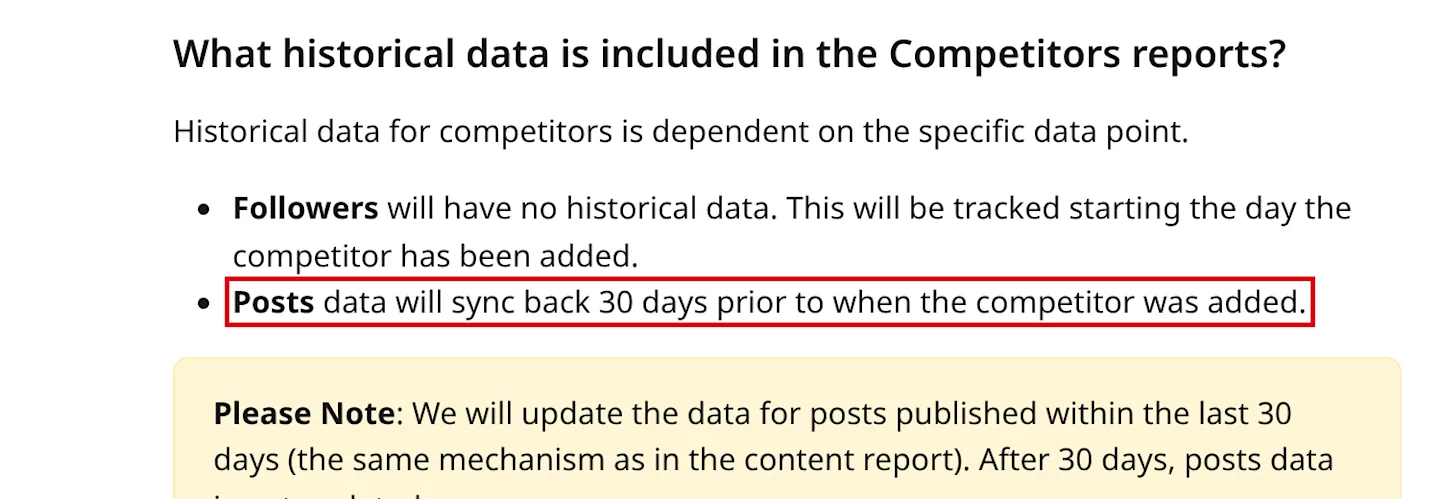
I’d use this Agorapulse Competitors help article to confirm the report covers Instagram and Facebook pages, and to see that Advanced includes 6 competitor profiles.
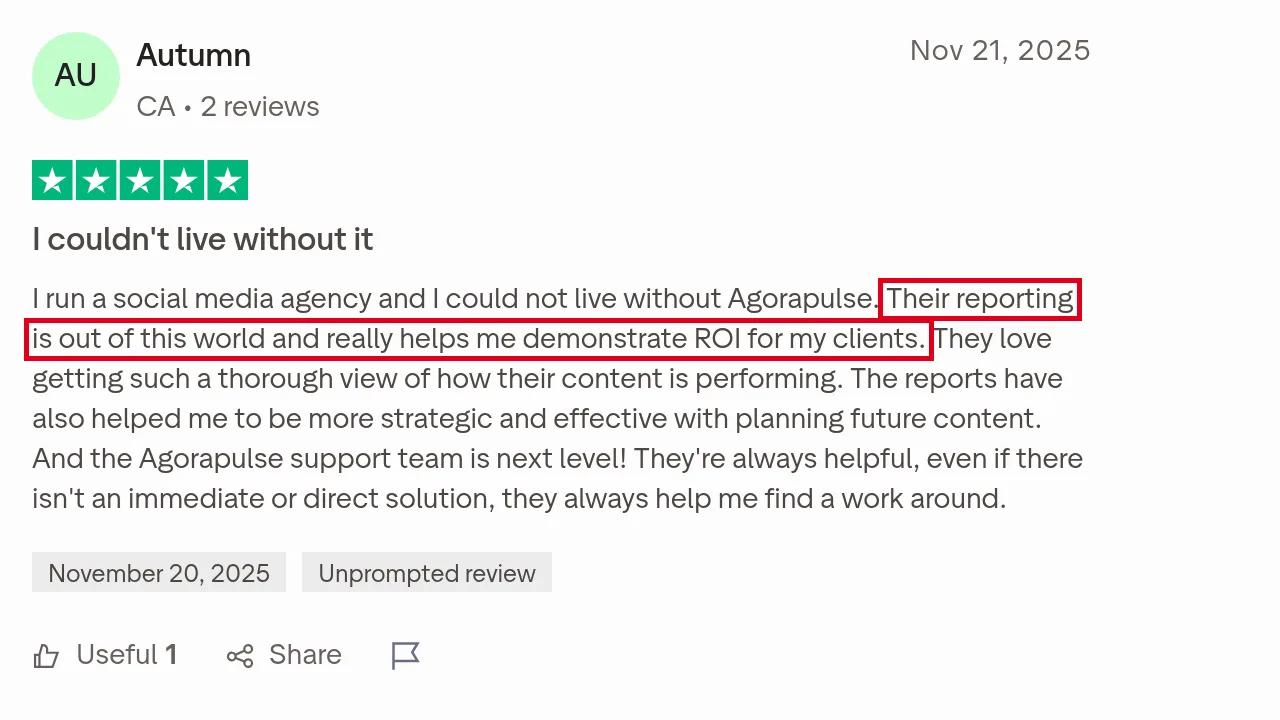
Trustpilot, 21 November 2025, more than a year old. I’d keep Autumn’s ROI comment in front of an agency buyer, because a client-ready benchmark is the reason I’d choose Advanced.
Features
Side-by-side metrics against each competitor
Top 6 posts across your competitor list
Follower change, posts by type and engagement by type
PDF export by email
Extra competitors as an add-on
Pricing
Agorapulse charges by the user and takes up to 20% off when you pay for the year:
Standard: $79 a user monthly if paid yearly, $99 if paid month to month. 1 competitor profile.
Professional: $119 yearly or $149 monthly. 1 competitor profile.
Advanced: $149 yearly or $199 monthly. 6 competitor profiles.
Advanced includes 6 competitor profiles. Standard and Professional include 1 competitor profile each.
Pros
The top-posts view shows what wins in a client’s category.
PDF export makes a client-ready benchmark.
Top content sorts by likes, comments, shares or engagement.
A February 2026 reviewer on G2: “It’s intuitive, easy to use, great for sharing calendars with clients, offers clear analytics”
Cons
Facebook and Instagram only; no TikTok, LinkedIn or YouTube rivals.
Follower data starts the day you add a competitor, and posts go back only 30 days.
1 competitor below Advanced isn’t a benchmark.
An October 2026 review: “We still sometimes have doubts about the data, especially in the reporting section between organic and paid results”
Use Agorapulse Advanced if your clients live on Meta and you already schedule there. Look elsewhere for TikTok benchmarks.
7. Emplifi
Emplifi is for global brands that want regional industry benchmarks and public-profile tracking in one suite.
Emplifi puts out quarterly industry benchmarks at global and regional level. Inside the product, public data benchmarking tracks up to 10 public profiles on Essential, 50 on Advanced and 100 on Intelligent. Competitive benchmarking compares your share of voice and mention volume with named rivals.
I’d open this Emplifi benchmark hub when I need a quarterly industry line by region, such as the Q3 2026 reports shown here, before I buy a seat for public-profile tracking.
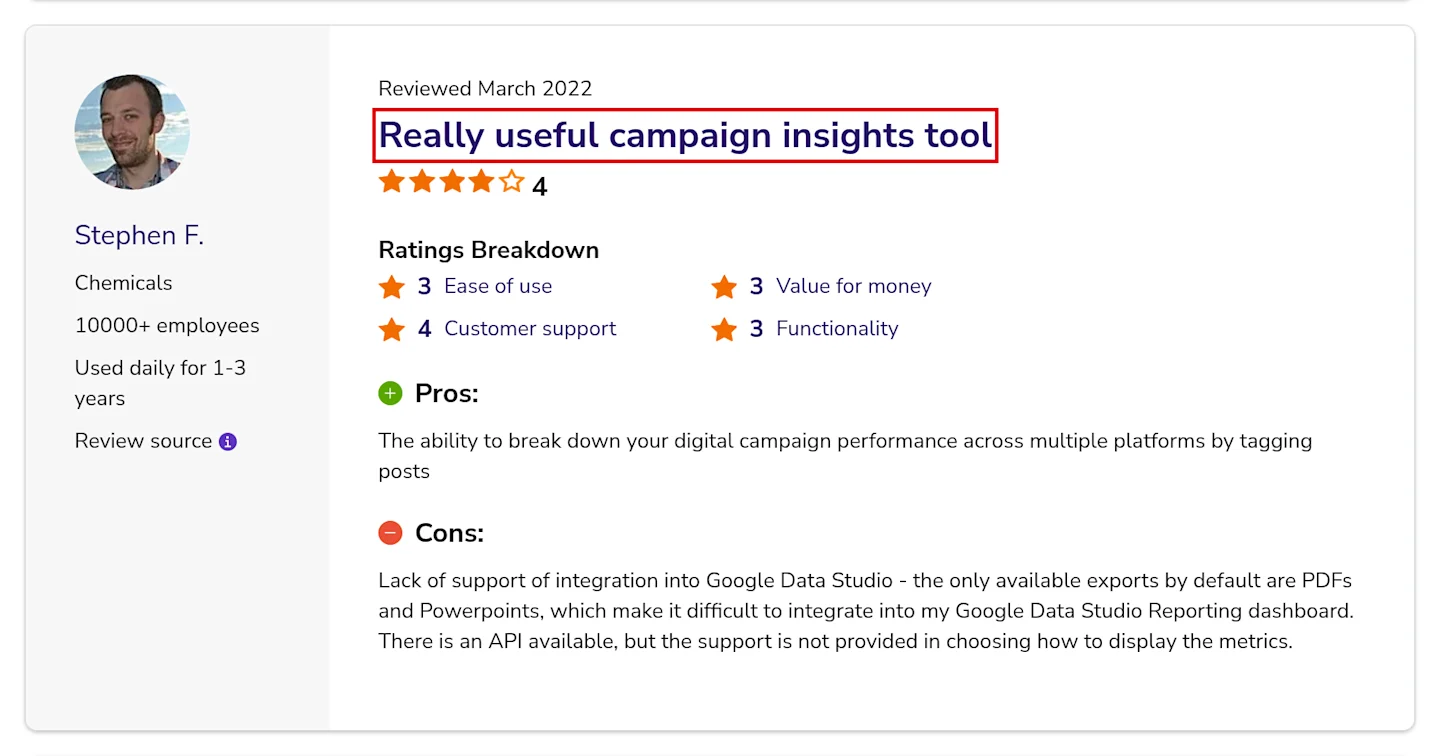
Software Advice, March 2022, older than 12 months. I’d pair Stephen F.’s campaign-insights note with the more recent G2 comments below, since this card is outside the last 12 months.
Features
Public data benchmarking: 10, 50 or 100 profiles by plan
Quarterly industry benchmarks, global and regional
Competitive benchmarking on share of voice and mention volume
Scheduled PDF and XLSX reports
Pricing
Emplifi has three Social Marketing plans:
Essential: starting at $1,249 a month, and the billing term is unnamed beside that amount.
Advanced: starting at $2,499 a month, and the billing term is unnamed beside that amount.
Intelligent: custom quote.
Every plan goes through a meeting.
Pros
Regional benchmarks help a brand that reports by market.
100 public profiles on the top plan covers a large category.
Scheduled reports send benchmarks to stakeholders without manual exports.
April 2026, via G2: “The possibility of extracting data much more quickly and in an organized manner, with various profiles gathered on the same screen, is a major positive point.”
Another April 2026 reviewer: “The topic of responding and benchmarking helped me a lot.”
Cons
$1,249 a month to start is out of reach for most small teams.
An April 2026 review: “The reporting can be limited.”
Another April 2026 reviewer: “The layouts of these dashboards are not very visually appealing.”
A third April 2026 review: “Integrations and API connections can be more costly than I’d like.”
Consider Emplifi if you’re a multi-region brand with an enterprise budget. Small teams get more from Socialinsider or Metricool.
8. Dash Social
Dash Social, formerly Dash Hudson, is for consumer brands that benchmark Instagram and YouTube.
Its competitive insights cover Instagram and YouTube against your competitors and your industry. The Advance plan adds competitive benchmarks, the plan comparison includes 3 competitors, and Enterprise adds market-level benchmarks. Every plan includes unlimited users.
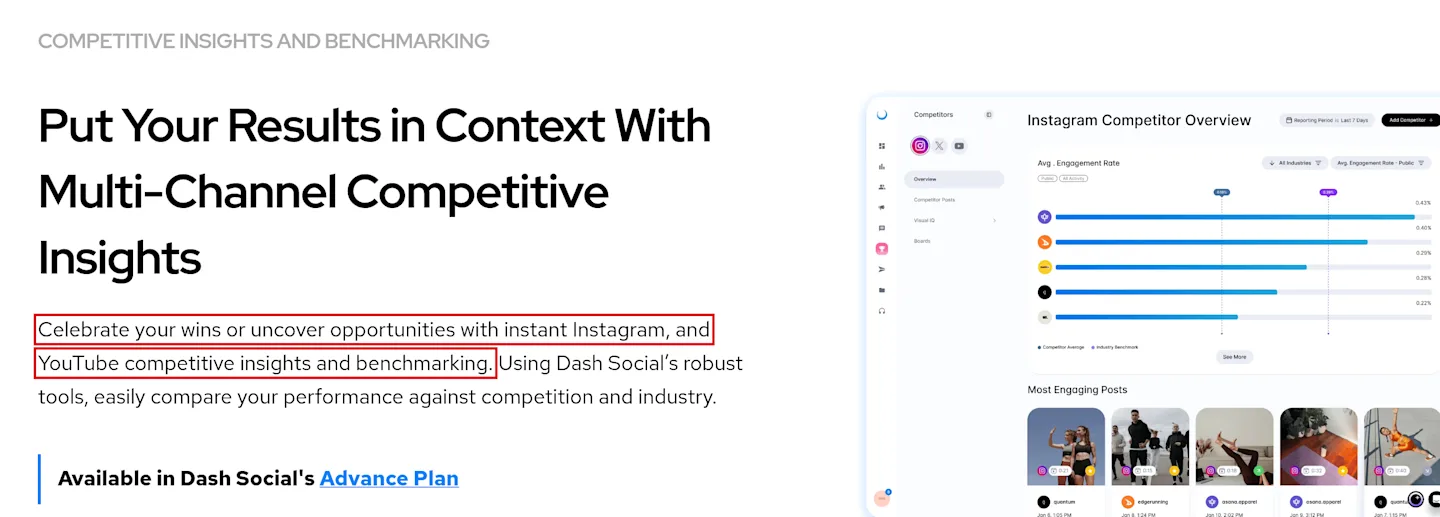
I’d use this Dash Social competitive insights page when Instagram and YouTube are the channels I need to benchmark, and I’d treat Advance as the plan that includes those competitive benchmarks.
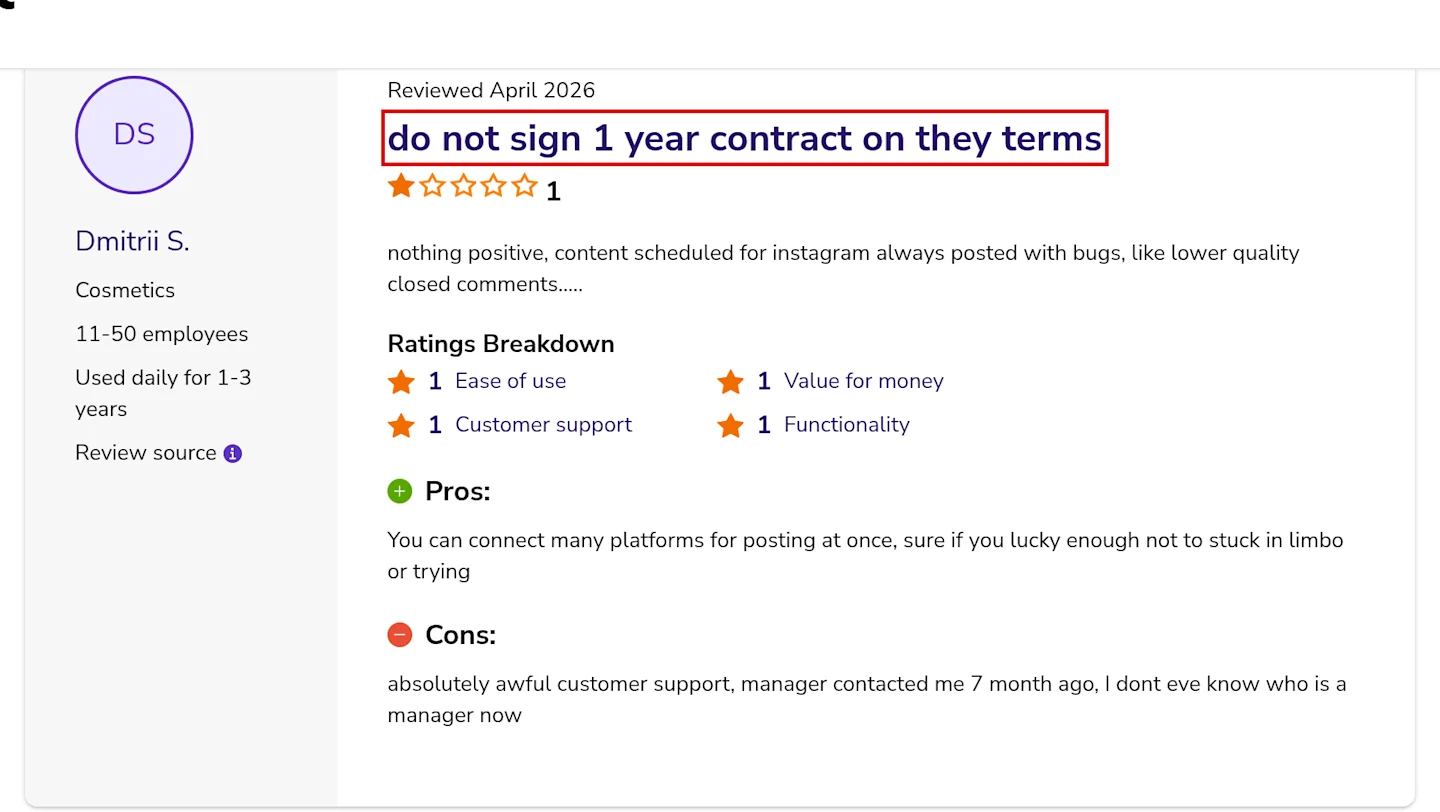
Software Advice, April 2026. I’d read Dmitrii S.’s card before a yearly contract, then weigh it against the May 2026 G2 notes on benchmark reporting in the beauty category.
Features
Instagram and YouTube competitive insights
Industry and competitor benchmarks on Advance
Market-level benchmarks on Enterprise
Custom dashboards and reporting on Advance
Unlimited users on every plan
Pricing
Dash Social shows no public prices. Engage, Advance and Enterprise all go through a demo, and each plan comes with a 14-day free trial.
Pros
Unlimited users means the whole team sees the benchmarks.
Market-level benchmarks on Enterprise suit brands that report by region.
A reviewer on G2 in May 2026: “I really value that Dash Social provides benchmark reporting and industry insights tailored to the beauty space, as these are highly relevant to my role and help inform our annual KPI setting.”
A May 2026 reviewer: “Social listening is also great as it helps quantify how often our brand is spoken of along with trends in industries and competitors”
Cons
Dash keeps prices behind a demo, so budgeting means a sales call.
3 competitors in the plan comparison is a short list.
A November 2024 G2 review (over 12 months old): “I would love to see more features like Rival IQ in their analytics section.”
Another May 2026 reviewer: “The analytics seem a little inaccurate sometimes, especially on TikTok!”
Try Dash Social if you’re a beauty, fashion or retail brand and Instagram is your main channel.
How to Choose a Social Media Benchmarking Tool
Match the tool to the question you report on:
Rivals you pick, head to head: Socialinsider or Rival IQ.
Many rivals on a tight budget: Metricool Starter.
Your industry average: Hootsuite, Emplifi or Socialinsider’s quarterly report.
Agency clients on Facebook and Instagram: Agorapulse Advanced.
Results by region: Emplifi or Dash Social Enterprise.
Next, count the rivals you need and check history. A benchmark with 3 months of data can’t show a seasonal trend. For a step-by-step process, read how to track competitors on social media. For a wider list that includes listening, see the social media competitor analysis tools roundup.
FAQ
Which social media benchmarking tools made my list?
Socialinsider, Rival IQ, Metricool, Hootsuite, Sprout Social, Agorapulse, Emplifi and Dash Social. Socialinsider is my pick because competitor tracking comes with every plan.
Is there a free social media benchmarking tool?
Metricool’s Free plan tracks 5 competitors on Facebook, Instagram, Threads, Bluesky and Twitch. Socialinsider also publishes a free quarterly benchmarks report.
What’s the difference between competitor benchmarking and industry benchmarking?
Competitor benchmarking compares you with rivals you pick. Industry benchmarking compares you with an average for your sector. Hootsuite includes industry benchmarking on every plan.
How many competitors should I benchmark against?
Pick enough to cover your direct rivals and one or two brands you want to catch. For most teams that’s 5 to 10, which rules out plans with 1 to 3 slots.
Can I benchmark TikTok accounts?
Socialinsider counts competitor accounts on all platforms. Agorapulse’s Competitors report covers only Instagram and Facebook, and Dash Social’s benchmarking page names Instagram and YouTube.
When you need a community share, not a channel average
I kept CommunityTracker unranked. The tools above benchmark your owned accounts and industry averages on the major social networks. CommunityTracker does not do that job. Instagram, TikTok and Facebook sit outside the official communities it tracks.
CommunityTracker is a GTM tool.
What it does well is a different benchmark: share of voice by community, for the official communities it tracks, compared with the brands you add. That is mention share in those communities, not an engagement-rate industry line. I’d use it when the question is “where do we show up against these rivals in communities,” not “how does our Instagram rate compare with the category.”
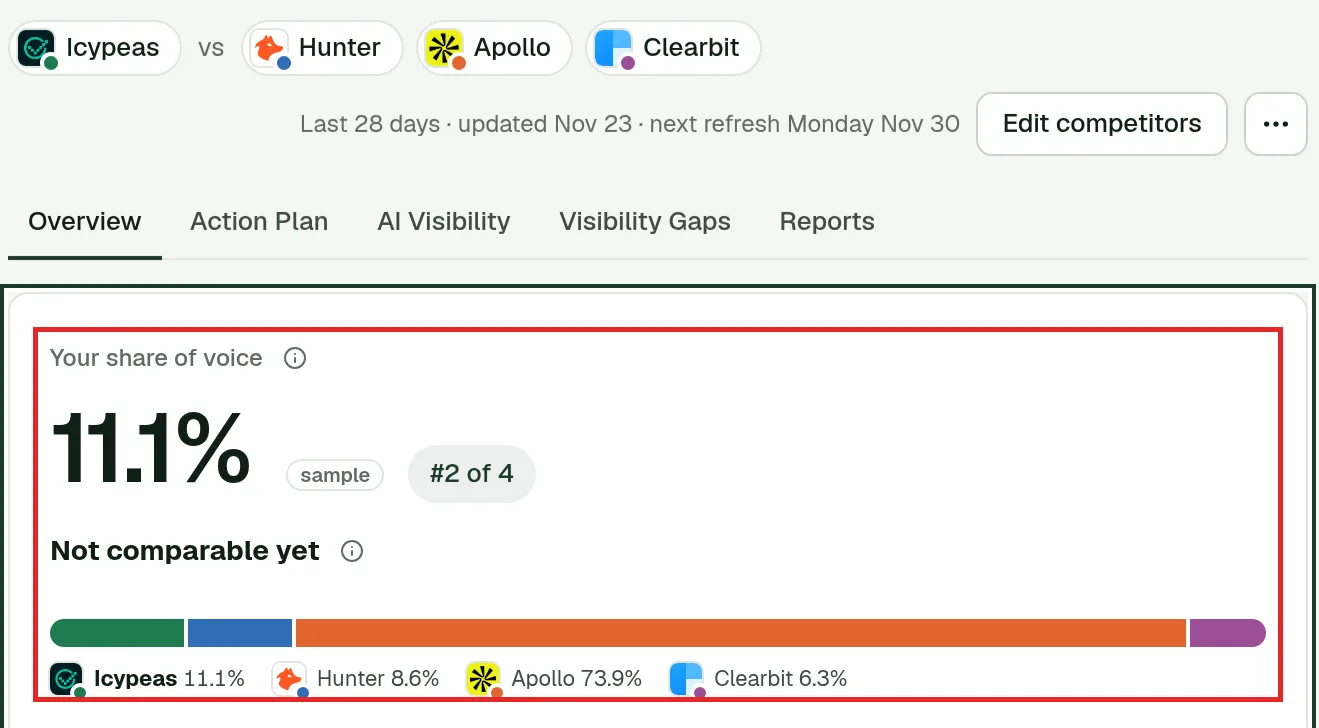
I’d read this share of voice overview as a community benchmark of Icypeas against Hunter, Apollo and Clearbit. The figures are sample data from a tracked set, and I would not use those percentages as a category share.
A blended share is available, and a community-level split sits beside it. Each workspace gets one share-of-voice report, and that report refreshes every Monday.
Share of voice starts on Pro, and the seven-day trial includes it. Starter does not include this report. Daily Slack alerts come with Pro.
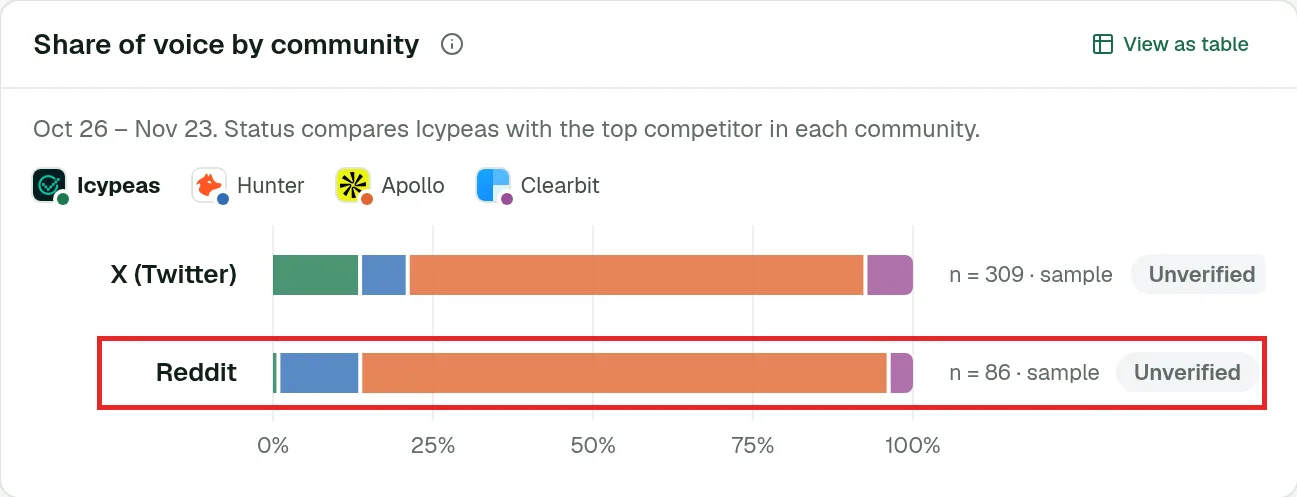
I’d open this community-level chart to see where that same sample run appears, community by community. The bars are sample data from a tracked set, and I would not use those bars as a category share.
It tracks official communities from a fixed set.
Advanced adds visibility gaps, an action plan, and a PDF of the share-of-voice report. Every paid plan already includes LinkedIn campaigns and email campaigns, and replies land in a single inbox.
Price of this community add-on
For a community-share add-on, Starter costs $39 a month, billed monthly. Pro costs $99 a month, billed monthly. Advanced costs $199 a month, billed monthly (pricing).
A seven-day trial costs $4.99.
Those seven days include the Pro features, and that trial does not renew.
Starter alerts once a day.
I treat this as a once-per-day digest, not a faster firehose.
100 warm emails a month on Starter, unlimited on Pro.
You can ask for annual billing. There is no fixed contract length. New paid plans carry a 14-day money-back window.