A social media scraper API collects data from platforms and returns it in a format your team can use.
Building and maintaining scrapers yourself can take ongoing engineering work. APIs can simplify collection by handling parts of the process, such as requests, data extraction, or proxy access.
But not every API supports the same platforms or performs equally well. In 2026, compare platform coverage, success rates, anti-bot handling, scalability, pricing, and ease of integration.
So, which provider fits your needs? I compared nine options, focusing on what they offer and the kinds of social media scraping tasks they can support.
TL;DR: Social Media Scraper APIs#
CommunityTracker: Provides API for scraping social media conversations and finding buying signals.
Apify: Ready-made social media scraper APIs that you can customize.
Bright Data: APIs and infrastructure for large-scale social media data collection.
Decodo: Rotating proxies for accessing social platforms during data collection.
SOAX: Geo-targeted proxy access for collecting social media data.
Oxylabs: Enterprise scraping APIs and infrastructure for high-volume collection.
Scrapfly: General-purpose scraping API with anti-bot features.
Zyte: Managed scraping and data extraction for web sources.
ScraperAPI: General-purpose scraping API for simpler collection needs.
Related Read: How to Scrape LinkedIn Posts Legally: Methods, Tools, and Safer Workflows in 2026
What to Look for in a Social Media Scraper API#
Choosing a social media scraper API is about more than platform support. Social networks have different technical systems, access restrictions, and anti-bot measures, so performance can vary between platforms.
Platform coverage: Check whether it supports the platforms and data types you need. A social monitoring tool may be a better fit if you need ongoing mention tracking rather than raw data extraction.
Scraping success rate: Look for reliable data extraction and resistance to blocking.
Proxy and IP management: Check how the provider manages IP rotation and access restrictions.
JavaScript rendering: Some platforms load content dynamically, making JavaScript rendering useful for certain data.
CAPTCHA and anti-bot handling: Check how the API handles CAPTCHAs and other anti-bot challenges.
Data quality: Look for structured and normalized output that is easy to process.
Scalability: Check whether it can handle your expected scraping volume and request limits.
Pricing: Compare the cost of requests or data volume at the scale you expect to use.
What Can You Use a Social Media Scraper API For?#
Social media scraper APIs can collect public social media data for research, monitoring, analysis, and lead generation. Common use cases include:
Competitor monitoring: Track competitors’ public activity, content, and engagement.
Market research: Collect social media data to study customer interests, markets, and industry activity.
Social listening and sentiment analysis: Analyze public conversations and feedback about brands, products, or topics. For interpreting conversations and turning them into actionable signals, a social intelligence tool may be more suitable.
Lead generation: Some teams use social data to generate leads from community conversations and support prospect research.
Influencer research: Analyze public profiles, content, and engagement to find relevant influencers.
Trend monitoring: Track conversations over time to identify emerging topics and changes in audience interest.
Content analysis: Analyze public posts, captions, comments, and other content to identify topics and patterns.
Brand monitoring: Track public mentions and conversations around a brand or product.
Customer research: Analyze public feedback and conversations to understand customer opinions, needs, and pain points.
Start with CommunityTracker API to collect relevant social conversations and identify buying signals for your workflow.
Social Media Scraper & Intelligence Platform Comparison#
Provider | Best for | Platform coverage | Core capabilities | Starting price |
CommunityTracker | Finding buying signals in social and community conversations | Reddit, LinkedIn, Hacker News, and GitHub on Starter; more communities on higher plans | API for community posts, signals, and Share of Voice data; monitoring and lead intelligence rather than general-purpose raw-data scraping | Free monitoring tier; API included with Pro at $99/month |
Apify | Customizable, ready-made social scrapers | Varies by Actor; marketplace includes Instagram, TikTok, Facebook, YouTube, Reddit, and LinkedIn scrapers | Actors with API access, scheduling, and dataset exports; each Actor has its own features and pricing | Free plan; paid plans from $39/month, plus usage and Actor costs |
Bright Data | Large-scale social media data collection | Instagram, TikTok, LinkedIn, YouTube, X, and Facebook | Prebuilt scraper APIs, structured data delivery, proxy management, browser rendering, and CAPTCHA handling | Free tier up to 5,000 records/month; then $1.50 per 1,000 records pay-as-you-go |
Decodo | Scraping with ready-made templates and proxy options | Coverage varies by scraper; TikTok is listed among supported targets | Web Scraping API, 100+ templates, JavaScript rendering, structured outputs, and standard or premium proxy pools | Free tier; paid plans from $19/month, with request-based usage |
SOAX | Geo-targeted access and general web extraction | Public web targets; social-platform availability depends on the target | Web Data API manages proxy rotation, retries, browser rendering, and HTML, JSON, Markdown, or XHR output | Pay-as-you-go available; subscription plans from $90/month |
Oxylabs | High-volume scraping with enterprise infrastructure | Dedicated TikTok scraper; other coverage depends on supported Web Scraper API targets | Scraper API, structured extraction, proxy rotation, batch requests, scheduling, and JavaScript rendering | Free trial up to 2,000 results; paid plans from $49/month |
Scrapfly | Scraping social platforms with anti-bot features | Scrapers available for Instagram, X, LinkedIn, TikTok, YouTube, Reddit, Threads, and Facebook | Scraping API, residential proxies, browser rendering, and anti-scraping features | Free trial credits; plans from $30/month |
Zyte | Managed web scraping and data extraction | Web targets; social coverage depends on the target and request | Automated proxy selection, browser rendering, session handling, and data extraction | $5 free credit; pay-as-you-go from $0.13 per 1,000 HTTP requests |
ScraperAPI | Simpler, general-purpose scraping | General web targets; no clearly defined catalog of dedicated social scrapers | API with proxy rotation, JavaScript rendering, and CAPTCHA/anti-bot handling; social extraction may require custom setup | Trial available; plans from $49/month |
1. CommunityTracker#

CommunityTracker’s API provides access to social and community conversations, including posts and buying signals. Teams can monitor relevant discussions, prioritize potential prospects, and use conversation context to guide outreach.
Key Features#
Post retrieval API: The
GET /api-postsendpoint returns AI-scored posts matching a keyword. Requests can include filters such as source, minimum score, date range, and result limit.Keyword monitoring: Tracks relevant terms and discussions across supported social and community sources.
Buying-signal discovery: Retrieved posts include an AI score to help identify relevant conversations
Share of Voice API: The
GET /api-intelligenceendpoint returns Share of Voice snapshots and AI summaries for configured queries, including snapshots over a date range.Keyword and source filtering: Query posts by keyword and, where supported, filter by source.
REST API access: Use an API key to call the endpoints and receive JSON responses.
Workflow connections: The API can be called from custom code or HTTP-capable workflow tools. CommunityTracker names n8n, Make, and Zapier as options.
Pricing#
CommunityTracker has a Free plan at $0/month, with paid plans starting at $39/month.
For API access, the Pro plan costs $99/month and includes 1,000 API calls/day, while Advanced costs $199/month and includes 5,000 API calls/day. API access is not available on the Starter plan.
Pros#
Finds prospects based on buying signals in social and community conversations.
Automatically identifies which people are more relevant to contact.
Combines buying signals with lead enrichment.
Gives sales teams the original conversation as context for outreach.
Master inbox to see both email and LinkedIn campaign conversations.
Cons#
It is focused on social media rather than general-purpose web scraping.
Teams looking specifically for raw social media data or scraping infrastructure may need a dedicated scraping platform.
The amount of contact information available can vary from one lead to another.
CommunityTracker is best suited for B2B sales and marketing teams that want to find people showing buying intent, identify who to contact first, and reach those prospects through email or LinkedIn.
Related Read: 10 Best Tools to Detect Buying Signals on LinkedIn in 2026
2. Apify#
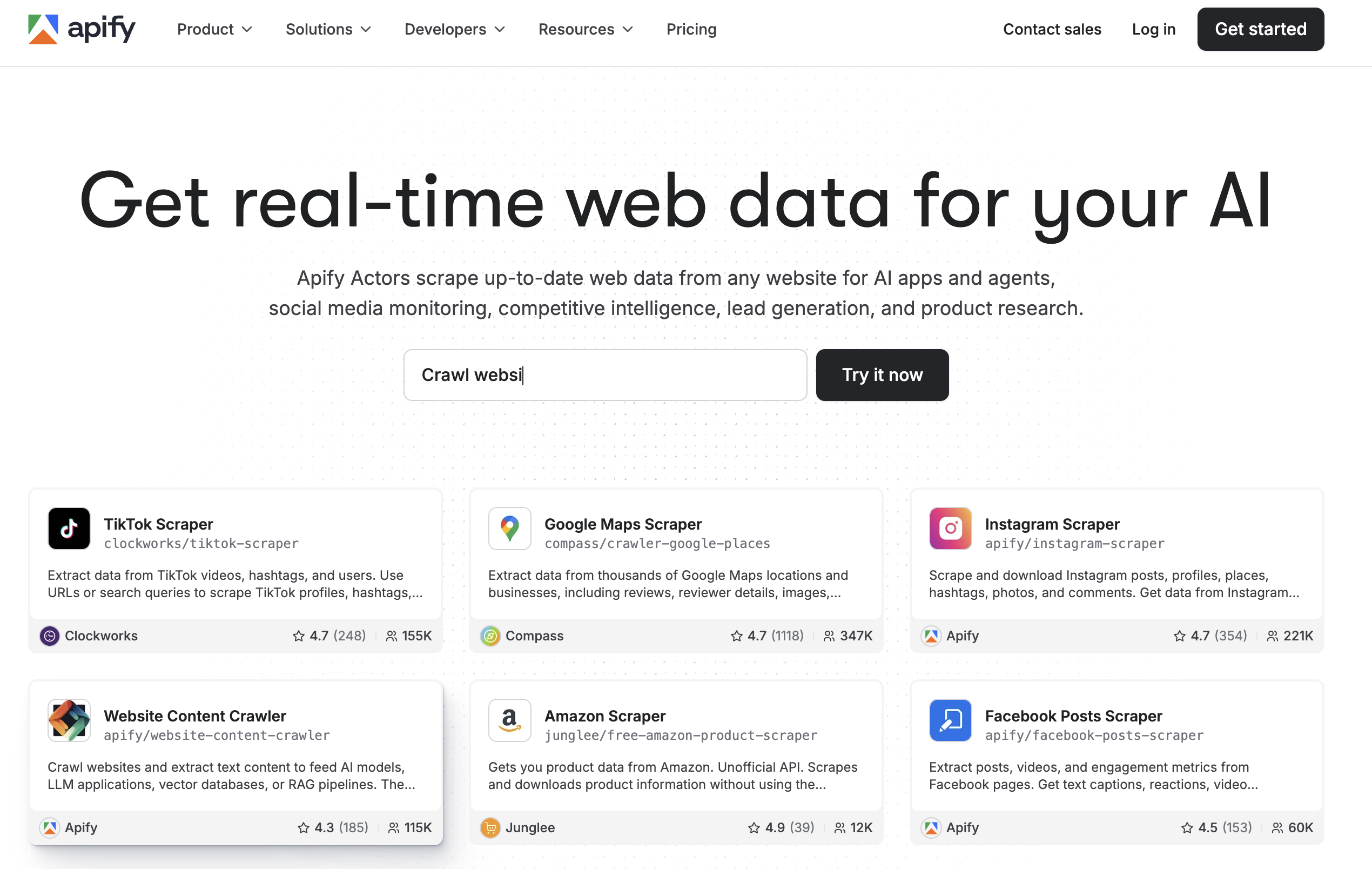
Apify is a web scraping and automation platform built around Actors, reusable programs that scrape websites, process data, and run automated tasks. Its Store includes ready-made social media scrapers, and developers can also build and run their own Actors.
Key Features#
Pre-built Actors: Provides ready-to-run scrapers for platforms such as Instagram, TikTok, Facebook, YouTube, Reddit, and LinkedIn.
Custom Actors: Developers can create their own scrapers using JavaScript, Python, Docker, or other supported approaches.
Social media Actors: Offers dedicated Actors for different social platforms and data types, including profiles, posts, comments, videos, and search results.
JavaScript rendering: Supports browser-based scraping for websites that require JavaScript execution.
Scheduling and automation: Actors can be scheduled to run at regular intervals and monitored through the platform.
Large-scale extraction: Actors can run in the cloud with configurable resources and concurrent runs for larger scraping jobs.
API and integrations: Provides a REST API, JavaScript and Python clients, CLI access, and integrations for connecting Actors and scraped data with other applications.
Data storage and exports: Scraped results can be stored in datasets and exported in formats such as JSON, CSV, and XLSX.
Pricing#
Apify has a Free plan at $0/month with $5 of included platform usage. The Starter plan costs $19/month, Scale costs $199/month, and Business costs $999/month, with additional usage charged based on consumption. Actor Store scrapers can use different pricing models, including pay-per-event and pay-per-usage, so the cost can vary by Actor.
Pros#
Large selection of ready-made social media scrapers.
Lets developers build and customize their own scrapers.
Provides API access, scheduling, storage, and automation in the same platform.
Supports both small scraping jobs and large-scale data collection.
Social media Actors are available for different types of data, such as profiles, posts, comments, videos, and ads.
Cons#
The quality and capabilities can vary between individual Actors because many are developed by different creators.
Custom Actors require technical knowledge to build and maintain.
Pricing can be harder to estimate because Actor pricing and platform usage vary by scraper and workload.
Users looking for a single, dedicated social media scraping API may find the Actor-based approach more complex.
Apify is best suited for technical users who need flexibility to use existing social media scrapers or build and customize their own data extraction tools.
3. Bright Data#
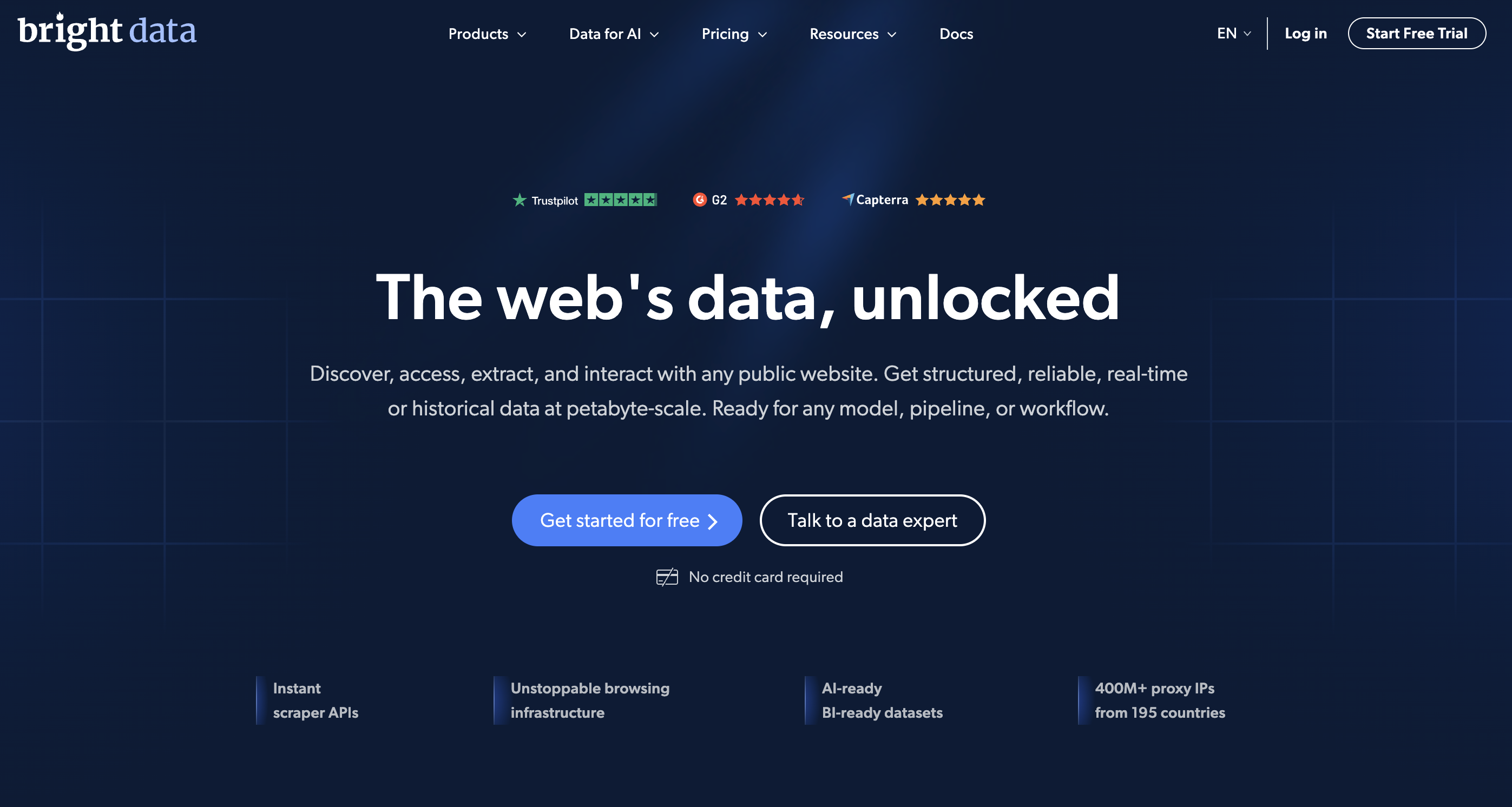
Bright Data provides dedicated social media scraping APIs for collecting public data from major social platforms. It offers ready-made scrapers for profiles, posts, comments, followers, hashtags, videos, and engagement data, along with the infrastructure needed to collect this data at scale.
Key Features#
Web Scraping API: Provides ready-made social media scrapers that return structured data through an API.
Scraping Browser: Provides managed browsers with JavaScript rendering, CAPTCHA solving, browser fingerprinting, and proxy management.
Proxy network: Uses residential, ISP, and datacenter proxies to support large-scale data collection.
Geotargeting: Supports location-based targeting for scraping from different regions.
Large-scale extraction: Supports high-volume data collection with bulk requests and concurrent scraping.
Structured data delivery: Scraped data can be delivered through API, webhooks, and cloud storage in structured formats.
Social Media Coverage: Bright Data has dedicated scrapers for Facebook, Instagram, TikTok, X (Twitter), LinkedIn, YouTube, and Reddit.
Pricing#
Bright Data offers 5,000 free records per month for its Web Scraper API. Pay-as-you-go pricing starts at $1.50 per 1,000 records, while the Scale plan costs $499/month for 384,000 records. Enterprise pricing is custom.
Pros#
Dedicated scrapers for major social media platforms.
Supports different social data types, including profiles, posts, comments, and engagement data.
Large proxy network and built-in anti-bot infrastructure.
Handles high-volume social media data collection.
Provides API, webhooks, and multiple data delivery options.
Suitable for recurring and large-scale scraping projects.
Cons#
Relatively expensive: Starting at $1.50 per 1,000 records, it can cost more than lower-priced scraping APIs, particularly for smaller projects.
Its broad infrastructure offering can be more complex than a simple social media scraper API.
Different platforms have different scraper types and available data fields, so coverage needs to be checked for the specific data you need.
Smaller teams or occasional users may not need the level of infrastructure Bright Data provides.
Bright Data is best suited for enterprises and data teams that need large-scale social media data collection and are willing to pay more for managed scraping infrastructure.
4. Decodo (formerly Smartproxy)#
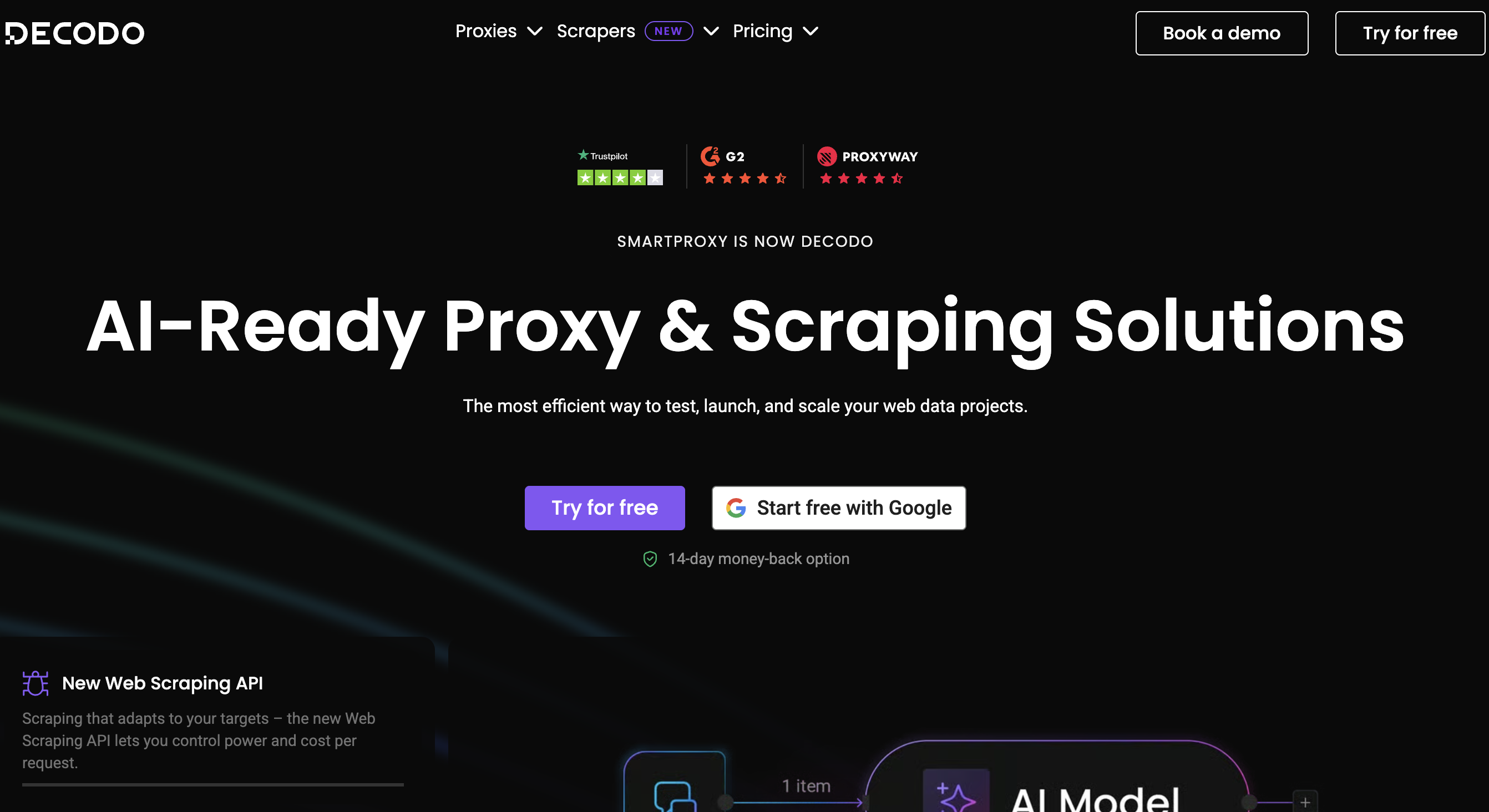
Decodo provides ready-made scraping solutions for social media platforms through its Web Scraping API.
It combines pre-built scraping templates with proxy rotation, JavaScript rendering, anti-bot handling, and structured data delivery, so developers can collect public social media data without building the scraping infrastructure themselves.
Key Features#
Ready-made scrapers: Provides pre-built templates for social platforms and specific data types, reducing the need to build scrapers from scratch.
Social media scraping: Provides dedicated scrapers for platforms such as TikTok, YouTube, Instagram, and Reddit, with platform-specific data available depending on the scraper.
Proxy options: Uses a pool of 125M+ IPs across 195+ locations, including residential, mobile, ISP, and datacenter proxies.
JavaScript rendering: Supports JavaScript rendering for dynamic websites and social platforms.
Anti-bot handling: Includes browser fingerprinting, proxy rotation, CAPTCHA handling, and automatic retries.
Structured output: Returns data in formats including HTML, JSON, CSV, XHR, PNG, and Markdown.
Real-time and asynchronous requests: Supports both synchronous and asynchronous scraping, allowing data to be collected immediately or delivered later.
Pricing#
Decodo's Web Scraping API has a free plan, with paid plans starting at $19/month. The $19 plan charges from $0.50 per 1,000 requests for standard proxies, while the $49 plan starts at $0.30 per 1,000 requests. Premium proxies and JavaScript rendering have higher per-request rates.
Pros#
Ready-made scrapers reduce the technical work required to collect social media data.
Supports several major social platforms and different types of social data.
Combines scraping APIs with a large proxy network and anti-bot infrastructure.
Provides structured output in multiple formats.
Offers both free and relatively low-cost paid entry points.
Supports API integration and asynchronous scraping.
Cons#
Social platform coverage is more limited than providers with a larger dedicated social scraper catalog.
Different platforms have different templates and available data fields, so the exact coverage needs to be checked before choosing a scraper.
Advanced scraping with premium proxies and JavaScript rendering costs more per request.
Teams needing highly customized platform-specific scrapers may need to use the universal Web Scraping API rather than a ready-made template.
Decodo is best suited for small and mid-sized teams that want ready-made social media scrapers, straightforward API access, and managed proxy infrastructure without building their own scraping stack.
5. SOAX#
SOAX is a proxy and web data platform that can be used for social media scraping when location-specific access is important.
Its residential and mobile proxy networks cover 195+ geolocations, with targeting available down to the city, region, ISP, and, on some plans, ASN level. Its Web Data API handles proxy rotation, JavaScript rendering, retries, and anti-bot measures for public web data collection.
SOAX does not present a large catalog of dedicated social media scrapers in the same way as platforms such as Apify or Bright Data.
Instead, it provides proxy infrastructure and a Web Data API for collecting public data from almost any website, including social media activity. This makes the specific social platforms and data fields available dependent on the target and extraction setup.
Key Features#
Residential proxies: Provide rotating residential IPs from 195+ geolocations, with country, region, city, and ISP targeting.
Mobile proxies: Provides mobile IPs from 195+ geolocations, useful when scraping targets that restrict or treat mobile traffic differently.
Geotargeting: Lets users select specific countries, regions, cities, ISPs, and, on higher plans, ASNs.
Web Data API: Provides an API for extracting data from almost any website while handling proxy rotation, browser behavior, retries, and JavaScript rendering.
Anti-bot handling: The Web Data API handles CAPTCHAs, WAFs, and other anti-bot measures as part of its managed extraction infrastructure.
Session control: Supports rotating and sticky sessions, allowing users to change IPs between requests or maintain a consistent session when needed.
Social Media Coverage:
Pricing#
SOAX has a free Sandbox account for testing. Its current paid plans start at $200/month for the Builder plan, which includes 200 credits. Higher plans are $500/month, $1,500/month, and $3,000/month. Pricing is based on data usage and the geographic tier of the proxy traffic.
Pros#
Strong residential and mobile proxy coverage for location-specific scraping.
Supports granular geographic targeting across 195+ locations.
Web Data API handles proxy rotation, JavaScript rendering, retries, and anti-bot measures.
Supports both rotating and sticky sessions.
Can be used for public data collection across a wide range of websites.
Cons#
Not a dedicated social media scraper platform: It does not provide the same range of platform-specific social media scrapers as providers built around ready-made social scraping.
Social media data extraction may require more implementation around the specific target and data fields you need.
Paid plans start at $200/month, which can be expensive for smaller social scraping projects.
The cost of scraping varies by traffic volume and geographic tier, making costs less straightforward for location-heavy scraping.
SOAX is best suited for teams that need geo-specific social media data collection and want control over residential and mobile IP locations when accessing public social and web data.
6. Oxylabs#
Oxylabs provides web scraping APIs and proxy infrastructure for collecting public web data at scale.
For social media scraping, its Web Scraper API can be used with supported social targets, including a dedicated TikTok Scraper API, while its residential and mobile proxy networks provide the infrastructure for location-specific and high-volume data collection.
Key Features#
Social media scraper/API options: Oxylabs offers dedicated scraping endpoints for specific targets, including TikTok, through its Web Scraper API. It also provides a Universal Source for custom web scraping.
Residential proxy network: Its residential network has 175M+ IPs across 195 countries, with automatic rotation and multiple session options.
Web Scraper API: Provides a single API for collecting web data, with automatic proxy rotation, pre-configured targets, batch queries, scheduling, and structured data extraction.
JavaScript rendering: Supports JavaScript-rendered scraping for dynamic websites and charges different rates when JS rendering is required.
Geo-targeting: Residential proxies support targeting by country, city, state, ZIP code, coordinates, and ASN.
Scalability: Supports bulk collection of up to 5,000 URLs per batch and high request rates on higher Web Scraper API plans.
Pricing#
Oxylabs Web Scraper API has a free trial with up to 2,000 results. Paid plans start at $49/month for the Micro plan.
Pricing is based on the target and features used: the Micro plan starts at $1.15 per 1,000 results for other targets without JavaScript rendering and $1.35 per 1,000 results with JavaScript rendering.
Higher plans reduce the per-result rate, with Business starting at $999/month.
Pros#
Large residential proxy network with coverage across 195 countries.
Strong geo-targeting options for location-specific data collection.
Web Scraper API handles proxy rotation, JavaScript rendering, CAPTCHA handling, and parsing.
Supports batch scraping, scheduling, and cloud data delivery.
Can scale to high-volume data collection.
Dedicated target endpoints are available for some platforms, including TikTok.
Cons#
Less social-media-specific: Its main product is a general Web Scraper API rather than a platform dedicated specifically to social media scraping.
Pricing depends on the target and features such as JavaScript rendering, which can make costs harder to estimate.
Its broader scraping infrastructure may be more than smaller teams need for occasional social media data collection.
Oxylabs is best suited for large-scale data teams and enterprises that need high-volume public data collection, strong proxy infrastructure, and the flexibility to scrape social and other web sources through the same platform.
Start with CommunityTracker API to collect relevant social conversations and identify buying signals for your workflow.
7. Scrapfly#
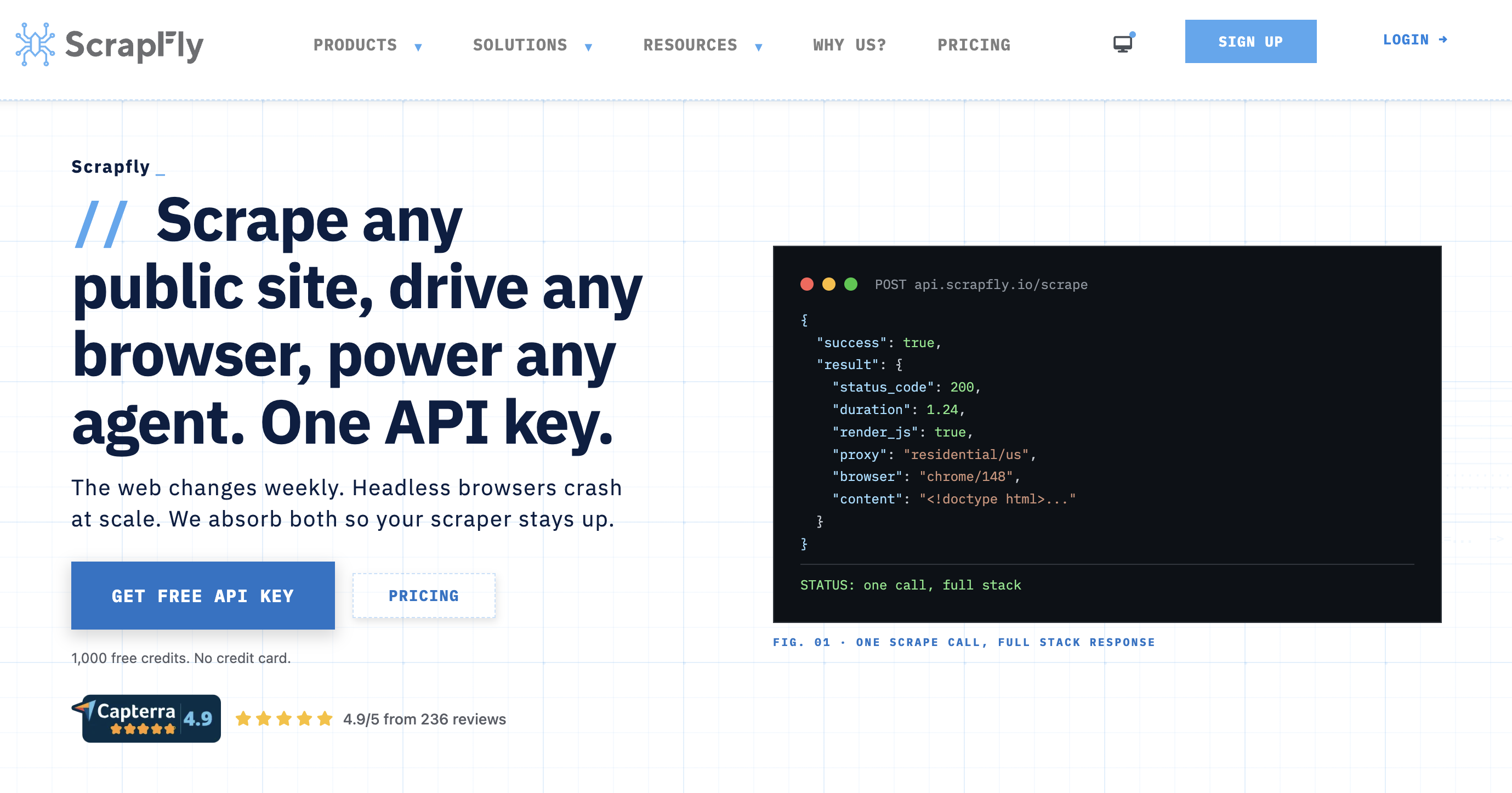
Scrapfly is a web scraping API focused on reliable data collection from websites with anti-bot protection.
For social media scraping, it combines an anti-scraping layer with residential proxies, browser and TLS fingerprinting, JavaScript rendering, and open-source scrapers for major social platforms.
Key Features#
Anti-Scraping Protection: Handles anti-bot systems and challenges that can block automated requests.
Residential proxies: Uses residential proxy rotation to reduce IP-based blocking.
Browser and TLS fingerprinting: Matches browser and network fingerprints to help requests appear more like normal browser traffic.
JavaScript rendering: Supports dynamic social platforms that require browser rendering.
Structured data extraction: Can return scraped content in structured JSON and normalize data across different platforms.
Open-source scrapers: Provides maintained scrapers for major social platforms using the same Scrapfly reliability layer.
Social Platforms Supported: Scrapfly provides open-source scrapers for Instagram, X (Twitter), LinkedIn, TikTok, YouTube, Reddit, Threads, and Facebook. The scrapers cover public data such as profiles, posts, comments, videos, companies, jobs, channels, and engagement data, depending on the platform.
Pricing#
Scrapfly offers a Discovery plan at $30/month with 200,000 API credits. Pro costs $100/month for 1 million credits, while Startup costs $250/month for 2.5 million credits. A free trial includes 1,000 API credits. Browser rendering and residential proxies consume additional API credits per request.
Pros#
Strong anti-bot and fingerprinting capabilities for protected websites.
Provides open-source scrapers for eight major social platforms.
Combines platform-specific scraper logic with a shared reliability layer.
Supports residential proxies and JavaScript rendering.
Structured extraction helps produce consistent data across platforms.
Cons#
More developer-focused than social scraping platforms that provide ready-to-use datasets.
Open-source scrapers still require technical setup and maintenance on the application side.
Primarily focused on publicly accessible data; login-walled and private content is outside the documented scope.
Developers need to manage API credit usage as features such as residential proxies and browser rendering increase request costs.
Scrapfly is best suited for developers building production-grade social scraping systems that need reliable scraping infrastructure and control over platform-specific extraction.
8. Zyte#
Zyte provides web scraping infrastructure for collecting public social media data at scale. Its social media offering covers public posts, profiles, engagement, and group activity.
Zyte API handles proxy rotation, browser rendering, sessions, and anti-bot measures. Teams can either build their own social media scrapers with Zyte API or use Zyte's managed data extraction service.
Key Features#
Social media scraping: Supports extraction of public social media data such as posts, profiles, engagement, comments, and replies.
Managed scraping: Zyte Data provides managed social data extraction, including standardized schemas and delivery based on the required data.
Automatic IP rotation: Zyte API automatically manages datacenter, residential, and mobile IPs as part of its scraping infrastructure.
CAPTCHA and anti-bot handling: Automatically handles CAPTCHA challenges and reroutes requests when websites block or throttle traffic.
JavaScript rendering: Provides browser rendering and JavaScript execution for pages where social content loads dynamically.
Session management: Supports cookies and sessions for maintaining state across requests.
Data extraction: Provides structured extraction through standard or custom schemas, with data available through API, S3, GCS, or scheduled endpoint delivery.
Pricing#
Zyte uses usage-based pricing rather than fixed social media scraper plans.
Pay-as-you-go Zyte API pricing starts at $0.13 per 1,000 HTTP requests, while browser-rendered requests start at $1.01 per 1,000 requests.
The actual price depends on the target website and the technology required. Zyte also offers volume discounts and custom enterprise pricing.
Pros#
Provides dedicated infrastructure for collecting public social media data.
Automatic proxy rotation and anti-bot handling reduce the infrastructure needed to manage scraping.
Supports JavaScript rendering for dynamically loaded social content.
Offers both self-managed API access and fully managed data extraction.
Standardized schemas make social data easier to process across different sources.
Enterprise plans provide higher concurrency, volume discounts, SLAs, and dedicated support.
Cons#
More enterprise-focused: Its managed infrastructure and usage-based pricing can be more than smaller teams need.
Social media scraping is part of its broader web data platform rather than a marketplace of ready-made social scrapers.
Costs vary by website complexity and scraping method, making the final price harder to estimate than a simple fixed-price API.
Zyte is best suited for enterprises and data teams that need managed social media scraping infrastructure, reliable public-data extraction, and support for large-scale scraping projects.
9. ScraperAPI#
ScraperAPI is a general-purpose web scraping API that handles proxy rotation, CAPTCHA and browser handling, and data extraction through a simple API. It can be used to collect data from public websites without managing the underlying scraping infrastructure yourself.
Key Features#
Proxy rotation: Uses rotating proxy pools to handle IP-based restrictions.
CAPTCHA and anti-bot handling: Includes CAPTCHA and anti-bot detection and handling.
JavaScript rendering: Supports JavaScript rendering for pages that require browser execution.
Geotargeting: Provides access to proxies across 50+ countries, with available locations depending on the plan.
Structured data: Provides structured data APIs and JSON auto-parsing for supported endpoints.
Async Scraper: Supports asynchronous scraping for large-scale data collection.
DataPipeline: Automates data collection without requiring code.
API integration: Can be connected to existing web scrapers through its API.
Pricing#
ScraperAPI plans start at $49/month for 100,000 API credits. Startup costs $149/month for 1 million credits, while Business costs $299/month for 3 million credits. A 7-day trial with 5,000 API credits is also available without a credit card.
Pros#
Handles proxy rotation, CAPTCHA handling, browser requirements, and retries.
Supports JavaScript rendering for dynamic websites.
Offers structured data endpoints for supported websites.
Supports asynchronous scraping for large-scale collection.
Provides geotargeting and a large proxy pool.
Can be integrated into existing scraping applications through an API.
Cons#
It does not provide a clearly defined set of dedicated social media scraping APIs.
Social media scraping may require more custom implementation compared with providers offering platform-specific scrapers or structured social media datasets.
It is primarily a web scraping infrastructure API, so social-specific data extraction is not its main focus.
ScraperAPI is best suited for developers and businesses that need a general-purpose scraping API and want to handle public web data collection without building their own proxy, browser, and CAPTCHA infrastructure.
Conclusion#
The best social media scraping API depends on the platforms it supports, the data it can return, collection volume, reliability needs, technical setup, and total cost.
Check that each provider’s current API covers your target platforms and use case, then compare performance and pricing at your expected scale.
Providers take different approaches: CommunityTracker focuses on collecting social conversations and surfacing buying signals.
Apify offers configurable, ready-made scrapers; Bright Data and Oxylabs provide large-scale data collection infrastructure. SOAX and Decodo offer proxy services that can support geo-targeted access.
Scrapfly provides scraping tools with anti-bot capabilities, and Zyte and ScraperAPI offer broader web scraping services. Their fit varies by platform and workflow, so validate the specific data source you need before choosing.
Start with CommunityTracker API to collect relevant social conversations and identify buying signals for your workflow.
FAQs#
What is a social media scraper API?#
A service that collects social media data and returns it in a usable format. Available data depends on the platform and provider.
Is there a free social media scraper API?#
Some providers offer free trials or limited plans. Check current limits and platform coverage.
What is the best API for scraping Instagram?#
It depends on the data you need, coverage, reliability, and price. Test providers against your specific use case.
Can you scrape LinkedIn with an API?#
Some services offer LinkedIn data collection, but access and reliability vary. Review LinkedIn’s terms and applicable laws first.
Can social media APIs bypass CAPTCHA?#
Some offer CAPTCHA-handling features, but none can guarantee access. CAPTCHA protections do not grant permission to collect restricted data.
What data can you extract from social media?#
Depending on access, data may include public posts, comments, profiles, timestamps, and engagement metrics.
Is social media scraping legal?#
It depends on the data, method, jurisdiction, and use. Check platform terms and applicable laws.
What is the difference between a scraper API and a proxy API?#
A scraper API returns extracted data. A proxy API routes requests; you typically handle collection and parsing.
How much does a social media scraper API cost?#
Pricing may depend on requests, records, bandwidth, or subscription tier. Check current provider pricing.
Which social media scraper API is easiest to use?#
Look for clear documentation, ready-made scrapers, simple setup, and support for your target platform.