A like and a request for a recommendation are both LinkedIn interactions. Can your LinkedIn buying-signal tool tell the difference?
Let’s say a RevOps manager likes a post about CRM migrations. A few days later, they write: “We’re looking to replace Salesforce before our renewal. Has anyone tried HubSpot?”
Before your sales rep reaches out, you need to know:
Did the tool find that request, or just the like?
Can your rep read the original post?
Does the person fit your ideal customer profile?
We compared 10 tools for detecting buying signals on LinkedIn by what they find, how they qualify prospects, and what they cost.
TL;DR#
CommunityTracker: Choose it if you want to find buyer conversations across LinkedIn, Reddit, and other communities, identify relevant prospects, and reach out through email or LinkedIn DMs.
Signado: Choose it if you know which LinkedIn topics, creators, or competitors you want to monitor.
Embers: Choose it if you want to find potential customers among people interacting with your posts, competitors, or selected creators.
Trigify: Choose it if you want to automatically check prospect details and send LinkedIn leads to your CRM.
Lynx Signal: Choose it if you prospect while scrolling LinkedIn and want relevant posts and comments flagged as you browse.
Linked Panda: Choose it if you know which creators attract your potential customers and want to find those people through their posts.
Clearcue: Choose it if you want to track interest from several people at the same company over time.
Getcleed: Choose it if you use LinkedIn activity alongside company news to decide which accounts to contact.
Gojiberry AI: Choose it if you want to find suitable prospects through LinkedIn activity and send automated messages from the same tool.
Valley AI: Choose it if you want to research your LinkedIn viewers and post engagers before contacting them through LinkedIn or email.
How I compared these LinkedIn buying-signal tools#
I compared each tool based on how well it finds relevant LinkedIn activity, assesses customer fit, and helps your team follow up:
Finds posts and comments about problems, recommendations, and switching tools.
Keeps the original conversation and its date alongside the prospect’s details.
Checks the person’s role and company against your ideal customer profile.
Makes clear which conversations it monitors and how often it checks for updates.
Sends leads and their context to your CRM or sales team.
Supports follow-up through email or LinkedIn, directly or through connected tools.
Provides enough monitoring and lead capacity for the price.
This separates tools that collect LinkedIn activity from those that help your team decide who to contact, why, and what to say.
What Buying Signals Should You Track on LinkedIn?#
Some LinkedIn activity gives you a clear reason to respond. Other activity needs more context.
Recommendation requests: “Which CRM would you recommend for a ten-person sales team?”
Problems with an existing tool: “Our CRM keeps assigning leads to the wrong reps.”
Plans to switch: “We’re looking to replace Salesforce before our renewal.”
Questions about a product: “Does HubSpot support custom lead-routing rules?”
Hiring or team changes: A company building a sales team may need new systems, but the change alone does not confirm demand.
Likes, follows, and profile views: These can show interest, but they do not explain whether someone needs your product.
Prioritize conversations where someone states a problem or describes an evaluation. Use lighter activity as a reason to investigate further.
For examples beyond LinkedIn, see our guide to B2B buying signals and when they justify outreach.
Tools to Detect Buying Signals on LinkedIn in 2026: Quick Comparison#
Tool | Choose it for | Requires LinkedIn browsing | Recommended plan and price |
CommunityTracker | Posts discussing problems, recommendations, and alternatives | ✗ | Starter — $39/month for LinkedIn monitoring, four keywords, and 5,000 mentions. Choose Pro at $99/month for all supported communities and AI scoring. |
Signado | Keyword matches and interactions with selected posts or profiles | ✗ | Lite — $29/month Includes five active sources and 1,000 monthly credits. |
Embers | Posts, comments, and reactions around selected profiles and keywords | ✗ | Solo — $49/month Includes five watched profiles and ten keywords. |
Trigify | Keyword matches and supported profile or company activity | ✗ | Starter — $40/month. Includes 4,000 monthly credits, 25 searches, and 25 workflows. Extra credits cost $0.012 each. |
Lynx Signal | Buying language in posts and comments you browse | ✓ | Starter — €23.99/month, billed annually. Includes 5,000 monthly credits and unlimited saved leads. |
Linked Panda | Relevant posts from selected profiles and the people interacting with them | ✗ | Growth — $99/month. Includes 1,000 profiles/month, five tracked profiles, customer-fit scoring, and HubSpot/Salesforce integrations. |
Clearcue | Monitoring selected LinkedIn profiles, posts, and interactions | ✗ | Starter — €99/month, or €79/month billed annually. Includes seven active signals and unlimited users. |
Getcleed | Pain points and competitor engagement in LinkedIn activity | ✗ | Pro — $129/month. Includes up to 1,000 leads analyzed and CRM/API integrations. |
Gojiberry AI | Finding prospects and automating email and LinkedIn outreach | ✗ | Pro — $99/month. Includes two AI agents and up to 1,800 prospects contacted per month. |
Valley AI | Researching prospects and contacting them through LinkedIn and email | ✗ | Everything — $199/month Includes research and both outreach channels. |
1. CommunityTracker#

CommunityTracker helps you find people talking about problems your product solves on LinkedIn, Reddit, and other communities.
You can read what they said, check whether they’re a potential customer, and contact them through email or LinkedIn.
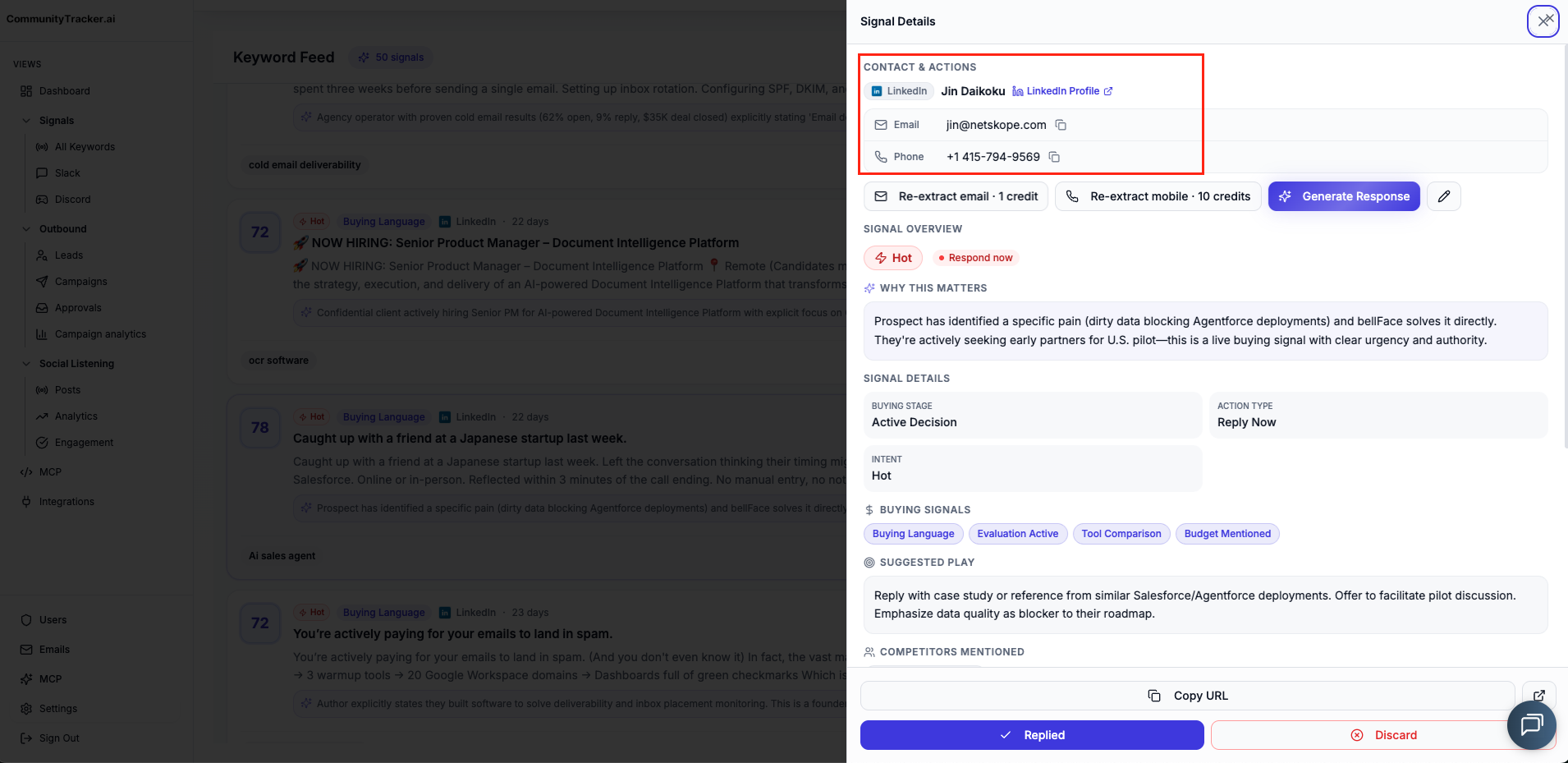
For example, someone might post: “Our CRM keeps losing lead details. What should we switch to?” That tells your team what the person needs help with and gives you a specific reason to respond.
Key features#
Find buyer conversations: Track posts where people ask for recommendations, describe problems, or compare alternatives.
Check who’s relevant: Review the person’s details alongside their post. Pro adds AI filtering and scoring to help prioritize conversations.
Prepare a response: Generate suggested replies based on the original conversation.
Reach out: Contact relevant prospects through email or LinkedIn.
Monitor other communities: Find conversations beyond LinkedIn, including Reddit, Hacker News, and GitHub.
Get daily alerts: Review new mentions each day, with Slack alerts available on Pro.
Pricing#
Starter costs $39/month and includes LinkedIn monitoring, four keywords, and 5,000 mentions across four supported sources. Pro costs $99/month and adds all supported communities, ten keywords, unlimited mentions, AI scoring, and daily Slack alerts. Advanced costs $199/month for twenty keywords and additional reporting.
Choose Starter for focused LinkedIn monitoring or Pro for broader coverage and scoring. The free plan covers Reddit only. Compare CommunityTracker’s plans.
Pros#
Shows what someone said, giving your team context for a relevant reply.
Finds conversations across several communities in one place.
Supports discovery, reply preparation, and outreach.
Limitations#
Starter is limited to four keywords and four sources.
Daily alerts suit a scheduled review routine; they should not be treated as instant notifications.
2. Signado#
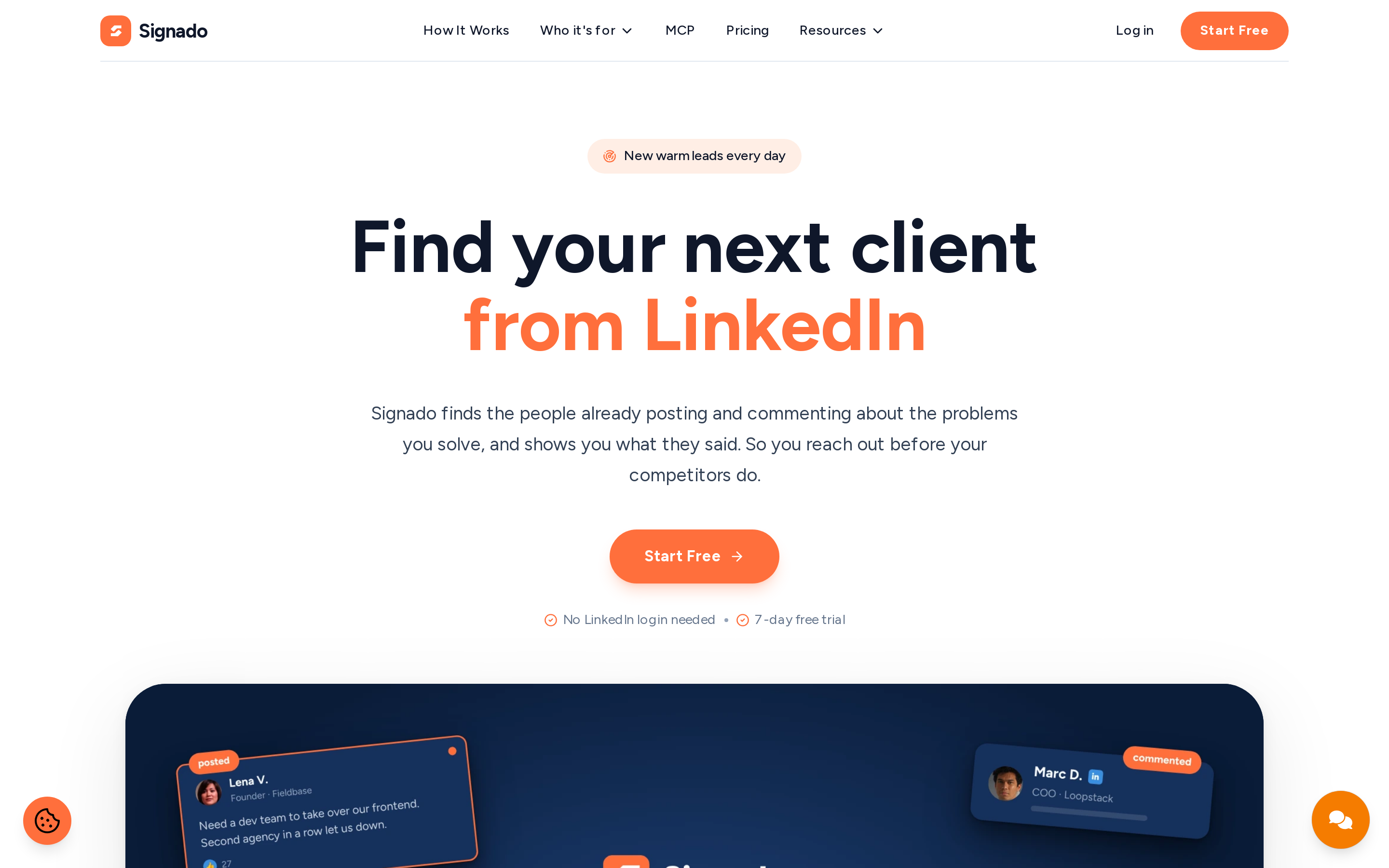
Signado lets you track a keyword, a LinkedIn post, or a creator’s or competitor’s profile. It finds people posting about those topics or interacting with that content, then checks how closely their role and company match the customers you want to reach.
You can read the post or comment that brought someone into your list, find their email address, and draft a message based on the conversation.
For example, if you sell CRM migration services, you could track “switching CRM” or a creator who regularly discusses sales software. Signado helps you find relevant people in those discussions and review what they said before contacting them.
For a closer comparison of keyword-based options, explore these keyword monitoring tools.
Key features#
Track topics: Find people posting or commenting about keywords related to your product.
Monitor selected profiles: Find people interacting with creators’ and competitors’ posts.
Start with a single post: Paste a public LinkedIn post URL to collect people who commented or reacted.
Check customer fit: Score people and companies against what you sell.
Prepare your follow-up: Find email addresses and generate suggested messages using the original conversation.
Pricing#
Lite costs $29/month for five active sources and 1,000 monthly credits. It suits a seller tracking a small set of topics or profiles. Starter costs $59/month for twelve active sources and 2,500 credits.
Growth and Scale offer higher limits at $99 and $349/month. Each paid plan includes a seven-day free trial.
Pros#
Lets you monitor a specific LinkedIn profile, company page, topic, or individual post for new activity.
Shows the original LinkedIn post or comment alongside the update, making it easier to reference the person’s exact point in your outreach.
Tracks public LinkedIn activity without requiring you to connect your personal LinkedIn account.
Cons#
Finding contact details and taking discovery actions uses credits, so high-volume prospecting can increase costs.
Monitoring capacity is limited by your plan, which may restrict the number of profiles, topics, or posts you can track simultaneously.
It is designed primarily for LinkedIn activity and does not provide the same coverage for discussions on platforms such as Reddit, X, or industry forums.
3. Embers#
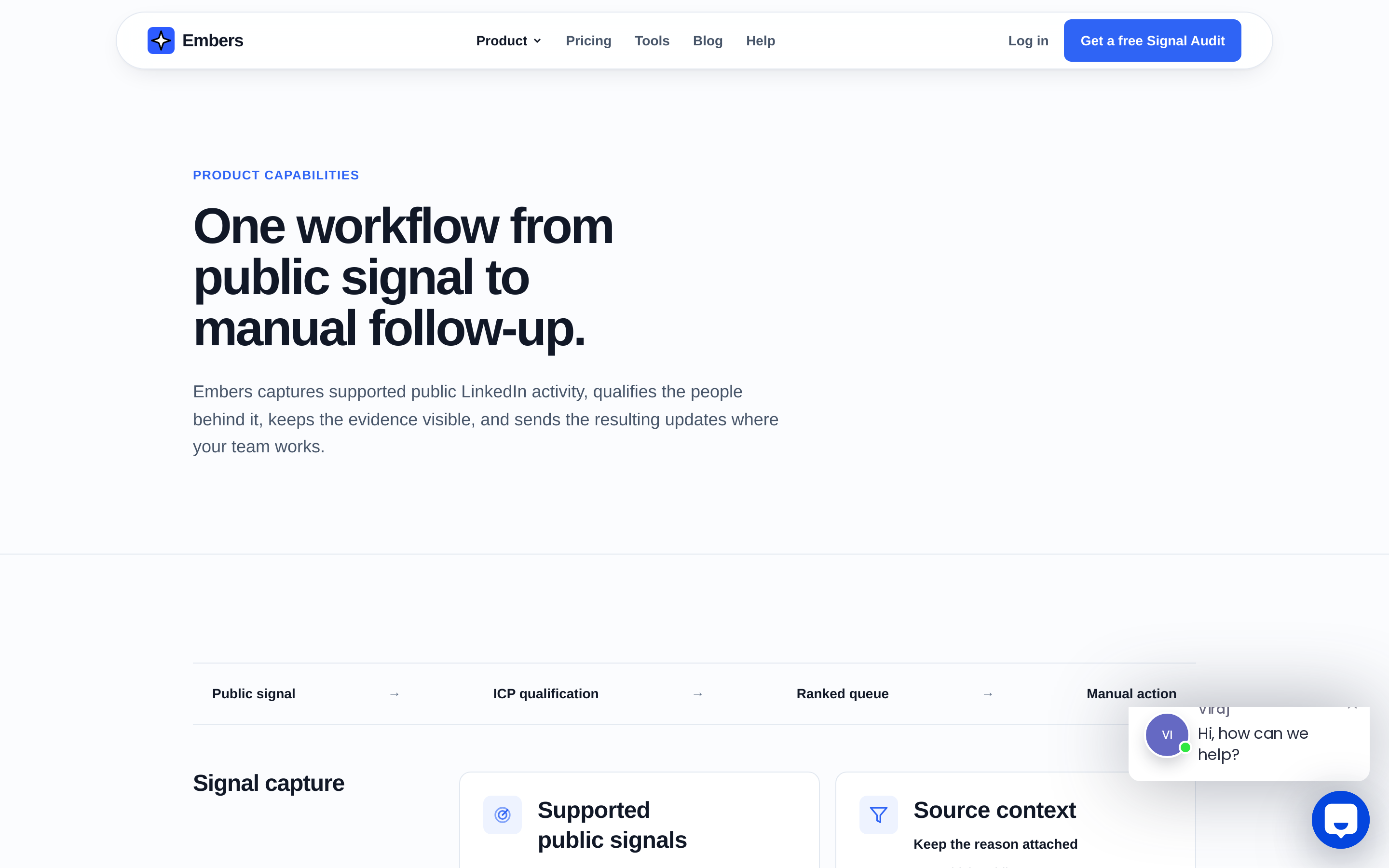
Embers monitors selected LinkedIn profiles and keywords, then identifies potential customers from posts, comments, and reactions. It checks how closely each person matches your ideal customer and keeps the original activity attached so you can see why they appeared in your list.
You can monitor your own profile as well as competitors, creators, and other public profiles.
Key features#
Monitor profiles and topics: Track public activity around selected profiles and keywords.
Review the original interaction: Open the post or comment behind each lead.
Separate fit from interest: See how well someone matches your target customer separately from how they interacted.
Filter out unwanted prospects: Apply exclusions to keep unsuitable people out of your list.
Send leads to other tools: Use HubSpot or webhooks to pass lead details and context into your sales workflow.
Pricing#
Solo costs $49/month, or $39/month billed annually, for one user, five watched profiles, and ten keywords. Growth costs $99/month, or $79/month billed annually, and adds unlimited team members, ten watched profiles, and 25 keywords.
Choose Solo for individual prospecting or Growth for a shared team workspace. Both offer a seven-day full-access trial requiring a payment method.
Pros#
Shows the interaction behind each lead, helping you distinguish a relevant comment from a casual like.
Separates customer fit from engagement, so frequent activity does not automatically make someone a suitable prospect.
Watches public profiles without requiring your LinkedIn password, session cookies, or a browser extension.
Growth includes unlimited team members, allowing several reps to review the same lead list without per-user fees.
Cons#
Monitoring runs daily, so new conversations may not appear immediately.
Solo is limited to five watched profiles and ten keywords; monitoring more sources requires an upgrade.
Messages remain manually reviewed and sent, so you need another tool if you want automated outreach.
Coverage depends on the profiles and keywords you configure; it does not capture every relevant LinkedIn discussion.
4. Trigify#
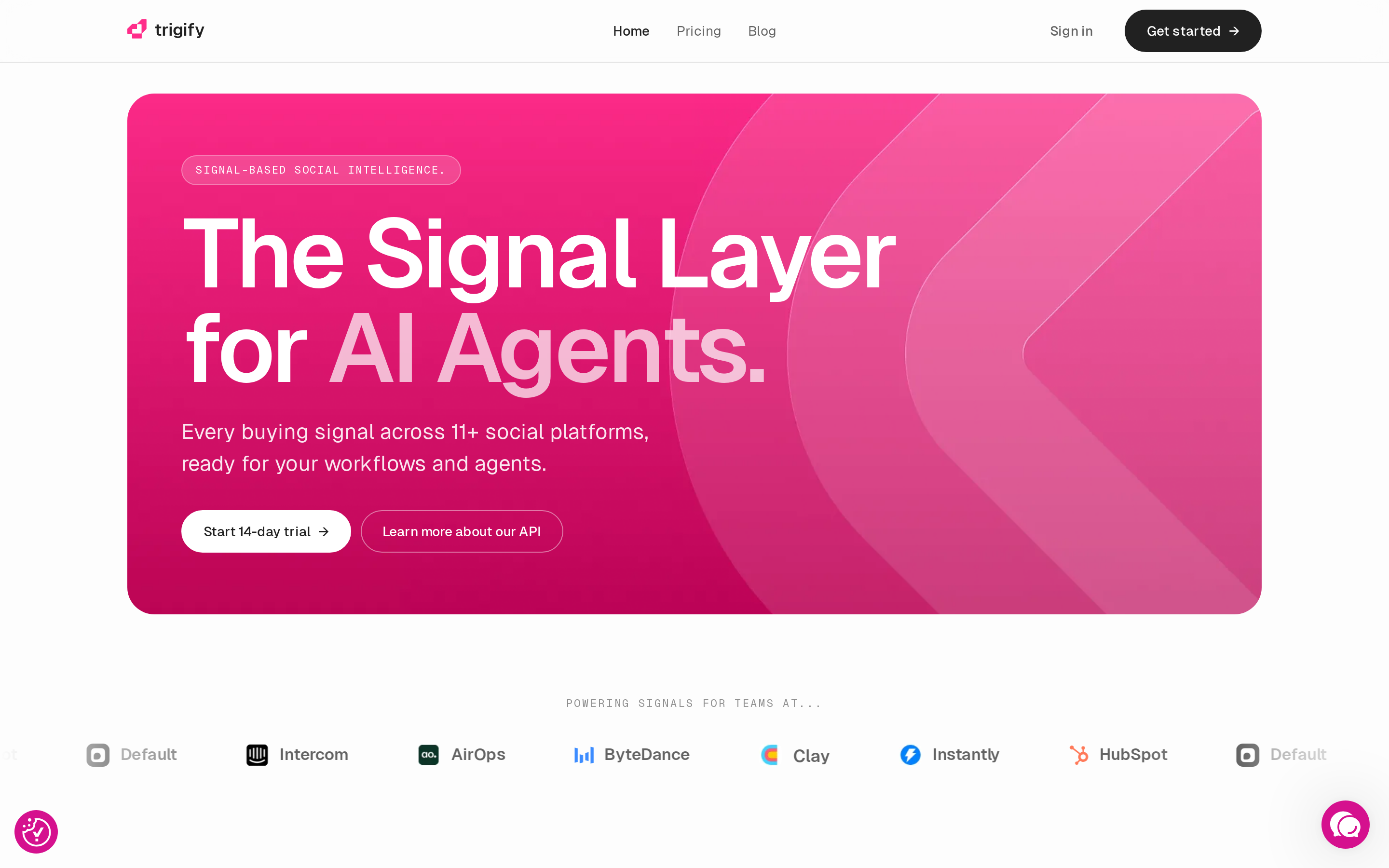
Trigify searches LinkedIn for relevant keywords and supports monitoring selected profiles or companies. It keeps the source post and date with each result, then lets you set rules for what happens next: check the person’s company, add contact details, or send the lead to your CRM.
You can set up a workflow that checks whether their company matches your target customers before sending their details and the post to a sales rep.
This makes Trigify useful when you already have a sales process and want LinkedIn signals to feed into it automatically.
Key features#
Find relevant discussions: Run keyword searches; check the plan requirements for profile and company monitoring.
Keep the original context: Retain the source post and timestamp alongside the prospect’s details.
Check prospects before passing them on: Use B2B data enrichment to add person and company information, then apply your qualification rules.
Automate the next step: Send matching prospects to your CRM or outreach tools.
Build custom connections: Use its API and AI-agent tools to work with your existing systems.
Pricing#
Starter costs $40/month for 4,000 monthly credits, 25 listening searches, and 25 workflows. Max costs $199/month for 40,000 credits, higher limits, and account-tracking features.
Choose Starter for keyword searches and smaller workflows. Consider Max if you need account monitoring or more capacity. Additional credits cost $0.012 each, and a 14-day trial is available.
Pros#
Can check company fit before a LinkedIn signal reaches a rep, reducing manual sorting.
Keeps the triggering post with the prospect, giving the rep a reason for the follow-up.
Connects discovery with your existing CRM and outreach process.
Lets you define different actions for different signals instead of treating every keyword match as a qualified lead.
Cons#
Searches, added prospect details, and workflow actions draw from the credit allowance, so the subscription price may not cover your full usage.
You need to configure searches, qualification rules, and destinations before the automation becomes useful.
Related Read: 6 Trigify alternatives for finding B2B buying signals.
5. Lynx Signal#
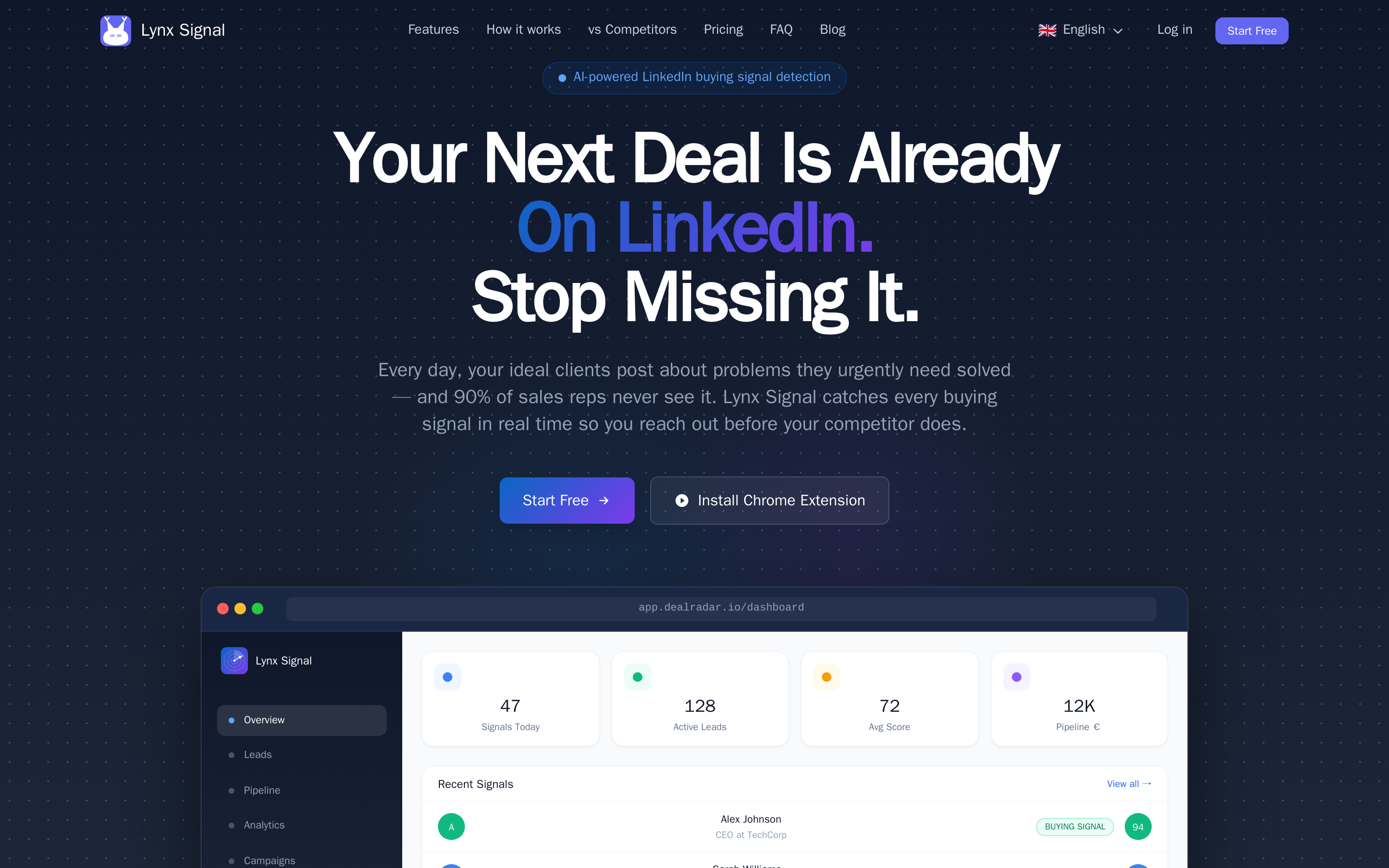
If you already spend time reading LinkedIn posts and comments, Lynx Signal adds buying-signal detection to that routine. Its Chrome extension scans the content you browse, flags potential opportunities, and lets you save people for follow-up.
It identifies buying requests, problem statements, and company events, then assigns an Opportunity Score. Coverage depends on what appears during your browsing session.
Key features#
Spot relevant conversations: Detect buying requests and problem statements in posts and comments as you browse LinkedIn.
Prioritize prospects: Use the 0–100 Opportunity Score to decide which signals to review first.
Track follow-ups: Save prospects and move them through stages in a built-in pipeline.
Prepare a message: Generate suggested outreach based on the conversation that triggered the signal.
Pricing#
The free plan includes 100 monthly credits and 50 saved leads. Starter costs €23.99/month, billed annually, for 5,000 credits, unlimited saved leads, and suggested messages. It suits regular individual prospecting.
Pros#
Lets you assess a signal while the conversation is in front of you.
Includes comment analysis, where people may share needs absent from the original post.
Keeps saved prospects and follow-up stages together.
Cons#
Only detects content you browse, so conversations outside your feed or browsing session may be missed.
Requires Chrome and its extension.
6. Linked Panda#
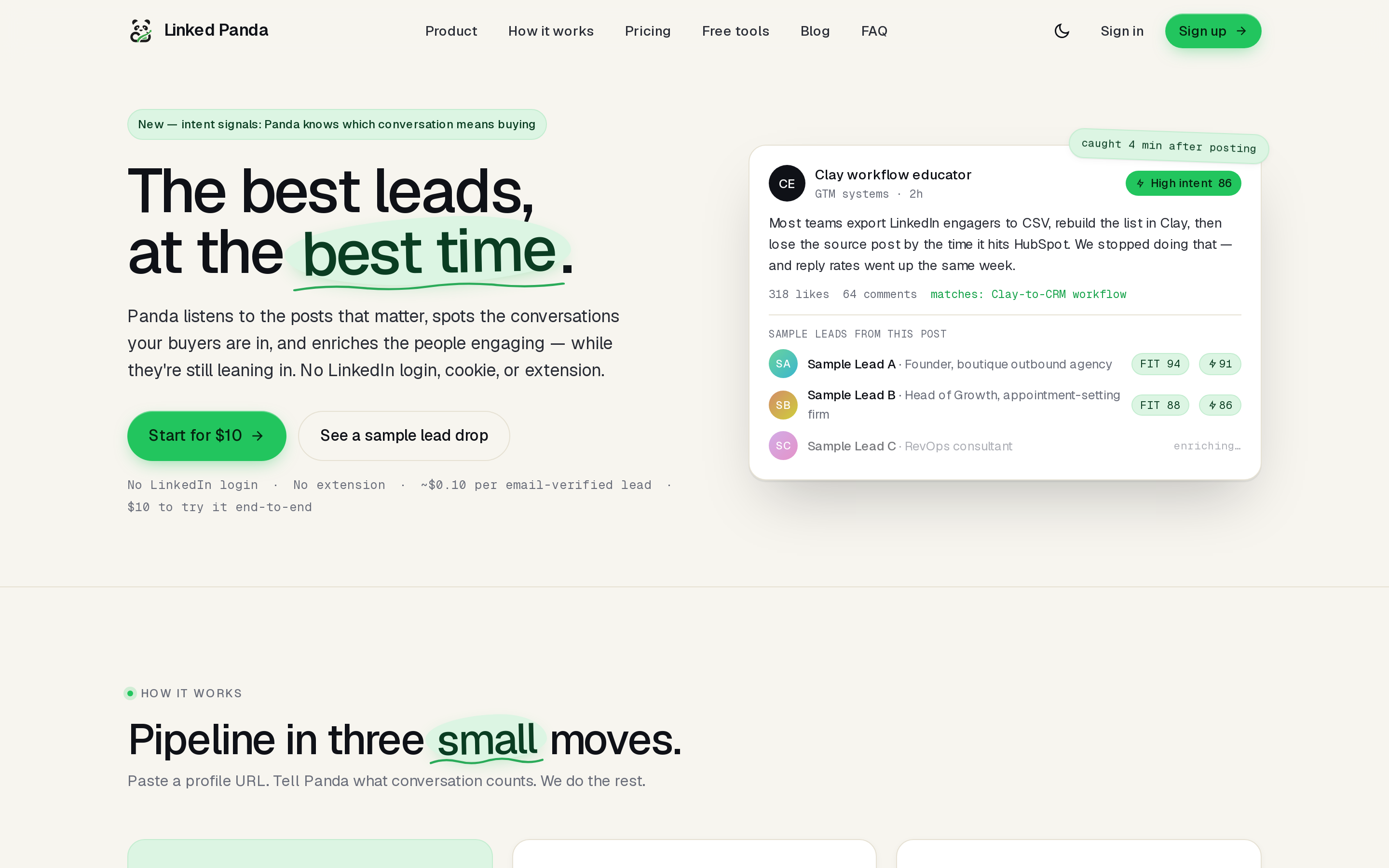
Linked Panda starts with the people and company pages you want to follow. You choose the topics that matter to your business, and it checks new posts for relevance before gathering the people who liked or commented on them.
This is useful when an industry creator attracts your target audience but also posts about unrelated topics. You can focus on conversations about the problems your product solves, then see which participants match your customer profile.
Key features#
Watch selected profiles and pages: Follow public activity from creators, competitors, and companies relevant to your market.
Filter posts by topic: Describe the conversations you want to find so unrelated posts can be excluded.
Find people in those discussions: Collect the people who commented or reacted to matching posts.
Check customer fit: Use scoring to identify participants who match the customers you serve.
Prepare leads for follow-up: Add work emails when available and send leads to HubSpot or Salesforce on supported plans.
Pricing#
The $10 pay-as-you-go pack lets you collect 100 lead profiles while monitoring two selected LinkedIn profiles. Starter costs $49/month for 500 collected lead profiles per month and monitoring of two selected profiles.
Growth costs $99/month for 1,000 collected lead profiles per month and monitoring of five selected profiles, with customer-fit scoring and HubSpot/Salesforce integrations explicitly included.
Pros#
Checks whether a post is relevant before collecting its audience, so you can avoid unrelated conversations.
Helps you focus on creators and companies that attract the right audience for your business.
Monitors public activity without requiring your LinkedIn login, session cookies, or a browser extension.
Includes work emails when available, reducing the need for a separate LinkedIn email-finder tool.
Cons#
Only discovers activity from the profiles you choose, so you may miss relevant conversations elsewhere.
People who read a post without liking or commenting will not appear.
A relevant topic does not always signal buying intent, so you still need to review each person’s activity.
7. Clearcue#
One comment may tell you little. Repeated interactions with relevant content can give your team more to investigate. Clearcue combines signals about people and companies so you can review that activity together.
For LinkedIn, it tracks selected profiles, posts, and engagement, including interactions with competitors. It can also add hiring and company news. Those events provide context, but they should remain distinct from what someone actually said on LinkedIn.
Key features#
Monitor LinkedIn activity: Track selected profiles, posts, and interactions with relevant content or competitors.
Combine signals: Review several events about the same person or company together.
Check company fit: Use company qualification on Pro to assess whether a business matches your target customers.
Track target accounts: Use Custom for account tracking, CRM sync, and API access.
Pricing#
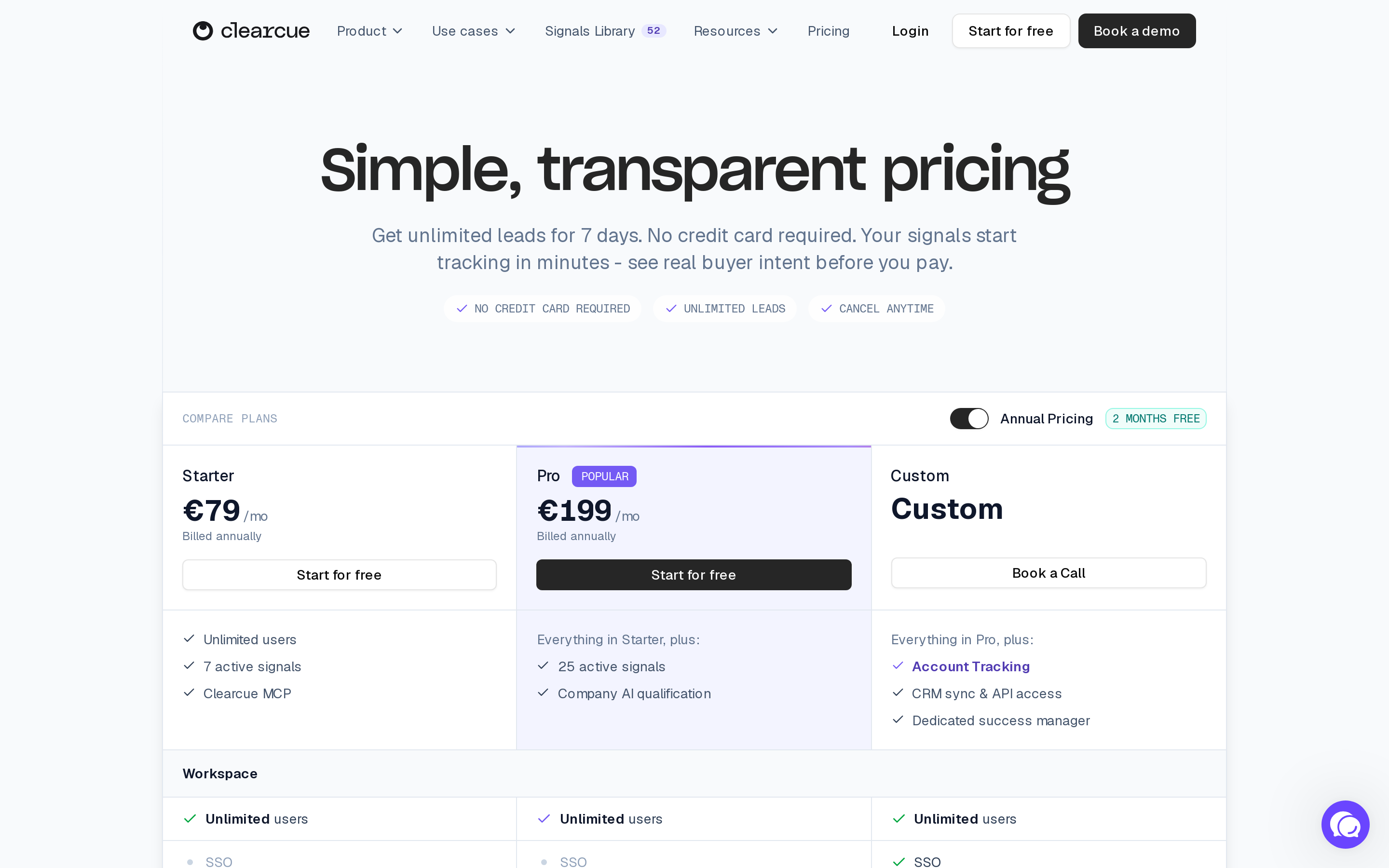
Starter costs €99/month, or €79/month billed annually, for seven active signals and unlimited users. Pro costs €199/month billed annually and includes 25 active signals plus company qualification.
Start with Starter for focused monitoring. Starter does not include dedicated account tracking or CRM sync; those require Custom. A seven-day trial includes unlimited leads without a card.
Pros#
Helps teams review several interactions together instead of treating each as a separate lead.
Includes unlimited users on Starter.
Combines personal activity with company context when researching an account.
Cons#
Starter cannot provide dedicated account tracking or CRM sync.
Open-ended keyword tracking is currently marked “coming soon.”
Combined scores still need interpretation: hiring news and a product complaint indicate different things.
8. Getcleed#
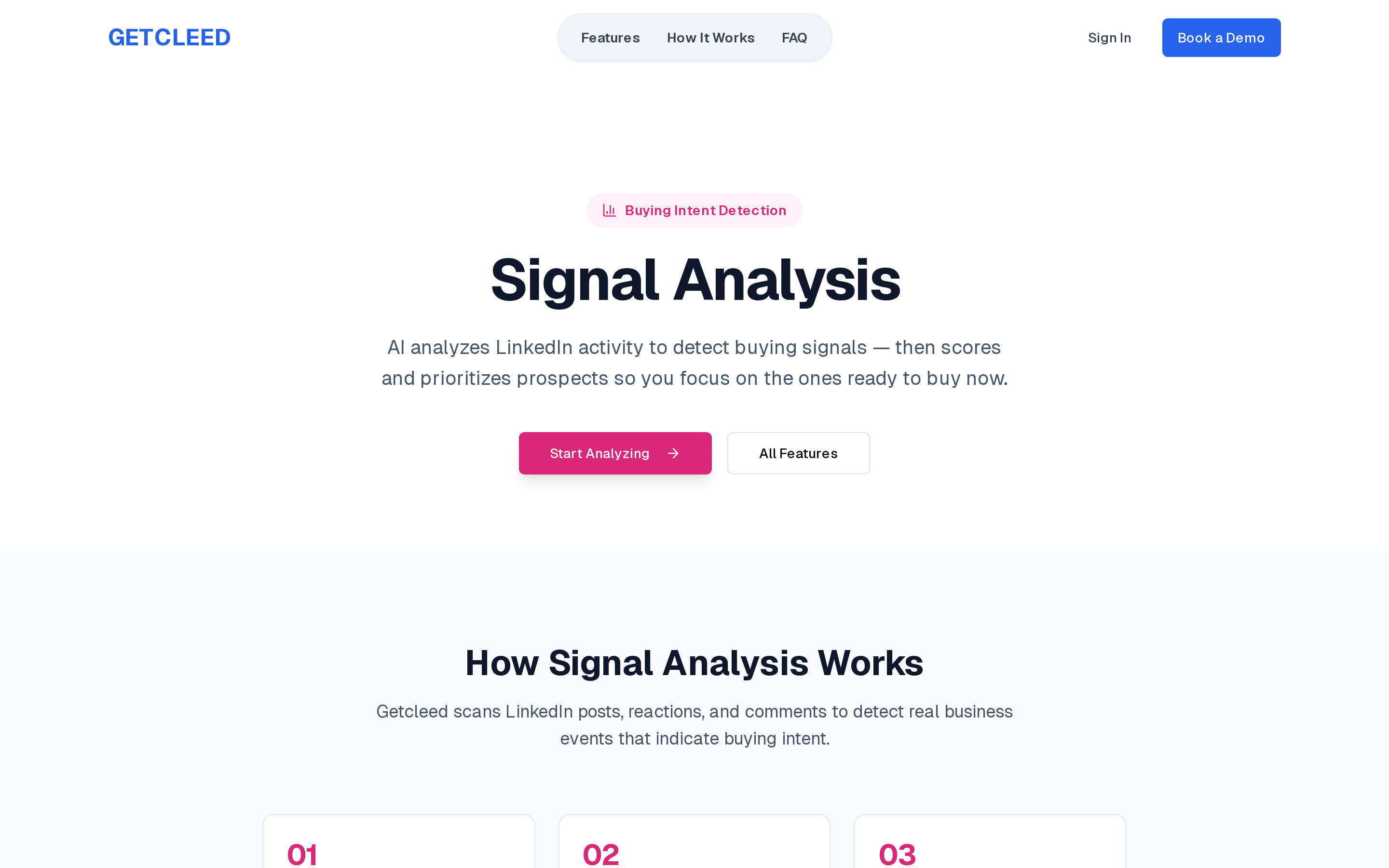
Getcleed asks you to define your target roles, industries, and company sizes before finding prospects. It examines LinkedIn posts, comments, and reactions alongside events such as hiring and funding.
Each prospect comes with a breakdown of the signals and an explanation of their relevance. You can then find contact details and prepare a message that references the activity.
Key features#
Find relevant activity: Detect pain points and competitor engagement alongside company changes such as hiring or funding.
Check customer fit: Score prospects against your target roles, industries, and company sizes.
Understand the recommendation: Review the signals and reasoning behind each prospect’s ranking.
Prepare outreach: Generate emails and LinkedIn message drafts based on the detected activity.
Send leads to your CRM: Pass contact details and signal context to connected sales tools.
Pricing#
Pro costs $129/month, or $99/month billed annually, with analysis of up to 1,000 leads and CRM/API integrations. Max offers unlimited analyzed leads at a custom price.
Pro suits teams that need to analyze up to 1,000 leads and send the results to their CRM. A seven-day trial is available.
Pros#
Explains the reason behind a prospect’s ranking.
Checks company fit alongside recent activity.
Uses the detected context when preparing outreach drafts.
Cons#
Combines LinkedIn activity with external events, so you must check what actually triggered the recommendation.
The published workflow describes weekly rescoring; rankings may not immediately reflect new developments.
Public documentation does not fully explain which LinkedIn conversations it can access.
9. Gojiberry AI#
Gojiberry AI combines prospect discovery with email and LinkedIn outreach. It finds people through relevant activity, checks how closely they match your target customers, and prepares messages for follow-up.
You can review messages before they are sent or allow campaigns to run automatically. Its lookalike searches also find similar prospects, but those people have not necessarily shown a buying signal.
Key features#
Discover prospects: Find people through relevant activity or lookalike searches based on your target customers.
Check customer fit: Score prospects against the type of person and company you want to reach.
Find contact details: Add email addresses through built-in enrichment.
Run outreach: Send email and LinkedIn campaigns with follow-ups.
Control sending: Review messages before they go out or enable automatic sending, then manage replies in a shared inbox.
Pricing#
Pro costs $99/month and includes two AI agents and up to 1,800 prospects contacted per month. Custom plans support larger teams and additional senders. Pro suits a small team combining discovery and outreach.
Pros#
Reduces manual transfers between prospect discovery and outreach tools.
Offers a review-before-sending option.
Brings replies from outreach into a unified inbox.
Cons#
LinkedIn sending requires a connected account.
Lookalike prospects are not necessarily showing buying signals; distinguish them from activity-based leads.
A like or competitor interaction may not justify outreach, so review the triggering activity before approving a message.
Related read: Gojiberry alternatives for comparing other prospecting and outreach options.
10. Valley AI#
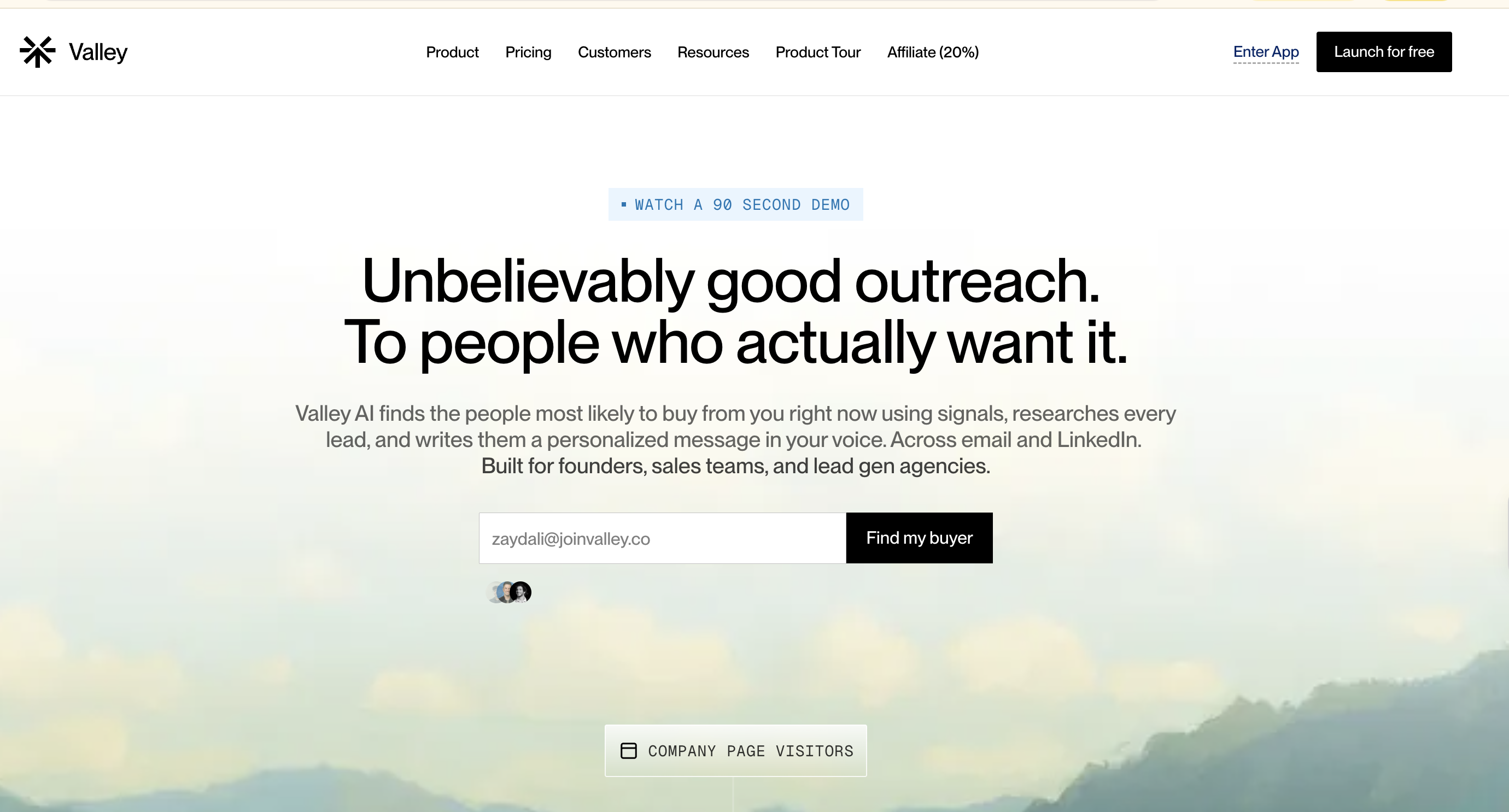
Valley uses available LinkedIn profile views, company-page follows, and post engagement to find people worth researching. It checks customer fit, gathers information about the prospect, and prepares LinkedIn or email outreach.
A profile view alone says little about someone’s needs. Valley adds research before you contact them, but viewer information remains limited to what the connected LinkedIn account can access.
Key features#
Capture LinkedIn signals: Find available profile viewers, company-page followers, and people interacting with posts.
Qualify prospects: Check whether each person matches your target customer profile.
Research before contacting: Gather person and company information to help shape the message.
Follow up across channels: Run LinkedIn and email outreach from the same platform.
Pricing#
Everything costs $199/month, or $149/month billed quarterly. It includes signal capture, qualification, research, and both outreach channels.
Everything includes both outreach channels, so you do not need the Deep plan for the features covered here. A seven-day unrestricted trial is available.
Pros#
Adds research before turning an interaction into a message.
Includes LinkedIn and email outreach in the base plan.
Keeps qualification, research, and follow-up together.
Cons#
Profile-view discovery depends on the viewer information available to the connected account.
Views and follows do not reveal a specific purchasing need.
Teams with an established outreach system may find parts of the workflow redundant.
Related Read: 9 Valley alternatives for personalized sales outreach.
Before You Choose a LinkedIn Buying-Signal Tool#
Test your shortlist against the same prospecting goal and target customer profile. Review ten results from each tool:
Relevance: How many describe a problem you solve or an active search for a solution?
Customer fit: Do the people and companies match your target customers?
Context: Can your rep read the original post, check its date, and understand why a response would be useful?
If ongoing conversation monitoring is your main requirement, compare the options in our LinkedIn social listening tools guide.
Find people discussing problems your product solves, see what they need, and follow up through email or LinkedIn. Get started with CommunityTracker.