Freckle.io Review: Is It a Real Clay Alternative in 2027?
Freckle.io review for 2027: is it a real Clay alternative? Free is 250 credits, Build is $99 for 1,000, and Clay still wins on providers and sending.
Adarsh Kumar
GTM Expert
Founder — CommunityTracker, Miraa.io, and Infraboxes
You’re paying Clay prices to fill empty fields in your CRM, and someone just asked whether a cheaper tool does the same job. Moving means rebuilding tables, so the saving has to be real.
Size the test wrong and you buy a tier you don’t need before you see one clean record. Size it right and you know in an afternoon.
Freckle’s Free plan gives you 250 credits, and Clay’s gives you 100 data credits a month. Freckle Build is $99 for 1,000 credits, and Clay Launch starts at $185 a month.
This Freckle.io review asks whether it’s a real Clay alternative. I’d say yes for CRM enrichment you repeat, and no if you need Clay’s 150+ data providers or its built-in email sequencer. The verdict comes next, then the prices and user reviews behind it.
Freckle vs Clay: The Short Verdict
Yes for one job, not for all of Clay. Freckle is a real alternative for CRM enrichment and agent-built workflows.
Where Freckle holds up. You ask for fields in plain English on records you already have, with unlimited users on every plan.
Where Clay still wins. Clay lists 150+ data providers against Freckle’s 40+, plus a built-in email sequencer and Claygent web research, and Freckle hands sending to another tool. Two users who tested both still send heavy pipelines or AI enrichment to Clay.
The CLI gap is narrower than Freckle claims. Freckle describes Clay’s CLI as “bolt-on.” On Nov 23, 2026, Clay advertises a CLI and API and a plugin for coding agents.
Price. Freckle Build is $99 a month for 1,000 credits. Clay Launch starts at $185 a month for 2,500 data credits and 15,000 actions. The units differ, so price your own job before you compare.
I’d test Freckle first if your gap is CRM enrichment, and keep Clay if the test falls short. For the wider field, I compared eleven tools in Clay alternatives.
TL;DR: Freckle at a Glance
Need | Freckle fit | Why | Better option if not |
|---|---|---|---|
Agent-built enrichment workflows | Strong | CLI built for Claude Code and Codex, with every workflow saved for reuse | Clay if your team already runs Clay tables |
Agency client delivery | Good | The Deal Lab reuses one workflow across clients | Clay if every client build is different |
CRM enrichment | Good | Built around CRM records, CSVs, webhooks and synced tables | Clay, which lists 150+ providers |
Plain-English research | Good | You ask for the field instead of building provider logic | Clay, which lists Claygent web research |
Outbound execution | Limited | Freckle prepares records and hands them to a sending tool | A sequencer you already run, or Clay’s built-in one |
Buying signals in communities | Not covered | Its signals cover hires, job postings and job changes | CommunityTracker |
One-time CRM cleanup | Good | Credit pricing and unlimited users fit project work | A single data vendor if the scope is narrow |
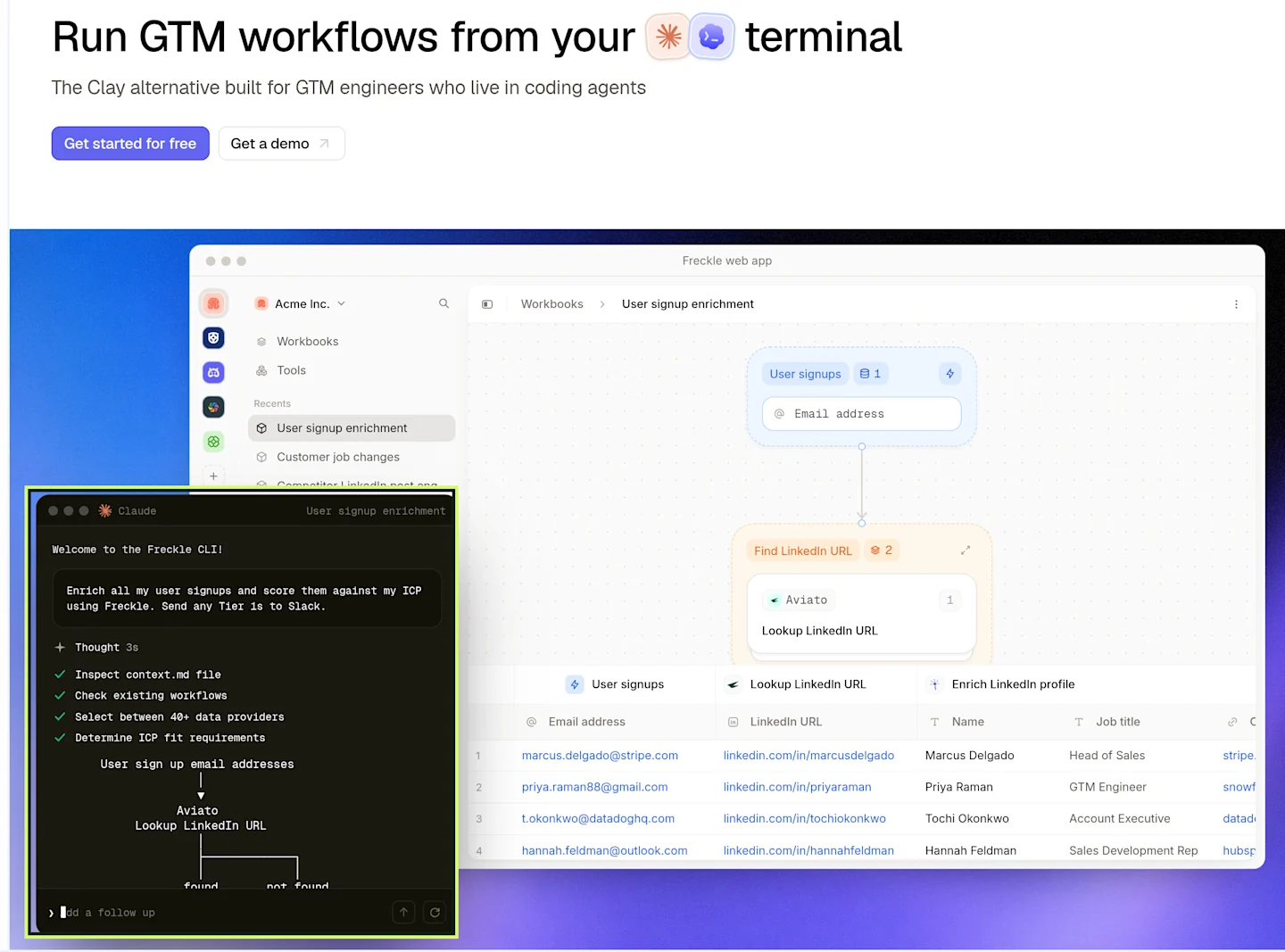
Freckle’s homepage on Nov 23, 2026: a Freckle CLI session in Claude sits in front of the Freckle web app, and both are open on a workflow named User signup enrichment.
Freckle.io Key Facts
Item | Detail |
|---|---|
What it does | Enriches and researches CRM records, CSVs and sign-ups through waterfall lookups and AI agents |
Data providers | 40+ |
How you use it | The CLI from a coding agent, or the web app with workflows and tables |
Free plan | $0, 250 free credits, no card needed |
Paid plans | Build from $99 a month, Scale from $699 a month, Enterprise by quote |
Seats | Unlimited users and tables on every plan |
Annual billing | 15% off |
Refunds | Fees are non-refundable, and unused credits are not refunded |
Security | SOC 2 Type II, announced Mar 5, 2026 |
Funding | $4M led by Gradient and 1984 Ventures, Sep 8, 2025 |
How I Put This Review Together
This is desk research, done on Nov 10, 2026. I read the live Freckle homepage, pricing page and provider breakdown, and I read the pricing slider’s code, because the credit count for each tier sits there. I compared the live pricing with a Wayback Machine capture of the same page from Jun 10, 2026. I read the terms of service and four blog posts. On Nov 23, 2026 I rechecked the pricing page and the slider code, and the tiers, prices and the 250-credit Free plan matched Nov 10.
I did not sign up, open the app, install the CLI or run a single enrichment. So I make no claim about match rates, speed or data quality.
I’ve spent about 5 years in GTM at startups I helped scale from 0 to $5M+ ARR. That’s my lens here: what a founder, agency or RevOps lead pays in credits and hours before the data is good enough to send.
What Changed at Freckle Between 2025 and 2026
The product in older reviews is not the product on the homepage today. The order of events, from Freckle’s own pages:
Sep 8, 2025. Freckle raised $4M and said 2,500+ companies used it to keep CRM data clean. The pitch was natural-language search in a simple table, built for in-house teams.
Jan 22, 2026. The current terms took effect.
Mar 5, 2026. Freckle announced SOC 2 Type II.
May 28, 2026. CEO Nathan Merzvinskis announced the CLI beta, said Freckle had passed 7,000 users, and wrote that the company now builds 100% of its own GTM workflows with it.
Jun 10, 2026. The archived pricing page still sold Build at $99 for 5,000 credits and listed 50+ data providers.
Sep 25, 2026. Freckle published a case study on The Deal Lab, a GTM engineering agency, and named it one of its first Preferred Partners.
Oct 30, 2026. The provider breakdown page, with credit costs per output, was last updated.
Two things in that list matter for you. Freckle now runs an agency partner program, and The Deal Lab is one of its first Preferred Partners. And the CEO wrote that Freckle put almost all its resources into the CLI. If you buy Freckle today, you’re buying the CLI’s roadmap.
Why Freckle Rebuilt Around a CLI
The CEO’s May post gives the reason. Over the prior six months, customers asked to build enrichment workflows straight from coding agents such as Claude Code and Codex, and didn’t want to leave the terminal for a product UI.
So Freckle rebuilt its core pieces to be agent-native: waterfall enrichments, research agents, a workflow engine, signals and integrations with the GTM stack. You state the job in plain English to Claude Code, and the agent works out the enrichment and orchestration. If your repo lacks the context, the agent may first ask how you define your ICP and score fit.
The goal, in the CEO’s words, is one GTM data layer that “humans and agents can use.” Existing customers can get help moving their tables and workflows to the CLI.
For a buyer, this changes who does the work. In 2025 a marketer typed a request into a table. In 2026 a GTM engineer directs an agent, and the marketer reads the result.
What Freckle Does Well
Freckle wins when the work is specific, repetitive and stuck inside the CRM. The 2026 product adds one more condition: the work repeats across segments or clients.
Workflows you build once. Freckle’s homepage sets its pitch against Clay on this point. It describes Clay as built to run from a SaaS UI “with a bolt-on CLI” and as a place where you rebuild tables and workflows from scratch. It describes Freckle as built natively for coding agents, with “every workflow saved and able to be re-used.” That’s Freckle’s comparison of itself with a rival, so test it. Clay now advertises a CLI and API and a plugin for coding agents, so the CLI isn’t something only Freckle offers.
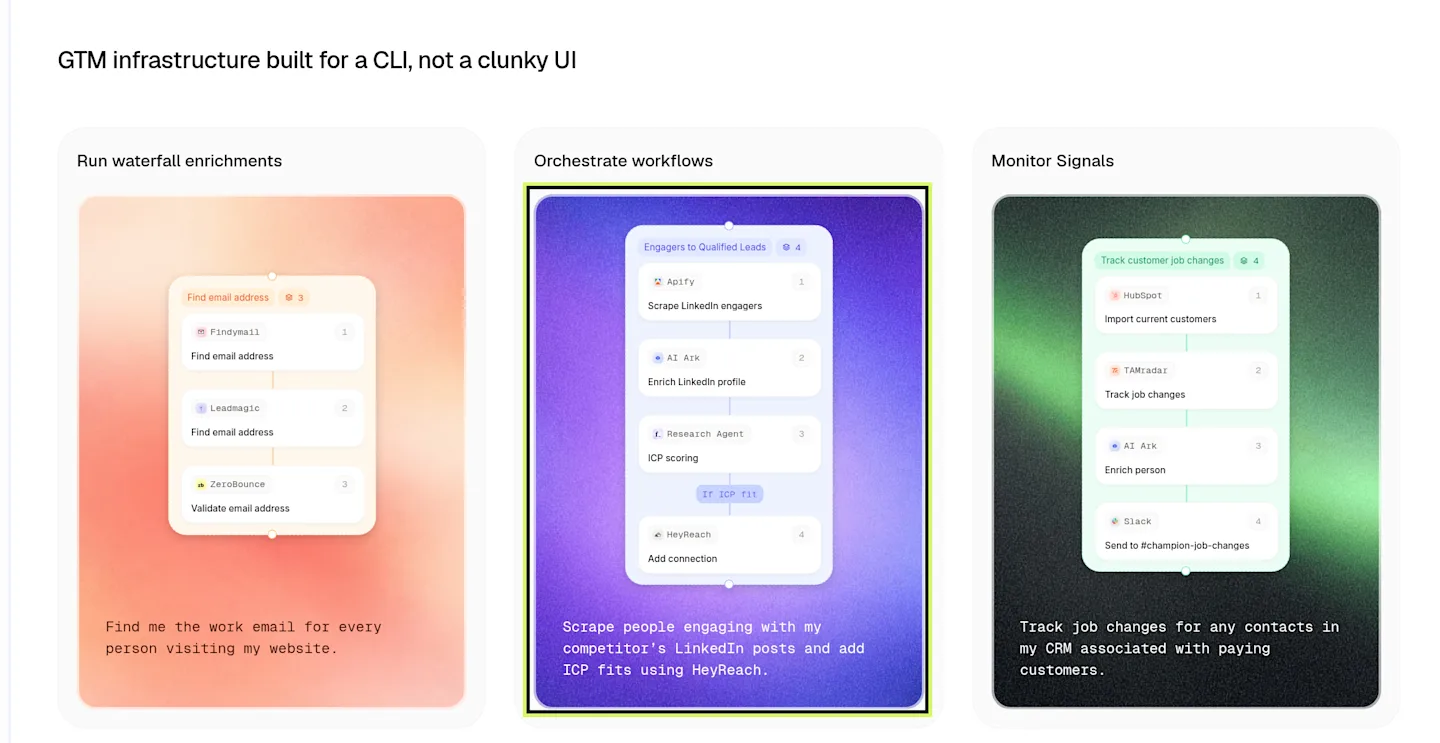
Freckle’s homepage on Nov 23, 2026: three cards for running waterfall enrichments, orchestrating workflows and monitoring signals. The middle card’s example prompt adds ICP fits using HeyReach.
The agency case. The Deal Lab, founded by Kellen Casebeer, builds GTM systems for B2B clients. Before Freckle, each new client meant rebuilding the same enrichment and workflows by hand in Clay, and the agency’s client count was capped by how much it could build manually. With Freckle, the team builds a workflow once, saves it and runs it again across clients. Kellen tested the CLI beta on real client work before launch.
Read that case study with its context. Freckle wrote it, The Deal Lab is a Preferred Partner, and the same post invites agencies into an affiliate program with a revenue share on the clients they bring. It shows the use case Freckle wants. It doesn’t show results you can check.
Jobs Freckle named in 2025. The funding post listed matching a personal-email sign-up to a company and scoring it, enriching inbound leads and pushing them into HubSpot, and checking phone numbers and social profiles before a campaign. The first of those now sits on Freckle’s homepage as a workbook named User signup enrichment.
A first project that fits. Pick a job that is small enough to test, messy enough to need enrichment, bound for your CRM and close enough to outreach that bad data would waste sends.
Four Workflows on Freckle’s Homepage
Each of these is a product mockup on Freckle’s homepage, so treat it as a vendor demo, not a test.
One workflow in two places. A Claude session and the Freckle web app are both open on a workbook named User signup enrichment, with Customer job changes and Competitor LinkedIn post engagers listed beside it.
A waterfall for work email. The prompt “Find me the work email for every person visiting my website.” runs Findymail, then LeadMagic, then ZeroBounce to validate the address.
A LinkedIn engager workflow. “Engagers to Qualified Leads” scrapes LinkedIn engagers through Apify, enriches each profile through AI Ark, scores ICP fit with a research agent and adds a connection through HeyReach for each ICP fit.
A job change monitor. It imports current customers from HubSpot, tracks job changes through TAMradar, enriches the person through AI Ark and posts the alert to Slack.
Two points matter for a buyer. The CLI and the web app sit on the same workflow, so a teammate who never opens a terminal can read the table. And the engager workflow is a LinkedIn signal play that hands leads to HeyReach, so Freckle stops where sending starts.
None of the four mockups tells you how long a run takes or how many credits a workflow uses.
Where Freckle Falls Short
The CLI is young. It went to beta in May, and the CEO calls it the default way of using Freckle from here on. If nobody on your team works in a coding agent, you’re buying the half of the product that gets less attention.
Clay still wins on provider count, a built-in sequencer and Growth automations. Provider count and the sequencer are in the short verdict above, and the Growth automations are in the Clay pricing table below. Freckle’s table app gives up some of that breadth to stay simple.
Start with the waterfall risk: if the first source returns bad data, everything downstream inherits it. Provider order should vary by field, CRM overwrite rules matter, and you need to see which source filled each value. Run a sample, check which provider filled each field, and compare it with accounts you know before you scale.
Freckle doesn’t send anything. It enriches and researches records, then hands them to a sending tool such as HeyReach.
Then there’s the paperwork:
Plans renew on their own, monthly or yearly, for the same length as your first term.
Fees are paid in advance and are non-refundable, except in narrow cases the terms name.
Unused credits are never refunded, and a downgrade can cost you unused credits.
Either side can end the terms with 5 days’ written notice.
And the FAQs are unfinished. On Nov 10, 2026, every answer under pricing questions such as “Do my unused credits roll over?” and “Can I top up credits if I need more?” read “Lorem ipsum,” and so did every homepage FAQ answer. The comparison table shows rollover and top-ups on paid plans with no amounts. The June page did publish them: rollover up to 2x the monthly limit, top-ups at 1.25x the plan’s per-credit rate. Whether those rules still apply, Freckle doesn’t say.
Freckle.io Pricing: What 1,000 Credits Buy
Freckle charges by credits, not seats, and every plan has unlimited users and tables. That’s the right model for this category, but only if you know what burns credits.
Each plan card shows a starting price only. The tier you land on depends on a slider that asks how many credits you need a month, and the numbers below come from that slider’s code.
Credits a month | Plan | Monthly price | Annual price a month (15% off) |
|---|---|---|---|
250 | Free | $0 | $0 |
1,000 | Build | $99 | $84 |
5,000 | Build | $259 | $220 |
10,000 | Build | $429 | $365 |
20,000 | Scale | $699 | $594 |
40,000 | Scale | $1,119 | $951 |
100,000 | Scale | $2,149 | $1,827 |
250,000 | Scale | $4,429 | $3,765 |
500,000 | Scale | $8,709 | $7,403 |
Over 500,000 | Enterprise | Quote | Quote |
Prices from the slider array; annual figures use Freckle’s own 15% rule, rounded to the dollar.
Clay’s pricing, for comparison
I read Clay’s public pricing on Nov 23, 2026. Clay sells four plans, and the monthly price on each card drops 10% when you pick annual billing.
Plan | Price a month | Data credits a month | Actions a month | What it adds |
|---|---|---|---|---|
Free | $0 | 100 | 500 | Unlimited seats and tables, up to 200 rows per table, no phone enrichment |
Launch | From $185 ($167 billed yearly) | 2,500 | 15,000 | Phone enrichment, signals, email campaign integrations, up to 50,000 rows per table |
Growth | From $495 ($446 billed yearly) | 6,000 | 40,000 | CRM auto-sync, HTTP API integrations, webhook automation, web intent signals |
Enterprise | Custom | 100,000+ | 200,000+ | SSO, role-based access, a dedicated growth strategist |
Clay runs two meters. Data credits buy the data and start at $0.05 each, and actions pay for the platform work and cost under $0.01 each. A lookup that returns nothing costs neither. Actions reset each cycle, and data credits roll over, up to 2x the monthly amount on Launch and Growth. Freckle runs one credit meter and no action credits. That’s why 1,000 Freckle credits and 2,500 Clay data credits aren’t the same thing, and why the only fair comparison is your own job run on both.
What changed since June 2026
An archived Wayback Machine capture of Freckle’s pricing page from June 10, 2026 shows these tiers:
Credits a month | Jun 10, 2026 | Nov 10, 2026 |
|---|---|---|
5,000 | $99 (Build) | $259 (Build) |
10,000 | $189 (Build) | $429 (Build) |
20,000 | $599 (Scale) | $699 (Scale) |
40,000 | $999 (Scale) | $1,119 (Scale) |
The Free plan went from 100 starter credits to 250.
The credit unit changed between those two dates, so these numbers are not a like-for-like price rise. In June, most outputs cost 1 credit and a phone number cost 5. Today each output has its own rate by provider, and most email and LinkedIn lookups cost less than 1 credit. I work through what that does to a real project below.
What each plan adds
Free: AI and agent columns, web search, scraping, waterfall enrichments and email finding, capped at 500 rows.
Build: unlimited rows, phone numbers, signal monitoring, BYO API keys, rollover credits and top-ups.
Scale: ad audiences that update on their own, competitor visitor feeds, Supabase and ad platform links, and 2-minute CRM syncs.
Enterprise: data warehouse sync, RBAC and SSO.
One conflict to check before you buy Build. The Build card lists “HTTP API” and says it’s for teams “integrating with their CRM,” but the comparison table on the same page marks HTTP API and CRM integrations as Scale and Enterprise only. In Sep 2025, Freckle said CRM integration was always free, and its June 2026 Free plan card still listed CRM integrations. The Nov 2026 plan table no longer shows that. I can’t settle this from outside. Ask Freckle in writing which plan you need for HubSpot or Salesforce sync.
Credits per output
Freckle’s provider breakdown lists the credits each output costs, based on a 20,000-credit plan, last updated Oct 30, 2026. A few rows that matter for CRM cleanup:
Output | Provider | Credits per output |
|---|---|---|
Find mobile phone | Freckle | 2.06 |
Find mobile phone | FullEnrich | 14.83 |
Find work email | LeadMagic | 0.28 |
Find work email | Findymail | 0.45 |
Validate email | ZeroBounce | 0.09 |
Find LinkedIn URL | Freckle | 0.41 |
Enrich company | Apollo | 1.04 |
Research agent | Default model | 0.19 |
Find personal email | Freckle | 6.50 |
Monitor contact job changes | Freckle signals | 3.53 |
Freckle prices its own phone lookup at $0.095 against $0.705 in Clay, its own comparison. Read it as a vendor claim.
A worked example
Say you want a work email, a validation check and a LinkedIn URL for 1,000 CRM contacts. With Findymail, ZeroBounce and Freckle’s LinkedIn finder, that’s 0.45 + 0.09 + 0.41 = 0.95 credits a record, or about 950 credits if every lookup returns. That fits the $99 Build tier.
Add a mobile number through Freckle’s own phone finder and you add 2.06 credits a record, about 3,010 credits in total, which moves you to the $259 tier. Pick FullEnrich for phones instead and the phones alone come to about 14,830 credits, which lands you on Scale.
Run the same job on the June rules, counting each lookup as one credit and each phone as five. The three lookups come to about 3,000 credits, which fit June’s $99 tier of 5,000. Adding phones makes about 8,000, which needed June’s $189 tier. So the email-only job costs $99 on both dates, and the job with phones moved from $189 to $259.
So a “1,000-record project” isn’t one number. The provider you pick for phones decides your plan.
Test 100 Records Before You Pay
Test Freckle and Clay on the same 100 records and compare time, match quality, cost and CRM handoff. If someone on your team already builds in Clay or a coding agent, that person is Freckle’s 2026 buyer, so have them run it. Here’s how I’d set it up on the Free plan:
Pick 100 records you know. Use accounts where you already have the right domain, headcount and one verified email. They’re your answer key.
Mix the inputs. Put in 30 records with a personal email only, 30 with a company name and no domain, and 40 full records. Freckle is built to work from partial records, and this checks that.
Ask for four fields. Work email, LinkedIn URL, headcount and one research field in plain English, such as “does this company have a self-serve plan?”
Price it first. At the listed rates, a work email through Findymail (0.45), a LinkedIn URL (0.41), headcount (1.04) and one research agent answer (0.19) come to 2.09 credits a record. For 100 records that’s about 209 credits, inside the 250 free. The headcount figure is my own assumption. The breakdown has no headcount row, so I priced headcount at its Enrich company rate, which lists Apollo at 1.04. Add ZeroBounce validation and you reach about 218.
Score the output. Count correct, wrong and empty for each field. Note which provider filled each value.
Check the sync. Push the results to a test view in your CRM and see what got overwritten.
Run the same 100 in Clay. Same fields, same scoring sheet. Clay’s Free plan allows up to 200 rows per table, so 100 records fit, and it comes with 100 data credits a month, so check how many credits each of your four fields burns before you run all 100.
If Freckle is right on 80 of your 100 known records and Clay is right on 85 but took a day to set up, you’ve learned what the five records are worth to you.
Pros and Cons of Freckle.io
Pros
You ask for fields in plain English. Freckle built the product around natural-language requests (Sep 2025 funding post), and the CLI takes the same kind of request through Claude Code.
Seats are free. Unlimited users and tables on every plan, Free included.
Users call it simpler and cheaper than Clay. Hooper-Warren says it delivers 90% of the value at a fraction of the cost, and Stetelle calls the pricing better than Clay’s.
There’s a $0 plan with 250 credits and no card. That covers a four-field test on 100 records.
Credit costs are public per provider. The provider breakdown lists credits per output, so you can price a project before you run it.
Workflows save for reuse. Build once, run again for the next segment or client.
The CLI and the web app share one workflow. A GTM engineer builds it from a coding agent, and a teammate reads the same table in the browser.
Cons
The low tiers buy fewer credits than in June. $99 bought 5,000 credits on Jun 10, 2026 and buys 1,000 now, though per-output rates fell too.
Unused credits are never refunded, and the terms warn that moving to a lower plan may cost you the unused ones.
The FAQs are placeholder text. Rollover limits and top-up rates aren’t published today, though Freckle published both in June 2026.
The plan for CRM sync is unclear. The pricing section above shows where the Build card and the comparison table disagree.
It doesn’t send outreach. You still need a sequencer such as HeyReach.
Users who tested both keep Clay for heavy work. Amirtha Raj sends multi-step pipelines to Clay, and Stetelle says AI enrichment is still better there.
One tester said it struggled to pull more than one prospect from the same company in one table. That comes from Leon Ibrahim’s September 2025 LinkedIn post, which is now older than 12 months.
Waterfalls can pass bad data downstream. Check which provider filled each value before you sync.
Company resources moved to the CLI, almost all of them, by the CEO’s May 28 post.
What Users Say About Freckle.io
I looked for people who say they used it. I found 11, all on LinkedIn, and I read those posts and comments directly on Nov 23, 2026. I also tried three public Reddit threads, first on old.reddit.com and then as a JSON feed. old.reddit.com sent each one to a login page, and each JSON feed returned 403. I dropped those five comments rather than count search snippets. Capterra, TrustRadius and Product Hunt also blocked my read, and I found no Freckle.io listing on the Chrome Web Store, so none of those are counted. No YouTube video is counted either, and I left out Freckle staff, affiliates, vendor case studies, and Freckle’s own testimonial page. A later pass over Hacker News, Indie Hackers, and user blogs did not add a counted review from those sites.
Across the 11, I count 17 positive points and 5 negative ones. These are public posts, not verified purchases. Shawn Tenam and Ethan Finkel say they tested it with beta access, and Adhitya Ganesh writes that he knows people across the teams he benchmarked, though nobody paid for or approved the results. Six comments show only a relative age on LinkedIn, so I converted that age from the Nov 23, 2026 capture time and marked each one as approximate. Daniel Hill’s, Kieran Hooper-Warren’s, Deepak Amirtha Raj’s and Leon Ibrahim’s posts are dated Nov 4, Sep 11, Sep 17 and Sep 24, 2025, which is older than 12 months, and I flagged each one in the table. Tom Johnson’s and Henley Wing Chiu’s comments show “1y” on the Nov 23, 2026 capture, so they may be at or just over 12 months; I marked those as approximate and at or near 12 months.
Reviewer | When and where | What they liked | What they didn’t like |
|---|---|---|---|
Daniel Hill | Nov 4, 2025, LinkedIn post (older than 12 months) | simple and fast: you say “go get email” and it does it | Nothing quoted |
Tom Johnson | about Nov 2025, captured Nov 23, 2026 (LinkedIn showed 1y; at or near 12 months), LinkedIn comment | “just beautiful” after using a lot of enrichment tools | Nothing quoted |
Henley Wing Chiu | about Nov 2025, captured Nov 23, 2026 (LinkedIn showed 1y; at or near 12 months), LinkedIn comment | one of the few tools he recommended for ease of use | Nothing quoted |
Shawn Tenam | about Aug 2026, captured Nov 23, 2026 (LinkedIn showed 3mo), LinkedIn comment (beta access) | likes the CLI and the workflow builder | Nothing quoted |
Kieran Hooper-Warren, founder of a GTM agency | Sep 11, 2025, LinkedIn post (older than 12 months) | clean UI and natural-language execution; 90% of the value at a fraction of the cost | Nothing quoted |
Deepak Amirtha Raj | Sep 17, 2025, LinkedIn post (older than 12 months) | simple natural-language prompts; works from the free plan | only worked with HubSpot at the time; built for quick CRM enrichment, so he sends multi-step pipelines to Clay |
Adhitya Ganesh | Aug 12, 2026, LinkedIn post (hand-scored benchmark) | led the combined commercial-owner task at 21 of 40; found the most founder fallbacks | its company route stopped after 45 of 50 rows |
Gui Stetelle | about Oct 2026, captured Nov 23, 2026 (LinkedIn showed 1mo), LinkedIn comment | better UI, pricing and CLI integration than Clay | AI enrichment is still better in Clay |
Leon Ibrahim | Sep 24, 2025, LinkedIn post (older than 12 months) | simple HubSpot-native experience and natural-language columns; finds decision-maker contact information with a prompted column | struggled to find more than one prospect from the same company in a single table |
Garrett Serviss | about Nov 2025, captured Nov 23, 2026 (LinkedIn showed 12mo), LinkedIn comment | called it a game changer for scaling enrichment | Nothing quoted |
Ethan Finkel | about Jun 2026, captured Nov 23, 2026 (LinkedIn showed 5mo), LinkedIn comment (beta access) | the CLI made it easier to build enrichments and campaigns | Nothing quoted |
On price. Two of the eleven, Hooper-Warren and Stetelle, say it costs less than Clay or delivers more of the value at a lower cost.
On depth. Three point the other way for heavy work. Amirtha Raj keeps multi-step pipelines in Clay, Stetelle says AI enrichment is better there, and Ibrahim, in a post older than 12 months, said it struggled to find more than one prospect from the same company in one table.
On the benchmark. In Ganesh’s hand-scored test, Freckle led the combined task at 21 of 40, and Clay’s and Freckle’s company routes stopped after 30 and 45 of 50 rows. It’s one author’s test, and he knows people on these teams.
Freckle vs Clay: Which Workflow Are You Buying?
Here is the head-to-head from each vendor’s public pricing and homepage, read on Nov 23, 2026.
Question | Freckle | Clay |
|---|---|---|
Free plan | $0 and 250 credits | $0, with 100 data credits and 500 actions a month and up to 200 rows per table |
Paid entry | Build from $99 for 1,000 credits | Launch from $185 a month for 2,500 data credits and 15,000 actions |
Meters | One credit meter, no action credits | Data credits and actions |
Data providers | 40+ | 150+ |
Sending email | Hands off to a sequencer | Built-in email sequencer, listed on Free |
CLI | Built for coding agents, in beta since May | A CLI and API and a coding-agent plugin |
AI research | Research agents inside workflows | Claygent, an AI agent with web research |
Buy it when | The same enrichment repeats across clients or segments | You want more providers, or sending, in one tool |
Freckle’s CEO also took aim at Clay’s natural-language builder, Sculptor, writing that “a human can build a Clay table faster and with better logic than Sculptor can.” That’s a rival’s opinion of Clay. Treat it as the claim Freckle wants you to test, and test it with your own 100 records.
Freckle and CommunityTracker: Clean Fields vs Buying Signals
Enrichment can’t answer one question: who is looking for a tool like yours right now?
Freckle fills fields on records you already have. It watches signals too, but its signal rows on the provider breakdown are company hires, job postings and contact job changes. Those are signals about people already in your CRM.
CommunityTracker is account intelligence and monitoring for B2B teams: it shows which accounts are ready to buy so you reach them first. Paid plans include email outreach, and the caps are what matter next to Freckle’s credit model:
Email outreach on paid plans: Starter up to 100 warm emails a month; Pro unlimited.
Alerts: Starter alerts once a day.
The plans:
Plan | Price | What you get |
|---|---|---|
Free | $0 | Free plan |
Starter | $39 a month | Up to 100 warm emails a month; alerts once a day |
Pro | $99 a month | Unlimited warm emails |
Advanced | $199 a month | Everything in Pro |
Trial | $4.99 once | 7 days of Pro |
A public post asking for an alternative to your rival never touches your CRM, so no enrichment tool will fill a field for it.
Freckle | CommunityTracker | |
|---|---|---|
Starts from | Records you have: CRM, CSV, sign-ups | Accounts it flags as ready to buy |
Signals | Hires, job postings, job changes | Accounts worth writing to this week |
Enrichment | 40+ providers through waterfalls | Not the job it is built for |
Outreach | Hands off to a sequencer | Email outreach on paid plans |
Entry price | Free $0, Build from $99 | Free $0, Starter $39, Pro $99, Advanced $199; 7-day trial for $4.99 |
Where Freckle wins: cleaning thousands of CRM records, matching sign-ups to companies, phone lookups and reusable agent workflows. CommunityTracker isn’t built to clean CRM fields at that scale.
Where CommunityTracker wins: a GTM workflow that points you at accounts ready to buy, so you write this week, before they fill a form. On Starter, warm email caps at 100 a month, so it’s built for a short list of timely accounts, not a blast. For more on reading buying signals, see the list of B2B buying signals and how to find leads on Reddit.
If you run both, the order I’d test is CommunityTracker to find who is worth writing to, and Freckle to fill the fields on the accounts you already hold. If you’re still choosing an enrichment tool, the broader comparison sits in B2B data enrichment tools and data enrichment tools for sales leads.
Who Should Use Freckle.io and Who Should Skip It
Use the CLI if a GTM engineer on your team already works in Claude Code or Codex and rebuilds the same enrichment for each client or segment. That’s the Deal Lab story, told by Freckle.
The web app still fits founders and RevOps generalists who need clean CRM fields without a dedicated Clay admin. It fits you if:
Your records exist but the fields are incomplete.
You need account research before outreach.
Nobody on your team will learn Clay deeply.
You want pricing by output, not by seat.
Skip Freckle if you need a sending system, or if nobody on your team will check enrichment results before you scale. Freckle won’t fix an ICP you haven’t defined.
Final Verdict: Is Freckle.io Worth It?
Yes, if a GTM engineer or agency on your team rebuilds the same enrichment for every client or segment. Freckle is now a CLI-first Clay alternative built for that person, with saved workflows and published credit costs per provider. Run one of those workflows through the CLI on the Free plan before you pay.
So is it a real Clay alternative? The short verdict still stands: yes for CRM enrichment and agent-built workflows, no for sending, provider breadth and heavy pipelines.
It’s also worth it if your CRM data is the bottleneck and you want plain-English enrichment with free seats. The web app still does that job.
No, if the gap is outbound execution or finding buyers you’ve never met. Freckle cleans what you have. Pair it with a sequencer, or with a signal tool like CommunityTracker when the leads you need aren’t in your CRM yet.
Get the CRM sync plan in writing before you pay. The conflict is in the pricing section.
Freckle.io FAQs
Is Freckle.io free?
There’s a Free plan at $0 with 250 credits, unlimited users and up to 500 rows, and no card is needed to start.
How much does Freckle cost a month?
Build starts at $99 for 1,000 credits and runs to $429 for 10,000. Scale starts at $699 for 20,000 credits. Annual billing takes 15% off.
Does Freckle refund unused credits?
No. Freckle does not refund unused credits, and a downgrade can cost you the ones you hold.
Is Freckle a Clay alternative?
Freckle calls itself one, and its CLI targets GTM engineers who would otherwise build in Clay. My answer is the same as the short verdict: yes for CRM enrichment you repeat, no if you need Clay’s 150+ providers or its built-in sequencer. For other options, see Bitscale alternatives.
How does Freckle’s free plan compare with Clay’s?
Freckle’s Free plan has 250 credits and no card. Clay’s Free plan has 100 data credits and 500 actions a month, with up to 200 rows per table.
Does Clay have a CLI too?
Yes. On Nov 23, 2026, Clay advertises a CLI and API and tells you to set up its plugin from your coding agent. Freckle describes Clay’s CLI as “bolt-on,” which is Freckle’s view.
Does Freckle send emails or LinkedIn messages?
No. It enriches and scores records, then hands them to a sending tool. Its homepage example adds ICP fits through HeyReach.