You and I know the agency version of monitoring breaks faster than the in-house version because every client brings a different risk, reporting cadence, and owner.
One client wants a crisis alert. Another wants a weekly share-of-voice report. A third expects the account team to find sales conversations before a rival replies.
In 2026, the hard part is not collecting another mention. It is keeping each client's query set clean and routing each result to the right person.
The best social media monitoring tools for agencies solve that operating problem without mixing client data or hiding the next move.
This list separates community intelligence from traditional monitoring. That distinction changes the shortlist. A tool built to count mentions may support a PR report. It may still leave your team to find buyer intent by hand.
TL;DR#
CommunityTracker - Best for turning social media buyer signals into GTM action
Brand24 - Best for broad mention tracking
Sprout Social - Best for account teams that need monitoring and client care
Hootsuite - Best for agencies that want publishing and monitoring in one workspace
Agorapulse - Best for inbox ownership and client reporting
Mention - Best for high-volume web and media listening
Awario - Best for lower-cost Boolean monitoring
Statusbrew - Best for moderation workflows and service-level reporting
Zoho Social - Best for agencies already using Zoho CRM or Zoho Desk
Sendible - Best for client workspaces and scheduled reports
How I evaluated social media monitoring tools for agencies#
I judged the work an agency repeats across clients: query setup, routing, escalation, and reporting. The test was whether each platform separates useful signals from noise and proves what happened. This evaluation is source-backed, not hands-on.
Signal quality: Can the team define intent and remove irrelevant matches before they flood an inbox?
Client separation: Can each brand keep its own queries and permissions without exposing another client's data?
Response workflow: Can an account lead assign a mention and track the next action?
Reporting: Can the agency show trends and outcomes in a client-ready format?
Cost at scale: Does price rise by seat or profile or keyword or mention volume?
Our guide to social media monitoring and social listening explains why live mention handling and trend analysis need different workflows.
Three types of social media monitoring tools agencies can choose#
The same search leads to three product categories. Separate them before comparing plans.
Listening-first tools monitor conversations across social networks and the wider web. They fit reputation research and Share of Voice reporting.
Social management + monitoring tools combine publishing with an inbox and approvals. They fit retainers that include content and response work.
Buyer-signal monitoring tools find high-intent conversations and route them toward sales or warm outreach. They fit demand generation contracts.
Quick comparison#
Tool | Best for | Sources / monitoring scope | Client separation | Client reporting | First usable monitoring price |
CommunityTracker | Buyer signals and warm outreach | 11 social media platforms & niche communities | Keyword projects | Share of Voice on Pro | Starter $39/mo |
Brand24 | Brand and PR monitoring | Social networks plus web and media | Separate projects | Scheduled reports and Share of Voice | Pro $399/mo annually |
Sprout Social | Social care | Connected profiles plus keyword monitoring | Profile groups and permissions | Team and client reports | Standard $199/seat/mo annually |
Hootsuite | Publishing plus monitoring | Connected profiles and recent mention search | Accounts and team roles | Scheduled exports on Advanced | Advanced varies by region; indexed near $249/user/mo annually |
Agorapulse | Inbox response operations | Connected profiles; web listening add-on | Profile groups and assignments | Branded reports | Standard $79/user/mo annually; listening adds $100/search/mo |
Mention | Reputation and web research | Social networks, news, blogs, forums, and web | Workspaces and roles | Scheduled reports and exports | Company $599/mo on annual contract |
Awario | Lower-cost Boolean monitoring | Social networks and web | Projects | Shared PDF reports on Pro | Pro about $124/mo annual equivalent ($149 monthly) |
Statusbrew | Moderation and SLA reporting | Social inbox plus social and web listening | Spaces and assignments | Team and SLA reports | Premium $229/mo annually |
Zoho Social | Agencies using Zoho | Connected profiles and monitoring columns | Brands, roles, and client portals | Scheduled branded reports | Agency $230/mo annually |
Sendible | Publishing and client workspaces | Connected-profile messages and mentions | Separate workspaces | Scheduled reports; branded on Premium | Plus about $84/mo annual equivalent ($99 monthly) |
1. CommunityTracker#
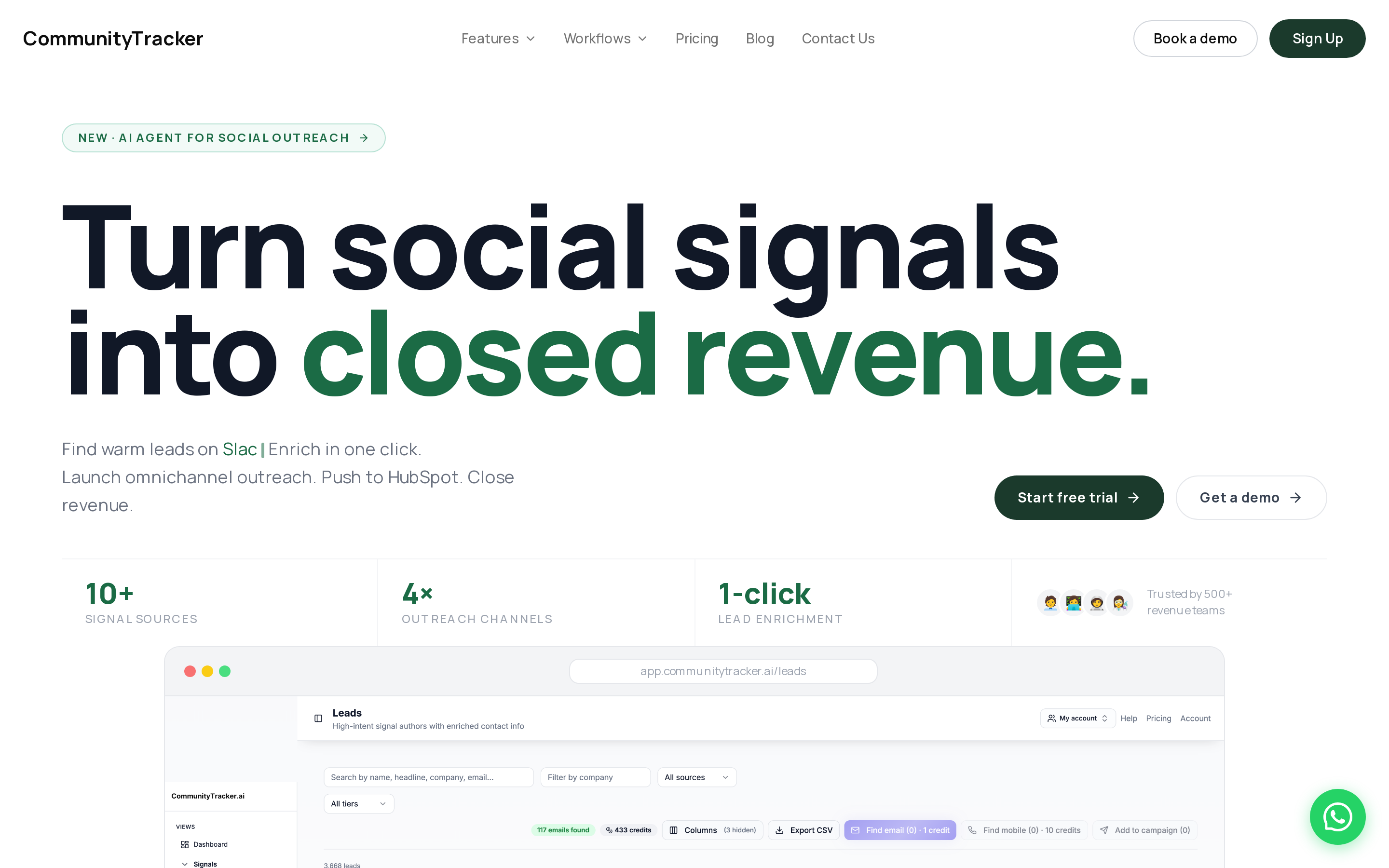
CommunityTracker is a buyer-signal monitoring and warm-outreach tool. It scores intent, preserves context, and routes useful posts toward a response or warm email across Reddit, LinkedIn, X, Bluesky, Hacker News, Indie Hackers, Dev.to, Stack Overflow, Product Hunt, GitHub, and Slack.
That scope fits demand generation. A founder asking for an alternative on Reddit is a high-intent signal. CommunityTracker helps the account team act on it.
Features#
Intent detection separates buying language from mention volume.
AI scoring pushes high-intent signals up the queue.
Email and LinkedIn Outreach to buyer signals
Daily Slack alerts put signals where the account team works.
Response generation drafts a reply from the conversation context.
Share of Voice tracks who gets named across relevant discussions.
CommunityTracker pricing#
Free cost: $0 for one Reddit keyword. Starter costs $39 per month for four keywords and 5,000 mentions. Pro costs $99 for ten keywords and all communities. Advanced costs $199 for 20 keywords plus Share-of-Voice Exporter and AI visibility. Annual billing is contact.
Pros#
Filters high-intent conversations from generic brand mentions, reducing monitoring noise.
Covers 11 platforms, including Reddit, LinkedIn, X, GitHub, Hacker News, and other communities.
AI scoring helps teams prioritize important conversations instead of reviewing every mention manually.
Slack alerts make it easier to catch relevant conversations while they are still active.
Share of Voice helps track how often your brand appears compared with competitors.
Keeps the original post and conversation context attached, making each mention easier to evaluate.
Cons#
It does not schedule or publish posts.
Starter covers Reddit, LinkedIn, Hacker News, and GitHub rather than all 11 platforms.
It lacks the broad news and broadcast coverage that PR agencies may need.
Who should not choose CommunityTracker: A social content agency that needs calendars and approvals should use Hootsuite or Sendible. A PR agency that tracks news reach should start with Brand24 or Mention.
Best for: Demand generation contracts that pay for buyer-signal discovery and warm outreach. Avoid if: The retainer centers on publishing or broad media coverage.
Read More: For the measurement layer behind this workflow, see our guide to community engagement analytics.
2. Brand24#
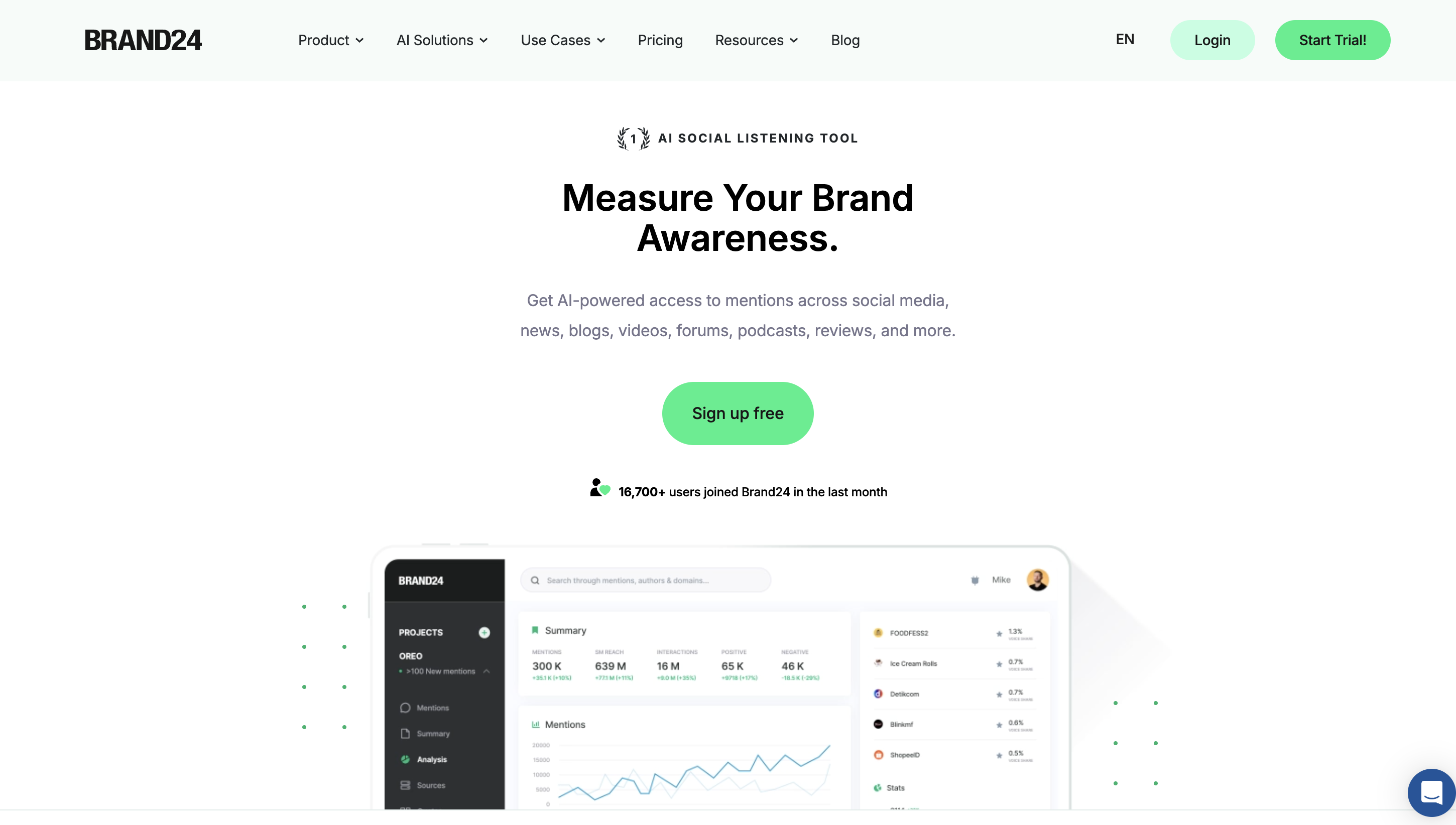
Brand24 collects keyword mentions from social networks and the wider web, groups them by project, and turns the resulting volume into reach, sentiment, and source analysis. An agency creates a project for each client. The product works well when a report needs to explain how a brand's conversation has changed.
Features#
Keyword projects collect social and web mentions.
Sentiment analysis groups positive and negative conversations.
Share of Voice compares a client with named competitors.
AI Event Detection explains sudden changes in volume.
Scheduled reports package findings for client review.
Brand24 pricing#
Pro costs $399 per month annually for 12 keywords, 40,000 mentions, unlimited users, and real-time updates. The 14-day trial mirrors Pro. Enterprise starts at $1,499. API access adds $99.
Pros#
Broad web coverage supports PR and brand reporting.
Project-level analysis keeps competitor sets separate.
Share-of-voice views give clients a clear trend line.
Cons#
The entry plan refreshes every 12 hours.
An individual includes one user and 2,000 monthly mentions.
Account teams still have to turn analysis into an outreach workflow.
Best for: PR clients that need broad mentions, sentiment, Share of Voice, and recurring reports.
Avoid if: A rep must act on buyer intent the same day.
Learn More: We have examined that tradeoff in our Brand24 review.
3. Sprout Social#
Sprout combines publishing with a Smart Inbox and keyword monitoring, so an agency can collect a client message, assign an owner, and measure the response beside profile performance. Reporting then connects response work with profile performance.
Features#
Smart Inbox combines messages and monitored activity.
Keyword and location monitoring find relevant posts.
Message tagging creates client reporting categories.
Approval workflows control content before publication.
Team productivity reports show ownership and response work.
Sprout Social pricing#
Standard costs $199 per seat per month annually and includes Smart Inbox, keyword monitoring, and five profiles. The 30-day trial needs no card. Professional costs $299 with unlimited profiles. Advanced costs $399 and adds customer-care reporting, API access, and helpdesk integrations.
Pros#
One workspace covers care, publishing, and reporting.
Tagging lets an agency map messages to client goals.
Helpdesk integrations suit service-led account teams.
Cons#
Per-seat pricing grows fast for a shared agency team.
Premium Listening is a separate product layer.
Essentials does not include the full Smart Inbox monitoring workflow.
Best for: Social care teams that need a Smart Inbox, ownership, publishing, and team reports.
Avoid if: Seat cost will erase the account margin.
4. Hootsuite#
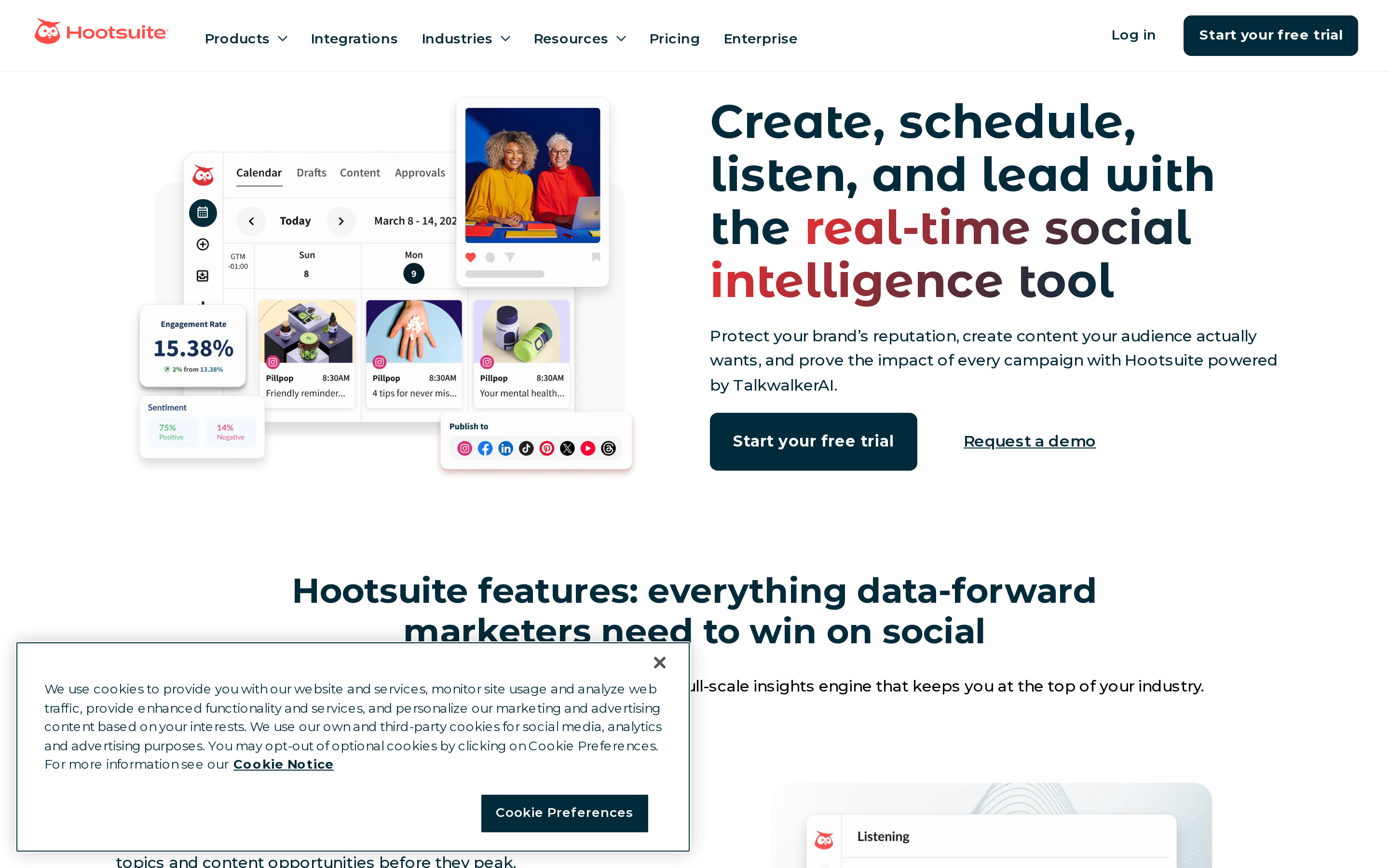
Hootsuite combines a calendar and inbox with brand search and competitor analysis, which lets a publishing team watch recent conversations, route direct replies, and report without changing systems. Standard searches the past seven days for mentions. Advanced extends that window to 30 days and adds routing plus report exports.
Features#
Brand and competitor search surfaces recent mentions.
Sentiment analysis groups the conversation.
Unified inbox routes direct responses.
Approval workflows control client content.
Custom reports can be exported or emailed.
Hootsuite pricing#
Advanced matches this workflow. Hootsuite varies prices by region; current indexed pricing is near $249 per user per month annually. The 30-day trial has posting caps. Enterprise uses custom pricing and adds premium listening plus SSO.
Pros#
Publishing and monitoring share one client workspace.
Standard includes a recent-mention search without an extra tool.
Advanced adds report delivery and message routing.
Cons#
Standard only searches seven days of mention history.
Price rises with every user.
Deep listening sits behind an enterprise add-on.
Best for: Agencies that publish, monitor, reply, and report from one workspace.
Avoid if: Historical web research drives the contract.
5. Agorapulse#
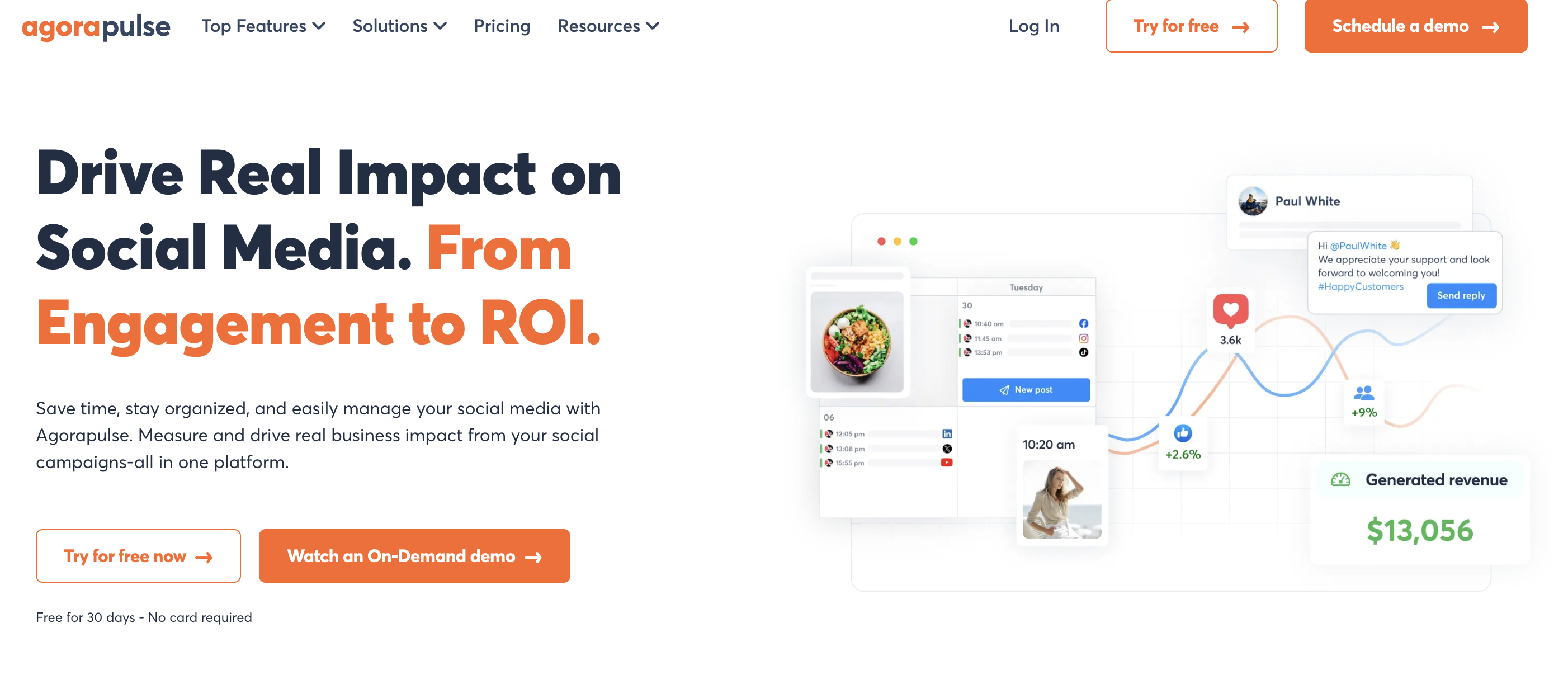
Agorapulse gathers messages and organic comments into one inbox, gives each item an owner, and carries its label into the account report. The agency can then show both content output and response work without rebuilding the evidence in a spreadsheet.
Features#
Social Inbox collects messages and organic comments.
Assignment rules give each item an owner.
Labels turn response work into report fields.
Branded reports package results for clients.
ROI reports connect social activity with web outcomes.
Agorapulse pricing#
Standard costs $79 per user per month annually for ten profiles, inbox monitoring, and branded reports. Social and web listening adds $100 per search. The 30-day trial needs no card. Advanced costs $149 and adds deeper controls.
Pros#
The inbox gives account teams a clear queue of ownership.
Reports carrying the agency branding support recurring client reviews.
All core plans include ten profiles before add-ons.
Cons#
Extra profiles cost $10 per month on annual billing.
Broad listening needs another product layer.
Per-user cost grows with every account specialist.
Best for: Inbox operations with assignments, response workflows, and branded reports.
Avoid if: The brief needs broad listening without an add-on.
6. Mention#
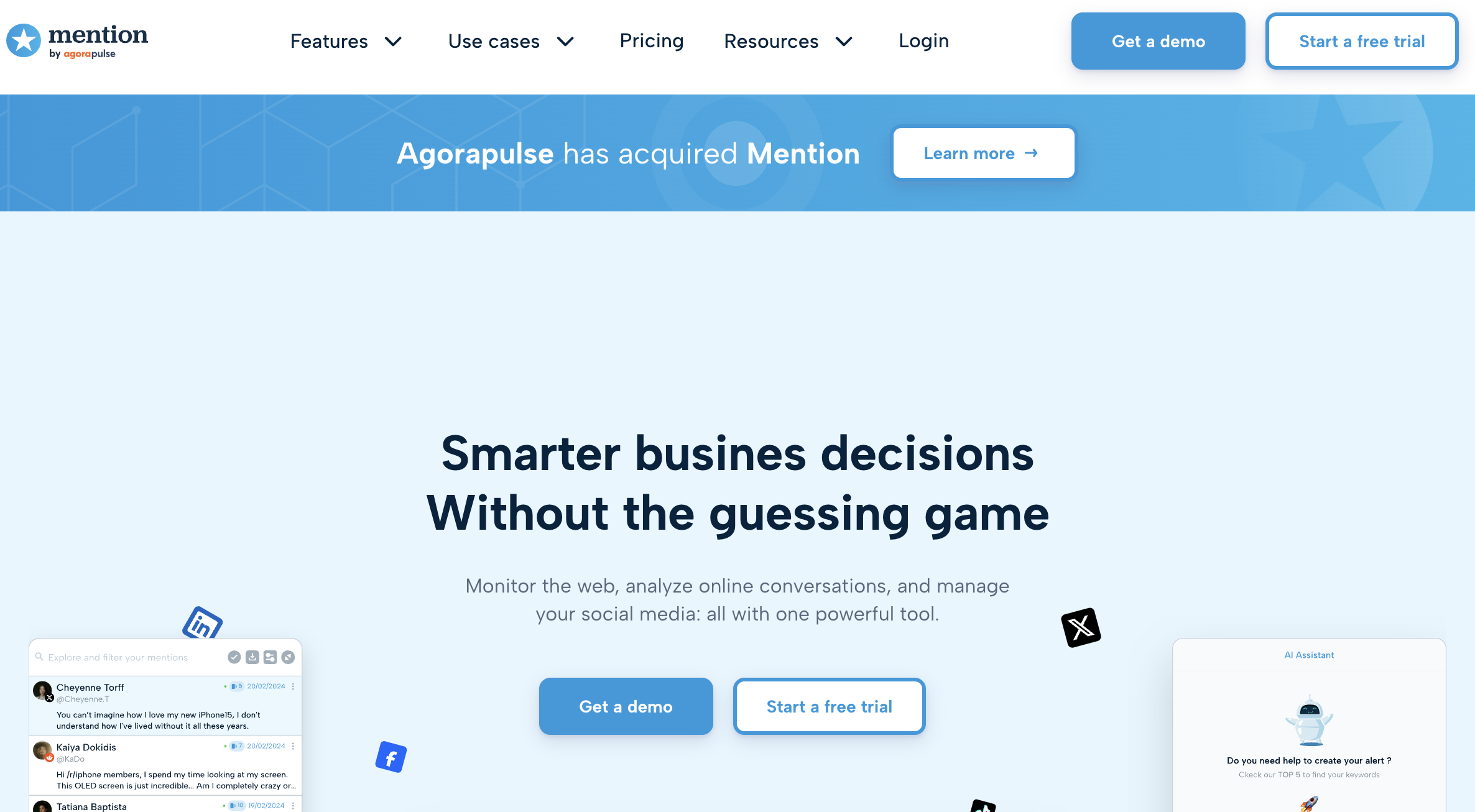
Mention tracks alert queries across social networks, plus news, blogs, and forums, while its Company plan separates clients with workspaces, roles, and access controls. Automated reports and data exports serve agencies that sell research or reputation monitoring.
Features#
Advanced Boolean alerts refine client queries.
Workspace roles separate account access.
Scheduled reports automate client delivery.
Spike notifications flag sudden changes.
Share of Voice compares a client with competitors.
Mention pricing#
Pricing: Company starts at $599 per month on an annual contract. No free plan or trial. It includes five alerts, 50,000 mentions, unlimited users, workspaces, and reports. Historical data and API access cost extra.
Pros#
Unlimited users suit a multi-role agency team.
Workspaces keep client access separate.
Web and forum coverage supports reputation briefs.
Cons#
The annual contract raises the entry commitment.
Five alerts can feel tight across several clients.
Publishing and response tools have been removed for new users.
Best for: Reputation research across social networks, news, blogs, forums, and the web.
Avoid if: Your team also owns publishing and replies.
7. Awario#
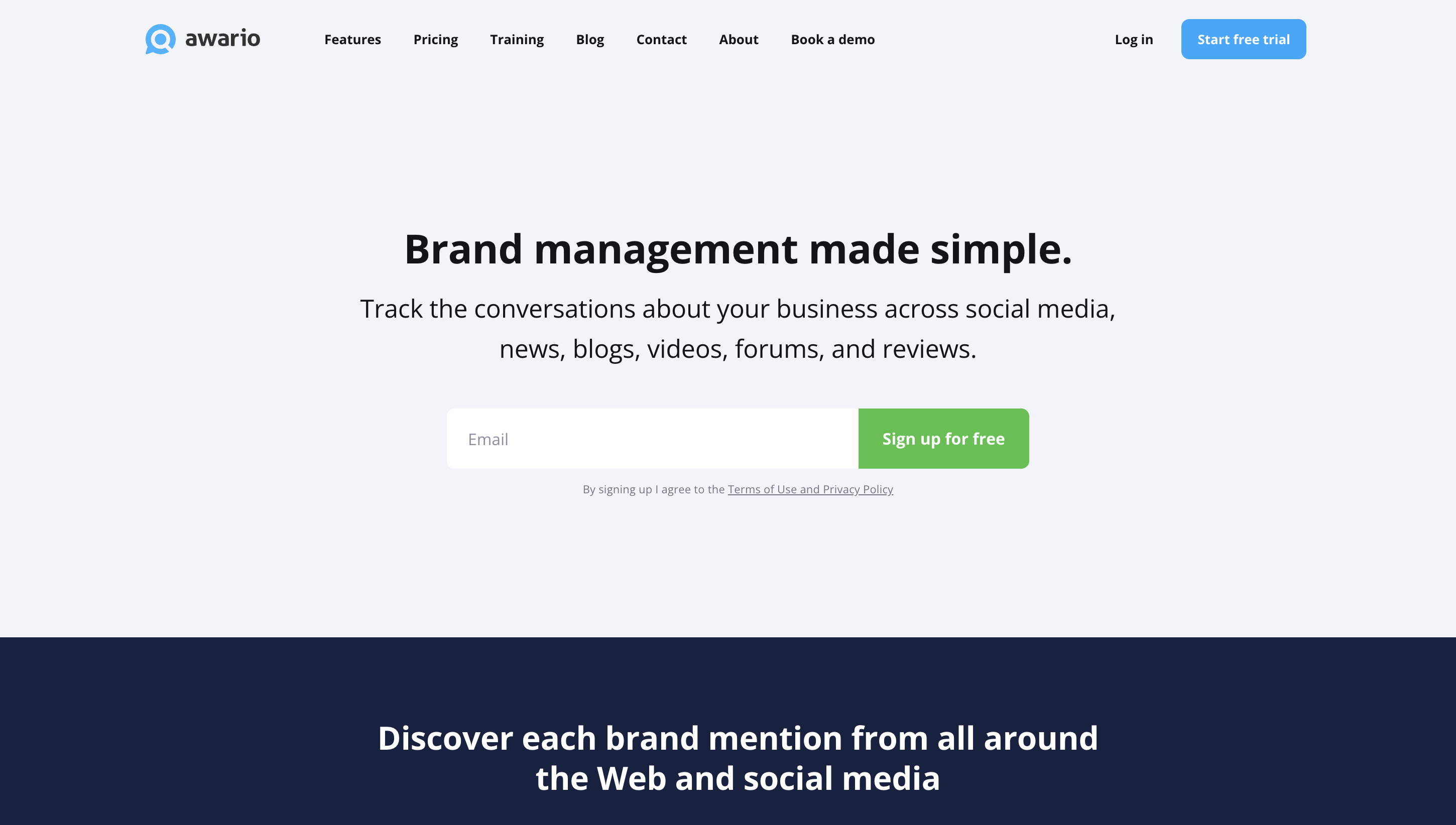
Awario tracks keywords across social networks and the web, then gives the team Boolean controls, alert feeds, and sentiment filters for removing false matches. Pro adds sharing and export tools for client work.
Features#
Boolean search controls keyword matching.
Mention feeds collect results by alert.
Sentiment analysis helps triage conversations.
Pro reports can be shared with clients.
Enterprise adds white-label reports and API access.
Awario pricing#
Pro is the first plan with exports and shared reports. It costs about $124 on an annual term for 15 alerts and 300,000 mentions. The seven-day trial needs no card. Enterprise costs $399 and adds white-label reports.
Pros#
Entry pricing is lower than most listening suites.
Boolean rules help agencies cut query noise.
Pro supports exports and shared reports.
Cons#
Starter has no exports or shared reports.
Each Starter alert stores 5,000 mentions.
White-label reporting requires Enterprise.
Best for: Boolean monitoring with client-ready PDF reports at a lower entry cost.
Avoid if: You need enterprise permissions below the top tier.
8. Statusbrew#
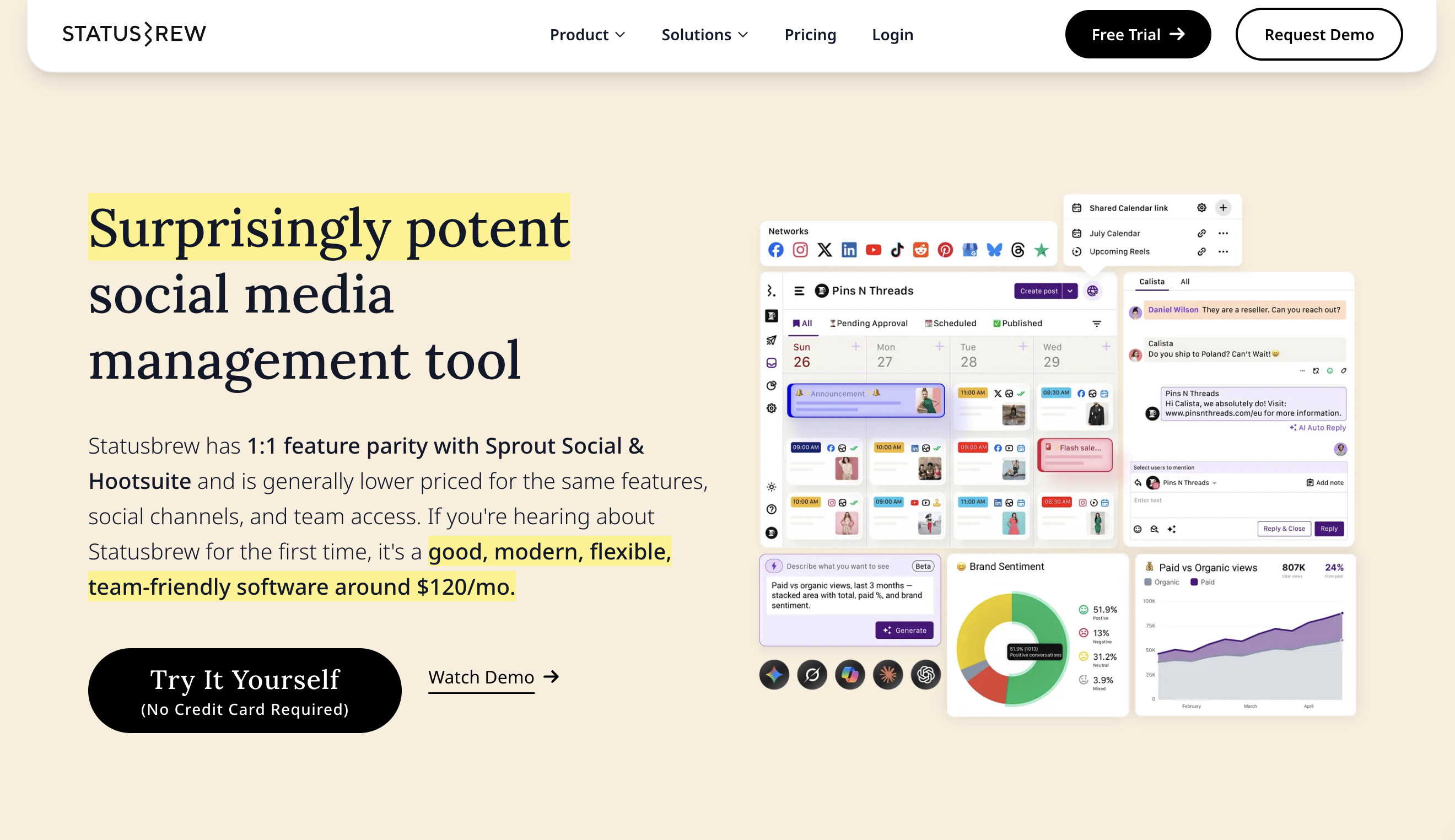
Statusbrew combines publishing and engagement with social and web listening on Premium, where keyword searches feed the Engage inbox, trigger moderation rules, and create an ownership trail. Rules then hide or tag, or assign work based on the client's process.
Features#
Brand Keyword searches monitor client terms.
Rule Engine automates moderation and assignment.
Team and SLA reports track response work.
Approval workflows control client publishing.
Competitor benchmarking supports review meetings.
Statusbrew pricing#
Premium starts at $229 per month annually with six users, 15 profiles, four searches, SLA reports, and assignments. Every paid plan has a 14-day trial. Enterprise is custom. Agency packages start at $49 per client.
Pros#
Rules reduce manual moderation work.
SLA reporting gives service agencies an outcome metric.
Agency pricing can follow the number of clients.
Cons#
Listening starts on the $229 Premium plan.
Premium includes only four keyword searches.
Extra capacity costs $50 for two searches and 1,000 conversations.
Best for: Moderation contracts measured through assignments, rules, and response SLAs.
Avoid if: The client needs many news research queries.
9. Zoho Social#
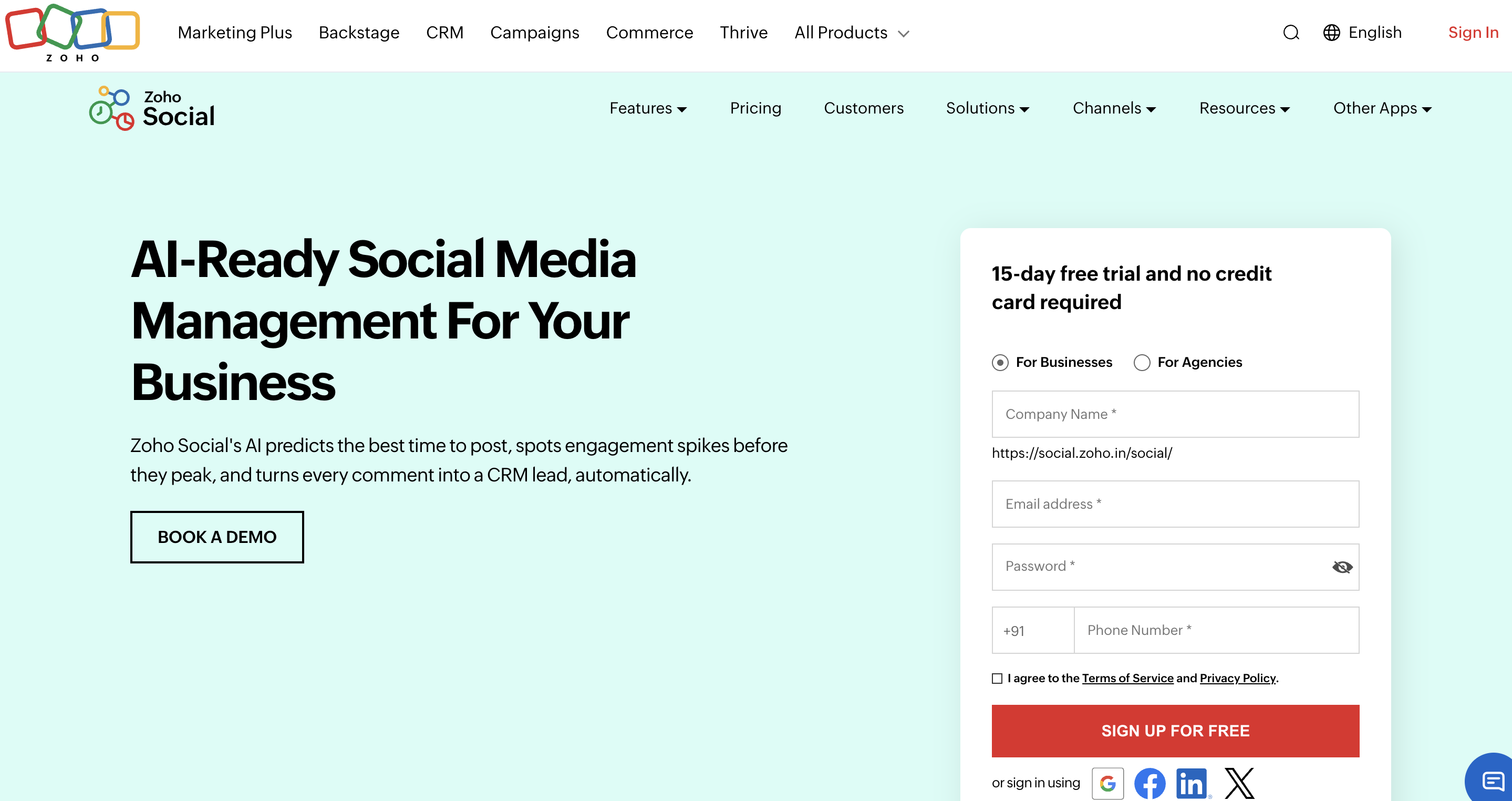
Zoho Social gives each brand its own profiles and monitoring columns, then lets the agency route a useful contact into Zoho CRM, Zoho Desk, or an account owner's queue. Agency plans to add client access and presentation-ready reports.
Features#
Monitoring columns track keywords and interactions.
Separate brands keep client profiles organized.
Client portals provide controlled access.
Branded reports support account reviews.
Zoho CRM and Desk connect signals to follow up.
Zoho Social pricing#
Agency costs $230 per month annually for ten brands, five team members, client portals, and branded reports. The 15-day trial needs no card and falls back to a free single-brand plan. Agency Plus costs $330 for 20 brands.
Pros#
The free plan gives a small team a real starting point.
Agency tiers include client access and branded reports.
CRM and Desk links connect monitoring with account work.
Cons#
Broad news and forum listening are outside its scope.
The jump from single-brand plans to an agency is large.
Monitoring depth depends on each network's connected-profile access.
Best for: Agencies that route work through Zoho CRM or Zoho Desk.
Avoid if: Broad news and forum monitoring define the service.
10. Sendible#
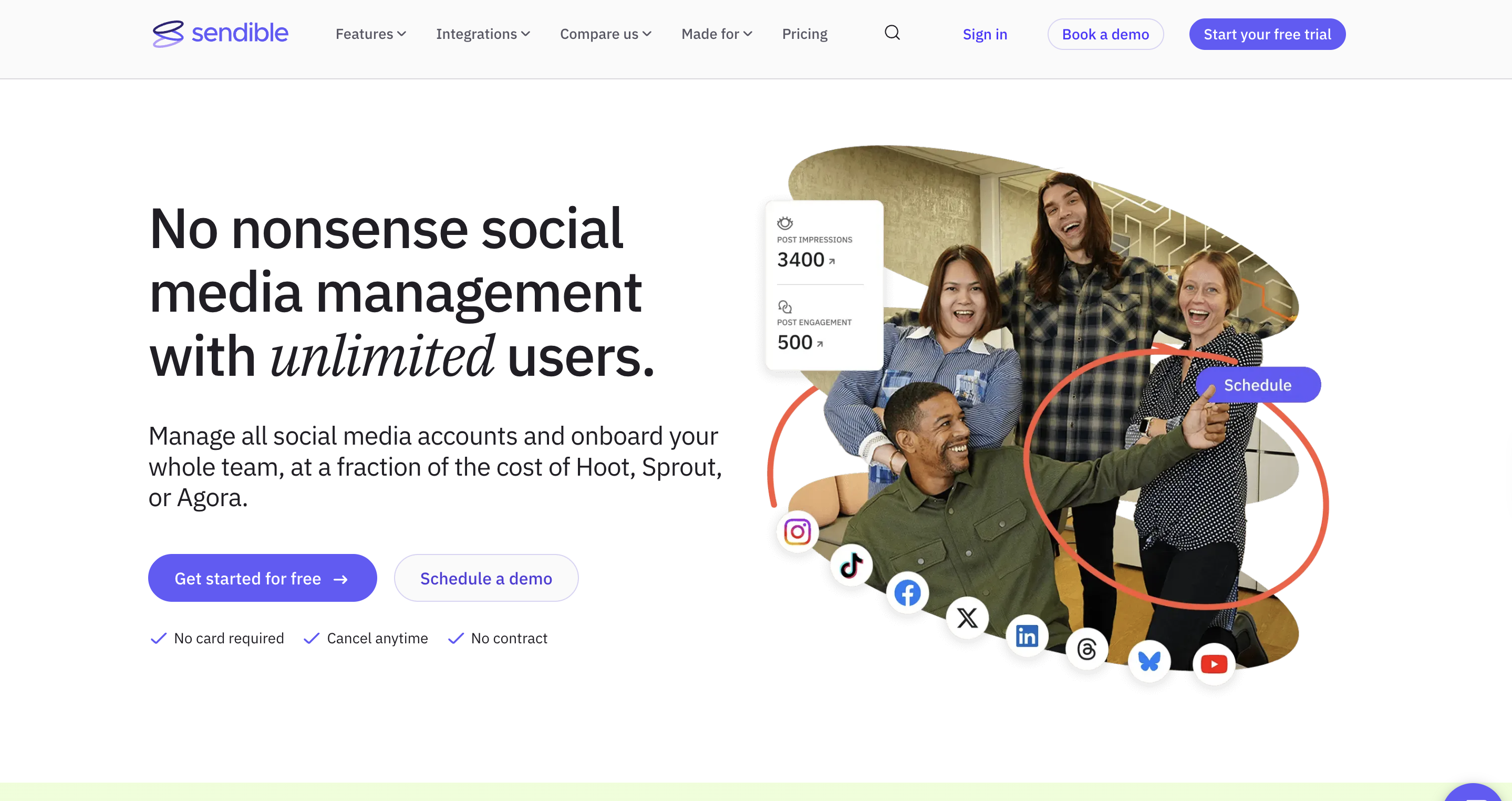
Sendible organizes each client inside a workspace with profiles, a calendar, approvals, and report settings that stay separate from every other account. Its monitoring tools collect messages and mentions from connected accounts. Account teams can reply without opening each network.
Features#
Client workspaces separate profiles and settings.
Monitoring and replying share one inbox.
Assignment and approvals support account teams.
Custom-branded reports appear on Premium.
Scheduled reports automate client updates.
Sendible pricing#
Plus, costs about $84 per year for three workspaces and 18 profiles. The 14-day trial needs no card. Premium costs $199 for seven workspaces plus branded reports and approvals. Enterprise costs $750.
Pros#
Workspaces map cleanly to client accounts.
Unlimited users on current plans reduce seat pressure.
Publishing and reporting live beside monitoring.
Cons#
Core includes one workspace.
Listening depth trails a dedicated research platform.
White-label access is an add-on on higher tiers.
Best for: Publishing retainers that need separate workspaces, approvals, replies, and reports.
Avoid if: Market intelligence is the main deliverable.
Other tools considered#
Brandwatch and Meltwater belong on an enterprise shortlist. Both support large-scale listening and media intelligence. We left them outside the main ten because this comparison prioritizes agency workflows with accessible entry paths and clearer pricing. Agencies serving global consumer brands or running a PR command center should still evaluate them.
How to choose the right monitoring tool for your agency#
Start with the client promise. Then map the tool to the work your team delivers each week.
Buyer conversations and warm outreach point to CommunityTracker.
Broad mentions and Share of Voice call for Brand24.
Social care and response ownership fit Sprout Social or Agorapulse.
Publishing plus monitoring belongs with Hootsuite or Sendible.
Reputation and web research make Mention the short pick.
Lower-cost Boolean monitoring favors Awario.
Moderation rules and SLA reporting make Statusbrew useful.
A Zoho-based agency workflow points to Zoho Social.
Test one real client query before signing an annual contract. Use the same query and review window in each product. Measure:
Relevant mentions against false positives
time spent filtering the feed
routing speed and response completion
actionable buyer signals
client-ready reporting
cost per useful result
A cheap plan fails when monitoring sits one tier higher. Model the price using the seats, clients, keywords, profiles, or mention volume the account will consume after three months. Add reporting and listening fees.
The test should answer two questions. Can the right owner act before the mention goes stale? Can the account lead prove the work without rebuilding a report? Our list of B2B buying signals gives you a tagging scheme for the first question.
Use CommunityTracker to turn client signals into pipeline#
Brand24 and Mention do broad listening well. Sprout Social and Hootsuite give agencies publishing workflows. Awario keeps keyword monitoring within reach for a small team.
CommunityTracker fits when your agency needs to find a high-intent signal across Reddit, LinkedIn, X, Bluesky, Hacker News, Indie Hackers, Dev.to, Stack Overflow, Product Hunt, GitHub, and Slack. Then show the next move while the post still matters.
If you only need publishing and a shared inbox, then a social management suite will be easier to justify. When the client pays for buyer-signal discovery, you can start with one keyword on the Free plan and audit the first week of results.