Trigify works well when LinkedIn engagement already gives your reps qualified people to contact. Its workflows keep the source post attached, enrich the person, score intent, and route the result into your sales stack. The case for switching starts when the conversation happens somewhere else, when reporting matters more than activation, or when your team needs a database rather than another signal feed.
Trigify Starter costs $40 per month. It includes 4,000 monthly credits, 25 listening searches, 50 Social Signals profiles, two active profiles, and a 24-hour lookback. Max costs $199 per month for 40,000 credits, unlimited searches, 5,000 stored profiles, ten active profiles, and a 30-day lookback. Both plans include unlimited workflows and a 14-day trial. Extra usage costs $0.012 per credit.
The strongest Trigify alternatives solve different problems. CommunityTracker expands public-conversation discovery. Octolens routes scored mentions from a wider mix of B2B and developer sources. Clay takes over when enrichment and orchestration are harder than discovery. Apollo replaces signal-led prospecting with database search plus native email and calling.
TL;DR#
CommunityTracker fits a B2B SaaS team that wants to find buying conversations beyond LinkedIn and keep the source context through warm outreach.
Octolens gives product and marketing teams wider B2B and developer-source monitoring, scored mentions, and flexible external routing.
Syften suits an operator who wants exact keyword alerts and is prepared to research, qualify, and contact each person manually.
Brand24 is built for marketing and PR teams that need sentiment, reach, media coverage, and scheduled reporting.
Clay is easier to justify after signals already reach a table or CRM and need enrichment, scoring, and custom routing.
Apollo trades current conversation context for database scale, verified contact data, email sequences, and calling.
Why teams move beyond Trigify#
Trigify starts from a useful premise: a person who engages with a relevant post gives a seller more context than a contact pulled from a static list. Its API, MCP server, CLI, integrations, and workflows make that signal usable outside the product.
The credit model requires active management. One returned search result costs one credit. Person enrichment costs four credits, company enrichment costs ten, and actions inside a loop run once for every item. A broad search followed by enrichment can consume Starter's 4,000 credits faster than the number of saved searches suggests.
Coverage creates another switching reason. Trigify monitors LinkedIn, X, Reddit, YouTube, and podcasts, but some teams need deeper access to GitHub, Stack Overflow, Slack, Facebook Groups, news, reviews, or the wider web. The replacement should follow the place where the buyer actually speaks.
Timing can force an upgrade too. Starter's Social Signals lookback is 24 hours. Max extends it to 30 days and adds 12 months of search history, 90 days of table storage, BYOK, and three workspaces. Hourly saved searches sit on Enterprise, so teams that need faster alerts should compare update frequency as carefully as source coverage.
The final reason has little to do with monitoring. A team may already collect product events, website visits, CRM changes, or account lists. Clay can enrich and route those records, while Apollo can replace conversation-led discovery with database prospecting and native outreach.
Insightful Read: Our guide to B2B buying signals that predict revenue explains why a source event needs timing and context before a rep treats it as intent.
How I evaluated these Trigify alternatives#
This comparison is based on current product documentation, pricing pages, and named third-party feedback where it adds evidence about operating friction. I did not open accounts or claim hands-on testing. Each product was judged on the part of Trigify's workflow it can replace and the work that remains after the switch.
Signal origin: Does the product find a live conversation, enrich an existing record, or build a list from a database?
Context preserved: Can a rep see the post or event that made the person relevant?
Next action: Does the product draft a reply, route an alert, enrich the record, or run outreach natively?
Usable cost: What does the first plan that supports the intended workflow include, and which meters or add-ons change the bill?
Operating burden: Which scoring rules, integrations, governance controls, or manual steps must the buyer rebuild?
Trigify alternatives compared by switching reason#
Tool | Switch when | Source | What happens next | Practical plan | Main compromise |
CommunityTracker | Buying conversations happen beyond LinkedIn | 11 public platforms | Scoring, response help, warm email, Slack | Pro, $99/mo | Daily alerts; no publishing suite |
Octolens | B2B and developer mentions need wider coverage | Social, developer, web, media | Slack, email, API, webhooks | Pro, $159/mo | Sales sequence remains external |
Syften | Precise alerts matter more than workflow depth | Communities and public web | Email; Slack/API on Standard | Standard, $49.95/mo | Qualification and outreach stay manual |
Brand24 | Sentiment and media reporting drive the purchase | Social, news, blogs, reviews, video, podcasts | Alerts, analysis, reports | Individual, $249/mo | Sales activation is external |
Clay | Signals already exist and need enrichment | Tables, CRM, connected signals, audiences | Enrichment, scoring, email, routing | Launch, $185/mo | Setup and upkeep belong to your team |
Apollo | Database scale matters more than live context | B2B contact and company database | Email, calling, sequences | Basic, $59/user/mo | No original public conversation |
Trigify | LinkedIn engagement already produces qualified people | LinkedIn-led social signals and searches | Enrichment, workflows, routing | Max, $199/mo | Credit and lookback limits |
1. CommunityTracker: Broaden where buying conversations begin#
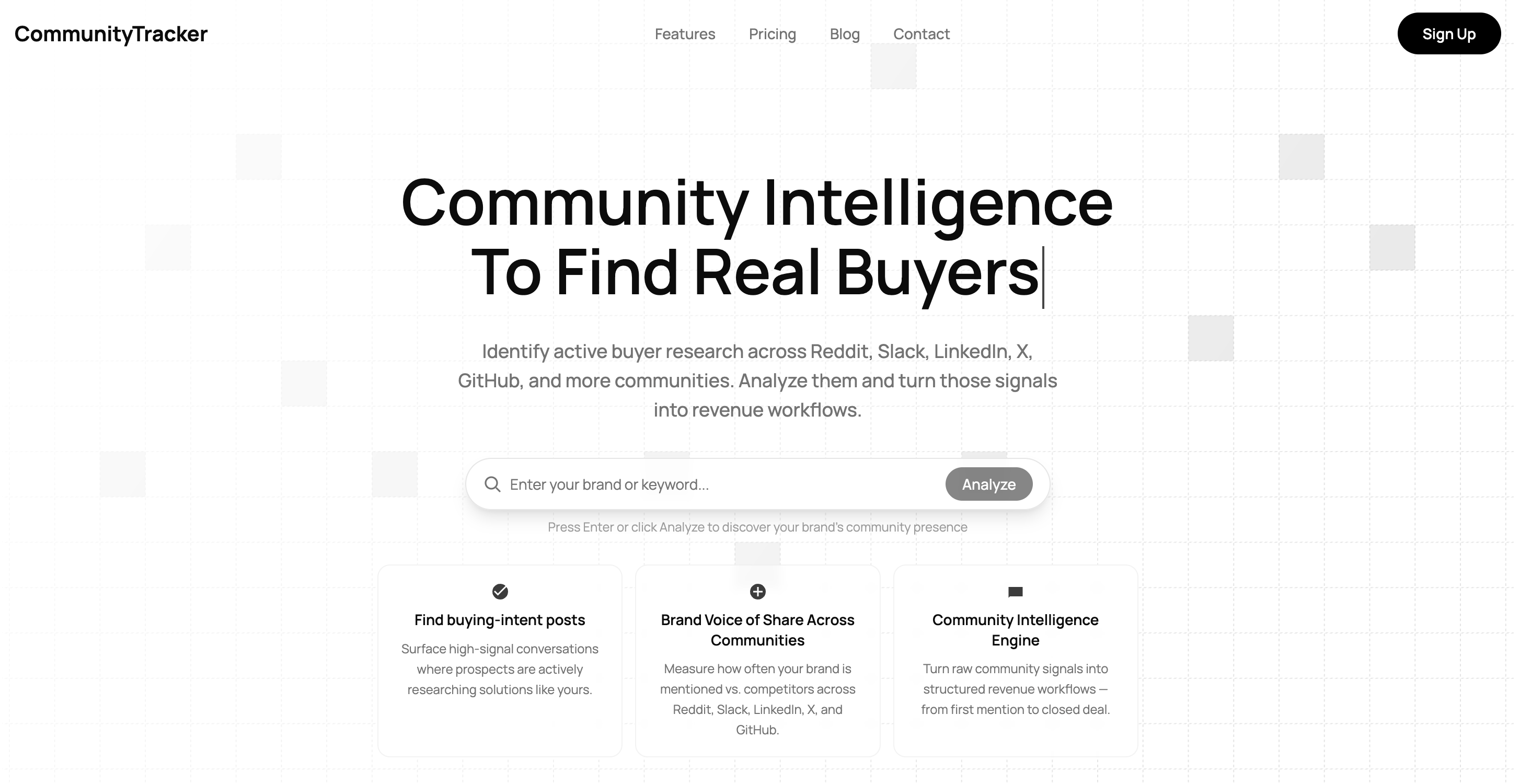
CommunityTracker fits when the missed opportunity starts outside LinkedIn. It tracks Reddit, LinkedIn, X, Bluesky, Hacker News, Indie Hackers, Dev.to, Stack Overflow, Product Hunt, GitHub, and Slack. The source conversation stays attached while intent scoring filters irrelevant matches.
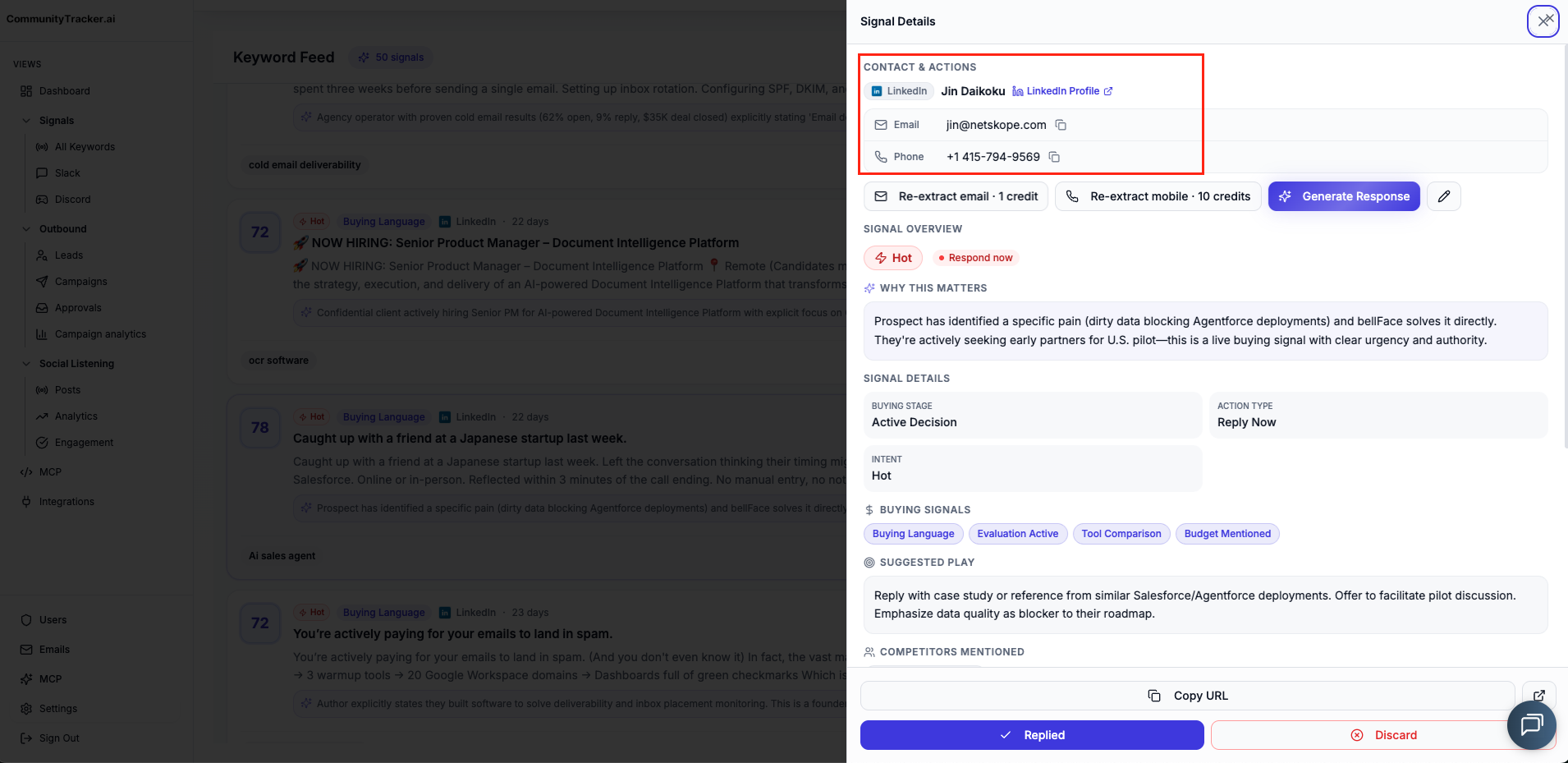
That context shapes the next move. A founder asking on Reddit for a replacement can be scored as a high-intent signal, sent to Slack, and paired with a drafted response. Available contact and company details support warm email follow-up. This is the route from signal discovery to GTM action.
The free plan costs $0 for one Reddit keyword and limited mentions. Starter costs $39 per month for four keywords, 5,000 mentions, Reddit, LinkedIn, Hacker News, and GitHub. It includes daily alerts, a response generator, and up to 100 warm emails per month.
Pro is the practical plan for the full workflow. At $99 per month, it includes ten keywords, all eleven platforms, unlimited mentions, unlimited warm emails, AI scoring, daily Slack alerts, Share of Voice, and Community AI. Advanced costs $199 for 20 keywords, the Share-of-Voice Exporter, and AI visibility. Annual pricing requires contact.
Compared with Trigify, the gain is broader public-conversation coverage at a lower price than Max. The loss is speed and product breadth. Alerts are daily, and CommunityTracker does not schedule or publish owned posts. PR teams that need broadcast media depth and executive sentiment reports should look at Brand24.
Who should not choose CommunityTracker: A founder monitoring a few exact phrases can run a simpler alert workflow in Syften. Teams whose qualified prospects already come from LinkedIn engagement should keep Trigify if its enrichment and routing cover the rest of the motion.
Quick Read: The AI social listening tools comparison separates buyer-intent filtering from broad mention collection.
2. Octolens: Route a wider B2B mention feed into your stack#
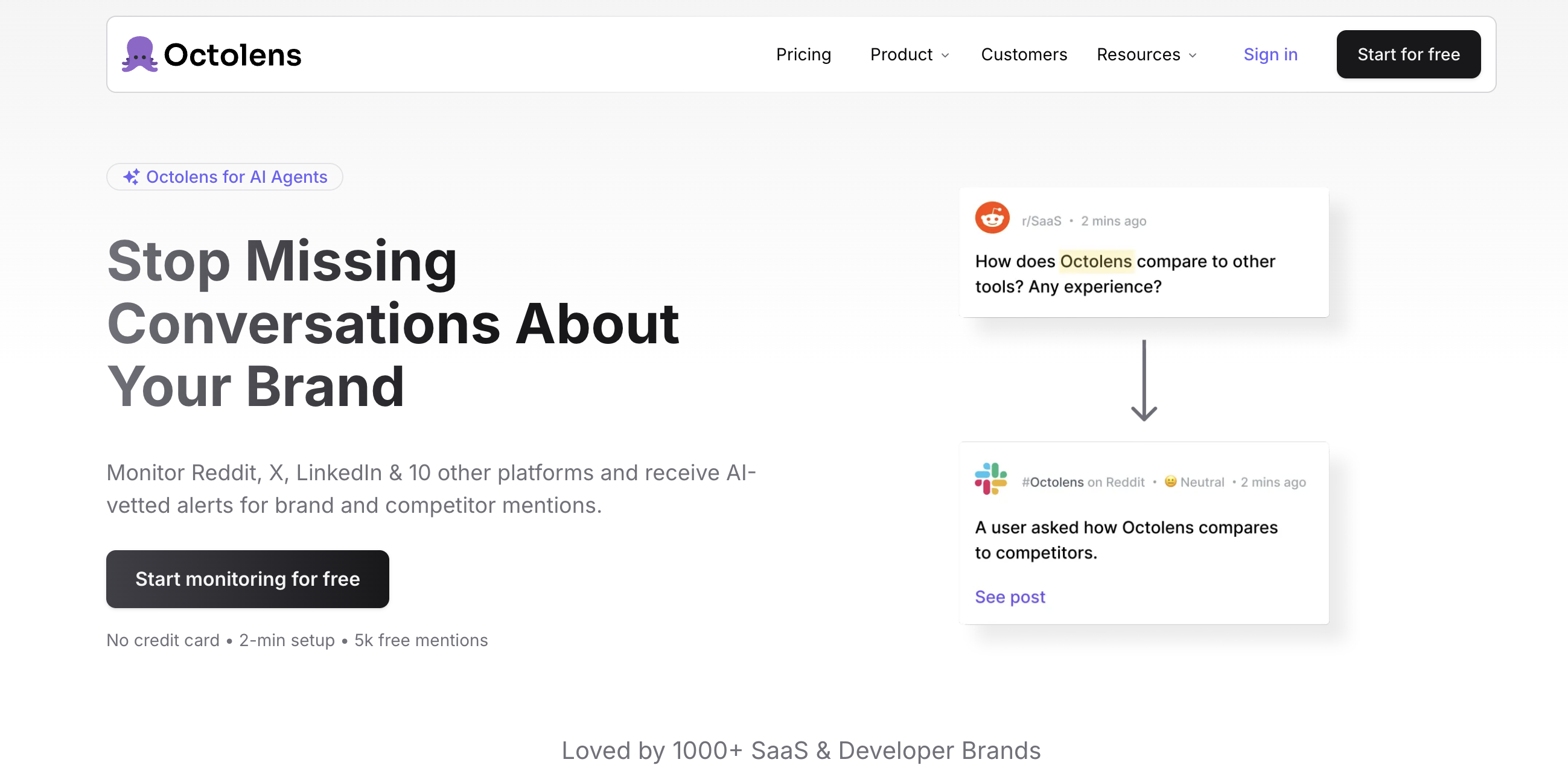
Octolens watches Reddit, X, Bluesky, GitHub, YouTube, Stack Overflow, Hacker News, and Dev.to. Scale adds podcasts, news, the web, and newsletters. This source mix suits software companies whose product conversations move between developer forums and public media.
Each mention receives a high, medium, or low relevance score. Tags identify buying intent, complaints, praise, and other categories. Operators can send the result to Slack or email, while the API, webhooks, and MCP server support external workflows on every paid plan.
Pro costs $159 per month for ten keywords, 15,000 mentions, unlimited seats, two years of history, and hourly refresh. Extra keywords cost $10 each and extra mentions cost $0.013 each. The seven-day trial includes Pro features and up to 5,000 mentions.
Scale costs $499 per month for 40 keywords and 50,000 mentions. It changes refresh from hourly to real time and adds the wider media sources. Extra Scale keywords cost $5 each, and extra mentions cost $0.01 each. Enterprise adds multiple workspaces, custom agents, and custom volumes.
A move from Trigify buys wider source coverage and simpler external routing. It removes the native sales motion. Octolens can deliver the mention and score, but your CRM or sales-engagement product still needs ownership rules, contact enrichment, and a sequence.
Octolens fits product marketing, developer relations, and demand teams that already have those downstream systems. A sales leader expecting one product to find, enrich, and contact a person will inherit an integration project.
3. Syften: Keep alerts precise and accept the manual work#
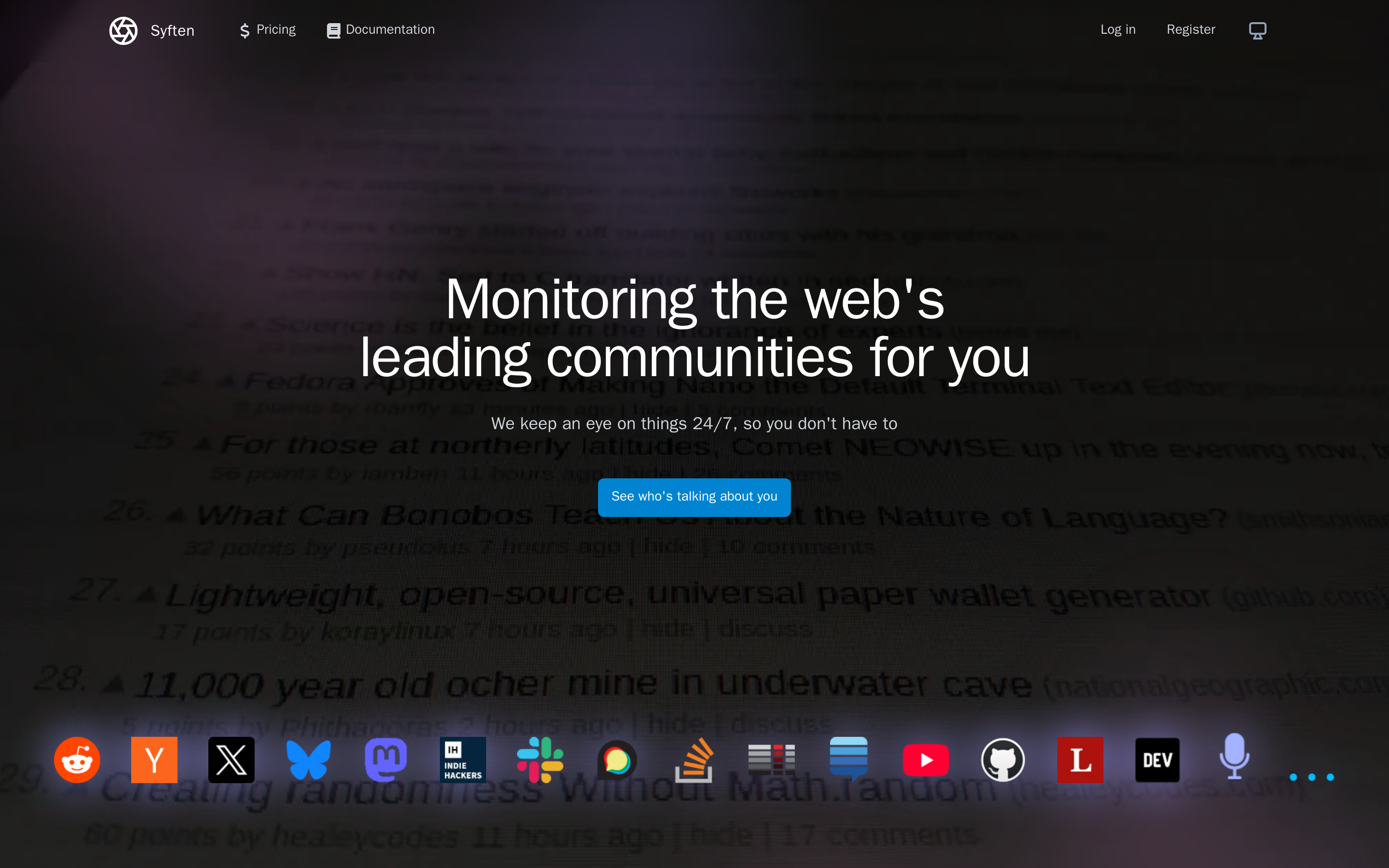
Syften monitors Reddit, forums, Stack Exchange, podcasts, Hacker News, Indie Hackers, GitHub, Slack communities, mailing lists, and the public web. Its filters can isolate a competitor name or a phrase such as "alternative to" without creating a sales record for every match.
Entry costs $29.95 per month for three community filters, one web filter, 100 community results per day, five web results per day, and a seven-day archive. Alerts arrive by email. The 14-day trial runs on Pro, requires no card, and opens 60 days of recent mentions.
Standard costs $49.95 per month. It adds AI filtering, Slack, API access, more filters, and optional X and YouTube monitoring. Pro costs $119.95 for 100 community filters, 20 web filters, unlimited archives, and webhooks.
Syften gives a founder filter control and predictable alerting at a lower entry price than Trigify. The original post remains the working context, but the product does not turn the author into an enriched prospect or run outreach. Someone must judge the match, find the person, assign an owner, and write the response.
Choose Syften when alert volume is low enough for a person to inspect every result. Once that volume requires lead scoring and rep assignment, the lower software bill moves work back to the team.
4. Brand24: Replace sales activation with media intelligence#
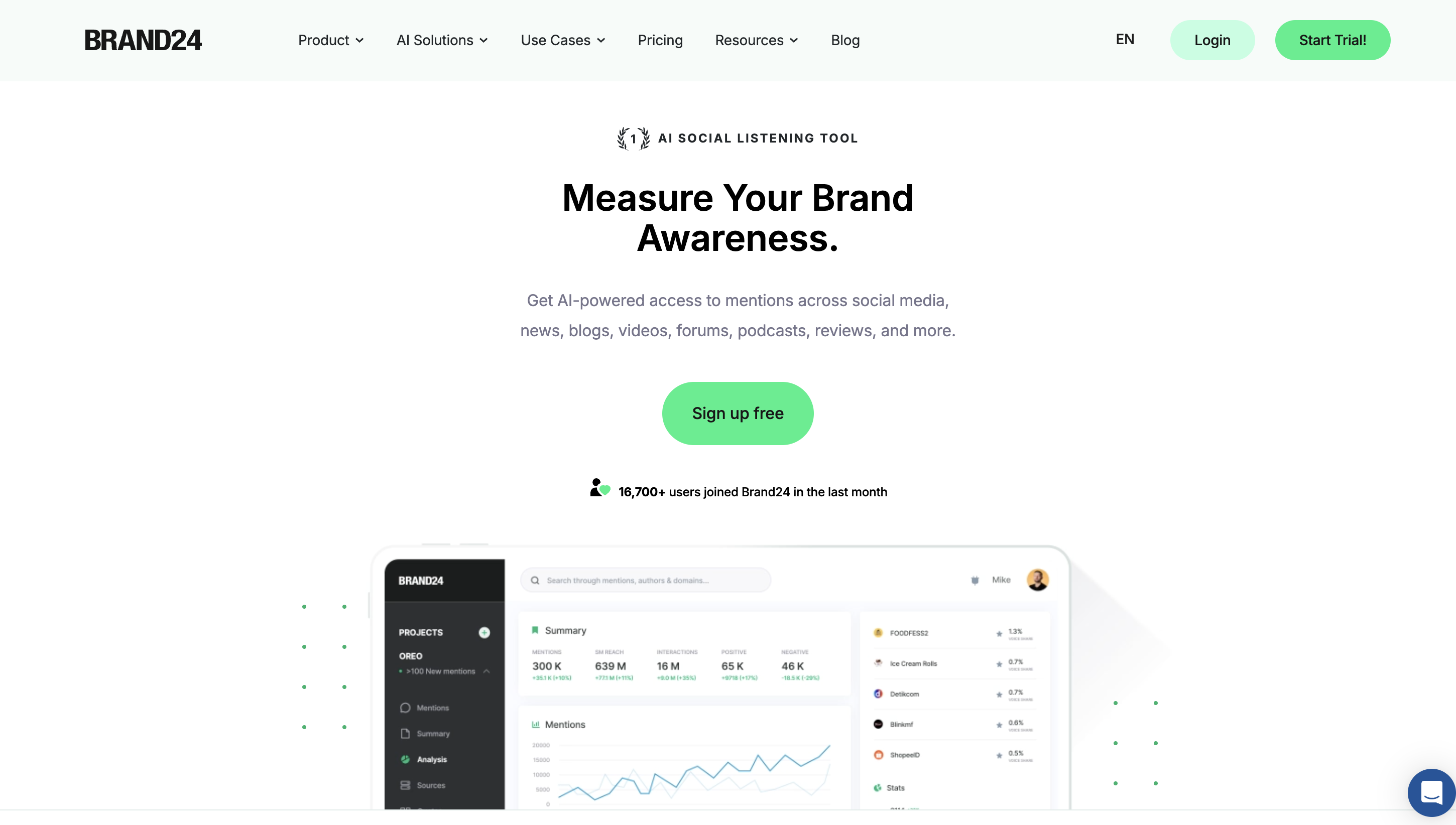
Brand24 collects mentions from social networks, news, blogs, reviews, video, podcasts, and other public web sources. It measures sentiment, reach, discussion volume, and source distribution. Spike alerts and scheduled reports help marketing and PR teams explain how a brand or topic is moving.
Individual costs $249 per month for three keywords, 2,000 monthly mentions, one user, and updates every 12 hours. The 14-day trial requires no card. Team costs $349 for seven keywords, 10,000 mentions, unlimited users, and hourly updates. Pro costs $499 for 12 keywords, 40,000 mentions, real-time updates, and deeper analysis. Enterprise starts at $1,499 per month.
Brand24 fits a communications team that reports sentiment, reach, media pickup, and campaign response. Those outputs are materially different from Trigify's person-level sales signals. A rise in mentions can tell marketing what changed, but a seller still has to identify the relevant person and create an outreach step.
The switch therefore exchanges sales context for media breadth. It is sensible for PR and brand teams. An SDR manager measured on qualified conversations will pay for analysis that does not complete the follow-up workflow.
5. Clay: Enrich and orchestrate signals you already have#
Clay makes sense once signal discovery is already working. A record can arrive from a CRM, an imported table, an audience search, a webhook, or a connected signal. Clay then uses data from more than 150 providers, enrichment waterfalls, Claygent research, scoring logic, and sequencer integrations to prepare the next action.
Its current model has two meters. Actions pay for work Clay performs, such as enrichment, AI research, routing, or exporting to another system. Data Credits buy data and AI from Clay's marketplace. Bringing your own provider keys avoids Data Credit charges, but each step still uses Actions.
Free includes 100 monthly Data Credits, 500 Actions, unlimited seats and tables, and a 200-row limit per table. Launch starts at $185 per month for 2,500 Data Credits and 15,000 Actions. It adds phone enrichment, signals, custom functions, recurring runs, and external email campaign integrations. A 14-day trial is available.
Growth starts at $495 for 6,000 Data Credits and 40,000 Actions. This is the first plan with CRM auto-sync, HTTP API calls, webhook automation, and web intent. Enterprise adds SSO, RBAC, bulk imports, data warehouse connections, and dedicated support.
Clay can preserve source context if the incoming record carries it. The operator has to design that contract, decide which signals deserve enrichment, and maintain table logic as providers or workflows change. Data Credits roll over up to twice the monthly allowance on Launch and Growth; Actions reset each billing cycle.
Compared with Trigify, Clay gives the team far more control over enrichment and orchestration. It expects the team to supply or configure discovery. Choose it when a GTM engineer owns the workflow and signals already enter a table. A seller who needs a working conversation feed with little setup will face more maintenance than the flexibility justifies.
6. Apollo: Trade live conversation context for database scale#
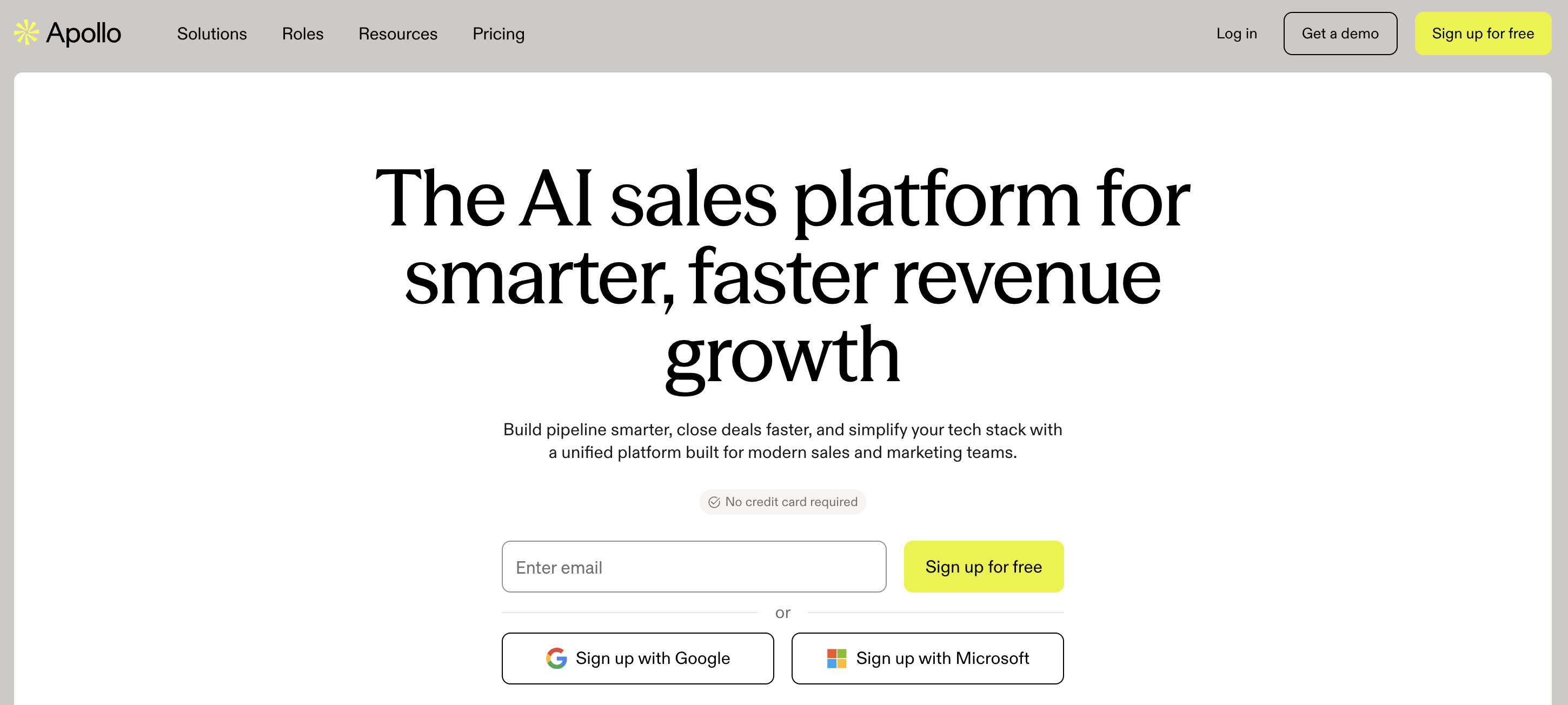
Apollo starts with a B2B people and company database. Reps filter accounts and contacts, reveal verified data with credits, then move records into email sequences or calling workflows. The contact record becomes the center of execution.
Basic costs $59 per user per month. Professional costs $99 per user, while Organization costs $149 per user on monthly billing. Apollo also has a free plan with limited credits and two active sequences. Basic and Professional trials last 14 days, include 100 credits, limit selection to 25 records at a time, and cap phone access at 20 numbers during the trial.
The database creates audience scale without waiting for a public conversation. Email and calling stay beside the record, so a small outbound team can search, contact, and manage replies in one system.
What disappears is the reason to contact that person now. A title and company filter establish fit. They do not preserve a current post about a competitor, a workaround, or a purchase problem. Reps need another intent source if timing matters. Credits also expire at the end of each billing cycle, and the per-seat bill rises with the team.
Apollo is easier to justify when contact volume and native outreach matter more than conversation provenance. Trigify remains stronger when LinkedIn engagement already identifies qualified people and the source post should follow them into the workflow.
Which Trigify alternative fits your workflow#
Start with the part of Trigify that stopped fitting:
For buying conversations across several public platforms, CommunityTracker keeps the original context and adds a route into warm outreach.
Octolens fits when developer sources, web coverage, relevance scoring, and external routing matter more than native sales sequences.
A few exact alerts are easier to justify in Syften, provided someone owns research and follow-up.
Brand24 gives marketing and PR teams the sentiment, reach, media coverage, and reporting that sales-signal products do not provide.
Clay belongs after discovery when a technical operator needs custom enrichment and routing.
Apollo suits teams that want a large database, email, and calling even though live conversation context disappears.
Trigify remains the better fit when LinkedIn engagement is the main source of buyer signals and its enrichment plus workflow routing already produces qualified prospects.
CommunityTracker fits teams that miss public buying conversations outside LinkedIn and want to turn community conversations into pipeline. Try it when source context should guide the next response. Syften may cost less for a few precise alerts, Brand24 may fit reporting teams better, and Trigify may remain right when LinkedIn engagement already drives the motion.