You and I can set a keyword alert in minutes. The real work starts when the results arrive. We still need to find the posts that show a problem. Then we need to decide whether a reply will help.
Keyword tracker tools solve different parts of that job. Some watch forums. Some scan pages that search engines index. Others filter mentions by intent and send the result to the person who can respond.
The right choice depends on where your buyers talk and what you plan to do with each alert. This list compares 15 tools by coverage. It also checks filtering and alert speed. You will see which tools stop at a match and which ones help you start a relevant conversation.
TL;DR#
CommunityTracker - Best for turning community high-intent social media buyer signals into warm outreach
Octolens - Best for B2B teams that need wide community coverage
Syften - Best for lean teams that want precise community filters
F5Bot - Best for free Reddit and Hacker News keyword alerts
ParseStream - Best for drafted public replies from tracked discussions
Mention - Best for enterprise web listening and team reporting
Awario - Best for Boolean searches on a mid-market budget
Brand24 - Best for brand analysis and high-volume mention tracking
BrandMentions - Best for agencies that need white-label reports
Mentionlytics - Best for multilingual listening and review monitoring
Google Alerts - Best for free indexed-web alerts
Talkwalker Alerts - Best for free web and news monitoring
Distill - Best for watching changes on named web pages
Visualping - Best for visual page-change alerts
Buska - Best for scored leads across a wide source set
How I evaluated these keyword tracker tools#
The useful question was whether a GTM operator can move from a match to a timely and relevant response.
Signal coverage: Does the tool watch the places where the target buyer speaks?
Intent control: Can you separate a purchase question from a casual mention?
Alert route: Can the right owner receive the signal while the thread still matters?
Outreach path: Does the result contain enough context for a useful public reply or warm email?
Cost at working volume: Do keyword caps and mention caps fit the expected signal load?
Before you set an alert, choose the phrases that reveal a problem or a vendor search. Our guide to B2B buying signals that predict revenue lists practical examples.
Keyword Tracker Tools Quick Comparison Table#
Tool | Community posts | Open web | Intent filter | Generate Replies | Free option |
CommunityTracker | ✓ | ◐ | ✓ | ✓ | ✓ |
Octolens | ✓ | ✓ | ✓ | ✓ | ◐ |
Syften | ✓ | ✓ | ✓ | - | ◐ |
F5Bot | ✓ | - | ◐ | - | ✓ |
ParseStream | ✓ | - | ✓ | ✓ | ◐ |
Mention | ✓ | ✓ | ◐ | - | ◐ |
Awario | ✓ | ✓ | ◐ | - | ◐ |
Brand24 | ✓ | ✓ | ◐ | - | ◐ |
BrandMentions | ✓ | ✓ | ◐ | - | ◐ |
Mentionlytics | ✓ | ✓ | ◐ | - | ◐ |
Google Alerts | - | ✓ | - | - | ✓ |
Talkwalker Alerts | - | ✓ | - | - | ✓ |
Distill | - | ✓ | ◐ | - | ✓ |
Visualping | - | ✓ | ◐ | - | ✓ |
Buska | ✓ | ✓ | ✓ | ✓ | ◐ |
1. CommunityTracker#
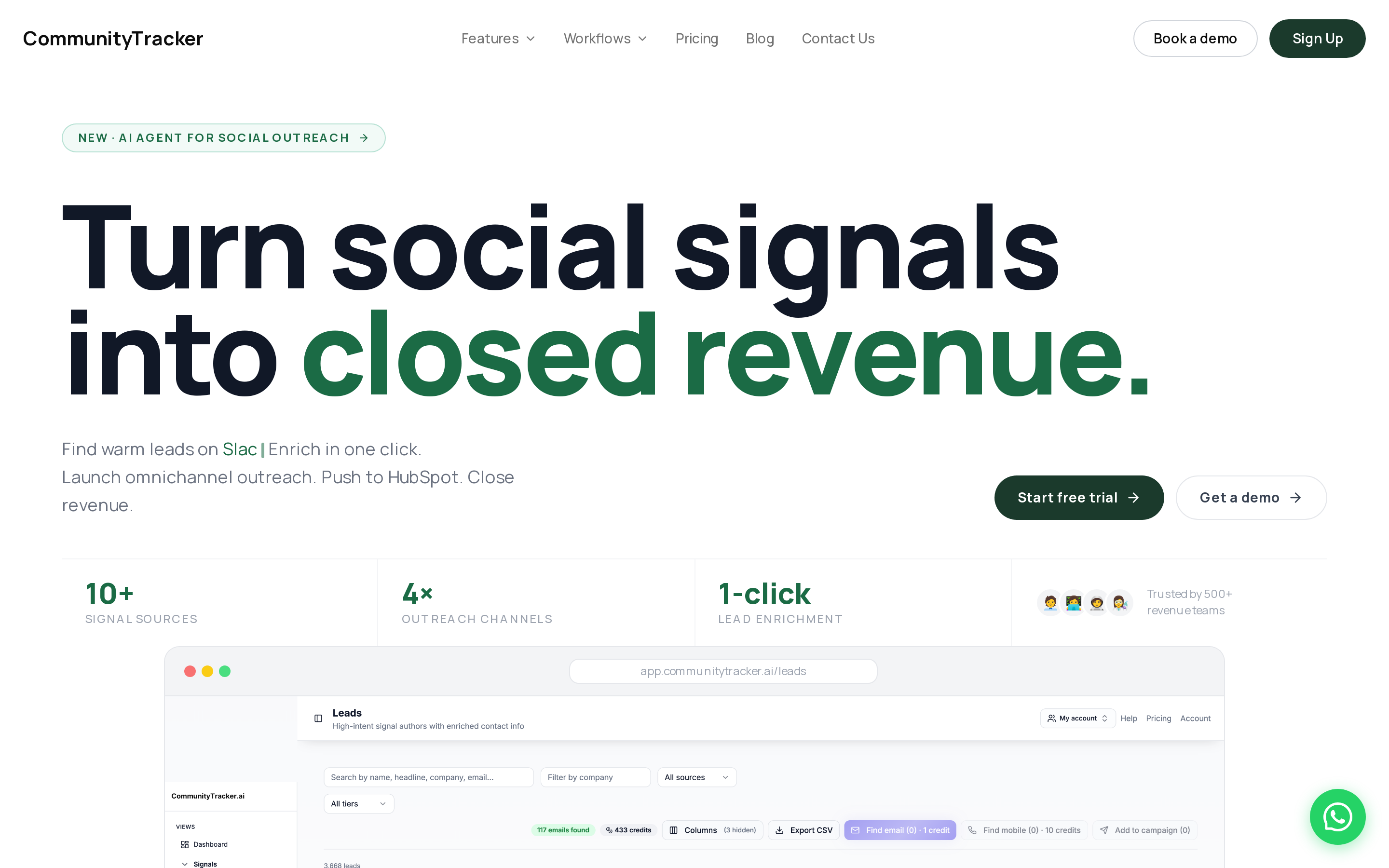
CommunityTracker is built for teams that want to find B2B buying signals across social platforms and communities, not just count brand mentions.
It tracks keywords across 11 sources: Reddit, LinkedIn, X, Bluesky, Hacker News, Indie Hackers, Dev.to, Stack Overflow, Product Hunt, GitHub, and Slack.
The useful part is what happens after a keyword match. CommunityTracker analyzes the surrounding context and scores the signal based on likely commercial intent. That helps separate a casual mention from conversations such as:
Someone asking for a tool recommendation
A buyer comparing products
A user complaining about a competitor
Someone actively looking for an alternative
A prospect describing a problem your product solves
Instead of sending every mention into the same queue, CommunityTracker helps GTM teams focus on conversations that are actually worth responding to.
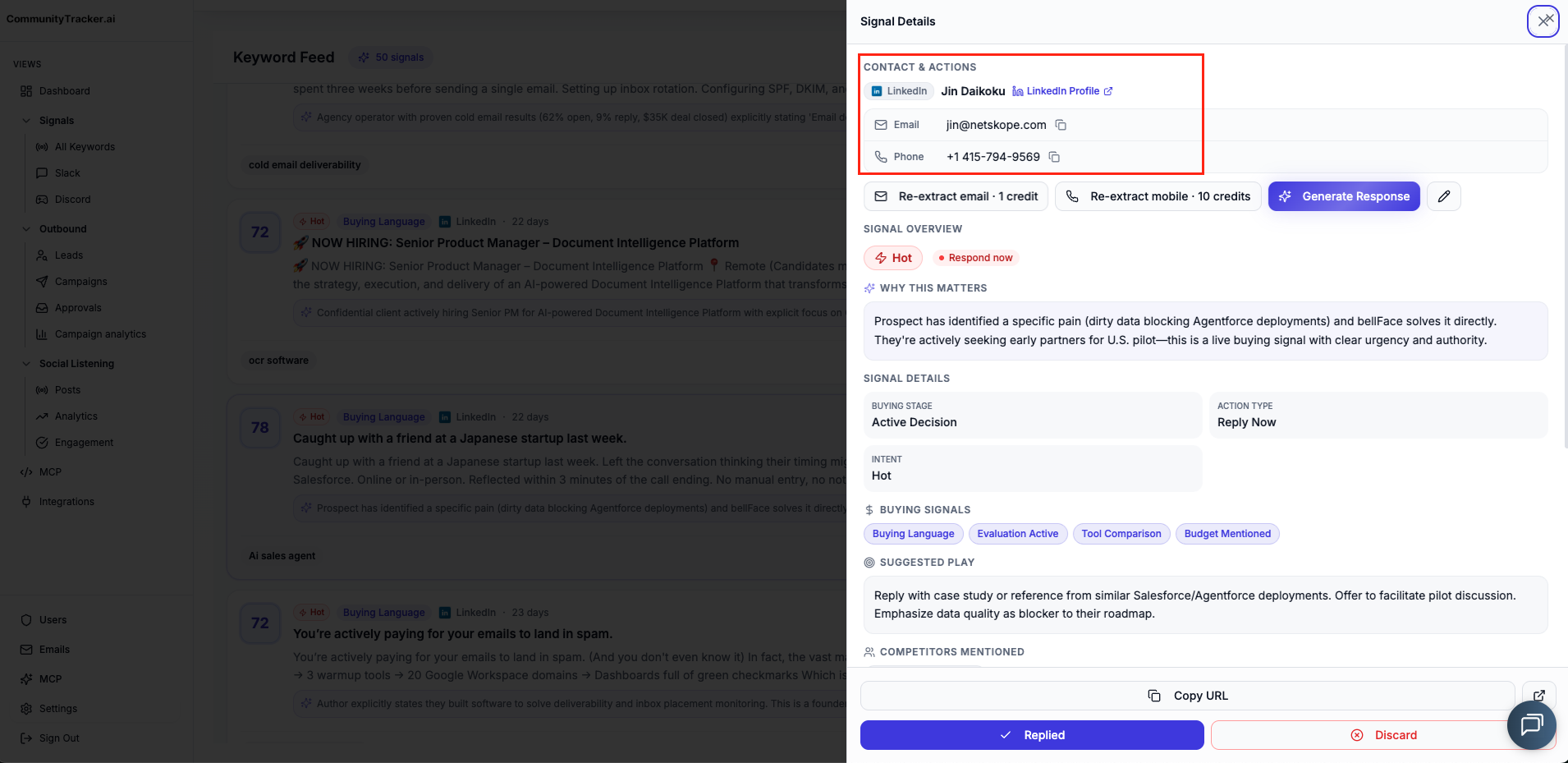
Teams can generate suggested responses, route relevant signals to Slack, and continue outreach through LinkedIn or email. This makes it closer to a buyer-signal and outreach workflow than a traditional social listening dashboard.
Key features#
Monitors 11 social, community, and developer platforms from one workspace
Uses AI filtering to remove irrelevant keyword matches
Scores conversations based on likely buying intent
Identifies product questions, competitor complaints, and alternative requests
Generates contextual responses for a human to review and edit
Sends relevant signals and alerts to Slack
Supports LinkedIn and email outreach after a prospect is identified
Tracks Share of Voice
Pricing: #
The $0 tier costs $0 and tracks one keyword on Reddit with daily alerts. Starter costs $39 per month for four keywords and 5,000 mentions. Pro costs $99 per month for ten keywords and unlimited mentions. Advanced costs $199 per month for twenty keywords plus Share-of-Voice Exporter and AI visibility. Annual pricing requires contact.
Pros#
AI intent scoring cuts through low-value mentions before they reach your team.
Covers both mainstream social platforms and developer-focused communities.
Suggested responses help teams act while a conversation is still active.
LinkedIn and email outreach let teams turn detected signals into direct conversations.
Slack alerts make it easier to route relevant opportunities to the right GTM owner.
The free plan gives you a practical way to test one Reddit keyword before paying.
Cons#
CommunityTracker is not built for scheduling or publishing social media content.
Its coverage is narrower than enterprise media-monitoring platforms that also track print, television, radio, or broader news databases.
Teams looking primarily for deep media analytics or traditional PR reporting may find specialist monitoring suites more comprehensive.
Insightful Read: When mention counts hide the useful posts, our guide to community engagement analytics beyond likes explains which signals deserve attention.
2. Octolens#
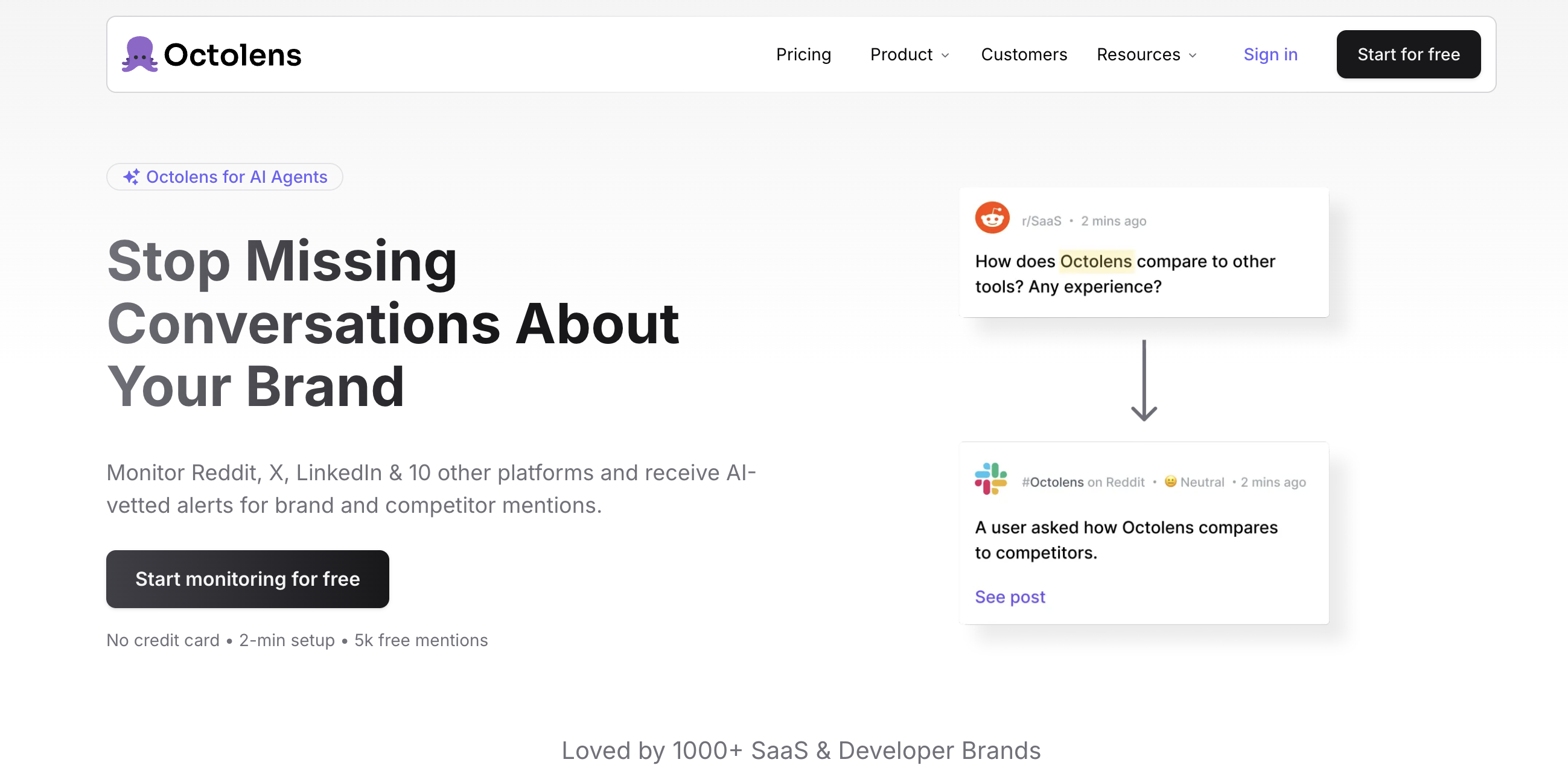
Octolens watches Reddit and LinkedIn, covers X, GitHub, and Stack Overflow, scores each result against business context, and routes alerts to Slack or email.
Features#
Monitors named social and developer sources
Scores relevance with business context
Supports API and webhooks
Stores historical results
Extends coverage to web pages and podcasts
Pricing: #
Pro costs $159 per month when billed annually. It includes ten keywords and 15,000 mentions. The seven-day trial includes Pro features and up to 5,000 mentions. Scale costs $499 per month and adds wider media coverage. Enterprise gates unlimited keywords and custom agents behind a quote.
Pros#
Covers multiple technical communities where developers and B2B buyers actively discuss tools and problems.
Unlimited seats on every plan make it easier to roll out across larger teams without paying per user.
API and webhook access make it flexible for teams that want to route alerts into their own workflows.
Cons#
AI relevance scoring still needs tuning. Octolens itself recommends refining company context, exclusions, and keywords when feeds become noisy, especially for broad or ambiguous terms.
Historical research is limited. New keywords generally get only about a week of backfill, so Octolens is much stronger for ongoing monitoring than researching conversations from months or years ago.
Keyword quality matters heavily. Broad keywords can generate substantial noise and consume mention limits, which means teams may need regular keyword cleanup and exclusions.
3. Syften#
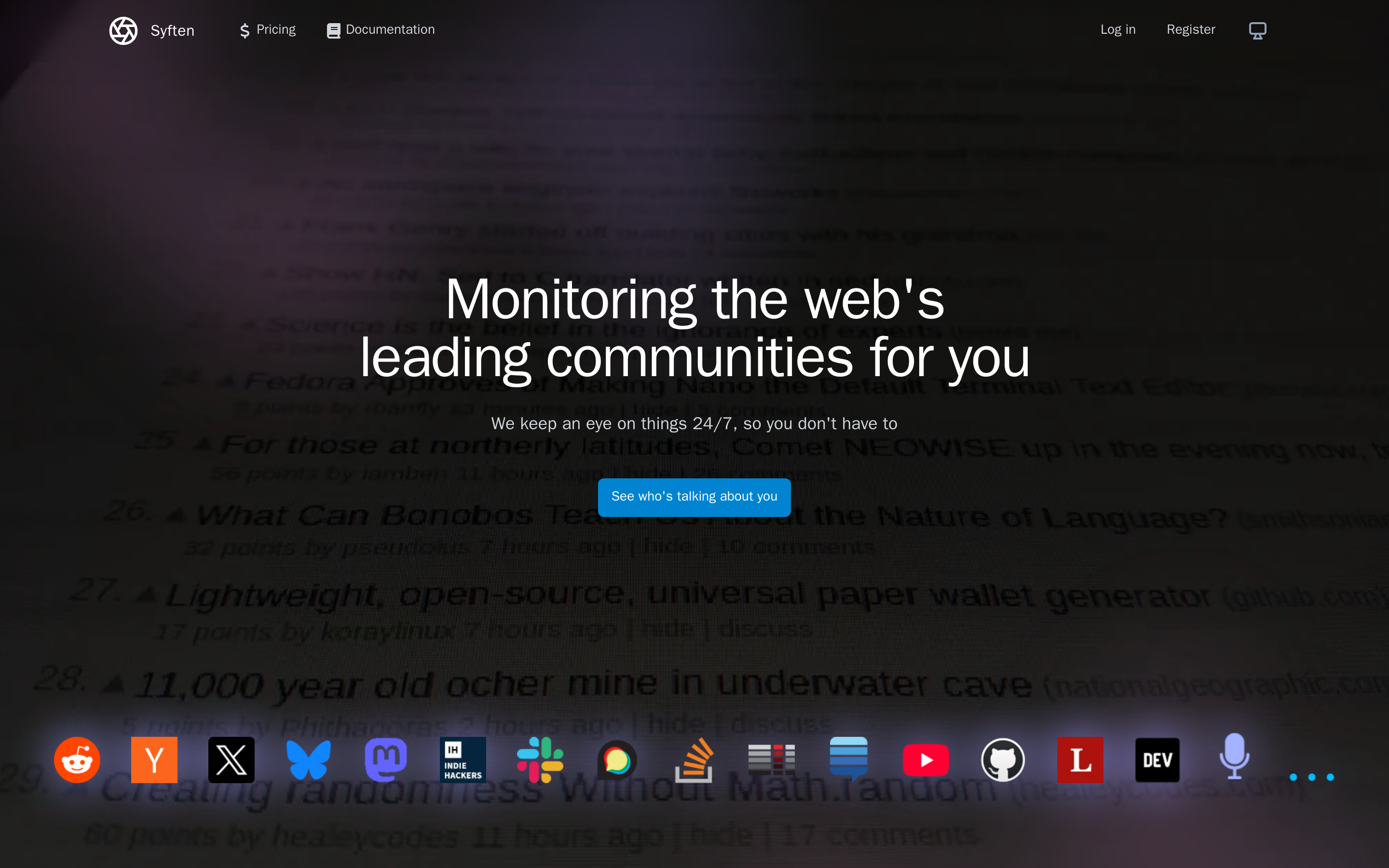
Syften tracks public web pages and discussion sources, including Reddit and Hacker News, GitHub and Stack Exchange, with query controls for narrow terms. Slack discussions and forums appear in the same alert queue.
Features#
Tracks web pages and community discussions
Supports exact filters and exclusions
Applies AI filters to reduce unrelated matches
Routes results through Slack and webhooks
Connects through API and MCP
Pricing: #
Entry costs $29.95 per month with three community filters and one web filter. The Pro trial runs for 14 days on the $119.95 plan and needs no credit card. Standard costs $49.95 per month. Pro includes unlimited archive access and webhooks. X and YouTube monitoring cost extra.
Pros#
Search controls suit narrow technical terms.
Community coverage includes developer sources.
Cons#
Entry allows only three community filters.
Web results cap at five per day on Entry.
X and YouTube require paid add-ons.
Insightful Read: Syften's MCP connection matters when you want another system to read its results. Our review of MCP servers for social listening explains that setup.
4. F5Bot#
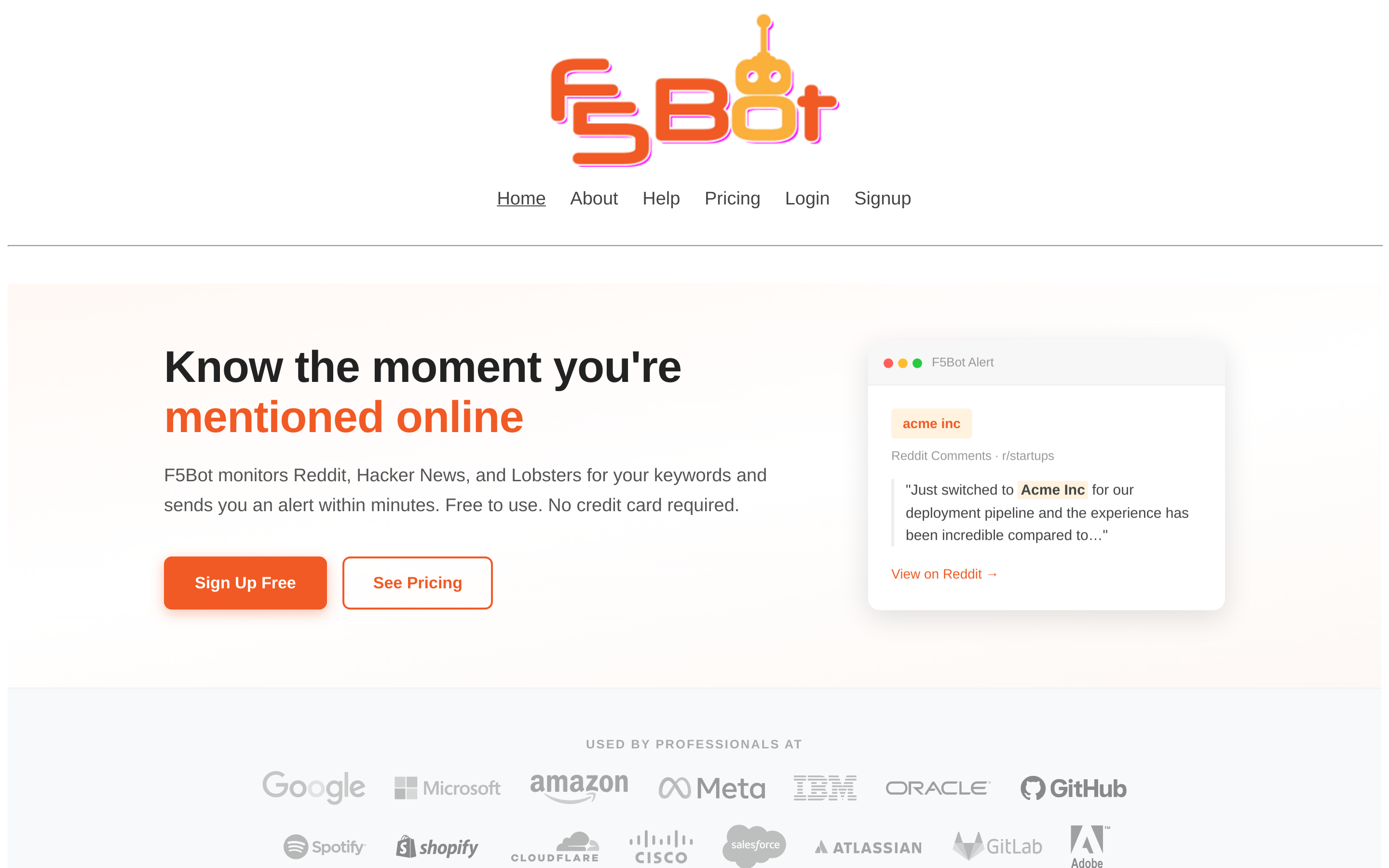
F5Bot scans posts and comments on Reddit, watches Hacker News and Lobsters, applies exact keyword rules, and can include or exclude named URLs. Paid plans improve speed and add delivery choices.
Features#
Scans both submissions and comments
Supports include and exclude flags
Sends email alerts
Gold routes alerts to Slack and Discord
Higher tiers apply AI filters
Pricing: #
The $0 account tracks five keywords with alerts within two hours. Silver costs $9.99 per month for twenty keywords and five-minute alerts. Gold costs $49.99 per month and adds 200 keywords plus feeds and integrations. Diamond starts at $500 per month with custom limits. That access is permanent and has no credit card requirement.
Pros#
The free tier supports a real monitoring loop.
Setup needs only a keyword and email address.
Paid filtering handles noisy terms better.
Cons#
Coverage stops at three sites.
Free alerts can arrive two hours late.
5. ParseStream#
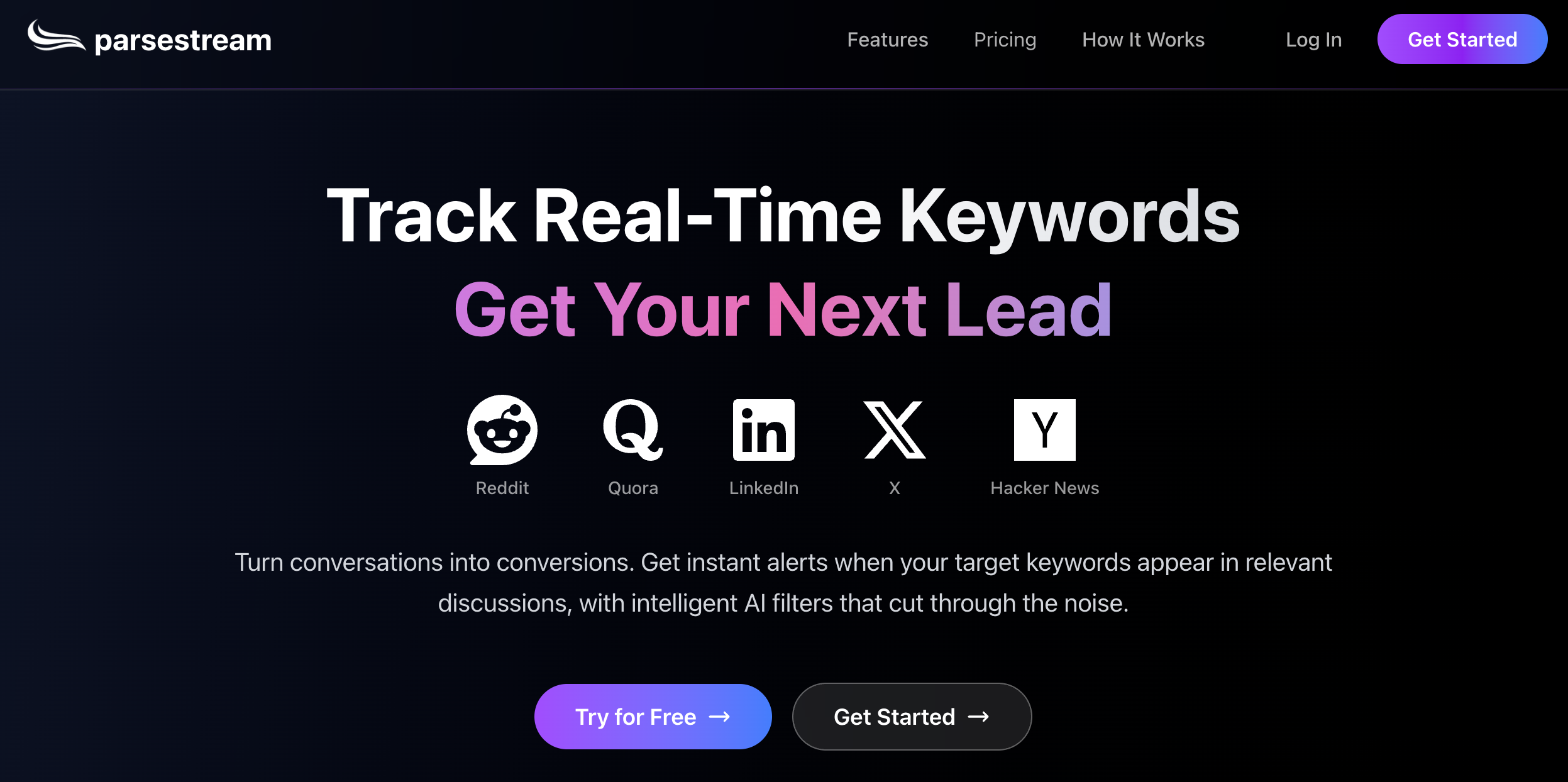
ParseStream monitors Reddit and Hacker News on every plan, while Pro adds LinkedIn and X plus Quora, labels lead intent, and writes a suggested public reply for review.
Features#
Detects lead and purchase intent
Drafts contextual public responses
Sends email and Slack notifications
Filters by subreddit
Tracks five discussion platforms on Pro
Pricing: #
Lite costs $29 per month after a trial that lasts three days. It covers twenty Reddit keywords and twenty forum keywords. Pro costs $79 per month and adds ten keywords on each of Quora, LinkedIn, and X. Growth costs $199 per month with higher limits. Enterprise offers custom integrations and unlimited seats.
Pros#
Suggested replies reduce response prep.
Lite gives small teams a low entry price.
Platform limits are published in clear numbers.
Cons#
Lite includes no LinkedIn or X tracking.
The trial lasts only three days.
The product focuses on public replies instead of email outreach.
6. Mention#
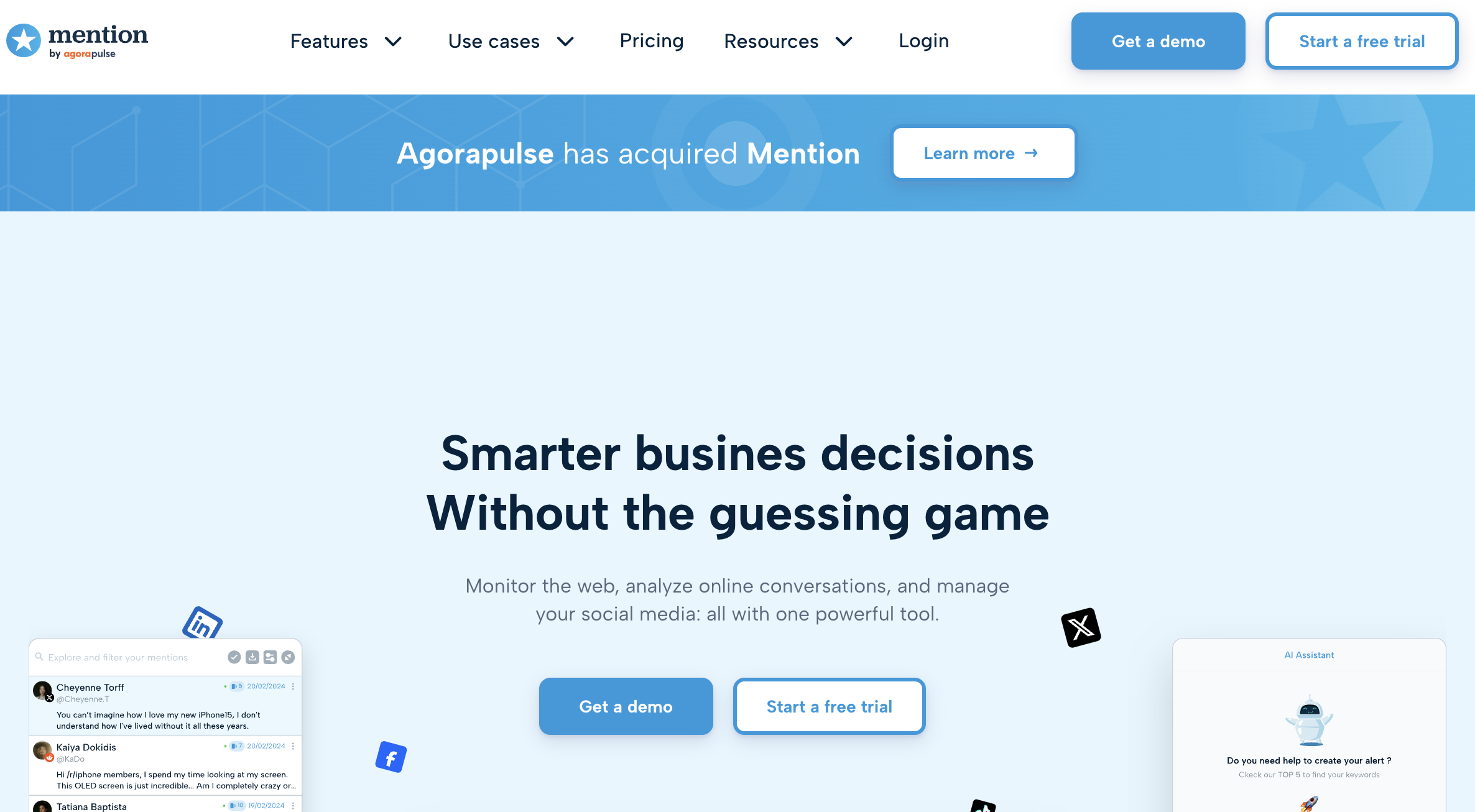
Mention tracks news pages, forums, Reddit, and X with Boolean alerts, while its Company plan includes five alerts and 50,000 mentions per month. Teams can export results and schedule reports.
Features#
Tracks web and news plus forums
Covers Reddit and X
Supports advanced Boolean queries
Schedules reports and exports data
Includes unlimited users on Company
Pricing: #
Company starts at $599 per month on an annual contract. A free trial exists before purchase. The current plan includes five alerts and 50,000 monthly mentions. Mention has no $0 tier, though buyers can use the trial before the annual contract. Historical data and API access sit behind paid upgrades.
Pros#
Reporting serves research and communications teams.
Unlimited users reduce seat math.
Broad web coverage supports reputation work.
Cons#
The annual entry commitment is high for a small GTM team.
Historical data costs extra.
Mention no longer sells its old self-serve Solo and Pro plans.
7. Awario#
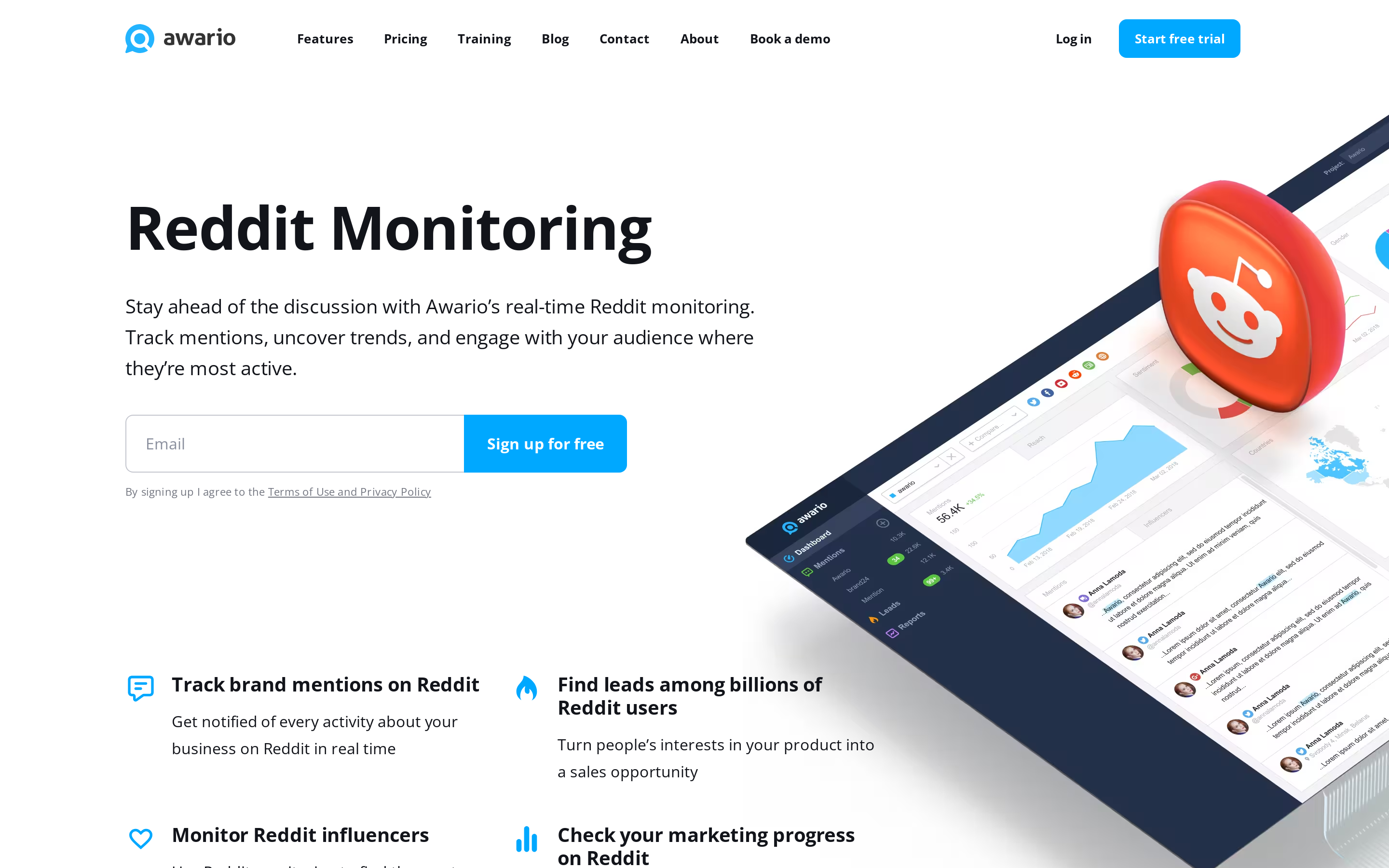
Awario groups keywords into topics, lets each topic contain many terms and operators, and supports brand names, competitor terms, or purchase phrases in one query.
Features#
Allows unlimited keywords inside each topic
Supports Boolean query logic
Exports mention data to CSV
Builds PDF reports
Enterprise opens API access
Pricing: #
Starter costs $49 per month or $29 per month with annual billing. Its free trial includes three alerts and 30,000 mentions. Pro costs $149 per month. Enterprise costs $399 per month and includes API access plus one million monthly mentions. Awario offers trial access instead of an ongoing $0 tier.
Pros#
Boolean search gives teams strong control over keywords, exclusions, and complex monitoring queries.
Covers social networks, blogs, forums, news sites, and the broader web from one monitoring workspace.
Includes dedicated lead-detection features for finding people looking for recommendations or discussing competitor products.
Cons#
Getting clean results can require carefully built Boolean queries, especially for broad or ambiguous keywords.
Its lead detection surfaces potential opportunities, but teams still need to review context and decide whether a mention represents genuine buying intent.
Mention history is storage-limited per alert; once the limit is reached, older mentions are replaced by newer ones, making it less suitable as a permanent research archive.
8. Brand24#
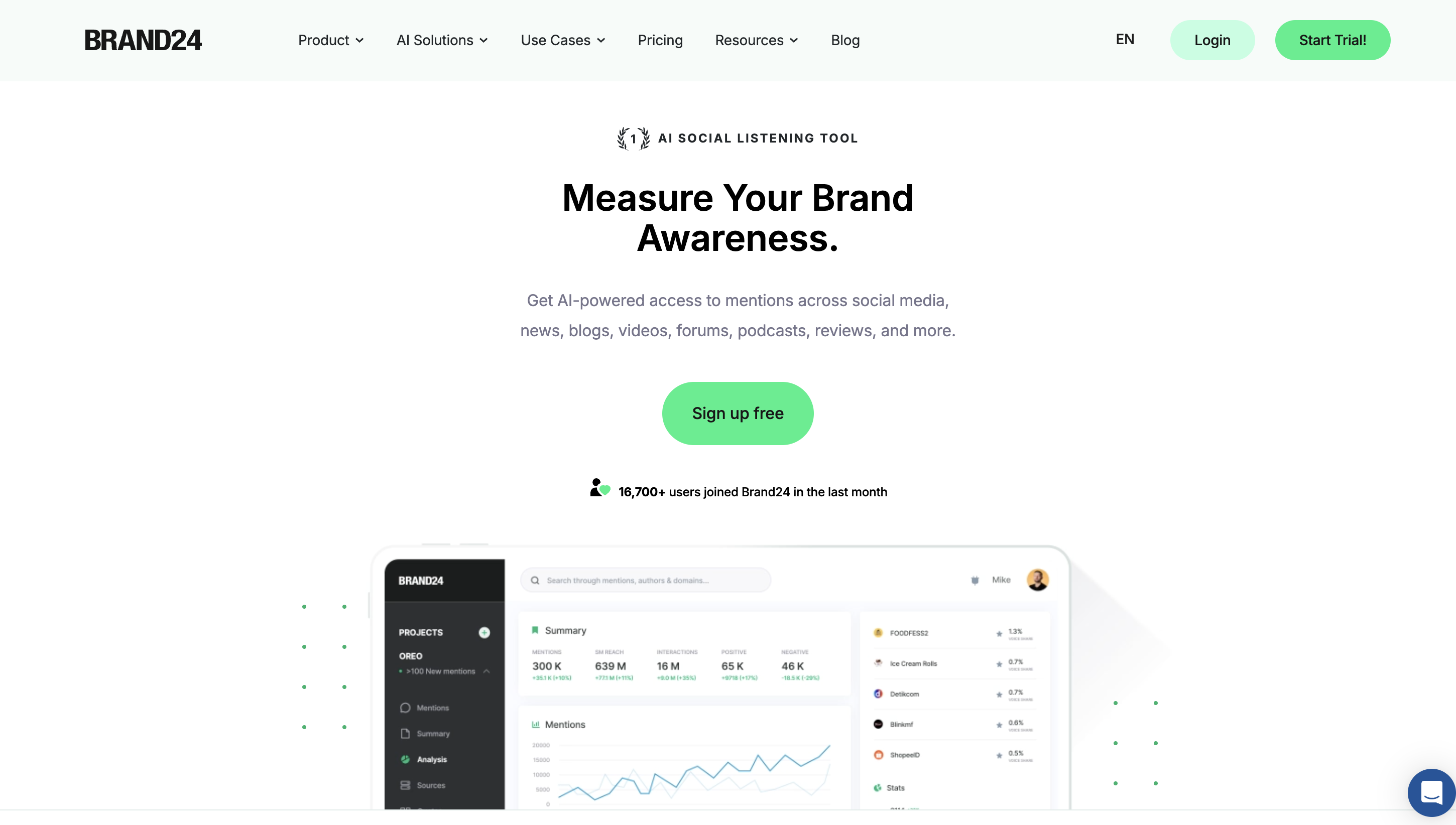
Brand24 scans online mentions and measures sentiment, while higher plans add topic analysis, event detection, faster refreshes, and larger mention limits. The product supports brand health and campaign analysis more directly than warm outreach.
Features#
Tracks keywords across online sources
Measures sentiment and mention reach
Detects topics and unusual events
Offers real-time updates
Builds reports for deeper analysis
Pricing: #
Individual costs $249 per month or $199 per month with annual billing. It includes three keywords and 2,000 monthly mentions. The Pro trial runs for 14 days with ten keywords and 30,000 mentions. Business costs $699 per month. Enterprise starts at $1,499 per month and includes custom limits plus dedicated consulting. Brand24 uses its 14-day Pro trial as the unpaid entry point.
Pros#
Strong analysis layer for understanding mention volume, sentiment, reach, share of voice, topics, and sudden spikes in conversation.
Smart Context Search helps narrow broad keyword feeds by meaning instead of relying only on exact-match filters or long Boolean queries.
AI Insights, Topic Analysis, and the Brand Assistant make large mention datasets easier to summarize and investigate.
Cons#
Broad or ambiguous keywords can still pull in irrelevant mentions, so projects often need exclusions and filter tuning before the feed becomes consistently useful. Brand24 explicitly documents this issue.
Sentiment analysis is not infallible; sarcasm and complex context can be misclassified, and Brand24 allows users to manually correct those cases.
Historical research is relatively shallow when you create a new project: Brand24 generally backfills up to about 30 days rather than giving you a deep multi-year archive from day one.
9. BrandMentions#
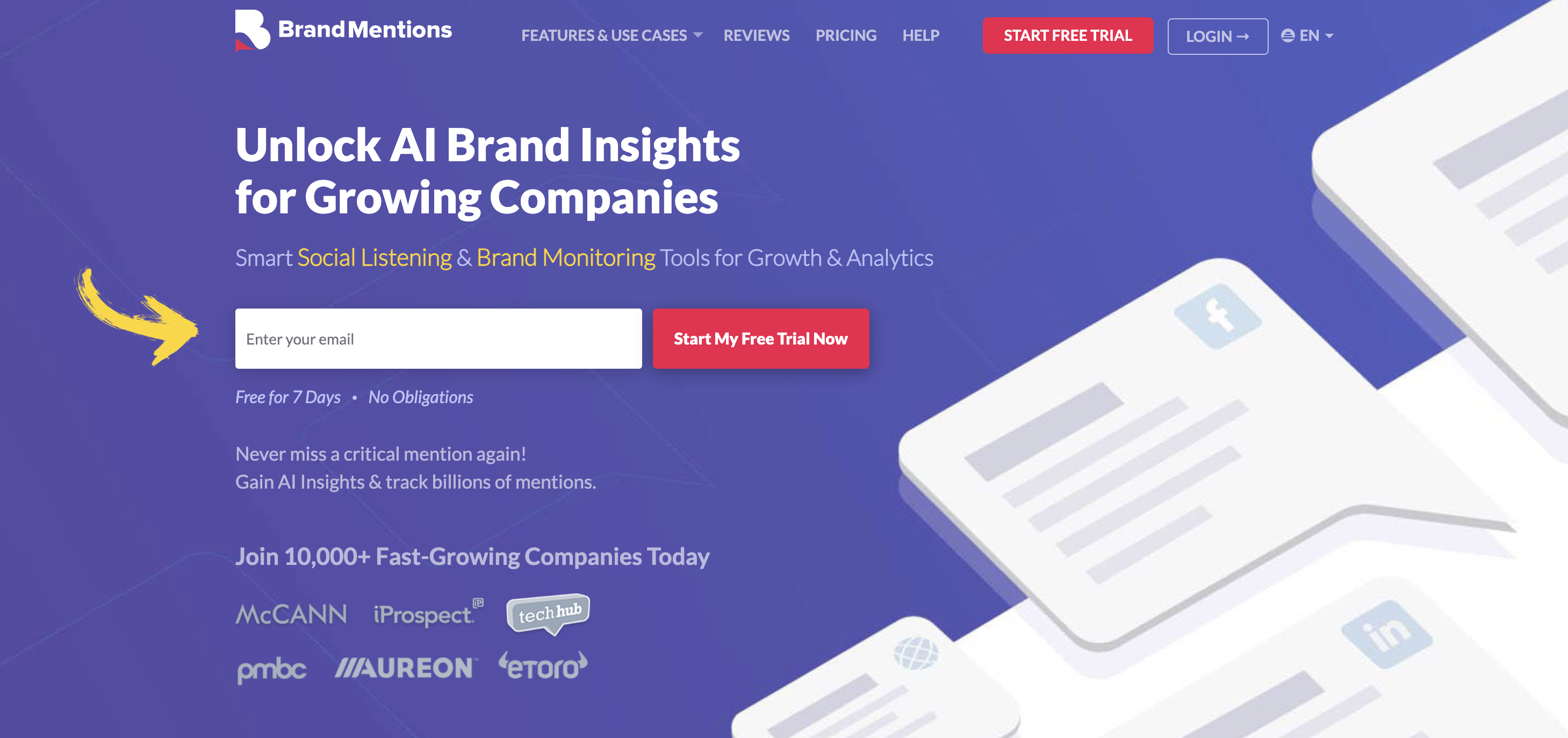
BrandMentions searches news pages, forums, review sites, and client brand terms. Agencies can track clients and build reports from one workspace, while higher plans add Boolean search, white-label output, historical data, and API access.
Features#
Searches news pages and discussion forums
Monitors Reddit and review sources
Measures multilingual sentiment
Creates standard and white-label reports
Enterprise includes full historical data
Pricing: #
Starter costs $99 per month with quarterly billing or $79 per month annually. Its trial gives seven days of access to the main product. Starter includes five keywords and 5,000 mentions. Expert costs $499 per month and adds Boolean search plus white-label reports. Enterprise starts at $1,299 per month. BrandMentions offers a 7-day trial rather than an ongoing $0 account.
Pros#
Reporting supports client delivery.
Published limits make agency cost planning easier.
Enterprise includes historical data and API access.
Cons#
Starter bills in three-month blocks.
Daily updates on Starter can miss a live outreach window.
White-label output requires the $499 Expert tier.
10. Mentionlytics#
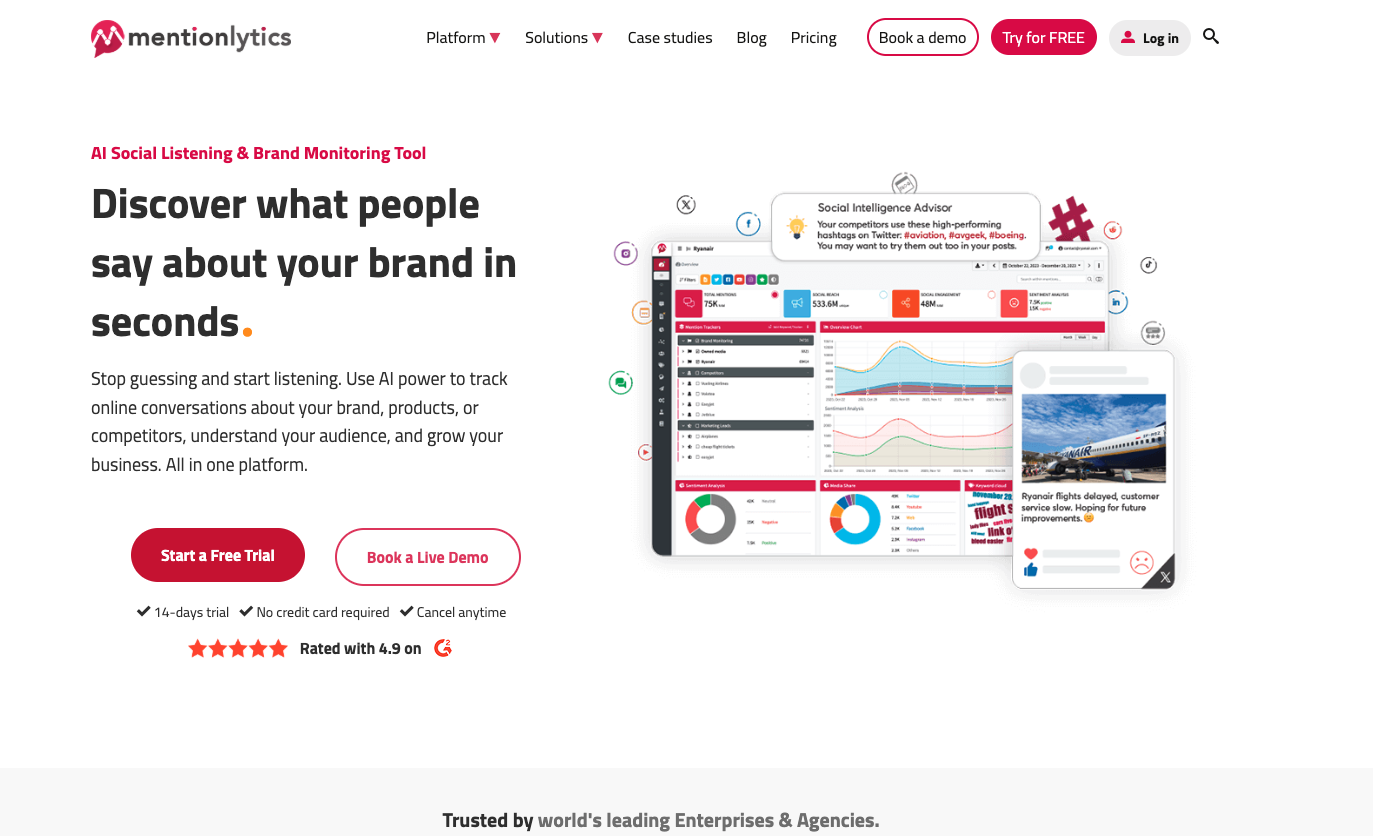
Mentionlytics combines web sources with review sites, groups mentions, analyzes emotion on higher plans, and keeps owned profiles beside keyword rules. Teams can monitor owned profiles alongside keyword rules.
Features#
Tracks news and blogs plus forums
Covers Reddit and Bluesky plus review sites
Monitors review sources through an add-on
Analyzes emotion in tracked mentions
Builds reports that teams can customize
Pricing: #
Basic costs $69 per month or $49 per month when billed yearly. The trial runs for 14 days and includes three keywords and 5,000 mentions plus ten profiles. Pro costs $499 per month and adds clustering with customizable reports. Enterprise starts at $1,299 per month. Mentionlytics gives buyers fourteen unpaid days, with no ongoing $0 account published.
Pros#
The trial includes every feature.
Multilingual analysis helps cross-market teams.
Review monitoring expands reputation coverage.
Cons#
Basic updates every twelve hours.
Review monitoring costs extra.
11. Google Alerts#
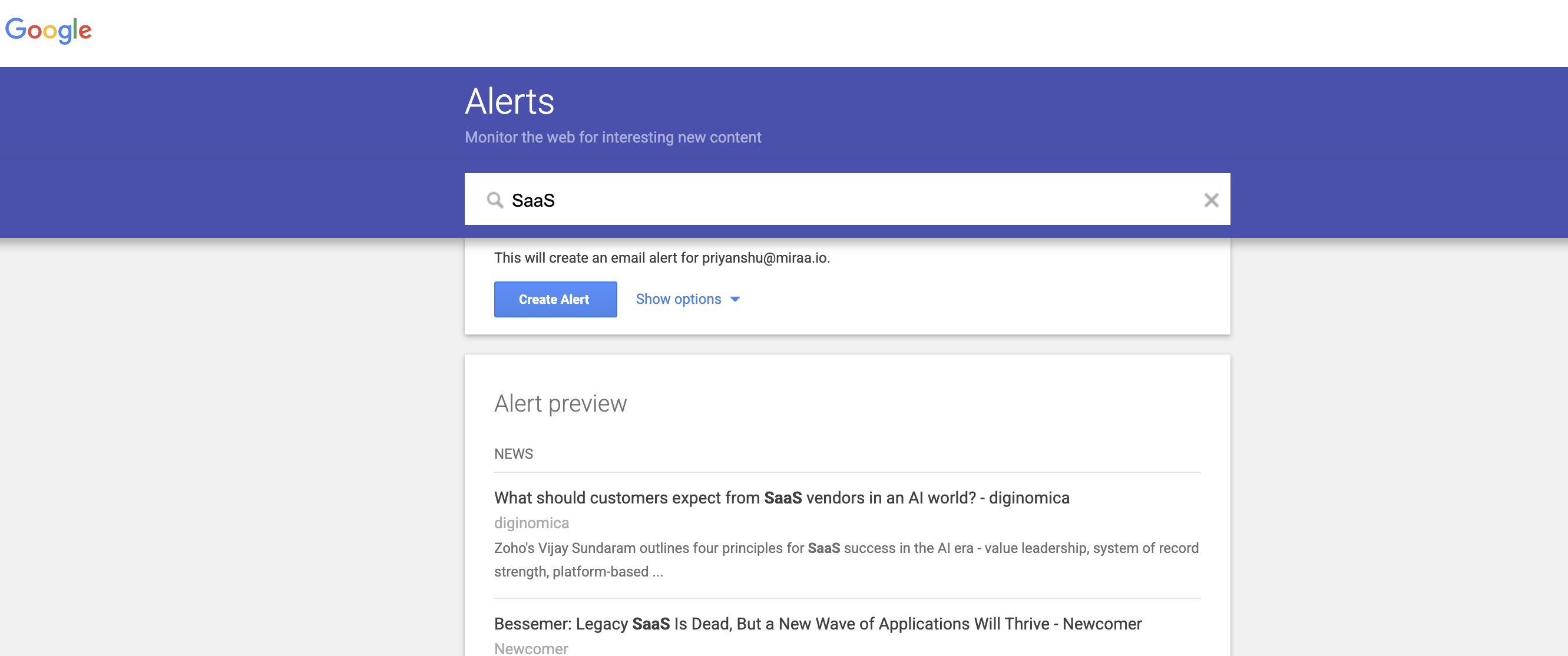
Google Alerts emails new search results that match a query. You can narrow a brand or phrase with search syntax. Results depend on what Google indexes and when it sends the digest.
Features#
Watches new indexed web results
Supports quoted phrases and exclusions
Sends email digests
Lets users select language and region
Offers immediate or digest frequency choices
Pricing: #
Google Alerts costs $0. There is no paid plan or trial. All users get the same feature set, and Google charges nothing.
Pros#
The service costs nothing.
Query syntax handles narrow terms well.
Cons#
Coverage misses many live community discussions.
There is no intent score.
Alerts can arrive after a thread has cooled.
Read More: Use Google Alerts for indexed pages. Our guide to how Google Alerts works and where it misses shows why forum posts still slip through.
12. Talkwalker Alerts#
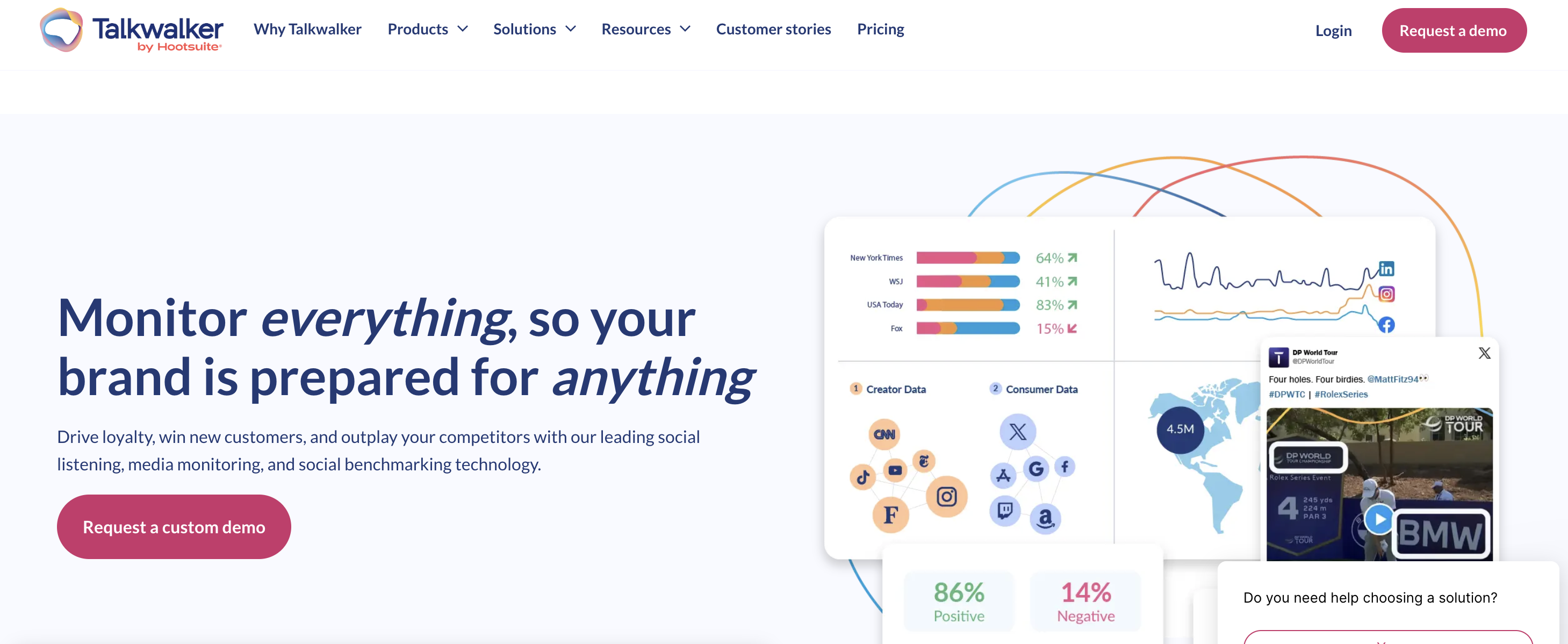
Talkwalker Alerts emails results for terms found across the open web. You can select the result type and delivery frequency. RSS gives you another way to route each alert. It serves the same backup role as Google Alerts with a different index.
Features#
Tracks a keyword or phrase
Covers web and news sources
Sends alerts by email
Filters by language
Offers RSS delivery
Pricing: #
Talkwalker Alerts costs $0. The alert product has no paid tier or time limit. Talkwalker's enterprise platform is a separate product with quote-based pricing.
Pros#
Free RSS delivery supports basic routing.
Setup needs no search infrastructure.
It can catch pages missed by another index.
Cons#
The alert product offers no buyer-intent model.
Community coverage is inconsistent.
Users must inspect each result by hand.
13. Distill#
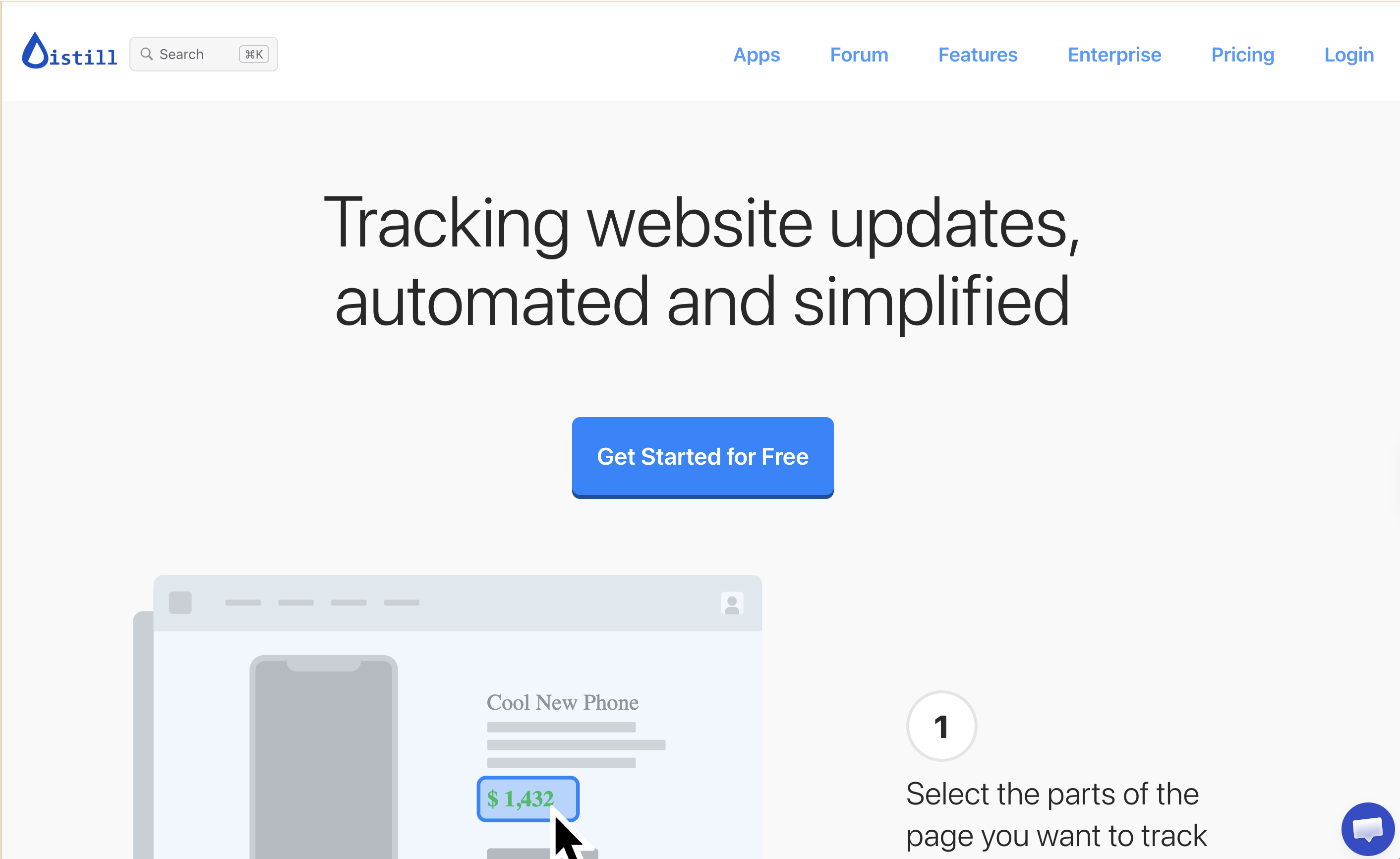
Distill watches selected web pages for changes, lets a user monitor a whole page or one element, runs checks in a browser or cloud, and alerts on the chosen condition. This catches a competitor price change or a new product line even when no discussion mentions it.
Features#
Watches selected page elements
Runs checks in a browser or the cloud
Sends email and push alerts
Automates page actions with macros
Sends alerts through webhooks
Pricing: #
Free costs $0 for twenty-five monitors, with five in the cloud and 1,000 cloud checks per month. Starter costs $15 per month for fifty monitors. Professional costs $35 per month. Flexi starts at $80 per month and gates the highest volume with usage charges.
Pros#
Element selection reduces irrelevant page changes.
The free plan supports a useful test.
Local browser checks are not metered like cloud checks.
Cons#
Distill watches pages instead of buyer conversations.
The free cloud interval is six hours.
Macros need paid plans and setup work.
14. Visualping#
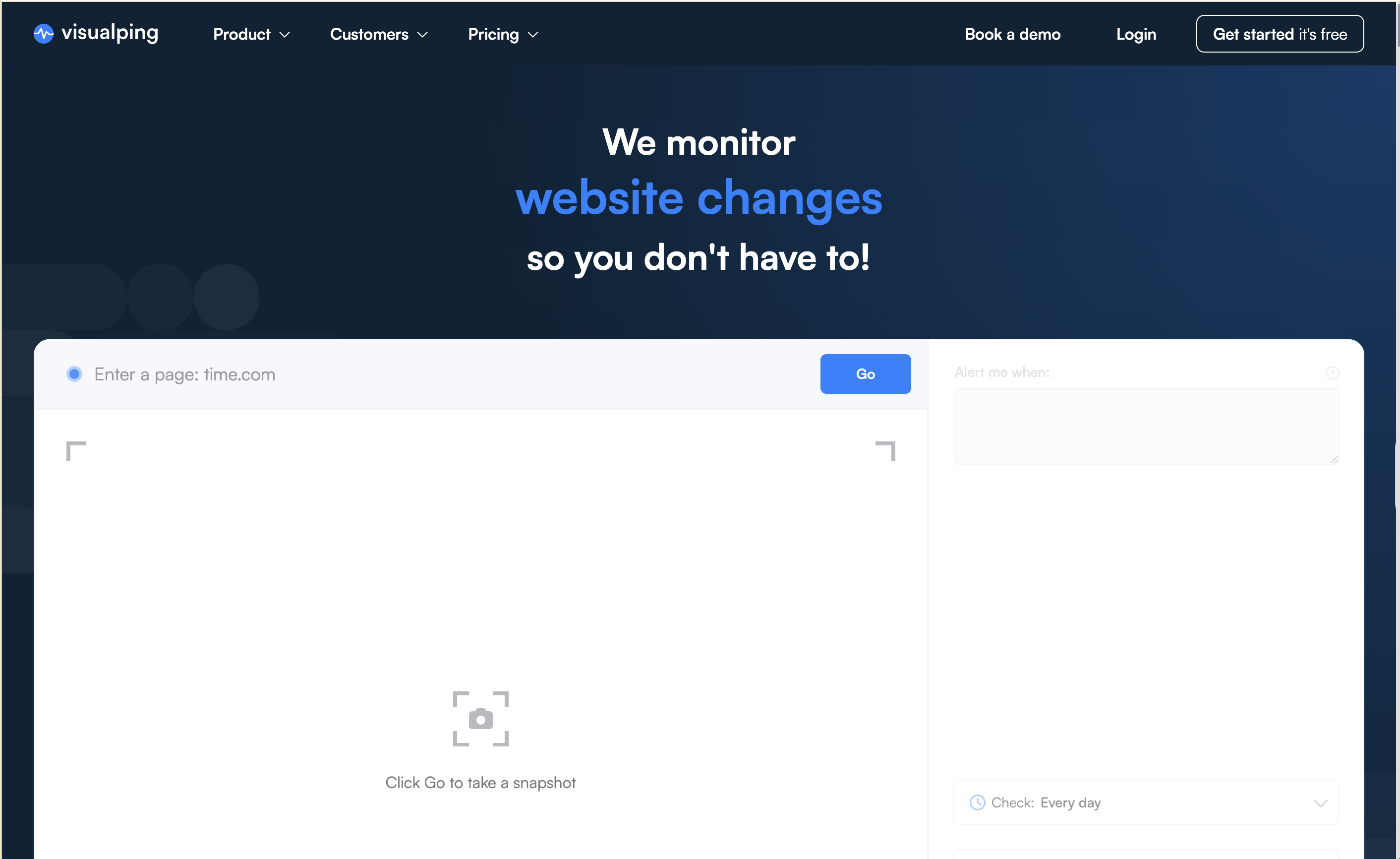
Visualping checks a page or selected element, highlights the change, stores the comparison, and works for pricing pages or launch pages. The result is a page-change signal instead of a buyer signal.
Features#
Watches full pages or selected elements
Compares visual and text changes
Sends email alerts
Stores change history
Business plans route alerts across teams
Pricing: #
The $0 tier costs $0 for five pages and 150 checks per month with a sixty-minute minimum interval. Personal starts at $14 per month or $10 per month with annual billing. Business starts at $140 per month or $100 per month with annual billing. The business tier gates Slack and team controls.
Pros#
Visual comparison shows what changed.
The free tier handles a small watchlist.
Element mode can ignore unrelated page movement.
Cons#
Visual changes can create noise on dynamic pages.
It does not monitor social media discussion.
Team routing costs more than personal monitoring.
15. Buska#
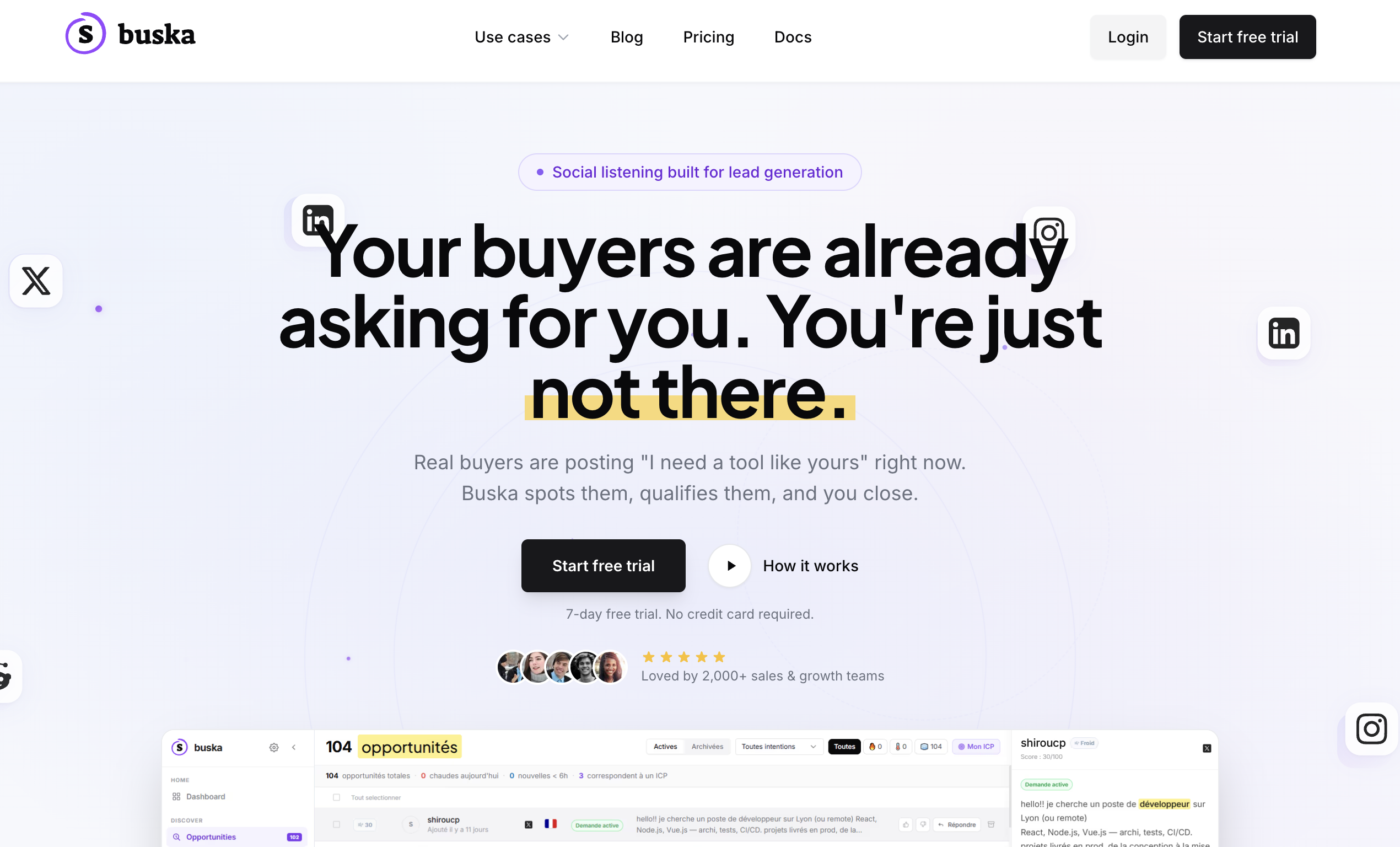
Buska scans public discussions for tracked pain and competitor terms, scores intent and ICP fit, then adds Reply Studio, enrichment, and outreach integrations on Growth.
Features#
Tracks more than sixteen sources on Starter
Scores each result for intent and ICP fit
Sends Slack and Discord notifications
Adds company data to each lead
Connects with CRMs and outreach tools
Pricing: #
Starter costs $49 per month after a seven-day trial with no credit card. It includes five monitored signals and daily lead updates. Growth costs $99 per month and adds 28 or more sources plus enrichment and Reply Studio. Scale costs $249 per month and includes hourly updates plus the full API. Buska lets one user try Starter for seven days, then access begins at $49 per month.
Pros#
Scoring combines purchase intent with account fit.
Growth connects signals to sales systems.
The seven-day trial needs no payment card.
Cons#
Starter updates leads once per day.
The $49 plan supports one team member.
Enrichment starts on the $99 Growth plan.
Related Read: 9 Buska Alternatives for Social Monitoring, Buyer Intent, and Lead Discovery
Which keyword tracker should you choose?#
Start with the decision that changes the work:
A GTM team that needs intent scoring and warm outreach should start with CommunityTracker.
Broad B2B source coverage with API access points to Octolens.
Precise filters for a lean operator make Syften worth a trial.
Free Reddit and Hacker News alerts belong to F5Bot.
Enterprise research and reporting justify Mention or Brand24.
Competitor page changes call for Distill or Visualping.
A free indexed-web backup belongs in Google Alerts or Talkwalker Alerts.
Run a one-week signal audit before you pay, tracking one competitor phrase, one problem phrase, and one recommendation phrase. Then count the useful results.
Use the right keyword tracker tool for what happens next#
The best keyword tracker tools do more than tell you that a phrase appeared somewhere. The real difference is what they help you do after that match.
Mention and Brand24 are stronger when your priority is broad listening, reporting, and brand analysis. F5Bot works well for simple forum alerts, while Distill is better suited to tracking changes on competitor pages rather than conversations.
CommunityTracker is a better fit when you want to turn keyword matches into GTM opportunities. It adds context and intent scoring to each signal, routes relevant conversations to the right owner, and helps teams continue the conversation through a reply, LinkedIn outreach, or email.
That makes it useful for teams that care less about collecting mentions and more about finding conversations that could turn into pipeline.
If that is your goal, start with one high-intent keyword on Reddit using CommunityTracker's free plan. Review the results for a week and see whether it surfaces conversations your team would genuinely want to act on. If all you need is basic monitoring of one source or one phrase, a simpler keyword tracker tool may be enough.